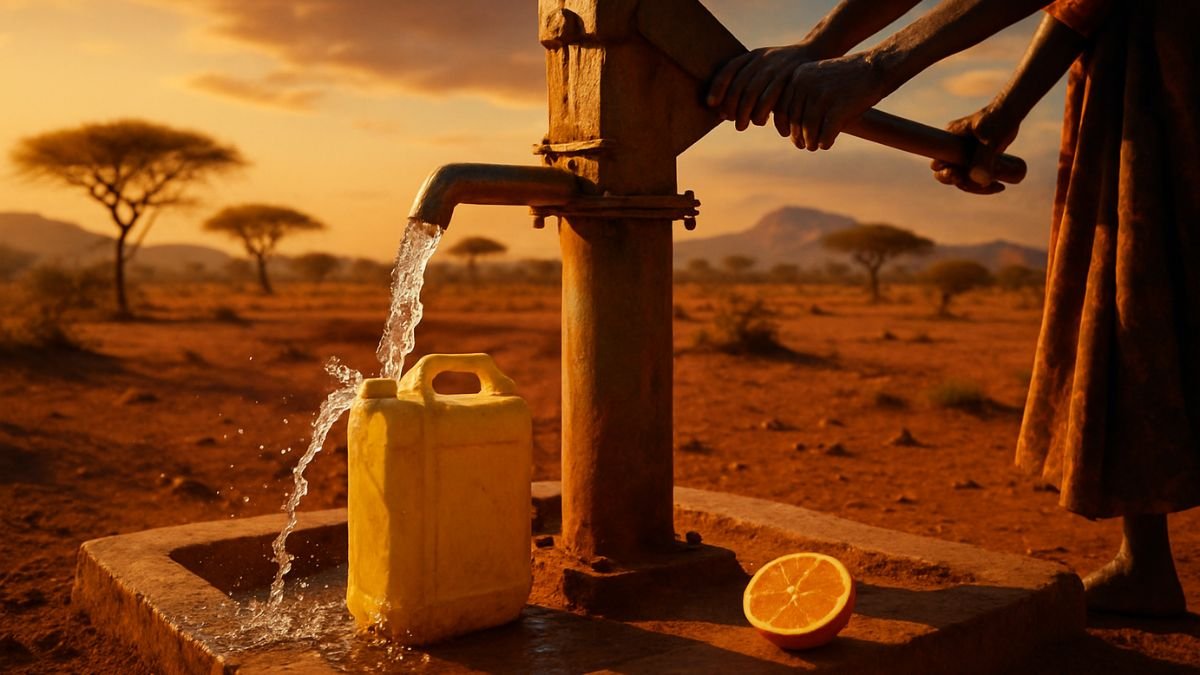
The sun over Turkana County was a hammer. It beat down on the dry earth, baking the red dust until it cracked like old pottery.
Zola adjusted the strap of the yellow jerrycan on her forehead. Her back ached. She had walked ten kilometers since dawn, her sandals kicking up clouds of dust with every step.
It was Christmas Day, though the land didn’t know it. The acacia trees were thorny and bare. The goats were thin, their ribs showing through their hides like the rungs of a ladder.
Zola was eighteen. She wore the beaded necklace of her tribe, the Turkana, rows of red and yellow packed tight against her throat.
She was afraid.
The drought had lasted two years. Water was scarce. And when water is scarce, peace is fragile. The well—the only working borehole for miles—sat on the borderlands between the Turkana grazing grounds and the lands of the Pokot.
There had been raids last week. Men with guns, stealing cattle. Zola’s father had told her to stay close to the manyatta, but the water containers were empty, and her little brother was crying with thirst.
She saw the pump in the distance. It stood like a lonely metal skeleton against the horizon.
She quickened her pace. If she was lucky, she would be alone.
She was not lucky.
As she neared the concrete apron of the well, she saw a figure. A woman. She was tall, draped in blue cloth, wearing the heavy brass earrings of the Pokot.
The enemy.
Zola froze. The wind whistled through the thorns. The other woman turned. She saw Zola. She didn’t move. She stood by the pump, her hand resting on the iron handle.
Zola’s heart hammered against her ribs. She gripped the empty jerrycan like a shield. She looked around. No men. No guns. Just two women and the heat.
Zola stepped forward. She had to. The thirst back home was a command she couldn’t ignore.
She walked onto the concrete slab. The Pokot woman watched her, eyes narrowed, calculating. She was older, perhaps thirty, with a face etched by the sun.
Zola set her can down under the spout.
The pump was an old, heavy manual lever. It took great strength to lift and depress, especially to get the suction going from the deep aquifer.
Zola grabbed the handle. She pushed down. It barely moved. She grunted, putting her weight into it. Nothing. The mechanism was stiff with rust and dryness.
She looked at the Pokot woman.
The woman looked at the handle, then at Zola’s straining arms.
Slowly, the woman stepped forward. She placed her hands on the handle, next to Zola’s. Her hands were rough, calloused, just like Zola’s.
They looked at each other. A silent agreement passed between them.
One. Two. Three.
They pulled up together. The handle groaned. They pushed down.
Creak. Clang.
Up. Down. Up. Down.
They found a rhythm. The iron handle rose and fell, powered by four arms. The friction warmed the metal. And then, a gurgle. A splash.
Clear, cool water burst from the spout, filling Zola’s yellow can.
The sound of the water was like music. It was the sound of life.
When the can was full, Zola capped it. She moved it aside and kicked the Pokot woman’s can under the spout.
They didn’t stop. They kept pumping until the second can was full.
They were sweating now, breathing hard in the heat. They stood there, two women from warring tribes, united by the weight of the water.
The Pokot woman reached into a pouch at her waist. She pulled out a small, withered orange. A rare treat in the drylands.
She split it in half. She held one half out to Zola.
Zola stared at it. To accept food was to create a bond.
She took it.
“Ashe,” Zola whispered in her own language. Thank you.
The woman nodded. She squeezed Zola’s shoulder—a brief, firm touch of solidarity.
They helped each other lift the heavy cans onto their backs, adjusting the straps. The weight was crushing, forty pounds of water, but it felt lighter than the fear had.
They turned in opposite directions. Zola walked north, back to her people. The woman walked south.
Zola didn’t look back, but as she walked, she tasted the sweet, sharp juice of the orange. Around her, the world was dry and harsh, and the men were still cleaning their guns. But here, on the dusty road, there was peace. Not a treaty signed on paper, but a peace made of water and sweat, carried on the backs of women who chose life over war.
A Prayer for the Heavy Handle
Let us speak now to the sun that does not choose which skin to burn. Let us speak to the dust that coats the throat of the friend and the enemy alike.
To the dry season that strips the land of its softness, leaving only the hard, cracking truth of our fragility. We are people of the tribe, of the banner, of the long memory of wrongs. We are taught to guard the perimeter, to hoard the resource, to look at the stranger across the border and see a thief. We build our identity on who we are against.
Let us confess the desperate truth to one another: The thirst is the same. The body does not know the politics of the border. The parched tongue does not speak the language of the raid. When the water runs out, the history of the war evaporates, leaving only the raw, undeniable fact that we will die without each other.
Let us ask for the strength to stand on the concrete slab next to the one we fear. To look into the eyes of the “other” and see not a threat, but a mirror. To realize that the handle of survival is too heavy for one pair of hands. It was designed that way. It requires the rhythm of two. It requires the synchronized sweat of the divided.
May we have the courage to find the rhythm. To push down when the other pulls up. To let the friction of our labor wear away the rust of our hatred. To let the sound of the water splashing into the can drown out the sound of the arguments we inherited from our fathers.
Let us learn the lesson of the well: We cannot drink the water of victory if the well is dry. We cannot survive in isolation. The pump works only when we work together. The life flows only when we lay down the shield and pick up the lever.
So, let us share the ladle. Let us split the withered fruit. Let us drink from the same stream and realize that it tastes of grace. Let us walk back to our separate camps with lighter steps, knowing that the weight on our backs is a burden we helped each other carry.
May we find that peace is not found in the absence of conflict, but in the presence of shared work. And may we remember that when the world is burning, the only way to cool it is to pump the water together.
The well is deep. The hate is shallow. Drink.







0 Comments