The Amazon River at night is not silent. It is a cacophony. It screams with the sound of cicadas, the splash of unseen things in the water, and the rustle of the endless, breathing jungle.
Thiago knew these sounds. He had piloted the Rio Verde, a rusted aluminum boat, for ten years. He knew the river’s moods. He knew where the sandbars hid and where the currents twisted like snakes.
But tonight, the river was angry.
It was Christmas Eve, and Thiago was three hours late. He was hauling crates of soda, sacks of flour, and bags of mail to the village of São Gabriel. The rain had started an hour ago—a torrential, blinding sheet of water that turned the world into gray static.
And then, the engine died.
It sputtered once, coughed a plume of black smoke, and fell silent.
The sudden quiet of the machinery was terrifying. The roar of the rain took over. Thiago pulled the starter cord. Yank. Sputter. Silence. Again. Yank. Silence.
He cursed, kicking the metal casing. He was drifting. Without the engine, he had no steering. The current grabbed the Rio Verde and began to spin it slowly, pulling him downstream, away from the village, away from the lights, away from safety.
He sat in the dark, the rain soaking through his poncho. He was alone.
In the Amazon, being alone in the dark is dangerous. There were balsas—huge logs drifting submerged that could punch a hole in his hull. There were caimans on the banks. And there was the crushing weight of isolation.
He drifted for an hour. The rain stopped as quickly as it had begun, leaving the air thick and hot. The clouds broke, and the moon revealed the river—a vast, black mirror stretching into the void.
Thiago shivered. He thought of his family back in Manaus, eating bacalhau and laughing. He thought he might spend Christmas drifting into the Atlantic.
Then, he saw it.
A spark.
It was faint, miles away on the left bank. A tiny, flickering orange dot. Then another. Then a third.
He grabbed his paddle. It was heavy work, fighting the current, but the lights gave him a target. He rowed until his shoulders burned, aiming the bow toward the sparks.
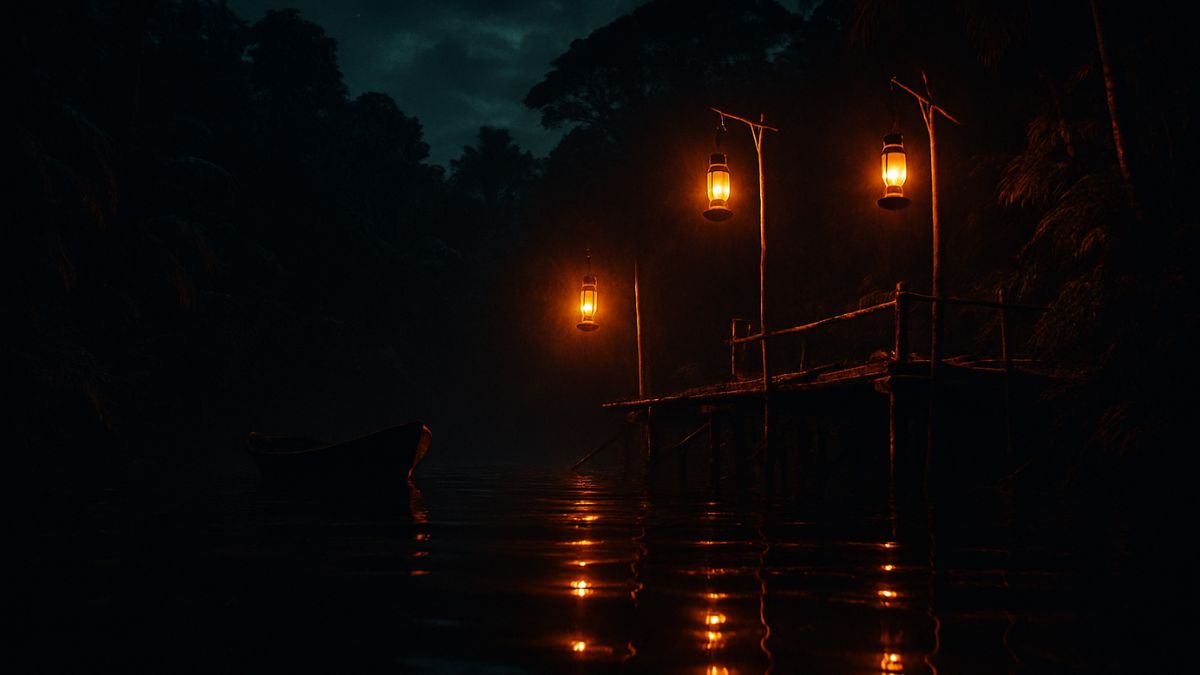
As he got closer, the dots resolved into shapes. They were kerosene lanterns. They were tied to the tops of wooden poles stuck into the mud of the riverbank.
A dock. A tiny, rickety wooden structure jutting out from the jungle.
Thiago shouted. “Olá!”
His voice echoed over the water.
A figure appeared on the dock. Then another. Flashlights clicked on, beams cutting through the humid air.
“Who goes there?” a voice called out, suspicious but curious.
“Thiago! The mail boat! My engine is dead!”
He threw the rope. A man caught it—a strong, calloused hand snatching the line from the air. He pulled Thiago in, securing the boat to the pylon.
Thiago stepped onto the wood, his legs shaking. He looked around.
It wasn’t a town. It was a comunidade—maybe three families living in stilt houses at the edge of the world. They wore shorts and t-shirts, their skin gleaming with sweat and repellent.
An older woman stepped forward. She held a lantern up to Thiago’s face. She looked at his soaked clothes, his shaking hands.
“I have mail,” Thiago stammered, pointing to the boat. “I have flour.”
The woman laughed. It was a warm, dry sound. “We don’t need mail tonight, son. We need to eat.”
She gestured to the center of the dock. There, under a thatched roof, a fire was burning in a metal drum. A fish—a massive tambaqui—was grilling over the coals, its skin crisp and blackened. A pot of rice was steaming.
“We thought you were my cousin coming from Santarém,” the man who caught the rope said, clapping Thiago on the back. “But you are hungry, so you are welcome.”
They didn’t ask for his papers. They didn’t ask for payment for the dock. They handed him a plate.
Thiago sat on a plastic crate. He ate the fish with his fingers. It tasted of smoke and river and lime. It was the best meal of his life.
He looked at the lanterns reflected in the black water. They looked like stars that had fallen to earth to keep them company.
“Why are the lights so bright?” Thiago asked.
“To guide the travelers,” the woman said, picking a bone from her fish. “The river is dark on Christmas. We don’t want anyone to miss the way home.”
Thiago looked at his dead boat, then at the faces of these strangers—fishermen, grandmothers, children—illuminated by the firelight. He realized he hadn’t missed Christmas. He had found it. It wasn’t in the city lights of Manaus. It was here, on a rotting dock in the middle of the jungle, where the only law was that no one stays adrift in the dark.
A Prayer for the Lights on the Bank
Let us speak now to the terror of the engine dying. Let us speak to the silence that follows the machine, when the only sound left is the rush of water and the beating of our own frantic hearts.
To the moments when we are cast adrift in the dark, stripped of our steering, our power, and our direction. We are people of the map and the schedule. We believe that if we have a destination, we are safe. But the river does not care about our destination. It cares only about the current. And when the current takes us, we are reminded of how small we are in the face of the wild night.
Let us confess the trembling truth to one another: We are afraid of the dark because we are afraid we are alone in it. We look at the black water and imagine monsters. We look at the jungle and imagine threats. We forget that the darkness is also a canvas for the light. We forget that while we are drifting, someone else is watching. Someone else is waiting.
Let us ask for the vision to spot the spark. To scan the horizon not for the grand harbor or the city glare, but for the tiny, humble flicker of a kerosene lamp on a rotting dock. To realize that salvation often comes in the smallest of forms—a dot of orange fire against a wall of black.
May we honor the keepers of the river lights. The ones who live at the edge of the world, who have nothing to give but a rope and a fire. They do not ask for our credentials. They do not ask for our cargo. They only ask if we are hungry. They are the proof that hospitality is not a function of wealth, but a function of humanity.
Let us learn the lesson of the Amazon: We are all pilot and passenger. Sometimes we are the ones driving the boat, sure of our path. And sometimes we are the ones drifting, praying for a rope.
So, let us light our own lanterns. Let us stick a pole in the mud of our own lives and hang a light upon it, not for ourselves, but for the stranger who might be floating by in the dark. Let us be the star that falls to earth to keep another company.
May we find that when we are pulled from the water by a stranger’s hand, we are not just saved from the river; we are saved from the illusion that we ever have to navigate this life alone.
The current is strong. The rope is stronger. Welcome ashore.







0 Comments