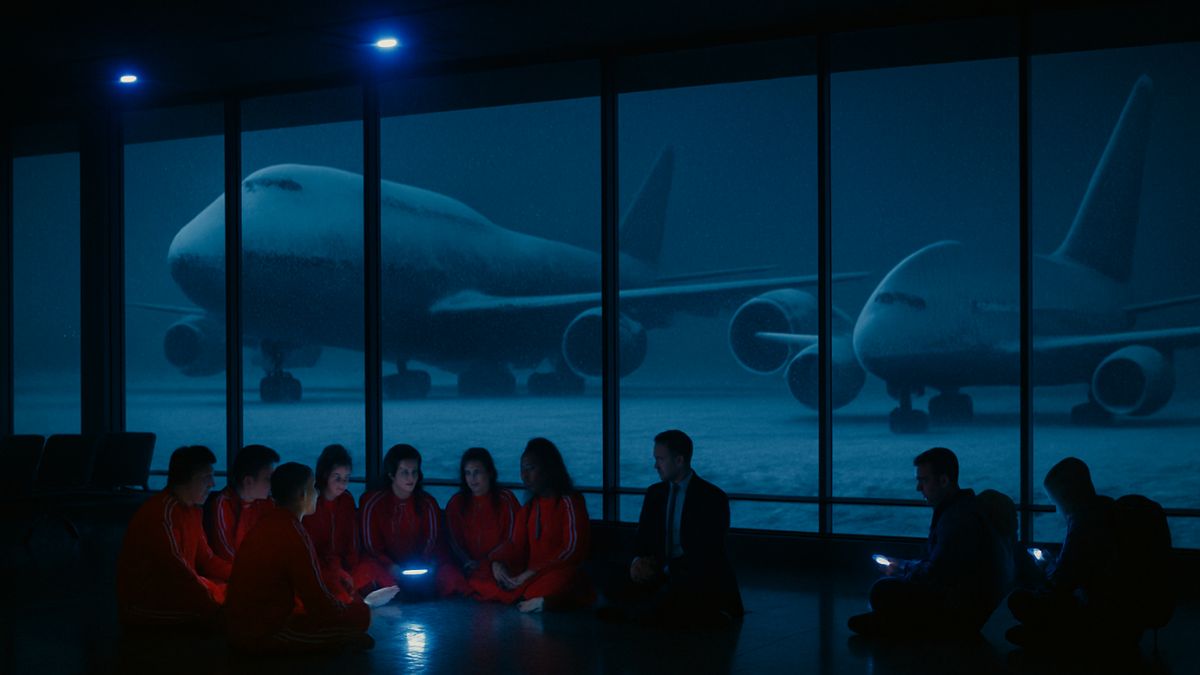
Frankfurt Airport was not built for magic; it was built for efficiency. It was a cathedral of steel, glass, and gray carpet, designed to move forty million people a year from Point A to Point B with the precision of a Swiss watch.
But on Christmas Eve, the watch had stopped.
Outside the floor-to-ceiling windows of Terminal 1, the tarmac was gone. It had been erased by a blizzard that swirled in violent, opaque sheets of white. The massive wings of the grounded Boeings and Airbuses were heavy with ice, looking like sleeping prehistoric beasts.
Inside Gate Z-15, the mood was not festive. It was toxic.
“Unmöglich!” Elias, a businessman in a sharp suit, barked into his phone. “I don’t care about the de-icing fluid. I have to be in Munich by dinner!” He paced a tight circle near the service desk, his voice cutting through the low hum of misery in the terminal.
A few feet away, Julian, an American tourist with a backpack that looked like it had survived a war, was engaged in a silent, aggressive standoff over the last functioning power outlet. His opponent was a teenage girl streaming a movie.
“I have 4% battery,” Julian hissed, pointing at his phone. “I just need to tell my mom I’m not making it to Chicago.”
The girl rolled her eyes and turned up the volume on her tablet.
Around them, the terminal was a microcosm of the world, and the world was tired. A family from India sat on their suitcases, sharing a bag of pretzels. A group of travelers from Brazil were arguing loudly with a gate agent in Portuguese. A choir group from Nigeria, dressed in matching green tracksuits, sat on the floor, leaning against each other in an exhausted pile of limbs and carry-on bags.
The air smelled of stale coffee, damp coats, and stress. The announcement system chimed—a cheerful, three-note tone that everyone had grown to hate.
“Ladies and gentlemen, due to severe weather conditions, all remaining flights for the evening have been canceled. We apologize for the inconvenience.”
The collective groan that rose from the gate was primal. It was the sound of hundreds of Christmas plans shattering at once.
Elias slammed his phone shut. Julian slid down the wall, putting his head in his hands. The Brazilian group stopped arguing and fell silent. The Indian family huddled closer together.
And then, the lights went out.
It wasn’t a total blackout, but a brownout. The harsh overhead fluorescents flickered and died, leaving only the dim, blue emergency lights running along the floor and the faint, ghostly glow of the snowstorm pressing against the windows.
The sudden darkness did something strange to the terminal. It stripped away the sterility. It hid the departure boards with their angry red “CANCELED” text. It made the vast space feel smaller, more intimate.
In the silence that followed, a sound emerged.
It started low, a deep, resonant hum from the floor near the window.
Hmm-hmm-hmm…
It was the bass section of the Nigerian choir. They hadn’t stood up. They hadn’t organized. They were just humming, perhaps to soothe themselves, perhaps to fill the void.
Then the sopranos joined in.
Silent night… holy night…
They sang in English, but the accent gave the words a roundness, a warmth that defied the metallic chill of the airport. The melody floated up toward the high steel rafters, softening the hard edges of the architecture.
Julian looked up from his dead phone. He knew that song. He had heard it in malls, in churches, on commercials. But here, in the semi-darkness, it sounded different. It sounded like a lifeline.
Without thinking, he began to hum along.
Near the service desk, Elias stopped pacing. He loosened his tie. He looked at the Nigerian group, then out at the snow. He took a breath and sang, his voice a sturdy baritone.
“Stille Nacht, heilige Nacht…”
The German lyrics wove into the English ones. Alles schläft, einsam wacht.
The Indian father, holding his sleeping daughter, began to hum the melody. He didn’t know the words, but he knew the feeling.
From the group of Brazilians, a woman stood up. She had a voice like a bell.
“Noite feliz, noite feliz…”
It happened slowly, then all at once. The terminal, which had been a battleground of competing needs just minutes ago, transformed. People stood up from their uncomfortable metal chairs. They moved closer to the center of the room, drawn to the music like moths to a lantern.
There was no choir director. There was no sheet music. There was just the song.
It was a chaotic harmony. The tempos didn’t quite match. The languages clashed—German, English, Portuguese, Spanish, French—colliding in the air. But underneath the differences was the same melody, the same three-quarter time, the same longing for peace.
Julian stood next to Elias. They didn’t look at each other, but their voices blended. The American’s tenor and the German’s baritone supporting the soaring harmonies of the Nigerian choir.
For five minutes, Frankfurt Airport was not a place of transit. It was a cathedral.
The anxiety about the charging port was gone. The anger about the de-icing fluid was forgotten. The hunger, the fatigue, the disappointment of missing the roast goose or the turkey—it all faded into the background.
They were stranded, yes. They were cold. They were strangers. But as the final notes of the song drifted into the rafters—Sleep in heavenly peace—they were not alone.
The silence that followed the song wasn’t empty. It was full. It was a silence of respect, of connection.
Someone clapped. Then everyone clapped. Not polite applause, but relieved, joyous applause. The Nigerian choir members stood up, bowing and laughing, high-fiving the Brazilian tourists.
Elias turned to Julian. The aggression was gone from his face.
“Here,” Elias said, reaching into his briefcase. He pulled out a portable power bank. “My phone is fully charged. Take it.”
Julian stared at him. “But… you might need it.”
“I don’t,” Elias said, smiling. “I’m not going anywhere tonight. Call your mother.”
Julian took the charger. “Thanks. Merry Christmas.”
“Frohe Weihnachten,” Elias replied.
The lights flickered and buzzed back on, bathing the terminal in artificial glare once more. The announcements resumed. The snow continued to fall. But the atmosphere had shifted irrevocably.
People began to share what they had. A bag of duty-free chocolates was opened and passed around. Coats were used as blankets for children. Conversations started between seats, in broken English and pantomime.
Julian called his mother in Chicago. He didn’t complain about the flight. He held the phone up so she could hear the ambient noise of the terminal—the laughter, the languages, the life.
“I’m okay, Mom,” he said, looking around at his new, temporary neighbors. “I’m safe. I’m with friends.”
And outside, the storm raged on, burying the runways in white, powerless against the warmth inside Gate Z-15.
A Prayer for the Place of Transit
Let us speak now to the spaces between destinations. Let us speak to the waiting room, the terminal, the gate where the clock has stopped.
To the moments when our plans are erased by the weather, and we are forced to stop moving. We are people of momentum, defined by where we are going, terrified of where we are. We view the delay as an insult, the cancellation as a theft. We look at the strangers around us not as companions, but as competitors for the charger, the seat, the last sandwich.
Let us confess the impatient truth to one another: We have forgotten how to wait together. We have forgotten that when the storm comes, the hierarchy of the itinerary dissolves. The first class and the economy class are equally grounded. The VIP and the backpacker are equally cold. The snow does not care about our status; it only cares that we are still here.
Let us ask for the grace to find the harmony in the static. To listen beneath the announcements and the complaints for the hum of a shared humanity. To realize that the frustration we feel is the same frustration beating in the chest of the person we are glaring at.
May we have the courage to lower our defenses when the lights go out. To drop the armor of the busy traveler and become, simply, a person in a room with other people. To start the song, even if our voice is shaking. To join the chorus, even if we do not know the words.
Let us learn the lesson of the layover: The destination is not the only place where life happens. Life happens in the pause. Connection happens in the interruption. Peace happens when we stop fighting the delay and start sharing the darkness.
So, let us share the power bank. Let us share the chocolate. Let us sing in a dozen languages and find that the melody is exactly the same. Let us transform the cathedral of efficiency into a cathedral of unity.
May we find that even when we are stuck, even when we are miles from where we want to be, we are never truly lost as long as we can hear each other singing.
The flight is canceled. The connection is confirmed. We are home in the song.








0 Comments