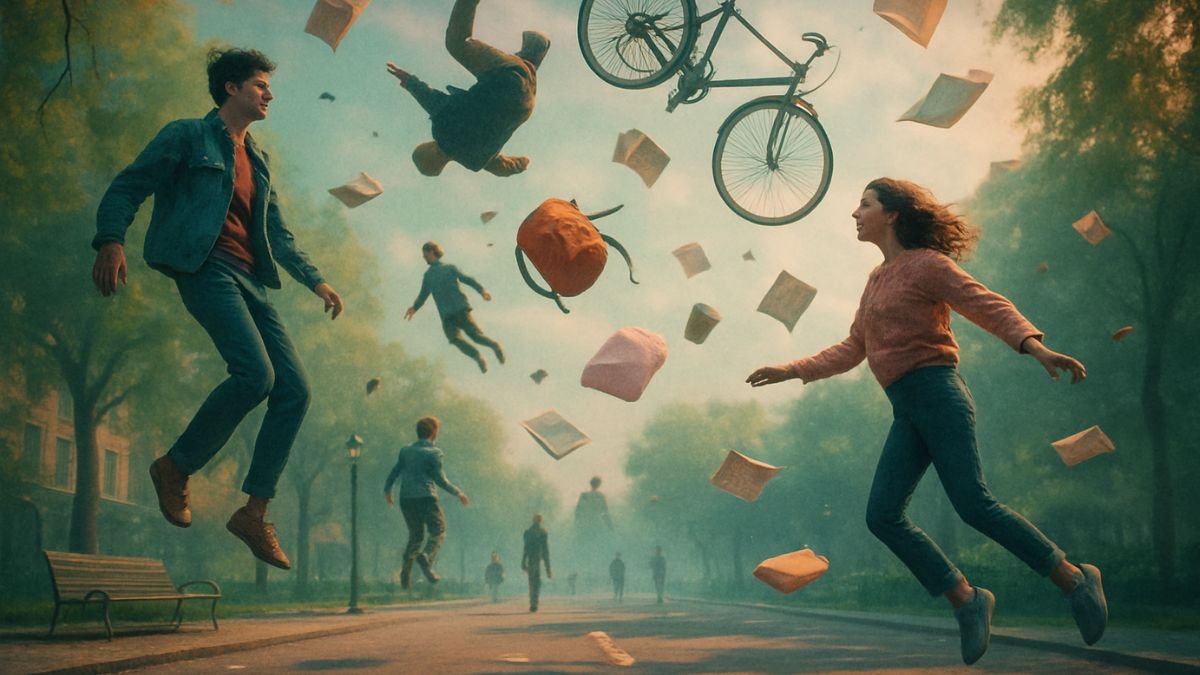
Ever Wish You Could Just Float Away?
Have you ever had one of those days? You know, when the bills are piled up, the to-do list is laughing at you, and your responsibilities feel like a physical weight on your shoulders. In those moments, have you ever wished you could just… float away? What if you could? What if that constant, invisible force holding you, your car, and your worries to the ground suddenly decided to take a 50% pay cut? Let’s take a wild leap into a world of reduced gravity, a world where everything we know is turned on its head, simply by making things a little bit lighter.
The Everyday Magic of a Half-G World
Let’s start with the fun stuff, the things your inner five-year-old is already screaming about. Your morning alarm goes off. You don’t just roll out of bed; you bound out, probably misjudging your own strength and sailing gracefully into the opposite wall. Getting dressed is a ballet. A simple hop to pull on your pants sends you three feet into the air.
Walking down the street would feel like being on the moon. Every step would be a long, soaring arc. Forget waiting for the bus; you could probably clear a few city blocks with a good running start. Imagine the sports! Basketball players wouldn’t just dunk; they’d hang in the air, contemplating their life choices before gently placing the ball in the hoop. Parkour would evolve into a form of low-altitude flight. Dancers would create movements that seem to defy physics as we know it, leaping and twirling in sustained, breathtaking displays.
But it’s the little things that would really get you. Remember that time you dropped your phone? Instead of a heart-stopping, screen-shattering instant, it would drift downward with a lazy indifference, giving you plenty of time to swoop in for a heroic, slow-motion save. Spilling your coffee would no longer be a mess; it would be a work of art, a beautiful, syrupy arc of brown liquid hanging in the air before finally, reluctantly, landing on the floor. It would be a world of accidental grace. But would a life without the sharp, sudden consequences of our clumsiness make us less careful, less… present?
The New You (and Everyone Else)
Living in a half-gravity world would fundamentally reshape us. After a few generations, humans would likely become taller and more slender. Our bones and muscles, no longer needing to fight such a relentless downward pull, would become less dense. We see this in astronauts who spend months in space; they return to Earth with significant bone and muscle loss. In a permanent half-G environment, this would become our new normal. We’d be a species of tall, graceful, and surprisingly fragile creatures.
Think about it: the very concept of “strength” would be recalibrated. Lifting 200 pounds would feel like lifting 100. We’d all be superheroes in the gym, but our underlying biological machinery would be, for lack of a better word, weaker. It poses a fascinating question, doesn’t it? Our strength, our resilience, is born from resistance. Our bones are strong because gravity demands it. Our muscles are powerful because they have to work against a constant load. If life becomes physically easier, do we, in a very real sense, become less?
And what of the animal kingdom? Birds could grow to enormous sizes, soaring on wings that wouldn’t need to work as hard. Insects, limited in size by their respiratory systems and exoskeleton strength, could become horrifyingly—or beautifully—large. Imagine butterflies with the wingspan of a hawk. Imagine squirrels gliding not just from tree to tree, but from neighborhood to neighborhood. Evolution would be on a whole new, fantastical playground.
A World Remade
The planet itself would heave a great sigh of relief and stretch itself out. Mountains are the result of a titanic battle between the upward thrust of tectonic plates and the crushing force of gravity pulling them down. With that downward force halved, mountains would soar to previously impossible heights. The Himalayas would make their current peaks look like foothills. We’d live in a world of epic, needle-like spires scratching a sky that felt both closer and farther away.
Trees, too, would join this race to the sky. No longer as constrained by the mechanical stress of their own weight, forests would become cathedrals of colossal lifeforms, creating canopies so high they’d have their own weather systems. Rain itself would change. Droplets would fall slower, turning storms into mesmerizing, gentle descents rather than furious downpours. Rivers, with less gravitational pull, would flow with less force, carving wider, more meandering paths through the landscape over millennia. The entire face of the Earth would be softer, taller, and grander.
The Cosmic Divorce
But here, the dream takes a darker turn. Gravity isn’t just about keeping our feet on the ground; it’s the glue that holds our world together. The Earth’s gravity is precisely strong enough to hold onto our precious atmosphere. With that force cut in half, the planet’s grip would weaken. Gas molecules, especially the lighter ones like hydrogen and helium, would have a much easier time achieving escape velocity and bleeding off into space. Over thousands or millions of years, our air would get thinner. Our skies would become a paler blue, and eventually, the very breath in our lungs would be siphoned away into the void.
And then there’s the moon. Our relationship with the moon is a delicate gravitational dance. It’s constantly trying to fly away in a straight line, and Earth’s gravity is constantly pulling it back, forcing it into orbit. If you weaken that pull by 50%, the moon wins. It wouldn’t fly away immediately, but its orbit would slowly, inexorably, widen. It would begin to drift away from us.
This would be a cosmic divorce of the most profound kind. The tides, governed by the moon’s pull, would weaken and change, disrupting marine ecosystems worldwide.1 More critically, the moon stabilizes the Earth’s axial tilt, giving us our predictable seasons. Without its steadying influence, the Earth would begin to wobble on its axis over geological time, leading to catastrophic climate swings. The moon, our constant silver companion, the silent keeper of lovers’ secrets and poets’ dreams, would shrink in our sky night after night, a slow, heartbreaking breakup written across the heavens. We’d look up and see our closest celestial partner saying a long, lonely goodbye. How would that change our art, our poetry, our sense of place in the universe, knowing we are becoming more and more alone?
Building a Lighter Future
But let’s not despair. Humans are adaptable. Faced with this new reality, our ingenuity would flourish. Architecture would be revolutionized. We could build towering, delicate structures that would be impossible today. Cities could become ethereal landscapes of impossibly thin skyscrapers and vast, arching bridges.
Transportation would be a mixed bag. Cars would need less energy to move, but they’d also have far less traction, making corners and sudden stops a terrifying, slide-filled adventure. But the upside? Space travel. Oh, the space travel. With escape velocity significantly reduced, leaving Earth would become exponentially easier and cheaper. A trip to orbit might become as commonplace as a flight across the ocean. The solar system would truly open up to us. We might lose our moon, but we could gain the stars. It’s a tragic, beautiful trade-off.
The Weight of It All
Thinking about gravity this way forces you to see it, to feel it. It’s not just a number in a physics textbook; it’s the silent sculptor of our reality. It dictates the size of a tree, the strength of our bones, the arc of a thrown ball, and the tether of our moon. It’s a constant, fundamental pressure that has shaped every form of life, every mountain, and every river.
And it makes you wonder about the other, invisible “gravities” in our own lives. The pull of family, the weight of expectation, the force of love, the downward pressure of fear. These things also shape us, strengthen us through their resistance, and hold our personal worlds together. We often wish these pressures would ease up, just like we wish we could float away from our problems. But maybe, just like physical gravity, we need them. Maybe they are the very forces that give our lives meaning, structure, and strength. Maybe without them, we too would become fragile and simply drift apart.
So, I’ll leave you with this to ponder. In a world with half the gravity, where you could leap over houses and dance on air, what’s the very first thing you would do? And more importantly, what invisible ‘gravity’ in your own life do you wish you could dial down, even just for a day? Let me know your thoughts in the comments. Let’s imagine together.








0 Comments