Vocabulary Preview
- Epoch: A distinct period of time in history characterized by notable events or features.
- Precipitate: To cause a situation, typically one that is sudden or significant, to happen.
- Vanguard: The leading position in any movement or field, or the people occupying it.
- Polymath: A person of wide-ranging knowledge or learning; a “Renaissance man.”
- Zeitgeist: The defining spirit, mood, or intellectual climate of a specific era.
- Ineffable: Too great, extreme, or beautiful to be expressed in words.
- Disseminate: To spread information, knowledge, or ideas widely.
- Iconoclast: A person who attacks cherished beliefs, institutions, or established values.
- Ameliorate: To make something bad or unsatisfactory better; to improve.
- Resurgence: A revival or increase in activity and popularity after a period of obscurity.
Listen
Or Read
The Birth of the Renaissance: Awakening Art and Thought
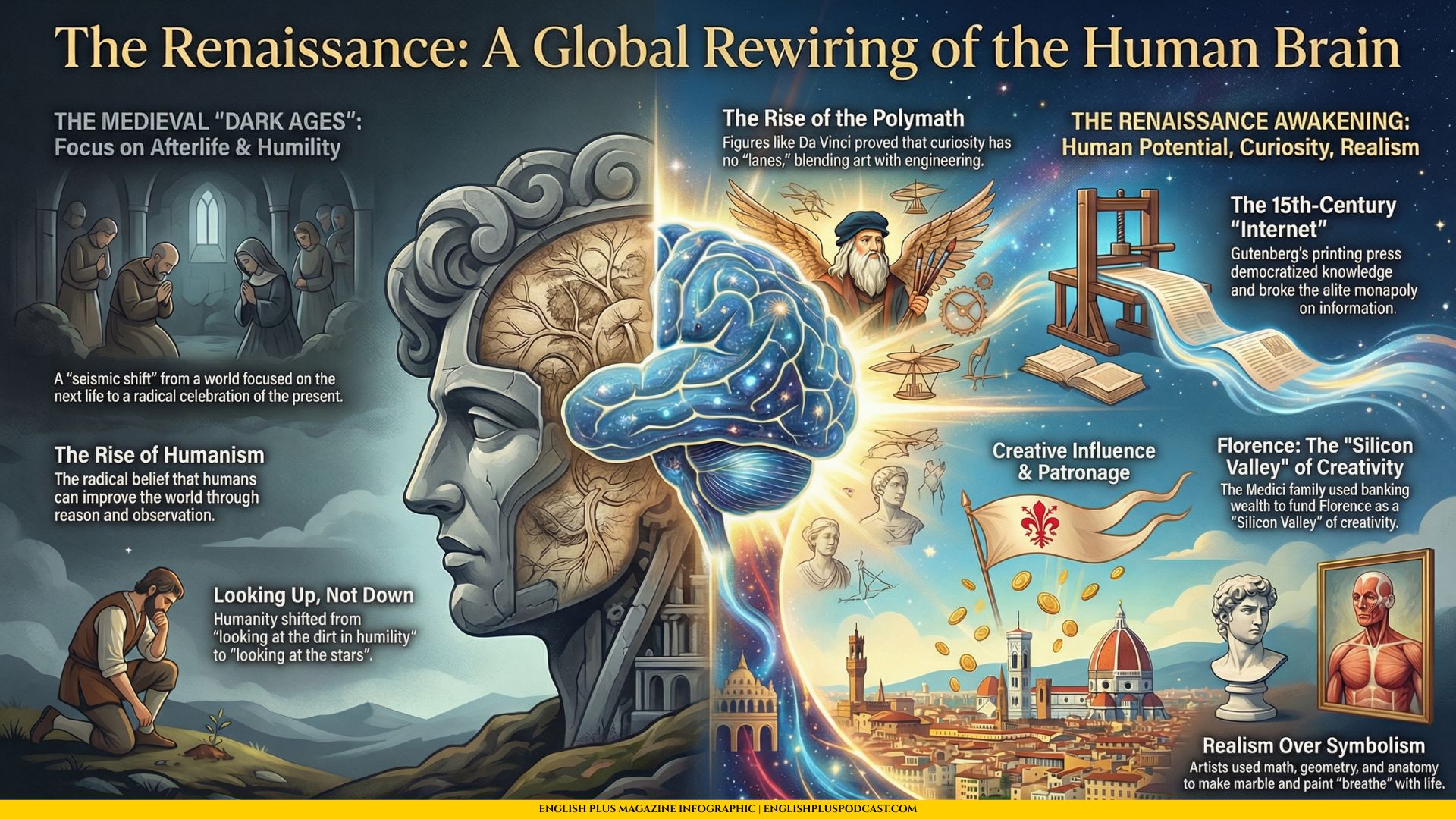
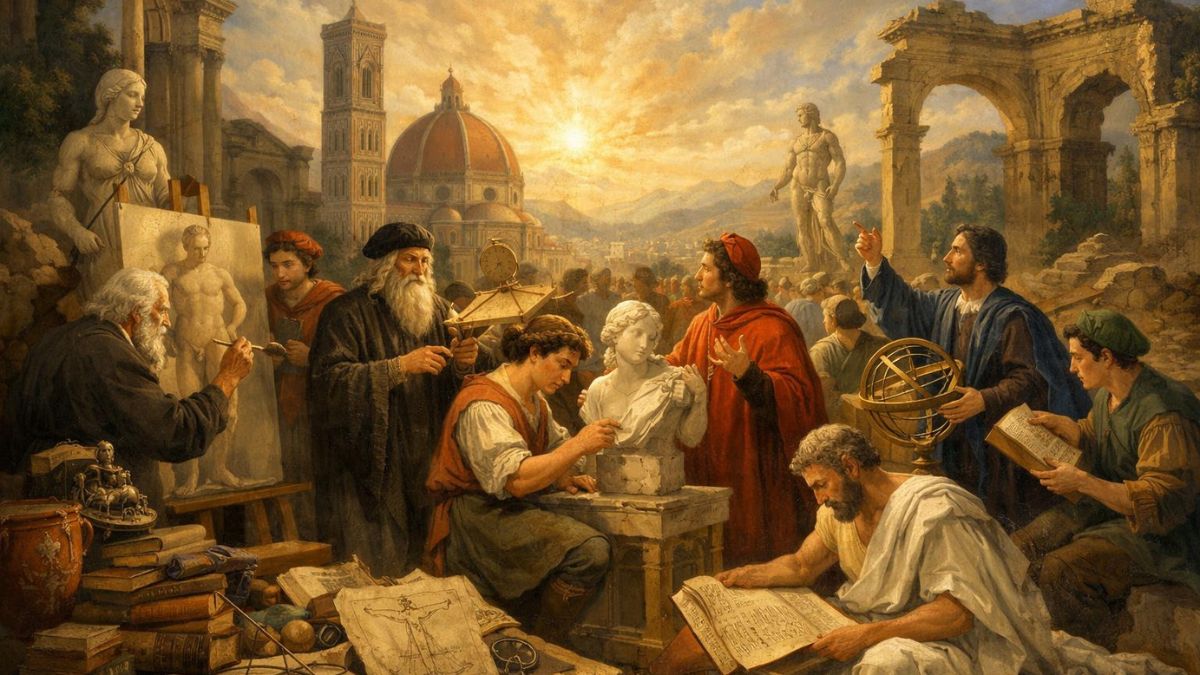
Imagine, if you will, waking up from a thousand-year nap. You stretch, rub your eyes, and look around, realizing that the gray, static world you left behind has suddenly burst into high-definition Technicolor. That is essentially what happened to Europe during the Renaissance. Now, I know what you’re thinking—history class, dusty books, men in tights staring at skulls. But let’s toss that image out the window for a moment. The Renaissance wasn’t just a time when people started painting better; it was a fundamental rewiring of the human brain. It was the moment humanity looked in the mirror and decided that we were actually pretty interesting. Before this seismic shift, the general vibe was largely focused on the afterlife. Life here on Earth was often seen as a grim waiting room for heaven, a place to endure rather than enjoy. But then, starting roughly in the 14th century, a new energy began to bubble up, primarily in the bustling city-states of Italy.
This new epoch didn’t just appear out of thin air like a magic trick. It was cooked up in a pressure cooker of specific historical ingredients. You had the messy end of the Middle Ages, the expansion of trade routes bringing in weird and wonderful goods from the East, and, ironically, the devastation of the Black Death, which shook up the social order so violently that survivors began to ask, “Is there more to life than this?” These factors helped precipitate a massive cultural shift. Suddenly, merchants had money—lots of it—and they didn’t just want to hoard it; they wanted to show it off. Enter the Medici family of Florence. These bankers were the original influencers, the patrons who decided that funding art and philosophy was the ultimate flex. Florence became the vanguard of this movement, a silicon valley of the 15th century where the currency was creativity rather than code.
At the heart of this explosion was a concept called Humanism. Now, don’t let the fancy terminology scare you. Humanism was simply the radical idea that humans are capable of greatness, that we can learn, create, and improve our world through reason and observation. It was a pivot from looking down at the dirt in humility to looking up at the stars in curiosity. This intellectual shift created the perfect environment for the rise of the polymath. Think of Leonardo da Vinci. The man wasn’t just a painter; he was an engineer, an anatomist, a botanist, and a musician. He didn’t stay in his lane because, in the Renaissance, there were no lanes. Curiosity was the only map you needed. When you look at his sketches of flying machines or the Vitruvian Man, you aren’t just seeing art; you are seeing a brain on fire, desperate to understand the mechanics of the universe.
This hunger for knowledge captured the zeitgeist of the time. It was an era where questioning the status quo became the new normal. And nothing fueled this fire quite like the invention of the printing press by Johannes Gutenberg. Before Gutenberg, books were handwritten, expensive, and rare—basically the Ferraris of the information world. After the printing press, ideas could disseminate across borders at a speed previously unimaginable. A radical idea written in Germany could spark a debate in Italy within weeks. It was the internet of the 1400s, democratizing knowledge and breaking the monopoly that the elite held over information.
Of course, we can’t talk about the Renaissance without talking about the art. If you compare a medieval painting to a Renaissance one, the difference is jarring. Medieval art was often flat and symbolic; size represented importance, not perspective. But Renaissance artists were obsessed with realism. They wanted to capture the ineffable beauty of the natural world. They dissected bodies to understand muscles, they studied geometry to master perspective, and they played with light and shadow to create volume. When Michelangelo chipped away at a block of marble to reveal David, he wasn’t just making a statue; he was celebrating the perfection of the human form. He was acting as an iconoclast, shattering the old rigid styles and replacing them with something that breathed, pulsed, and felt alive.
This artistic revolution wasn’t just about making things look pretty, though. It was an attempt to ameliorate the human condition by surrounding people with beauty and truth. Architects like Brunelleschi didn’t just build churches; they engineered mathematical marvels that defied gravity, lifting the human spirit along with the stone. They believed that by understanding the laws of nature—math, symmetry, proportion—they could get closer to the divine. It was a spiritual pursuit grounded in scientific reality. This blend of faith and reason, of art and science, is what makes the Renaissance so unique. It was a time when a scientist could be a poet, and a painter could be a mathematician.
As we moved into the later years of this period, the ripples of this resurgence of classical learning and new discovery spread outward, influencing everything from politics to exploration. It laid the groundwork for the Scientific Revolution and the Enlightenment. It taught us that we have the agency to shape our destiny, that we aren’t just passive actors in a cosmic play. The Renaissance reminds us that history isn’t a straight line of progress; it’s a series of awakenings. It challenges us to look at our own world and ask: What are the “dark ages” of our current time? What assumed truths do we need to challenge? Are we merely surviving, or are we creating?
So, as you go about your day, take a look around. The smartphone in your pocket, the perspective in the movies you watch, the very way we value individual human rights—so much of it traces its DNA back to those crazy, messy, brilliant centuries. The Renaissance didn’t just leave us with museums full of masterpieces; it left us with a mindset. It bequeathed us the audacity to believe that we can understand the universe and our place in it. And that brings me to a question I’d love for you to chew on: If we were to spark a new Renaissance today, right here and now, what values or ideas do you think should be at the center of it? What needs to be reborn in our modern world? Let me know what you think in the comments below!
Word Power
Alright, let’s take a breath and look back at some of the heavy-hitting words we just used. I know lists of vocabulary can feel a bit like eating dry toast, but these words are actually like spices—they add so much flavor to how you express yourself.
First up, we used the word epoch. This isn’t just a “time” or a “period.” An epoch is a defining chapter. Think of it like the seasons of your life. High school was an epoch. Your twenties might be another epoch. In the article, we called the Renaissance a new epoch because it was a total game-changer for history.
Then we had precipitate. Now, in chemistry, this means a solid forming from a liquid, but in conversation, it means to trigger something suddenly. We said the Black Death helped precipitate the Renaissance. In your life, a bad argument might precipitate a breakup, or a sudden bonus might precipitate a shopping spree. It’s a great cause-and-effect word.
We talked about Florence being in the vanguard. If you are in the vanguard, you are at the very front of the line, leading the charge. Tech companies today love to say they are in the vanguard of innovation. It sounds much more powerful than just saying they are “leaders.”
I love the word polymath. It sounds cool, right? It describes someone who is good at everything. Da Vinci is the classic example, but you might know a polymath in real life—that annoying friend who speaks four languages, plays the piano, and codes their own apps.
Then there is zeitgeist. This is a German loanword that literally means “time spirit.” It refers to the mood of an era. The zeitgeist of the 1960s was rebellion and freedom. The zeitgeist of today might be defined by digital connectivity and anxiety. It’s what everyone is feeling but maybe hasn’t said out loud.
Ineffable is a beautiful word for when you are speechless. It’s usually used for things that are overwhelmingly good or spiritual. The feeling of holding your newborn baby? Ineffable. The view from a mountaintop? Ineffable. It means words just aren’t enough.
We mentioned the printing press helping to disseminate ideas. To disseminate is to scatter widely, like seeds. You disseminate information, rumors, or news. If you’re a manager, you might need to disseminate the new policies to your team.
Iconoclast is a punchy word. Originally, it meant someone who smashed religious statues. Today, it’s a rebel—someone who challenges the “way things have always been done.” Steve Jobs was an iconoclast. If you hate popular trends just because they are popular, you might be a bit of an iconoclast too.
Ameliorate is a fancy way of saying “to improve” or “to make better,” specifically regarding a bad situation. You take aspirin to ameliorate a headache. Governments try to ameliorate poverty. It implies soothing or fixing a problem.
Finally, resurgence. This is a comeback. Vinyl records have seen a resurgence. Old fashion trends often have a resurgence. It’s when something that was asleep or dead comes back to life, just like classical learning did in the Renaissance.
Speaking Tips & Challenge
So, how do you actually use these without sounding like you swallowed a thesaurus? The key is to be casual about it.
- Don’t force it. If “improve” works better than ameliorate, use “improve.” Save ameliorate for when you are writing a formal email or discussing a complex problem. “We need to find a way to ameliorate the traffic situation.”
- Use “Zeitgeist” for culture. When you are talking about movies, music, or vibes with friends, zeitgeist is a great word. “This movie really captures the current zeitgeist.”
- “Precipitate” is great for storytelling. When you’re telling a story about how one thing led to another, use it. “His comment precipitated a huge argument.”
Here is your challenge for the week:
Identify an iconoclast in your life or in the news—someone who is doing things differently. Then, try to describe what they are doing to a friend (or just out loud to yourself) using the words vanguard and ameliorate.
For example: “Elon Musk is such an iconoclast; he wants to be in the vanguard of space travel to ameliorate the risk of humanity staying on one planet.”
Give it a shot! You might be surprised at how smart you feel just saying them.







0 Comments