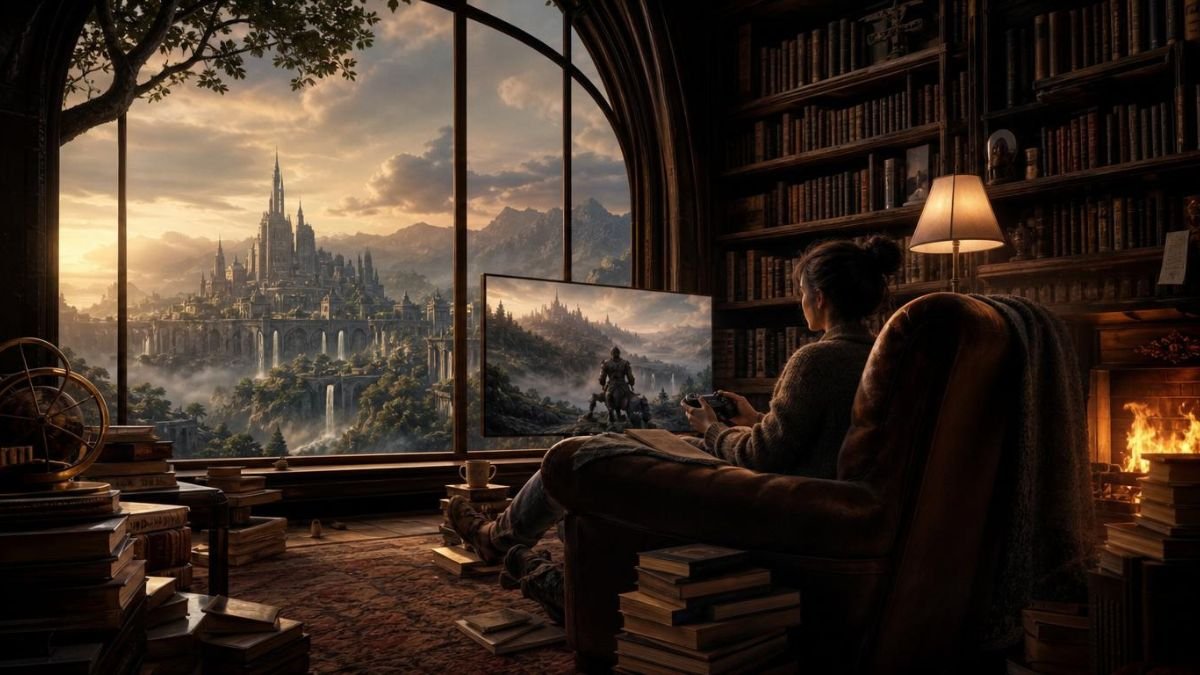
Can a video game make you cry? Can a controller-guided adventure teach you as much about the human condition as a Pulitzer Prize-winning novel? This episode explores the fascinating idea that video games have grown into a genuine literary form. Choose the level that feels right for you. If you find the words easy to understand and the ideas clear, try the next level. The goal is to keep growing — both in English and in the way you think about the world!
Word Power | Choose Your Level
KEYWORDS
1. story (n.) — a series of events told in order, with characters and a plot
2. character (n.) — a person in a story, film, or game
3. choice (n.) — when you pick one thing from two or more options
4. emotion (n.) — a strong feeling, like happiness, sadness, or fear
5. adventure (n.) — an exciting journey or series of unusual events
6. hero (n.) — the main character who does brave things in a story
7. message (n.) — the main idea or lesson a story tries to teach
8. world (n.) — the place or environment where a story happens
9. player (n.) — someone who plays a game
10. literature (n.) — written works, such as books and stories, especially those of great quality
ARTICLE
Have you ever played a video game and felt something deep — maybe sadness, excitement, or hope? If yes, you already know that games can be more than just fun. They can tell powerful stories. And that is exactly why some people say that video games are the new literature.
Think about your favorite book or movie. There is a story with a hero who faces problems and grows. There are emotions — you care about what happens. There is a message — something the story wants to teach you. Now think about games like The Last of Us, Zelda, or Red Dead Redemption. These games have all of those things too. They have rich characters, exciting adventures, and worlds so detailed and beautiful that they feel real.
But here is what makes games different from books and films: you are the player. You are inside the world. You can move, explore, and make choices. In many games, the choices you make change what happens next. You are not just reading about the hero — you ARE the hero. That is something no book or film can do. When you make a difficult choice in a game and something bad happens, the emotion you feel is real. You are involved.
Think about a game like Journey. You walk through a beautiful desert. There are no words and no instructions. But you feel things — wonder, loneliness, and joy. The game tells a story without using a single word. Now that is impressive.
Some people say that games are not literature because they are "just for fun." But that is not fair. Books can be fun too. Movies can be fun. The question is not "is this fun?" The question is "does this tell me something important about life?" And many games do exactly that.
Games like Undertale ask you: "Is violence always the answer?" Games like What Remains of Edith Finch tell sad and beautiful stories about family and loss. These are not simple messages. These are deep ideas.
Of course, not all games are like this. Many games are just about action and fun. That is fine! Not all books are great literature either. But the best games — just like the best books — can change the way you think and feel.
So the next time someone says, "Stop playing games and go read a book," maybe you can smile and think: maybe I already am. What do you think — can a video game be as powerful as a book? Tell us in the comments below!
WORD POWER
Let's explore these 10 words from the article. They are all useful in everyday life, so let's look at them carefully. The first word is story. A story is a series of events with a beginning, middle, and end. It usually has characters and a problem to solve. We use "story" all the time: "Tell me a story." "That's a great story!" In the article, we talked about how games have stories just like books. French: histoire, Spanish: historia, Italian: storia, Arabic: قصة (qissa).
Next is character. In stories, a character is any person (or animal or creature!) that plays a role. The hero is a character. The villain is a character. When we talk about someone's personality in real life, we also use "character": "She has great character." In games, characters are very important — they make us care about what happens. French: personnage, Spanish: personaje, Italian: personaggio, Arabic: شخصية (shakhsiyya).
Then there's choice. A choice is when you have two or more options and you pick one. "I had a choice between coffee and tea." In games, choices often change the story. This is special — you decide what happens. In life, we make choices every day. Good vocabulary about choices: "make a choice," "have no choice," "the right choice." French: choix, Spanish: elección, Italian: scelta, Arabic: اختيار (ikhtiyar).
Now, emotion. An emotion is a strong feeling — happiness, sadness, fear, surprise, love. In the article, we talked about how games make you feel real emotions. In English, we say "feel an emotion" or "express an emotion." It's important not to confuse "emotion" with "feeling" — they are very similar, but "emotion" is a little more formal. French: émotion, Spanish: emoción, Italian: emozione, Arabic: عاطفة (aatifa).
Let's talk about adventure. An adventure is an exciting journey or experience, often involving some risk or the unknown. "We had a great adventure in the mountains!" In stories, the adventure is the exciting journey the hero takes. In games, you often go on long adventures across big, beautiful worlds. French: aventure, Spanish: aventura, Italian: avventura, Arabic: مغامرة (mughamara).
Now, hero. The hero is the main character — the one who faces problems and tries to solve them. We call brave, good people "heroes" in real life too. "She is a real hero." Interestingly, "hero" doesn't always mean someone perfect. Many great heroes in stories make mistakes. That's what makes them interesting! French: héros, Spanish: héroe, Italian: eroe, Arabic: بطل (batal).
Then we have message. The message of a story is its main lesson or idea. "The message of the film is that kindness matters." In the article, we asked: does the game tell us something important about life? That's the message. Not all stories have a clear message, but the best ones usually do. French: message, Spanish: mensaje, Italian: messaggio, Arabic: رسالة (risala).
What about world? In storytelling, "world" doesn't mean the Earth — it means the place where the story happens. Fantasy worlds, science fiction worlds, historical worlds. Game designers spend years building these worlds. We say "the story's world" or "world-building." French: monde, Spanish: mundo, Italian: mondo, Arabic: عالم (alam).
Let's look at player. In games, the player is the person who plays. But "player" has other uses: a music player, a team player (someone who works well with others). "She's a real team player." In the article, the player is also the hero — and that's special. French: joueur, Spanish: jugador, Italian: giocatore, Arabic: لاعب (laib).
Finally, literature. Literature refers to written works — especially books, stories, poems, and plays — that are considered to have high quality and lasting value. "She studied English literature at university." We use it to talk about the body of written works from a culture or period. In the article, we asked: can games be part of literature? French: littérature, Spanish: literatura, Italian: letteratura, Arabic: أدب (adab).
SPEAKING CHALLENGE
Tip 1: Use "story" + verb phrases: "The story shows us...", "The story teaches us..."
Tip 2: Use "in my opinion" + statement + reason: "In my opinion, games can be literature because they tell powerful stories."
Tip 3: Compare two things with "just like": "A good game is just like a good book — it makes you think."
Your Challenge: Record yourself for 1 minute answering: "What is your favorite story — from a book, film, or game? What was the hero like, and what was the message?" Use at least 5 of the 10 keywords. Don't worry about being perfect. Just speak! The more you practice, the more natural it will feel.
KEYWORDS
1. narrative (n.) — the story or account of events, and the way it is told
2. immersive (adj.) — deeply engaging; making you feel completely absorbed in an experience
3. moral complexity (n. phrase) — the quality of containing difficult ethical questions without simple right-or-wrong answers
4. interactive (adj.) — responding to the user's input; involving two-way communication or action
5. empathy (n.) — the ability to understand and share the feelings of another person
6. protagonist (n.) — the main character of a story, around whom the plot centers
7. agency (n.) — the capacity to make meaningful choices that affect outcomes
8. world-building (n.) — the process of constructing a detailed fictional world with its own rules, history, and geography
9. themes (n.) — the central ideas or subjects explored in a work of literature or art
10. medium (n.) — a means of artistic expression or communication (plural: media)
ARTICLE
When was the last time a piece of entertainment made you question your own values, challenge your assumptions, or sit in silence for a few minutes after it ended — not because you were confused, but because something had genuinely moved you? If a video game has ever done that for you, then you already understand intuitively what scholars and critics are increasingly arguing: that video games belong in the conversation about literature.
The case for video games as literature is not simply about games getting better graphics or more sophisticated scripts. It is about a fundamental recognition that narrative — the art of telling stories — is not confined to the printed page. The medium itself shapes what stories can do, and games offer storytelling possibilities that no other form of art can replicate.
Consider agency — the player's ability to make choices that genuinely affect the story. In conventional literature, a reader accompanies a protagonist through events they cannot alter. In the best interactive narratives, the player becomes the protagonist, bearing the weight of decisions that carry real moral consequence. Games like The Witcher 3 or Disco Elysium place you in situations where there are no clean answers, no obvious right choices. These are exercises in moral complexity — the kind that the best literary fiction has always prized. The difference is that here, you don't just observe the dilemma; you live it.
This is where empathy comes in — arguably the central function of all great literature. When a novel forces you inside the perspective of someone utterly unlike yourself, it expands your sense of what it means to be human. Games can do this too, often more viscerally, because the immersive quality of the medium collapses the distance between reader and character. In The Last of Us, you don't read about a father's desperate love for a surrogate daughter; you enact it. Your hands are on the controller when the hard decisions are made. The emotional charge is direct and undeniable.
The most ambitious games also demonstrate extraordinary depth of world-building. The fictional universes of Dark Souls, The Elder Scrolls, or Planescape: Torment are not backdrops — they are richly layered environments with their own histories, mythologies, languages, and internal logic. They reward curiosity and close attention in the way that great narrative worlds always have, from Tolkien's Middle-earth to Ursula Le Guin's Earthsea. The player who stops to read the in-game texts, to notice the environmental storytelling, to trace the consequences of ancient events across the present landscape, is doing something that looks remarkably like close reading.
And the themes that the best games engage with are hardly trivial. Nier: Automata asks whether consciousness creates meaning or whether meaning is a story we tell ourselves. Papers, Please implicates you in systemic oppression by making you its instrument. What Remains of Edith Finch explores grief, memory, and the stories families tell about themselves with a delicacy that most contemporary novels would struggle to match. These are not incidental observations — they are the central, deliberate concerns of artists who happen to work in an interactive medium.
Of course, the objection is predictable: most games are not like this. Most games are escapist entertainment with no more literary ambition than a summer blockbuster. True enough. But the same could be said of most books. The existence of pulp fiction does not disqualify the novel as an art form; the existence of mindless shooters should not disqualify the game. We judge literature by its heights, not its average. And at its heights, the game has reached extraordinary places.
The more interesting question is not whether games can be literature — that debate is largely settled in the affirmative — but what this recognition means for how we educate, how we interpret culture, and how we talk about the stories that shape us. The medium is evolving faster than our critical vocabulary for it. Perhaps it's time to expand that vocabulary. What game has challenged, moved, or stayed with you in the way that great literature does? Share your experience in the comments below.
WORD POWER
These ten words are genuinely powerful for anyone who wants to discuss stories, culture, and ideas in English. Let's go through them carefully. Narrative comes from the Latin narrare, meaning to tell. A narrative is not just a story — it's the specific way a story is told. Two films can cover the same events but have completely different narratives if they're told from different perspectives or in different orders. In the article, we talked about games offering storytelling possibilities beyond the printed page. You can use "narrative" in so many contexts: "the political narrative," "a coherent narrative," "the dominant narrative." French: narratif / récit, Spanish: narrativa, Italian: narrativa, Arabic: سردية (sardiyya).
Next: immersive. When something is immersive, it pulls you in completely — you forget your surroundings and feel fully absorbed. We used it to describe how games collapse the distance between player and character. You'll hear this word increasingly in tech and entertainment: "immersive VR experience," "an immersive novel." To immerse means to plunge into something. "She immersed herself in research." French: immersif, Spanish: inmersivo, Italian: immersivo, Arabic: غامر (ghaamir).
Then moral complexity. Moral refers to questions of right and wrong. Complexity means something is not simple — it has many layers and no easy answers. Together, moral complexity describes situations where good and bad are entangled, where every choice has costs, and where honest people might disagree about what to do. This is what the best literature — and the best games — explore. "The moral complexity of the character made the story deeply compelling." French: complexité morale, Spanish: complejidad moral, Italian: complessità morale, Arabic: التعقيد الأخلاقي (at-ta'qid al-akhlaaqi).
Now, interactive. Interactive means that the user's input changes or shapes the experience. An interactive display lets you touch and respond. An interactive story lets you make choices. The word comes from "inter" (between) and "active" (doing). In language learning, interactive activities are ones where you respond, react, and contribute — like this one! French: interactif, Spanish: interactivo, Italian: interattivo, Arabic: تفاعلي (tafa'uli).
Let's talk about empathy. This is one of the most important words in any language. Empathy is the ability to step into someone else's experience and genuinely feel what they feel — not just understand it intellectually, but feel it. The article argues that great literature builds empathy, and games can do this even more directly than books. "Empathy is not sympathy — sympathy is feeling sorry for someone; empathy is feeling with them." French: empathie, Spanish: empatía, Italian: empatia, Arabic: التعاطف (at-ta'aatuf).
Then there's protagonist. This Greek-rooted word means the "first actor" in a story — the main character whose journey drives the plot. The protagonist is not always the hero in the moral sense; they might be deeply flawed or even villainous. The point is that the story follows them. "In this game, the protagonist's choices shape the entire world around them." French: protagoniste, Spanish: protagonista, Italian: protagonista, Arabic: البطل الرئيسي (al-batal ar-ra'isi).
Now, agency. In philosophy and psychology, agency means the capacity to act and make choices. When you have agency, your decisions matter and produce real consequences. In storytelling, narrative agency means the audience can influence the story. The article argues this is what distinguishes games from films and novels. "The game gave players genuine agency — nothing felt predetermined." French: agentivité / capacité d'agir, Spanish: agencia, Italian: agentività, Arabic: القدرة على الفعل (al-qudra 'ala al-fi'l).
Let's explore world-building. This compound noun describes the creative process of constructing a fictional universe — its geography, history, cultures, rules, and lore. Tolkien is considered the master of world-building in literature. Game designers are increasingly recognized as world-builders of extraordinary ambition. "The world-building in this game is so detailed it takes years to fully explore." French: construction du monde, Spanish: construcción de mundos, Italian: creazione di mondi, Arabic: بناء العوالم (bina' al-'awalem).
Now, themes. The themes of a work are its central ideas or concerns — the big questions it's really about beneath the surface of plot. A story might be about a war on the surface but about loyalty and betrayal at the level of theme. "Loss," "identity," "power," "belonging" are all themes. When you analyze literature, identifying themes is one of the most important skills. "The game's central themes of free will and identity make it philosophically rich." French: thèmes, Spanish: temas, Italian: temi, Arabic: مواضيع (mawadi').
And finally, medium (plural: media). A medium is a form or channel through which something is communicated or expressed. Paint is a medium; the novel is a medium; film is a medium; the game is a medium. Each medium has unique strengths and limitations. The article argues that the game's medium allows for forms of storytelling no other medium can match. "Every medium has constraints that force artists to be creative." French: medium / support, Spanish: medio, Italian: mezzo, Arabic: وسيلة تعبير (wasilat ta'bir).
SPEAKING CHALLENGE
Tip 1: Use "narrative" + adjective: "a complex narrative," "a linear narrative," "a fragmented narrative."
Tip 2: Use "agency" in discussions of control and choice: "As a learner, I want more agency in choosing what I study."
Tip 3: Frame an argument with "the case for/against": "I'd make the case for games being literature because..."
Your Challenge: Record a 2-minute response to: "Choose a game, film, or book and explain its main themes and what made it morally complex. How did it build empathy in you?" Use at least 6 of the 10 keywords. Listen back and pay attention to how naturally you use terms like "narrative," "agency," and "themes" — these are the kinds of words that immediately elevate your spoken English.
KEYWORDS
1. ludic (adj.) — relating to or having the characteristics of play; from the Latin ludus (game or play)
2. narratology (n.) — the academic study of narrative structure, how stories are constructed and how they produce meaning
3. diegesis (n.) — the story world as presented within a narrative; the internal logic and events of that world
4. procedural rhetoric (n. phrase) — the use of game mechanics and rules themselves to make arguments or express meaning, as theorized by Ian Bogost
5. remediation (n.) — the process by which a new medium incorporates, transforms, and critiques older media forms
6. emergent narrative (n. phrase) — a story that arises organically from player interaction with systems, rather than being wholly pre-authored
7. aesthetic experience (n. phrase) — the distinctive quality of engagement produced by a work of art, involving perception, feeling, and meaning-making
8. authorial intent (n. phrase) — the goals, meanings, and messages a creator consciously or unconsciously embeds in a work
9. ontological instability (n. phrase) — a condition within a narrative where the nature of reality, identity, or existence is fundamentally uncertain or contradictory
10. canon (n.) — the body of works officially recognized as of high cultural and literary value within a tradition or discipline
ARTICLE
Consider the following scenario: you spend forty hours with a character whose grief, rage, moral failings, and occasional tenderness you have come to know with the intimacy of a long-read novel. You have made choices on their behalf — choices whose consequences you carry in a way that no passive reader can. At the end, something shifts. Not just in the story, but in you. Is that literature? Or does it matter what we call it?
The question of video games as literature has moved, in the past decade, from a defensive provocation to a settled critical position in many quarters. The more interesting work now is theoretical: understanding what the ludic dimension of games — the fact that they are played, not merely consumed — adds to, subtracts from, or irrevocably transforms the aesthetic experience of narrative. This is not a question literary theory has fully answered, because the frameworks of narratology were developed almost entirely within the context of non-interactive forms.
The foundational tension in applying narratological frameworks to games is what theorists call the "narratology vs. ludology" debate: the question of whether games are best understood as narrative forms or as rule-based play systems, and whether these two dimensions are fundamentally in conflict. Hardcore ludologists like Jesper Juul argued that the diegesis — the story world, its logic, its internal events — is always subordinate to the mechanical system; that narrative in games is essentially decorative, a scaffolding around the real work of play. This position has largely been abandoned in its strong form. The more nuanced contemporary view recognizes that the best games produce a productive tension between diegesis and ludic mechanics, in which each layer comments on and enriches the other.
This is where Ian Bogost's concept of procedural rhetoric becomes genuinely illuminating. Bogost argues that games make arguments not through dialogue or description but through their systems — their rules, their feedback loops, their affordances and refusals. Papers, Please makes its argument about bureaucratic complicity not through its cutscenes but through the monotonous, error-punishing mechanics of document inspection. Every time the game slows you down, penalizes you for mistakes, and confronts you with a human cost you cannot afford to acknowledge, it is enacting a rhetorical position: that systemic oppression is sustained not by exceptional villainy but by ordinary, exhausted, compliant labor. No novel can produce this argument quite as directly, because no novel makes you do it.
The concept of remediation — developed by Bolter and Grusin — offers another productive frame. Each new medium does not simply emerge; it incorporates and transforms the media that preceded it. Cinema remediated theater and the novel; television remediated cinema; games remediate all of these and add new dimensions. What is distinctive about game remediation is that it does not merely represent the conventions of earlier forms — it renders them interactive, subjecting them to the logic of emergent narrative. A game like Disco Elysium remediates the hardboiled detective novel, but the player's input continuously co-authors the diegesis in ways that no fixed text can.
The question of authorial intent in games is correspondingly complex. In literary theory, debates about authorial intent — from the New Critics' deliberate exclusion of it to Roland Barthes' declaration of the "death of the author" — have shaped how we read and value texts. In games, this question bifurcates: there is the intent of the development team (designers, writers, artists) and there is the emergent narrative produced by the player's interaction with systems. Both are real; neither is complete. The player who speedruns through a narrative game, bypassing scripted sequences in the interest of mechanical mastery, is producing something that exists in genuine tension with the designers' authorial intent — and that tension is itself a kind of meaning.
Some of the most sophisticated games deliberately thematize this tension. Nier: Automata is perhaps the defining example: a game about androids questioning the meaning of programmed existence that is also, structurally, about players questioning the conventions of the game form itself. The game's famous ending sequence — which requires the player to sacrifice their save data in an act of genuine loss — produces a moment of ontological instability that collapses the boundary between game-world and real-world, diegesis and player-experience. This is not a trick or a gimmick. It is the game using its unique affordances to produce an aesthetic experience of mortality and legacy that is simply unavailable to any other medium.
The question of whether games deserve a place in the literary canon is, ultimately, a question about who gets to draw the boundaries of cultural value — and why. Historically, those boundaries have been drawn by institutions (universities, literary prizes, broadsheet critics) that are slow to recognize new forms. Film waited decades for academic legitimacy. Photography was long dismissed as mechanical reproduction rather than art. The game is waiting now, though the wait is shortening. What is less debatable is that the most accomplished games of the past two decades have produced aesthetic experiences of genuine depth, complexity, and human significance — experiences that have changed how people think, feel, and understand themselves and the world. Whether we call that literature or something new, it seems important not to dismiss it.
The critical framework we apply to games shapes not just how we evaluate them but what kinds of games get made. If the ludic turn in culture is to produce genuine art — not just profitable entertainment — it needs a critical culture sophisticated enough to distinguish between the two. The canon is not static; it has always been a contested, evolving space. Perhaps the question to ask is not "do games deserve to be in it?" but "how will including them change it?" Drop your thoughts below — and if you can name a game that produced in you a genuine aesthetic experience, we would very much like to hear about it.
WORD POWER
Let's work through these ten terms with the care they deserve — they sit at the intersection of philosophy, literary theory, and cultural studies, and facility with them will significantly elevate your intellectual English. Ludic comes from the Latin ludus, meaning game or play. When we describe something as ludic, we're pointing to its play-like qualities — its freedom, its rule-governed improvisation, its orientation toward pleasure and exploration rather than utility. Crucially, "ludic" does not mean trivial. Philosophers from Schiller to Winnicott have argued that play is fundamental to human development and meaning-making. "The ludic dimension of the game resists reduction to pure narrative." French: ludique, Spanish: lúdico, Italian: ludico, Arabic: لعبي / ترفيهي (la'bi / tarfihi).
Narratology is the formal academic study of narrative — how stories are structured, how they produce meaning, what conventions they rely on, and how they position readers or audiences. Key narratologists include Gérard Genette (who analyzed narrative time, perspective, and voice), Vladimir Propp (who identified structural functions in folktales), and, more recently, Marie-Laure Ryan, who has worked on narrative in digital and interactive media. Knowing narratology allows you to discuss stories analytically rather than impressionistically. "Narratology provides the theoretical tools to analyze how games construct meaning through story." French: narratologie, Spanish: narratología, Italian: narratologia, Arabic: علم السرد ('ilm as-sard).
Diegesis is a term borrowed from classical poetics. Plato used it to describe narrative (telling) as opposed to mimesis (showing/enacting). In contemporary narratology and film theory, diegesis refers to the story world itself — everything that exists within the internal logic of the narrative. Diegetic sound in a film is sound that characters can hear; non-diegetic sound (like a film score) exists outside the story world. In games, the diegesis includes the game world, its events, its characters — distinct from the player's extra-diegetic experience of playing. "The game's diegesis is internally consistent, but its mechanics repeatedly break with it." French: diégèse, Spanish: diégesis, Italian: diegesi, Arabic: الحكي / عالم القصة (al-haky / 'alam al-qissa).
Procedural rhetoric, as developed by Ian Bogost in his 2007 book Persuasive Games, refers to the argumentative power of processes, rules, and systems — the claim that how a game works is itself a form of argument. Traditional rhetoric persuades through speech and writing; procedural rhetoric persuades through what you are made to do. This concept has significant implications beyond games: any designed system — a tax code, a bureaucratic process, an interface — embeds procedural arguments about how the world works and who matters. "The procedural rhetoric of the game naturalizes surveillance by making it feel like a security measure." French: rhétorique procédurale, Spanish: retórica procedimental, Italian: retorica procedurale, Arabic: البلاغة الإجرائية (al-balagha al-ijra'iyya).
Remediation is a concept from Jay David Bolter and Richard Grusin's 1999 book of the same name. It describes the process by which newer media incorporate, transform, and critique the conventions of older media. All media are, in a sense, remediations: the novel remediated oral storytelling, cinema remediated theater, television remediated radio. Remediation is not mere imitation; it involves a complex negotiation between transparency (trying to be "realistic" by hiding the medium) and hypermediacy (drawing attention to the medium itself). Games that call attention to their own game-ness are practicing hypermediacy. "The game's remediation of film noir conventions is deliberate and critically self-aware." French: remédiation, Spanish: remediación, Italian: rimediazione, Arabic: إعادة التوسيط (i'adat at-tawasut).
Emergent narrative describes stories that arise from the interaction between a player and a game's systems, rather than being predetermined by the designer. In highly systemic games like Dwarf Fortress, Crusader Kings, or even Minecraft, the player's decisions produce story-like sequences of events that feel narratively meaningful even though no author wrote them. This challenges conventional notions of authorship and raises fascinating questions about the nature of storytelling: does a story need an author, or just a structure within which meaningful events can unfold? "The emergent narrative that arose from three hours of play was more compelling than most scripted stories." French: récit émergent, Spanish: narrativa emergente, Italian: narrativa emergente, Arabic: السرد الناشئ (as-sard an-nash'i).
Aesthetic experience is a philosophical concept with roots in Kant's Critique of Judgment. It refers to the distinctive mode of engagement produced by art — a combination of perceptual attention, emotional response, and meaning-making that differs from instrumental or purely intellectual engagement. John Dewey developed a particularly influential account in Art as Experience (1934), arguing that aesthetic experience is not confined to "high art" but is a quality of heightened, integrated engagement available wherever form and content come together meaningfully. "The aesthetic experience the game produces is inseparable from the player's active participation." French: expérience esthétique, Spanish: experiencia estética, Italian: esperienza estetica, Arabic: التجربة الجمالية (at-tajriba al-jamaliyya).
Authorial intent refers to the meaning, purpose, or goals a creator consciously or unconsciously embeds in their work. Literary theory has a complex relationship with this concept: New Criticism insisted that the text must be analyzed on its own terms, independent of what the author "meant." Barthes declared the "death of the author" to assert the primacy of the reader in meaning-making. Intentionalists counter that intent provides important context for interpretation. In game studies, this debate is sharpened by the fact that a game's design team may have clear authorial intent while the player's actions produce outcomes the designers never envisioned. "The tension between authorial intent and player action is constitutive of the game as a form." French: intention de l'auteur, Spanish: intención autorial, Italian: intenzione autoriale, Arabic: النية المؤلفية (an-niyya al-mu'allifiyya).
Ontological instability describes a condition in which the fundamental nature of reality, identity, or existence within a narrative is uncertain, contradictory, or unstable. It's a characteristic feature of postmodern fiction (think Philip K. Dick, Paul Auster, or Mark Z. Danielewski) and of certain games that deliberately destabilize the player's sense of what is real within the game world. When Nier: Automata asks the player to delete their save data, it creates a moment of ontological instability: the boundary between game and reality briefly dissolves, producing a genuine experience of loss and consequence. "The novel's ontological instability makes certainty about any aspect of its reality impossible." French: instabilité ontologique, Spanish: inestabilidad ontológica, Italian: instabilità ontologica, Arabic: عدم الاستقرار الوجودي ('adam al-istiqrar al-wujudi).
Canon in literary and cultural studies refers to the body of works considered authoritative, essential, and representative of the highest cultural and artistic value within a tradition. The word comes from Greek kanon (a rule or measuring rod). The literary canon has always been contested: feminist and postcolonial scholars have argued compellingly that it has historically privileged the work of white, Western, male authors at the expense of other traditions. Today, the question of whether the game canon — the games considered most artistically significant — can or should be integrated into broader cultural canons is an active and important debate. "The expansion of the canon to include digital forms reflects changing conceptions of cultural value." French: canon, Spanish: canon, Italian: canone, Arabic: قانون أدبي / مرجعية ثقافية (qanun adabi / marja'iyya thaqafiyya).
SPEAKING CHALLENGE
Tip 1: Use "procedural rhetoric" as a lens: "The procedural rhetoric of this design normalizes..." — powerful in discussions of systems, technology, and institutions, not just games.
Tip 2: Practice using "ontological" to describe philosophical uncertainty: "There's an ontological dimension to this question that we haven't addressed."
Tip 3: Deploy "canon" critically: "Who decides what enters the canon — and whose values does that reflect?"
Your Challenge: Prepare a 3–4-minute analytical talk on the following: "Choose any game you know well and apply at least three of the ten concepts from this article to analyze it. Focus not just on what the game is about but on how it works — its procedural rhetoric, its diegesis, its emergent narrative, its aesthetic experience." This is genuinely difficult, and that's the point. The struggle to find the right word, to deploy a concept accurately, to sustain an analytical argument in real time — that is the edge of your English. Work there.
Reading Comprehension Quizzes
Instructions: Choose the best answer (A, B, C, or D). Then write 1–2 sentences to justify your choice.
1. What is the main idea of the article?
A) Video games are better than books.
B) Video games can tell powerful stories, just like literature.
C) Everyone should stop reading books and play games instead.
D) Most video games are too violent.
Your justification: _______________________________________________
2. What makes video games different from books and films, according to the article?
A) They have better music.
B) They are always more exciting.
C) The player makes choices and is part of the story.
D) They cost more money.
Your justification: _______________________________________________
3. What example does the article give of a game that tells a story without words?
A) Zelda
B) The Last of Us
C) Undertale
D) Journey
Your justification: _______________________________________________
4. What question does the game Undertale ask, according to the article?
A) "Is friendship important?"
B) "Is violence always the answer?"
C) "Should we protect the environment?"
D) "Is technology dangerous?"
Your justification: _______________________________________________
5. How does the article respond to people who say games are "just for fun"?
A) It says those people are completely right.
B) It says fun and literature cannot mix.
C) It says books and movies can be fun too, and fun doesn't mean shallow.
D) It says games should be more serious.
Your justification: _______________________________________________
6. Which word in the article describes the feeling you have when something bad happens in a game because of a choice you made?
A) Adventure
B) Emotion
C) Message
D) Character
Your justification: _______________________________________________
7. What does the article say about the game What Remains of Edith Finch?
A) It is too violent.
B) It tells sad and beautiful stories about family and loss.
C) It has no story.
D) It is the best game ever made.
Your justification: _______________________________________________
8. What is the article's conclusion about ALL video games?
A) All games are literature.
B) All games are just for fun.
C) Not all games are great literature, but the best ones can change how you think and feel.
D) Games are better than books.
Your justification: _______________________________________________
9. The article says that when you play a game like The Last of Us, you are the hero. What does this mean?
A) You always win in the game.
B) You control the main character and make the decisions.
C) The game is very easy to play.
D) The game has no other characters.
Your justification: _______________________________________________
10. What is the best title for just the last paragraph of the article?
A) "Why Games Are Not Literature"
B) "Games vs. Books: A Final Answer"
C) "A Question Worth Thinking About"
D) "Why You Should Stop Playing Games"
Your justification: _______________________________________________
1. B — The article says "video games are the new literature" and shows how games tell powerful stories. A and C are too extreme — the article doesn't say games are better than books. D is not the focus at all.
2. C — The article says: "You can move, explore, and make choices" and "you ARE the hero." A, B, D are not mentioned as the key difference.
3. D — "Journey" is described as a game that tells a story "without using a single word." A, B, C are mentioned for other reasons.
4. B — The article says: "Games like Undertale ask you: Is violence always the answer?" A, C, and D are not in the article.
5. C — The article says "Books can be fun too. Movies can be fun." It challenges the idea that fun and depth are opposites. A is wrong — the article disagrees. B and D are not stated.
6. B — The article says "the emotion you feel is real" when something bad happens after a choice. The other words don't describe a feeling.
7. B — The article says it "tells sad and beautiful stories about family and loss." A, C, and D are not stated.
8. C — The article says "not all games are like this" and "not all books are great literature either," but "the best games can change the way you think." A and D are too strong. B is what critics say, not the article's view.
9. B — "You are the player. You are inside the world... you ARE the hero." A, C, and D misread the sentence.
10. C — The last paragraph ends with a question: "Can a video game be as powerful as a book?" It is clearly an invitation to think, not a final answer. A, B, and D misrepresent the tone.
Instructions: Choose the best answer. Write 2–3 sentences of justification.
1. What does the article identify as the key argument for games as literature — beyond better graphics?
A) That games are more popular than books.
B) That narrative is not limited to printed text, and games offer unique storytelling possibilities.
C) That games are cheaper to produce than films.
D) That games are educationally superior to traditional literature.
Your justification: _______________________________________________
2. How does the article explain the concept of "agency" in games?
A) Agency means the player can pause and replay sections.
B) Agency means the player's choices carry genuine moral weight and affect the story.
C) Agency means the game is very long and complex.
D) Agency means the player can design their own character.
Your justification: _______________________________________________
3. How does the article contrast the empathy-building function of games with that of novels?
A) Novels build more empathy because they describe emotions more precisely.
B) Games build empathy less effectively because they are more focused on action.
C) Games can be more direct because their immersive quality collapses distance between player and character.
D) There is no difference — the article treats them as equal.
Your justification: _______________________________________________
4. What literary comparison does the article use to describe the world-building in games like Dark Souls?
A) Shakespeare's plays
B) Tolkien's Middle-earth and Ursula Le Guin's Earthsea
C) The Harry Potter series
D) Greek mythology
Your justification: _______________________________________________
5. What does the article say the game "Papers, Please" does?
A) It makes you feel like a superhero.
B) It implicates you in systemic oppression by making you its instrument.
C) It is about bureaucracy in a funny, light-hearted way.
D) It teaches you about the history of immigration.
Your justification: _______________________________________________
6. How does the article handle the objection that "most games are just entertainment"?
A) It dismisses the objection as uninformed.
B) It concedes the point and says only a few games count.
C) It uses the same logic to point out that most books are not literary masterpieces either, and we judge literature by its heights.
D) It argues that all games have literary value if you look closely enough.
Your justification: _______________________________________________
7. What does the article suggest "close reading" of a game might involve?
A) Reading the game's instruction manual carefully.
B) Noticing in-game texts, environmental storytelling, and the consequences of past events.
C) Playing a game multiple times to improve your score.
D) Reading academic reviews of the game.
Your justification: _______________________________________________
8. According to the article, what is the "more interesting question" about games and literature?
A) Whether games will eventually replace novels.
B) What recognizing games as literature means for how we educate and interpret culture.
C) Which games deserve to be classified as literature.
D) Whether games cause more empathy than books.
Your justification: _______________________________________________
9. The article says the game medium is "evolving faster than our critical vocabulary." What does this imply?
A) Games are becoming simpler to understand.
B) Critics are too slow to keep up with new games.
C) We need new ways of talking about games as a literary and cultural form.
D) The vocabulary of literature is becoming outdated.
Your justification: _______________________________________________
10. What is the overall tone of the article?
A) Defensive — trying to protect games from criticism.
B) Analytical and persuasive — building a case with specific examples and addressing counterarguments.
C) Nostalgic — mourning the decline of traditional literature.
D) Neutral — presenting both sides without drawing a conclusion.
Your justification: _______________________________________________
1. B — The article says the case is about "a fundamental recognition that narrative is not confined to the printed page" and that games offer unique storytelling possibilities. A is about popularity, not a literary argument. C and D are not stated.
2. B — The article describes agency as "the player's ability to make choices that genuinely affect the story" with "real moral consequence." A, C, and D describe gameplay mechanics but miss the literary and moral dimension the article emphasizes.
3. C — The article says games can build empathy "often more viscerally" because immersion "collapses the distance between reader and character." A is the opposite of the article's argument. B contradicts it. D is wrong — the article makes a clear distinction.
4. B — The article explicitly compares game world-building to "Tolkien's Middle-earth and Ursula Le Guin's Earthsea." A, C, and D are not mentioned.
5. B — The article says Papers, Please "implicates you in systemic oppression by making you its instrument." A, C, and D misrepresent this nuanced description.
6. C — The article says "the same could be said of most books" and "we judge literature by its heights, not its average." A is too dismissive. B understates the article's position. D overstates it.
7. B — The article says the attentive player who "stops to read the in-game texts, notice environmental storytelling, trace the consequences of ancient events... is doing something that looks remarkably like close reading." A, C, D are not what the article means.
8. B — The article explicitly frames it: "The more interesting question is... what this recognition means for how we educate, how we interpret culture." A is not stated. C is too narrow. D is not the question posed.
9. C — The article says "perhaps it's time to expand that vocabulary," implying we need new critical language for this emerging form. A and B misread the sentence. D makes a claim about traditional literature the article doesn't make.
10. B — The article presents specific examples (The Witcher 3, Disco Elysium, Nier: Automata), addresses the obvious objection, and builds toward a conclusion. A mischaracterizes the tone. C is wrong — the article looks forward, not backward. D is wrong — the article clearly argues a position.
Instructions: Choose the best answer. Write 3–4 sentences of detailed justification, referencing the text.
1. How does the article characterize the current state of the "video games as literature" debate?
A) It is still a deeply contested provocation with no clear resolution.
B) It has moved beyond provocation to a settled critical position, with the more interesting work now being theoretical.
C) It has been conclusively resolved in favor of games' literary status.
D) It is primarily a generational conflict between older and younger critics.
Your justification: _______________________________________________
2. What is the "narratology vs. ludology" debate, and how does the article resolve it?
A) It's a debate about whether games or books are more valuable; the article sides with books.
B) It's a debate about whether games are narrative or rule-based; the article adopts a nuanced view that the best games produce productive tension between diegesis and ludic mechanics.
C) It's a debate within narratology about how to categorize fictional worlds; the article defers to Juul's position.
D) It's a debate about whether procedural rhetoric is a legitimate form of argument; the article rejects it.
Your justification: _______________________________________________
3. How does the article explain the specific argument made by "Papers, Please" through its mechanics?
A) The game argues that bureaucracy is necessary for social stability.
B) The game's monotonous, error-punishing mechanics enact the argument that systemic oppression is sustained by ordinary, exhausted compliance.
C) The game argues that immigration policy is inherently unjust.
D) The game demonstrates that procedural rhetoric is less effective than written argument.
Your justification: _______________________________________________
4. What does the article identify as distinctive about how games remediate earlier media?
A) Games remediate earlier media by making them more visually spectacular.
B) Games not only incorporate conventions of earlier forms but render them interactive, subjecting them to the logic of emergent narrative.
C) Games remediate earlier media by simplifying their narratives for wider audiences.
D) Games are the only medium that practices remediation.
Your justification: _______________________________________________
5. How does the article handle the question of "authorial intent" in games?
A) It argues that designer intent is the only legitimate source of meaning in games.
B) It dismisses the concept of authorial intent as irrelevant to games.
C) It identifies a bifurcation between design-team intent and emergent meaning produced by player interaction, arguing that the tension between them is itself meaningful.
D) It argues that players are always wrong to interpret games against their designers' intentions.
Your justification: _______________________________________________
6. How does the article describe Nier: Automata's ending sequence as a literary achievement?
A) It praises the visual beauty of the final cutscene.
B) It describes it as producing ontological instability by collapsing the boundary between game-world and real-world, generating an aesthetic experience of mortality unavailable to other media.
C) It calls it the most emotionally manipulative moment in game history.
D) It uses it as evidence that games cannot tell serious stories.
Your justification: _______________________________________________
7. What argument does the article make about the relationship between critical culture and game-making?
A) Critical culture is irrelevant to the commercial success of games.
B) The critical framework applied to games shapes what kinds of games get made, making sophisticated criticism necessary for genuine artistic development.
C) Academic criticism of games is too technical to influence the industry.
D) Critical culture should only evaluate games on commercial terms.
Your justification: _______________________________________________
8. How does the article use the historical example of film and photography to support its argument?
A) To show that all new art forms eventually fail to gain institutional recognition.
B) To demonstrate a pattern in which new media are initially dismissed and only later recognized as legitimate art forms.
C) To argue that film and photography are still not fully respected as art forms.
D) To suggest that games will never achieve the status of film.
Your justification: _______________________________________________
9. What does the article suggest the speedrunning player does to the game's authorial intent?
A) They fulfill the designers' intent more completely than other players.
B) They destroy the narrative value of the game entirely.
C) They produce something in genuine tension with the designers' intent, and that tension is itself a form of meaning.
D) They demonstrate that authorial intent is irrelevant.
Your justification: _______________________________________________
10. The article's final question reframes the debate: instead of "do games deserve to be in the canon?" it asks "how will including them change it?" What does this shift imply?
A) The article concedes that games do not yet deserve canonical status.
B) The article implies that the canon is a fixed, neutral space that games might disrupt.
C) The article treats the canon as a contested, evolving space and suggests that including games raises productive questions about cultural value.
D) The article suggests that the canon should be abolished entirely.
Your justification: _______________________________________________
1. B — The article opens by saying the question has "moved from a defensive provocation to a settled critical position in many quarters" and that "the more interesting work now is theoretical." A misrepresents the current state. C overstates it. D introduces a generational framing the article does not use.
2. B — The article summarizes the debate, references Juul's position, then states the "more nuanced contemporary view" that the best games create "productive tension between diegesis and ludic mechanics." A completely mischaracterizes the debate. C gets Juul wrong — the article says his strong position "has largely been abandoned." D conflates two different debates.
3. B — The article specifies: "the monotonous, error-punishing mechanics of document inspection... enacting a rhetorical position: that systemic oppression is sustained not by exceptional villainy but by ordinary, exhausted, compliant labor." A inverts the argument. C is an oversimplification not stated in the text. D contradicts the article's evident position on procedural rhetoric.
4. B — The article says games do not merely "represent the conventions of earlier forms" but "render them interactive, subjecting them to the logic of emergent narrative." A is a superficial reading. C is contradicted by the article's examples. D is wrong — the article establishes remediation as a general principle of media evolution.
5. C — The article says "the question of authorial intent in games is... complex" and identifies a "bifurcation" between design intent and emergent meaning, then states: "that tension is itself a kind of meaning." A and D are too authoritarian and not what the article argues. B is the opposite of the article's careful treatment of the concept.
6. B — The article describes it as producing "ontological instability that collapses the boundary between game-world and real-world, diegesis and player-experience" and generating "an aesthetic experience of mortality and legacy... unavailable to any other medium." A focuses on visuals, which the article ignores. C's characterization of "manipulation" is not the article's framing. D is directly contradicted.
7. B — The article says: "The critical framework we apply to games shapes not just how we evaluate them but what kinds of games get made." A and D contradict this explicitly. C is not stated.
8. B — The article lists film and photography as examples of media that "waited... for academic legitimacy" and were initially "dismissed," establishing a historical pattern. A draws the opposite conclusion. C is not stated. D contradicts the clear analogical purpose of the examples.
9. C — The article says the speedrunner is "producing something that exists in genuine tension with the designers' authorial intent — and that tension is itself a kind of meaning." A is wrong — the article explicitly says this is "in tension with" intent. B overstates. D misreads the subtle claim.
10. C — The article describes the canon as "a contested, evolving space" and frames the question as one about what including games will do to it — implying it is open, changeable, and shaped by values. A misreads the rhetorical shift as concession. B is contradicted by the explicit description of the canon as contested. D is not suggested anywhere in the text.






0 Comments