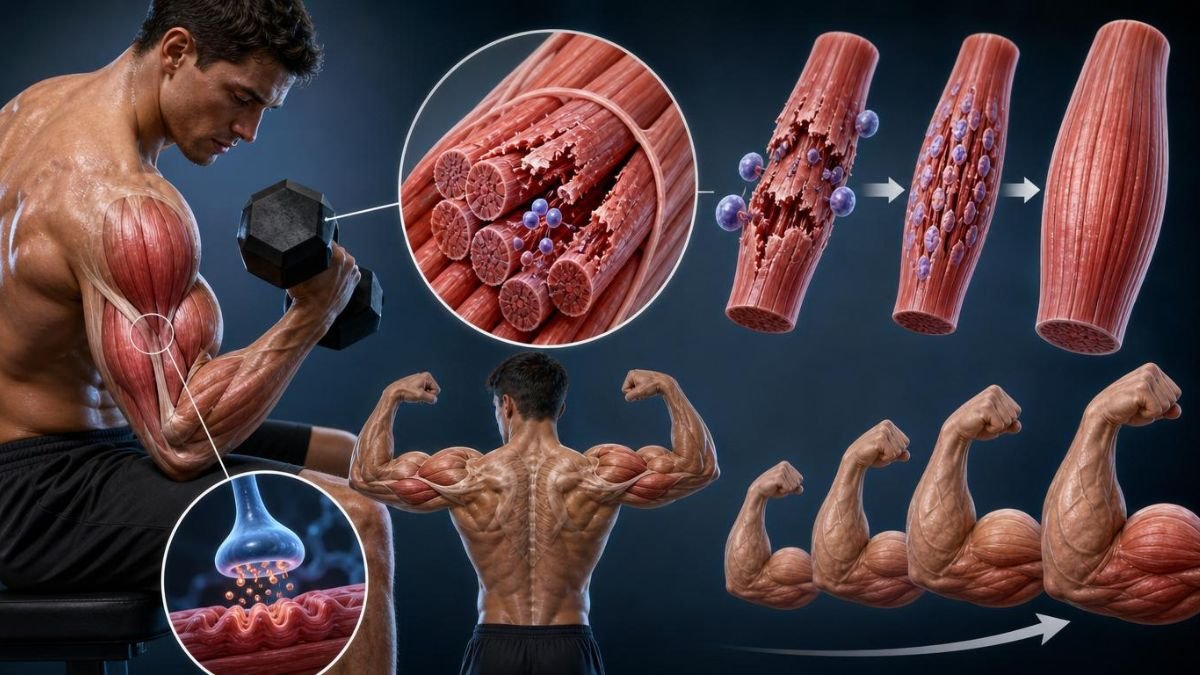
Do you think doing 1,000 sit-ups a day will give you a six-pack? Do you believe that sore muscles mean your workout worked? This lesson takes on some of the biggest myths about muscle growth and gives you the real science. There are three levels below — choose the one that matches your English and your curiosity. Start where you feel comfortable, but don't stay there too long. Challenge is how you grow — in the gym and in English!
Word Power | Choose Your Level
KEYWORDS
1. muscle (n.) — a part of your body that you use to move
2. exercise (n./v.) — physical activity that makes your body stronger
3. rest (n./v.) — a period of time when you are not working or exercising
4. pain (n.) — a feeling that something in your body hurts
5. protein (n.) — a substance in food (like meat, eggs, and beans) that helps the body build and repair itself
6. damage (n.) — harm or injury to something
7. repair (v.) — to fix something that is broken or hurt
8. myth (n.) — a false idea or belief that many people think is true
9. stronger (adj.) — having more power or ability than before
10. grow (v.) — to become bigger or more developed
ARTICLE
Have you ever looked at someone with big, strong muscles and wondered: how did they do that? Maybe you have tried to exercise more, but your muscles are still the same. Maybe you believed some things about muscles that are not actually true. Well, let's talk about how muscle growth really works — and let's bust a few myths along the way.
First, let's understand the basic idea. When you exercise — especially when you lift weights or do hard physical activities — you are making very small damage in your muscle fibers. This sounds bad, but it is actually good! Your body sees this damage and says, "I need to repair this and make it stronger." So it does. And when it repairs, the muscle becomes a little bigger and stronger than before. This process is called muscle growth, or hypertrophy.
But here is the important part: your muscles do not grow when you exercise. They grow when you rest. That's right — the growth happens after the gym, not inside it. When you sleep and take days off, your body is working hard to repair those small injuries. So rest is not lazy. Rest is part of the plan!
Now, let's talk about some myths. The first myth is: "No pain, no gain." Many people think that if they are not in pain after a workout, nothing happened. But that is not true. Pain is not the same as progress. Feeling very sore for three days after every workout can mean you did too much. Smart training does not always hurt.
The second myth is: "You can get a flat stomach by doing 500 sit-ups every day." Exercise does not remove fat from one place on your body. When your body loses fat, it loses it everywhere — not just your stomach. So sit-ups will make your stomach muscles stronger, but they will not make your belly smaller unless you also eat well.
And speaking of food — protein is very important for muscle growth. When your body repairs your muscles, it uses protein to do it. If you don't eat enough protein, your muscles cannot grow well. Good sources of protein include eggs, chicken, fish, beans, and dairy products. You don't need special protein shakes — real food works great.
Another myth is that women should not lift heavy weights because they will look "too big." This is simply not true. Women have much less testosterone than men, which is the hormone that helps build big muscles. Women can lift weights and become stronger and healthier without looking like a bodybuilder.
The truth is: muscle growth is a simple process. Exercise, eat well, and rest. Your body does the rest. You don't need to suffer or follow crazy programs. You just need to be consistent — and patient.
So let's think about this: what myth about exercise or muscles have you believed before? Has any of this surprised you? Share your thoughts in the comments below — we would love to hear your story!
WORD POWER
Let's look at each of the ten keywords and see how they work in context and in life. First: muscle. Your body has more than 600 muscles! They help you move, breathe, and even digest food. When we talk about "building muscles," we usually mean the skeletal muscles — the ones you use to move your arms and legs. In English, you can say "flex a muscle" (tighten it), "pull a muscle" (injure it slightly), or "use your muscles" (do hard physical work). French: muscle, Spanish: músculo, Italian: muscolo, Arabic: عضلة (adala).
Now let's look at exercise. Exercise is any physical activity done to stay healthy or get fitter. You can use it as a noun: "I do exercise every day." Or as a verb: "She exercises three times a week." There are many types: cardio exercise (running, cycling), strength exercise (lifting weights), and flexibility exercise (yoga, stretching). French: exercice, Spanish: ejercicio, Italian: esercizio, Arabic: تمرين (tamrin).
Let's talk about rest. Rest doesn't mean doing nothing forever — it means giving your body time to recover. In fitness, "rest days" are planned days where you don't exercise. This is when your muscles actually grow! In everyday English: "I need a rest." "Let's take a rest break." "Rest is important for mental health too." French: repos, Spanish: descanso, Italian: riposo, Arabic: راحة (raha).
Now, pain. Pain is an uncomfortable feeling that tells you something is wrong. In the article, we said that pain is not always a sign of progress. There are two types of muscle pain: "muscle soreness" (a normal, dull ache after exercise) and "sharp pain" (a warning sign of injury). In English, we say: "I am in pain." "That causes pain." "No pain, no gain" is a popular (but partly misleading) saying. French: douleur, Spanish: dolor, Italian: dolore, Arabic: ألم (alam).
Next is protein. Protein is one of the three main macronutrients (with carbohydrates and fats). It is made of amino acids, which are like the building blocks your body uses to repair and build muscle. Foods rich in protein include meat, eggs, dairy, fish, nuts, and legumes. In English: "This meal is high in protein." "Protein helps muscle recovery." French: protéine, Spanish: proteína, Italian: proteina, Arabic: بروتين (brutin).
Then there is damage. Damage means harm or injury. In the context of muscle growth, small amounts of damage to muscle fibers are actually necessary — the body repairs them and makes them stronger. In everyday English: "The storm caused damage." "The car has some damage." "Don't damage your health." It is usually a noun, but can be a verb: "The accident damaged the engine." French: dommage / dégât, Spanish: daño, Italian: danno, Arabic: ضرر (darar).
Now, repair. To repair means to fix something. Your body is amazing at self-repair. When you sleep, your body is busy repairing muscle fibers, fighting infection, and restoring energy. In everyday English: "Can you repair this?" "The phone needs repairs." "The body repairs itself during sleep." French: réparer, Spanish: reparar, Italian: riparare, Arabic: يصلح (yusallih).
Let's look at myth. A myth is a story or belief that people accept as true, even though it's not. In Greek mythology, myths were stories about gods and heroes. In everyday life, myths are common: "Swallowing gum takes 7 years to digest" is a myth. "Carrots give you super-eyesight" is a myth. In the article, we busted several fitness myths. French: mythe, Spanish: mito, Italian: mito, Arabic: خرافة (khurafah).
Now, stronger. This is the comparative form of "strong." Strong means having a lot of physical or mental power. "She is strong." "He got stronger after training." "You need to be strong to carry this." In fitness, we talk about getting stronger over time — lifting more weight, doing more repetitions. French: plus fort, Spanish: más fuerte, Italian: più forte, Arabic: أقوى (aqwa).
And finally, grow. To grow means to become bigger, stronger, or more developed. We used it to describe how muscles grow when your body repairs them. But "grow" has many uses: "Children grow fast." "Her business is growing." "I want to grow as a person." It's a verb with many forms: grow, grew, grown. French: grandir / croître, Spanish: crecer, Italian: crescere, Arabic: ينمو (yanmu).
SPEAKING CHALLENGE
Tip 1: Use "I used to think... but now I know..." to talk about changed beliefs. "I used to think you had to feel pain to grow muscles, but now I know rest is just as important."
Tip 2: Use "actually" to introduce a surprising fact: "Actually, muscles grow when you rest, not when you exercise."
Tip 3: Use "for example" to give examples: "Foods with protein include, for example, eggs, chicken, and beans."
Your Challenge: Record yourself for 1 minute answering: "What myth about health or exercise have you believed? What do you know now?" Use at least 5 of the 10 keywords. Speak naturally — don't read from notes if you can help it. Every time you speak, your English gets stronger!
KEYWORDS
1. hypertrophy (n.) — the increase in the size of muscle fibers due to resistance training and repair
2. progressive overload (n. phrase) — the gradual increase of stress placed on the body during training to continually stimulate muscle growth
3. recovery (n.) — the process by which the body repairs and restores itself after physical stress
4. testosterone (n.) — a hormone primarily produced in males that plays a key role in muscle development and other physical characteristics
5. spot reduction (n. phrase) — the false belief that exercising a specific body part will reduce fat in that area
6. cortisol (n.) — a stress hormone produced by the body that, when chronically elevated, can break down muscle tissue
7. catabolism (n.) — the metabolic process of breaking down molecules, including muscle tissue, for energy
8. anabolism (n.) — the metabolic process of building up complex molecules, including muscle, from simpler ones
9. myth (n.) — a widely held but false belief or idea
10. frequency (n.) — how often something happens or is done within a given period of time
ARTICLE
If you've ever wandered through a gym locker room or scrolled through fitness content online, you've almost certainly been ambushed by advice that sounds authoritative but is, at best, oversimplified and at worst, actively misleading. The science of muscle growth — or hypertrophy — is far more nuanced than gym culture typically acknowledges, and the myths surrounding it reveal something interesting: we often believe what confirms our fears and flatters our assumptions rather than what the evidence actually says.
Let's start with the biology. Hypertrophy — the scientific term for muscle growth — occurs through a process of controlled stress and repair. When you perform resistance training, you create microscopic tears in muscle fibers. In response, your body activates satellite cells, which fuse to damaged fibers and contribute to their repair and enlargement. The key driver of this process is progressive overload: the principle that muscles must be consistently presented with a greater challenge than they are accustomed to in order to keep growing. Stay at the same weight and repetition count forever, and your body adapts, and adaptation stops. Keep pushing the demand upward, and the stimulus for growth continues.
Here is where the first myth becomes important. The popular saying "no pain, no gain" misrepresents what productive training actually feels like. The relevant stimulus for hypertrophy is metabolic stress and mechanical tension — not acute pain. Severe soreness lasting three or four days after every session is typically a sign of overtraining, not optimal stimulus. Chronic overtraining elevates cortisol — the body's primary stress hormone — which promotes catabolism: the breakdown of muscle tissue for energy. The irony is that training too hard, too often, without adequate recovery, actively works against the very goal you're pursuing.
Speaking of recovery: this is the most undervalued variable in most people's fitness programs. The physiological work of anabolism — building muscle — happens not during exercise but primarily during rest, particularly deep sleep. Growth hormone secretion peaks in the early hours of sleep. Protein synthesis reaches its highest rate during rest. The gym is where you create the stimulus; sleep and nutrition are where you cash in on it. Neglect recovery, and you are essentially accumulating debt that the gym can't repay.
The myth of spot reduction deserves particular attention because it is one of the most persistent and commercially exploited myths in fitness. The idea that doing crunches will reduce abdominal fat, or that inner-thigh exercises will slim your thighs, is physiologically false. Fat mobilization — the process by which stored fat is released for energy — is hormonal and systemic, not local. When your body needs fuel and fat is its source, it draws from its overall reserves, not specifically from the region you're exercising. The only way to reduce fat in a specific area is to reduce overall body fat — which requires a sustained caloric deficit, not an isolated exercise.
Then there is the persistent concern among women that strength training will make them look "too big." This myth is not just wrong — it is costing women significant health benefits. The reason men build larger muscles more easily than women is primarily testosterone: men produce approximately 10–20 times more of this anabolic hormone than women do. Women can and do build strength and lean muscle through training, but the hormonal environment makes the extreme muscular development some fear essentially impossible without pharmaceutical intervention. What women consistently find after sustained resistance training is improved body composition, greater bone density, and enhanced metabolic frequency — meaning their muscles burn calories more efficiently at rest.
The principle of frequency — how often you train a muscle group — is itself nuanced. Conventional gym wisdom once held that muscles needed 48–72 hours between sessions. Research has since refined this: training each muscle group 2–3 times per week, at moderate volume, tends to produce superior results to once-weekly high-volume sessions, because the protein synthetic response to resistance training begins declining after about 24–36 hours. Higher frequency means more repeated stimuli, which means more sustained anabolism.
The pattern across all of these myths is consistent: they oversimplify a complex system, often in service of either selling you something (a supplement, a device, a program) or confirming a bias (training should hurt, women shouldn't bulk, fat disappears where you want it to). Critical thinking about fitness is not an optional extra. The same skepticism you'd apply to a dubious news headline is exactly what you need when someone tells you the secret to a six-pack.
So the next time you hear a confident fitness claim — whether from a friend, an influencer, or a poster on a gym wall — it's worth asking: is this consistent with what the body actually does? What does the evidence actually say? What is this claim asking me to believe, and who benefits from me believing it? How have your own ideas about muscle growth and fitness changed as you've learned more? Tell us in the comments below.
WORD POWER
These ten terms sit at the intersection of biology, fitness science, and critical thinking — and facility with them will help you engage with health and fitness topics with real authority. Let's work through them. Hypertrophy is a Greek-rooted word: hyper means over or beyond, and trophe means nourishment. In biological contexts it refers to the increase in the size of cells or organs. Muscle hypertrophy specifically means that individual muscle fibers increase in diameter (called myofibrillar hypertrophy) and in the volume of fluid within the cell (sarcoplasmic hypertrophy). In everyday English, you can say "She underwent significant hypertrophy after six months of training." But it's a technical term — in casual conversation, "muscle growth" is fine. French: hypertrophie, Spanish: hipertrofia, Italian: ipertrofia, Arabic: تضخم عضلي (tadakhkhum adali).
Now, progressive overload. Progressive means occurring in stages, advancing over time. Overload means placing more demand on a system than it is accustomed to. Together, this is the foundational principle of strength training: you must continuously increase the demand — whether through more weight, more repetitions, less rest, or greater range of motion — to keep stimulating adaptation. Without progressive overload, your body reaches homeostasis (a stable state) and growth plateaus. "She tracked her progressive overload carefully to ensure consistent gains." French: surcharge progressive, Spanish: sobrecarga progresiva, Italian: sovraccarico progressivo, Arabic: الحمل التدريجي المتزايد (al-himl at-tadarrujiy al-mutazayid).
Then there's recovery. In fitness contexts, recovery encompasses everything that happens between training sessions: sleep, nutrition, hydration, stress management, and active rest. It is during recovery that anabolism (building) takes place. The concept of "recovery debt" — the accumulation of unrepaired tissue damage — is useful: it explains why chronic overtraining leads to performance decline and increased injury risk. "His recovery protocol included eight hours of sleep, adequate protein, and two rest days per week." French: récupération, Spanish: recuperación, Italian: recupero, Arabic: التعافي (at-ta'afi).
Let's explore testosterone. Testosterone is an androgen — a class of hormones that promote the development of male characteristics. It is produced in the testes (in men), the ovaries (in women), and the adrenal glands (in both). In muscle physiology, testosterone promotes protein synthesis, inhibits muscle breakdown, and contributes to the development of satellite cells used in muscle repair. The massive difference in testosterone levels between men and women is the primary reason for the gender difference in muscle-building capacity. "Testosterone levels peak in early adulthood and decline gradually with age." French: testostérone, Spanish: testosterona, Italian: testosterone, Arabic: هرمون التستوستيرون (hurmun at-tastustirin).
Now, spot reduction. This is one of the most persistent fitness myths. The belief is that targeting a specific body part with exercise will preferentially burn fat from that area. It sounds intuitive — exercise your abs, lose belly fat — but it's not how fat metabolism works. Fat is mobilized from storage through a hormonal response to an overall energy deficit; it does not selectively drain from the exercised region. Research consistently shows that people doing localized exercises do not lose more fat in that region than elsewhere. "The spot reduction myth has been convincingly debunked by multiple controlled studies." French: réduction localisée, Spanish: reducción localizada, Italian: riduzione localizzata, Arabic: تخفيف الدهون الموضعي (takhfif ad-duhun al-mawdi'i).
Then cortisol. Cortisol is a glucocorticoid — a type of steroid hormone — produced by the adrenal cortex in response to stress. Its primary function is to mobilize energy by raising blood glucose levels. In short bursts (acute stress), cortisol is useful and normal. Chronically elevated cortisol — caused by sustained overtraining, poor sleep, or high psychological stress — promotes catabolism: the breakdown of muscle protein for energy. This is why managing psychological stress is genuinely relevant to athletic performance. "Chronically elevated cortisol from overtraining can undo weeks of progress." French: cortisol, Spanish: cortisol, Italian: cortisolo, Arabic: الكورتيزول (al-kurtiizul).
Now, catabolism (from the Greek katabole, meaning "throwing down"). It is one half of metabolism — the destructive half. In catabolic processes, complex molecules are broken down into simpler ones, releasing energy. In muscle physiology, catabolism describes the breakdown of muscle protein for fuel, which is what happens during prolonged intense exercise without adequate fueling, during chronic stress, or during insufficient sleep. Understanding catabolism helps explain why extreme calorie restriction and constant training without rest leads to muscle loss rather than gain. "Without sufficient protein intake, the catabolic process exceeds the anabolic, leading to net muscle loss." French: catabolisme, Spanish: catabolismo, Italian: catabolismo, Arabic: الهدم (al-hadm).
And anabolism (from the Greek anabole, meaning "throwing up" — building up). The constructive half of metabolism. Anabolic processes use energy to build complex molecules from simpler ones: amino acids into protein, protein into muscle fibers. Anabolic steroids derive their name from this process — they artificially amplify the body's anabolic capacity. Without illegal shortcuts, anabolism in muscle is primarily driven by training stimulus, adequate protein, and sufficient rest. "The anabolic window after training — the period of heightened protein synthesis — supports the case for post-workout nutrition." French: anabolisme, Spanish: anabolismo, Italian: anabolismo, Arabic: البناء (al-bina').
Let's look at myth in its fitness context. A myth in this sense is not a harmless story — it's a false belief that has real consequences. Fitness myths persist because they are intuitive, they confirm existing biases, and they are commercially useful. The myth of spot reduction sells ab machines. The "no pain, no gain" myth sells extreme programs. Recognizing a myth requires the same critical thinking skill as evaluating a news headline: ask for the evidence, consider the source, and remain open to revising your belief. "Busting fitness myths requires engaging with actual exercise physiology rather than gym lore." French: mythe, Spanish: mito, Italian: mito, Arabic: خرافة (khurafah).
And finally, frequency. In exercise science, frequency refers to how often a muscle group or training session occurs within a given period (usually a week). The debate between high-frequency and low-frequency training has been ongoing for decades, but current research broadly supports higher frequency (2–3 times per week per muscle group) for hypertrophy goals, because it provides repeated anabolic stimuli while allowing sufficient recovery between sessions. "Increasing training frequency from once to twice a week per muscle group produced measurably better hypertrophy outcomes." French: fréquence, Spanish: frecuencia, Italian: frequenza, Arabic: التكرار / تكرار التمرين (at-tikrar / tikrar at-tamrin).
SPEAKING CHALLENGE
Tip 1: "The myth is that X, but the reality is Y" — a great structure for busting misconceptions in any discussion. "The myth is that you need to feel sore for training to work, but the reality is that soreness is not a reliable indicator of hypertrophy."
Tip 2: Use "evidence suggests" or "research shows" to ground your claims: "Research shows that progressive overload is the key driver of hypertrophy."
Tip 3: Use "in contrast" to compare two ideas: "In contrast to catabolism, which breaks down tissue, anabolism builds it."
Your Challenge: Prepare a 2-minute talk: "What is the biggest health or fitness myth you used to believe — and what changed your mind?" Use at least 6 of the 10 keywords. The real challenge here is not just using the words but using them accurately. Does the word fit the context? Is your claim supported by evidence? That's the critical thinking part — and it's just as important as the vocabulary.
KEYWORDS
1. mechanotransduction (n.) — the cellular process by which mechanical stimuli (like muscle tension) are converted into biochemical signals that trigger growth
2. metabolic stress (n. phrase) — the accumulation of metabolic byproducts (like lactate) during exercise that contributes to hypertrophy independently of mechanical tension
3. confirmation bias (n. phrase) — the tendency to search for, interpret, and recall information in a way that confirms one's pre-existing beliefs
4. homeostasis (n.) — the physiological tendency of biological systems to maintain stable internal conditions by regulating variables like temperature, pH, and hormone levels
5. myofibrillar hypertrophy (n. phrase) — growth in the contractile proteins (actin and myosin) within muscle fibers, leading to increased strength
6. sarcoplasmic hypertrophy (n. phrase) — growth in the non-contractile fluid and energy stores within muscle fibers, increasing size without proportional strength gains
7. epistemic humility (n. phrase) — the intellectual virtue of recognizing the limits of one's knowledge and remaining open to revision in light of new evidence
8. hormetic stress (n. phrase) — a mild, controlled stressor that produces a beneficial adaptive response in the body; the "right dose" of stress
9. nocebo effect (n. phrase) — the phenomenon whereby negative expectations cause a real harmful outcome; the opposite of the placebo effect
10. dose-response relationship (n. phrase) — the principle that the effect of a stimulus depends on its quantity; that more of something does not always produce proportionally more of an outcome
ARTICLE
There is a particular kind of intellectual comfort in a clear, simple rule about the body. "No pain, no gain." "Lift heavy or go home." "Abs are made in the kitchen." These aphorisms do something epistemically seductive: they reduce a complex biological system to a manageable instruction, and they carry the authoritative weight of folk wisdom accumulated over decades of gym culture. The problem — predictably — is that several of them are wrong, and the ways they are wrong reveal something genuinely interesting about how we form and sustain beliefs in the face of contradictory evidence.
The cellular mechanisms underlying muscle growth are considerably more sophisticated than gym lore suggests. Mechanotransduction — the process by which mechanical tension in muscle fibers is converted into intracellular biochemical signals — is one primary pathway. When a muscle is loaded beyond its accustomed threshold, mechanosensitive proteins in the cell membrane activate signaling cascades that ultimately upregulate protein synthesis via the mTOR pathway. This is myofibrillar hypertrophy: growth in the contractile apparatus itself, producing increases in both size and functional strength.
But this is not the only pathway. Metabolic stress — the accumulation of byproducts like lactate, inorganic phosphate, and hydrogen ions during high-repetition, lower-intensity training — also triggers hypertrophic responses, apparently through mechanisms including cell swelling, reactive oxygen species signaling, and hormonal activation. This second pathway tends to produce sarcoplasmic hypertrophy: an increase in the non-contractile fluid and energy stores within muscle cells. The practical implication is that the dichotomy between "heavy lifting for strength" and "light, high-rep training for tone" is neurophysiologically crude. Both modes produce real hypertrophy through complementary mechanisms; the differences are of emphasis and outcome, not of binary opposition.
Understanding these mechanisms helps dismantle the most philosophically revealing myth in fitness: the conflation of discomfort with productive stimulus. The "no pain, no gain" maxim draws on a real biological truth — hormetic stress, the dose-dependent principle that a controlled stressor induces beneficial adaptation. But it commits the dose-response fallacy: more of a beneficial stimulus is not infinitely better, and beyond the hormetic threshold, additional stress becomes destructive rather than adaptive. Chronic overtraining elevates cortisol and inflammatory cytokines, suppresses the immune system, and inverts the dose-response relationship between stimulus and adaptation. The athlete who trains through persistent fatigue, ignoring the body's recovery signals, is not demonstrating discipline — they are demonstrating a failure to understand the biology they claim to be optimizing.
The persistence of this myth, despite extensive evidence, is instructive. It survives in part because of confirmation bias: individuals who train intensely and achieve results attribute their success to the intensity and pain, regardless of whether controlled trials support this causal attribution. They remember the brutal sessions; they forget the adequate sleep and nutrition. This is compounded by what might be called the nocebo effect of fitness culture: the widespread expectation that progress should be painful creates an environment in which people genuinely experience more discomfort than the biology requires — and then mistake that discomfort for validation.
The myth of spot reduction — the belief that localized exercise preferentially mobilizes fat from the exercised region — is physiologically implausible to anyone who understands that fat mobilization is a systemic, hormonally-mediated process. Lipolysis (fat breakdown) occurs in response to catecholamines and other hormones circulating in the bloodstream; these do not selectively target the region adjacent to active muscle. The adipocytes (fat cells) in any given region release fatty acids in response to the same systemic hormonal signal that mobilizes fat throughout the body. Yet this myth not only persists but is commercially productive, sustaining an industry of targeted fat-reduction devices, creams, and protocols with no credible mechanistic foundation.
The gender and muscle myth — women will become "bulky" through resistance training — combines physiological error with cultural anxiety in a particularly consequential way. The error is simple: the androgenic hormonal environment required for extreme muscular hypertrophy (specifically, testosterone levels sufficient to sustain the rate of protein synthesis required) is absent in women without exogenous supplementation. Women can absolutely develop significant strength and lean muscle mass; they cannot develop extreme muscular bulk through natural training. What this myth costs women — in terms of avoided strength training, reduced bone density, impaired metabolic function, and foregone self-efficacy — is genuinely significant.
Underlying all of these myths is a deeper epistemological problem: fitness culture, like many domains governed by commercial incentives and strong emotional investment, is hostile to epistemic humility. Certainty sells; nuance is boring; revision of beliefs is experienced as weakness rather than as intellectual maturity. The same homeostatic tendency the body uses to maintain physiological equilibrium — to resist perturbation and return to a stable state — can be observed in belief systems: we resist information that destabilizes our confident understanding of how bodies work, we assimilate anomalies rather than accommodating them, and we surround ourselves with communities that confirm what we want to believe.
The antidote is not a different set of confident claims. It is epistemic humility: the recognition that exercise science is complex, evolving, and individual in its applications; that what works robustly in a controlled trial may interact with your specific physiology, history, and psychology in ways that cannot be predicted from population averages; and that the most useful posture toward any fitness claim is not credulous acceptance or cynical rejection, but calibrated, provisional judgment informed by the best available evidence and revised when that evidence changes. The dose-response relationship is a useful metaphor here too: not just for stimuli and adaptations, but for certainty itself. A moderate dose of certainty gives you the confidence to act; an excessive dose gives you the rigidity that prevents you from learning.
Which fitness belief, held with confidence, has the evidence recently asked you to revise? And what does the experience of revising it tell you about how you form beliefs more generally? We'd genuinely like to hear that reflection in the comments below.
WORD POWER
These ten terms span exercise physiology, cognitive psychology, and epistemology — an unusual combination that reflects this article's dual purpose: to explain the science and to examine the thinking. Let's explore them with the care they deserve. Mechanotransduction is a compound of the Greek mechane (machine/contrivance), transducere (to lead across), and the suffix -tion. It describes the process by which physical forces are converted into cellular chemical signals. In muscle physiology, mechanotransduction explains how loading a muscle produces not just physical strain but a cascade of molecular events culminating in protein synthesis. Beyond fitness, the concept applies to bone remodeling (why weight-bearing exercise strengthens bones), cardiac adaptation (why athletes develop larger hearts), and even cell signaling in embryonic development. "The mechanotransduction pathways activated during resistance training are the same ones implicated in bone density maintenance." French: mécanotransduction, Spanish: mecanotransducción, Italian: meccanotraduzione, Arabic: النقل الميكانيكي للإشارات (an-naql al-miikaniki lil-ishaaraat).
Metabolic stress describes the accumulation of metabolic byproducts during exercise — primarily lactate, inorganic phosphate, and hydrogen ions — that create an environment in the muscle cell conducive to growth. Brad Schoenfeld's influential work on the mechanisms of hypertrophy identified metabolic stress as one of three primary stimuli (alongside mechanical tension and muscle damage). The "pump" experienced during high-repetition training — the cell swelling sensation — is partly an expression of metabolic stress and is itself a signal for certain anabolic processes. "Metabolic stress explains why high-rep, lower-weight training can produce comparable hypertrophy to heavy lifting, contrary to gym dogma." French: stress métabolique, Spanish: estrés metabólico, Italian: stress metabolico, Arabic: الإجهاد الأيضي (al-ijhad al-ayadi).
Confirmation bias is one of the most extensively documented cognitive biases in psychology, first formally described by Peter Wason in 1960. It refers to the tendency to seek out, interpret, and remember information in ways that confirm pre-existing beliefs. In fitness contexts, it explains why a gym-goer who believes in extreme training will attribute their results to that intensity rather than to confounding variables (sleep, nutrition, genetics), and will discount or not notice evidence that contradicts their approach. Recognizing confirmation bias in yourself requires the kind of metacognitive effort that most people avoid precisely because it is uncomfortable. "The fitness industry exploits confirmation bias by tailoring content to audiences who already believe what it's selling." French: biais de confirmation, Spanish: sesgo de confirmación, Italian: bias di conferma, Arabic: التحيز التأكيدي (at-tahayuz at-ta'kidiy).
Homeostasis is Claude Bernard's foundational concept from 19th-century physiology: the tendency of biological systems to maintain stable internal conditions. In exercise physiology, homeostasis is what training disrupts and what recovery restores. The body does not simply return to its pre-training baseline; if the training stimulus was appropriate, it returns to a slightly elevated baseline — a phenomenon called supercompensation. The concept extends productively to cognitive and belief systems: we tend to maintain ideological homeostasis, returning to stable positions and resisting perturbation. "Understanding homeostasis helps explain both the adaptive response to training and the cognitive resistance to belief revision." French: homéostasie, Spanish: homeostasis, Italian: omeostasi, Arabic: التوازن الفسيولوجي (at-tawazun al-fiziyulujiy).
Myofibrillar hypertrophy refers specifically to growth in the contractile proteins — actin and myosin — that constitute the functional machinery of muscle contraction. Myofibrillar hypertrophy increases both muscle size and force output, making it the primary goal of strength athletes. It is predominantly stimulated by high mechanical tension: heavy loads relative to one's maximum capacity. "Powerlifters prioritize myofibrillar hypertrophy through low-repetition, high-load training protocols." French: hypertrophie myofibrillaire, Spanish: hipertrofia miofibrilar, Italian: ipertrofia miofibrillare, Arabic: تضخم الألياف العضلية المقلصة (tadakhkhum al-aliyaf al-'adaliyya al-muqalissa).
Sarcoplasmic hypertrophy refers to growth in the sarcoplasm — the non-contractile fluid and organelles within the muscle cell, including glycogen stores, mitochondria, and metabolic enzymes. It produces increases in muscle size without proportional gains in strength. Bodybuilders, whose primary goal is aesthetics rather than athletic function, often prioritize sarcoplasmic hypertrophy through moderate loads, higher repetitions, and metabolic stress protocols. The dichotomy between myofibrillar and sarcoplasmic hypertrophy is somewhat simplified in practice — both occur simultaneously — but it explains why some very large muscles are not proportionally strong. "Sarcoplasmic hypertrophy accounts for the "pumped" appearance of bodybuilders who may not match powerlifters in strength despite greater size." French: hypertrophie sarcoplasmique, Spanish: hipertrofia sarcoplasmática, Italian: ipertrofia sarcoplasmatica, Arabic: تضخم البروتوبلازم العضلي (tadakhkhum al-burtubulaazim al-'adali).
Epistemic humility is a philosophical virtue increasingly discussed in both academic epistemology and public discourse. Epistemic refers to knowledge (from the Greek episteme); humility refers to an accurate assessment of one's limitations. Epistemically humble people don't lack confidence — they have calibrated confidence: they are appropriately certain where evidence is strong and appropriately tentative where it is weak. In a domain like exercise science, where research is rapidly evolving, individual variation is enormous, and commercial incentives distort information, epistemic humility is not just philosophically virtuous — it is practically essential. "A commitment to epistemic humility prevents the confident assertion of claims that exceed the available evidence." French: humilité épistémique, Spanish: humildad epistémica, Italian: umiltà epistemica, Arabic: التواضع المعرفي (at-tawadu' al-ma'rifi).
Hormetic stress is named for the hormesis principle in toxicology: the dose-response phenomenon in which a substance that is harmful at high doses is beneficial at low doses. Applied to exercise, hormetic stress describes the level of physical stress that induces beneficial adaptation — enough to disrupt homeostasis and trigger supercompensation, but not so much that it overwhelms the body's repair capacity. The concept of hormesis challenges the implicit assumption in "no pain, no gain" that more stress always produces more adaptation. It also explains the value of strategic deloading and periodization in training programs. "Hormetic stress is the reason that some exercise is better than none, but more is not infinitely better than some." French: stress hormétique, Spanish: estrés hormético, Italian: stress ormetico, Arabic: الإجهاد الهرمسي (al-ijhad al-hurmusiy).
Nocebo effect is the mirror of the placebo effect. Where placebo describes the phenomenon whereby positive expectations produce real beneficial outcomes, nocebo describes the phenomenon whereby negative expectations produce real harmful ones. In exercise contexts, the nocebo effect helps explain how the cultural expectation that "training must hurt" may actually amplify the pain experience beyond what the mechanical stimulus would produce — and then be mistaken for validation of the belief. More broadly, the nocebo effect is one reason that how we talk about training — the language of suffering and warfare that pervades gym culture — matters more than it might appear. "The nocebo effect suggests that framing training as necessarily painful may increase perceived discomfort and reduce adherence." French: effet nocebo, Spanish: efecto nocebo, Italian: effetto nocebo, Arabic: التأثير السلبي للتوقعات (at-ta'thir as-salbiy lit-tawaqqu'aat).
Finally, the dose-response relationship is a foundational concept in pharmacology, toxicology, and exercise physiology. It describes the relationship between the magnitude of a stimulus and the magnitude of the response it produces. In exercise science, the dose-response relationship for hypertrophy is non-linear: small doses of stimulus (below-threshold training) produce little response; moderate doses produce significant response; excessive doses reduce the response or produce harm. Understanding the dose-response relationship challenges the maximalist logic of much gym culture — the assumption that more volume, more intensity, more frequency, and more restriction is always better. "A sophisticated understanding of dose-response relationships is the foundation of effective periodization." French: relation dose-réponse, Spanish: relación dosis-respuesta, Italian: relazione dose-risposta, Arabic: العلاقة بين الجرعة والاستجابة (al-'ilaqa bayna al-jur'a wal-istijaba).
SPEAKING CHALLENGE
Tip 1: "The evidence suggests X, which challenges the common assumption that Y." A classic structure for evidence-based argumentation that acknowledges complexity.
Tip 2: Use "distinguish between" to show conceptual precision: "It's important to distinguish between myofibrillar and sarcoplasmic hypertrophy when discussing training goals."
Tip 3: Deploy "epistemic humility" as a value: "What I appreciate about good science communicators is their epistemic humility — they tell you what the evidence says and where its limits are."
Your Challenge: Construct a 4-minute analytical monologue on: "Choose one fitness myth you have encountered. Explain why it persists (using confirmation bias, nocebo effect, or commercial incentives as explanatory tools) and what the actual science says (using at least three of the biological terms from this article). Then reflect on what this example tells you about how you personally form and revise beliefs." This is a genuinely demanding task — you are being asked to synthesize scientific content with psychological and epistemological analysis in real-time spoken English. Take it seriously, record yourself, and listen critically. That critical listening is itself a practice of epistemic humility.
Reading Comprehension Quizzes
Instructions: Choose the best answer (A, B, C, or D). Then write 1–2 sentences to justify your choice.
1. When do muscles actually grow, according to the article?
A) During exercise
B) During rest and sleep
C) When you eat a lot
D) When you feel pain
Your justification: _______________________________________________
2. What causes muscles to grow bigger and stronger?
A) Stretching every day
B) Eating only vegetables
C) Small damage to muscle fibers that the body repairs
D) Sleeping for 12 hours every night
Your justification: _______________________________________________
3. What does the article say about the saying "No pain, no gain"?
A) It is completely true and you should always feel pain.
B) It is a good guide for beginners.
C) It is a myth — pain does not always mean progress.
D) It only applies to professional athletes.
Your justification: _______________________________________________
4. Why can't sit-ups alone give you a flat stomach?
A) Sit-ups do not work the stomach muscles.
B) The body loses fat everywhere, not just in one area.
C) Sit-ups are dangerous for your back.
D) The stomach is not a muscle.
Your justification: _______________________________________________
5. What is protein used for in the body?
A) It gives you energy to exercise.
B) It repairs and builds muscles.
C) It keeps your heart healthy.
D) It helps you sleep better.
Your justification: _______________________________________________
6. Why is the myth about women lifting weights incorrect?
A) Women are not strong enough to lift heavy weights.
B) Women have much less testosterone than men, so they won't become "too big."
C) Women's muscles grow faster than men's.
D) Heavy weights damage women's joints.
Your justification: _______________________________________________
7. According to the article, what is the process called when muscles grow bigger after repair?
A) Protein synthesis
B) Recovery
C) Hypertrophy
D) Cardio
Your justification: _______________________________________________
8. What does the article say about special protein shakes?
A) They are essential for muscle growth.
B) They are the best source of protein.
C) You don't need them — real food provides enough protein.
D) They cause damage to muscles.
Your justification: _______________________________________________
9. What does the article suggest is the simple formula for muscle growth?
A) Train every day without rest
B) Eat protein only
C) Exercise, eat well, and rest
D) Do sit-ups and push-ups every morning
Your justification: _______________________________________________
10. What is the tone of the article toward the reader?
A) Critical and demanding
B) Friendly and informative, correcting common mistakes gently
C) Very scientific and difficult to understand
D) Funny and not serious
Your justification: _______________________________________________
1. B — The article says: "your muscles do not grow when you exercise. They grow when you rest." A is wrong — exercise creates the damage. C and D are not stated as the time of growth.
2. C — "You are making very small damage in your muscle fibers... your body sees this damage and says: I need to repair this and make it stronger." A, B, and D are not the mechanism of growth.
3. C — The article calls it "the first myth" and says "pain is not the same as progress." A is wrong. B is not said. D is not stated.
4. B — "When your body loses fat, it loses it everywhere — not just your stomach." A is wrong — they do work stomach muscles. C is not mentioned. D is factually and textually wrong.
5. B — "Your body uses protein to repair your muscles." A is the role of carbohydrates. C and D are not stated.
6. B — The article says: "Women have much less testosterone than men, which is the hormone that helps build big muscles." A, C, and D are not the explanation given.
7. C — The article explicitly names it: "This process is called muscle growth, or hypertrophy." A, B, and D are different terms not used in this context.
8. C — "You don't need special protein shakes — real food works great." A and B are the opposite of the article's advice. D is not stated.
9. C — "muscle growth is a simple process. Exercise, eat well, and rest." A contradicts the advice about rest. B and D are too narrow.
10. B — The article uses simple language, addresses the reader directly, and gently corrects myths. A, C, and D misrepresent the tone.
Instructions: Choose the best answer. Write 2–3 sentences of justification.
1. According to the article, what is the key biological driver of muscle hypertrophy?
A) The quantity of protein consumed immediately after training.
B) Progressive overload — the continuous increase of training demand on the muscle.
C) Training to failure in every session.
D) The release of cortisol during intense exercise.
Your justification: _______________________________________________
2. How does the article explain the paradox of overtraining?
A) Overtraining is only a problem for professional athletes.
B) Overtraining leads to elevated cortisol, which promotes catabolism, actively working against muscle growth.
C) Overtraining is caused by not eating enough protein.
D) Overtraining only affects recovery time, not muscle growth.
Your justification: _______________________________________________
3. When does anabolism primarily occur, according to the article?
A) During intense resistance training sessions.
B) Immediately after consuming protein.
C) During rest and sleep.
D) During the warm-up phase of training.
Your justification: _______________________________________________
4. Why is the concept of spot reduction described as "physiologically false"?
A) Because fat cannot be used as fuel by the body.
B) Because fat mobilization is hormonal and systemic, not local.
C) Because exercise does not burn fat at all.
D) Because only cardio exercise can reduce body fat.
Your justification: _______________________________________________
5. What does the article identify as the primary reason men develop larger muscles more easily than women?
A) Men's muscles are denser than women's.
B) Men have a higher training frequency.
C) Men produce significantly more testosterone.
D) Women's bones cannot support heavy muscle growth.
Your justification: _______________________________________________
6. Why does the article suggest training each muscle group 2–3 times per week is better than once a week?
A) Because it reduces the risk of cortisol elevation.
B) Because it minimizes recovery time.
C) Because the protein synthetic response declines after 24–36 hours, so higher frequency provides repeated stimuli.
D) Because it increases testosterone production.
Your justification: _______________________________________________
7. What does the article suggest is the common thread running through most fitness myths?
A) They are all created by the supplement industry.
B) They oversimplify a complex system, often serving commercial or confirmation bias interests.
C) They are based on outdated but once-valid research.
D) They all involve the concept of progressive overload.
Your justification: _______________________________________________
8. What does the article imply about the benefits of strength training for women?
A) Women should avoid heavy weights because of hormonal differences.
B) Women benefit from improved body composition, bone density, and metabolic efficiency.
C) Women's results from strength training are always inferior to men's.
D) Strength training has the same hormonal effects in women as in men.
Your justification: _______________________________________________
9. The article describes the gym as where you "create the stimulus" and sleep/nutrition as where you "cash in on it." What does this metaphor suggest?
A) That training is more important than recovery.
B) That recovery is where the actual muscle growth occurs, making it as important as training itself.
C) That nutrition is the most important factor in muscle growth.
D) That sleep is more important than training.
Your justification: _______________________________________________
10. What broader critical thinking lesson does the article draw from its discussion of fitness myths?
A) You should only trust professional athletes for fitness advice.
B) The same skepticism applied to dubious news headlines should be applied to fitness claims.
C) Science is always more reliable than personal experience.
D) Fitness myths are less harmful than other types of misinformation.
Your justification: _______________________________________________
1. B — The article identifies progressive overload as the key principle: "Muscles must be consistently presented with a greater challenge than they are accustomed to." A is a factor in recovery but not named as the key driver. C and D describe counterproductive or secondary processes.
2. B — The article explicitly links overtraining to elevated cortisol, which "promotes catabolism: the breakdown of muscle tissue for energy." A is wrong — the article doesn't limit this to professionals. C and D misidentify the mechanism.
3. C — The article states: "Growth hormone secretion peaks in the early hours of sleep. Protein synthesis reaches its highest rate during rest." A is when the stimulus is created. B and D are not stated.
4. B — The article explains: "Fat mobilization is hormonal and systemic, not local." A is wrong — fat absolutely can be used as fuel. C is wrong — exercise does burn fat. D is not stated.
5. C — "Men produce approximately 10–20 times more of this anabolic hormone than women do." A, B, and D are not the explanations given.
6. C — The article says: "the protein synthetic response to resistance training begins declining after about 24–36 hours... Higher frequency means more repeated stimuli, which means more sustained anabolism." A, B, and D are not the stated reason.
7. B — The article concludes: "they oversimplify a complex system, often in service of either selling you something... or confirming a bias." A is too narrow. C is not stated. D is wrong — not all myths involve progressive overload.
8. B — The article says women find "improved body composition, greater bone density, and enhanced metabolic frequency." A is the myth the article refutes. C and D are not the article's position.
9. B — The metaphor frames the gym as earning potential and recovery as the actual collection. The article says: "Neglect recovery, and you are essentially accumulating debt that the gym can't repay." A, C, and D misread the balance the metaphor establishes.
10. B — The article explicitly says: "The same skepticism you'd apply to a dubious news headline is exactly what you need when someone tells you the secret to a six-pack." A is too prescriptive. C overstates. D is not asserted.
Instructions: Choose the best answer. Write 3–4 sentences of detailed justification, referencing the text.
1. The article describes the aphorisms of gym culture as "epistemically seductive." What does this phrase imply?
A) That gym advice is designed to manipulate athletes psychologically.
B) That simple rules about the body are intellectually appealing because they reduce complexity to manageability — a quality that makes them feel authoritative regardless of their accuracy.
C) That gym culture is fundamentally dishonest.
D) That most gym-goers lack the intelligence to evaluate fitness advice critically.
Your justification: _______________________________________________
2. How does the article distinguish between myofibrillar and sarcoplasmic hypertrophy?
A) Myofibrillar hypertrophy produces size; sarcoplasmic hypertrophy produces strength.
B) Myofibrillar hypertrophy involves growth in contractile proteins and increases both size and strength; sarcoplasmic hypertrophy involves growth in non-contractile fluid and increases size without proportional strength gains.
C) Both types produce identical outcomes; the distinction is only theoretical.
D) Myofibrillar hypertrophy is only possible in men; sarcoplasmic hypertrophy occurs in both sexes.
Your justification: _______________________________________________
3. How does the article use the concept of hormetic stress to critique the "no pain, no gain" aphorism?
A) It argues that pain is entirely irrelevant to training outcomes.
B) It acknowledges the biological truth in the aphorism (stress drives adaptation) while showing it commits the dose-response fallacy — more stress beyond the hormetic threshold is destructive, not productive.
C) It uses hormetic stress to argue that all overtraining is permanent and irreversible.
D) It argues that the aphorism is completely accurate for professional athletes.
Your justification: _______________________________________________
4. What role does confirmation bias play in the persistence of the "no pain, no gain" myth, according to the article?
A) It causes athletes to forget their workouts entirely.
B) It leads athletes to attribute their results to intensity and pain while disregarding confounding variables that might explain success.
C) It prevents athletes from trying new training methods.
D) It is only relevant to novice athletes who lack experience.
Your justification: _______________________________________________
5. How does the article explain the persistence of the spot reduction myth despite being "physiologically implausible"?
A) Because most people have never studied biology.
B) Because it is commercially productive, sustaining an industry of products with no credible mechanistic foundation.
C) Because early exercise science incorrectly supported it.
D) Because it works for a small subset of the population.
Your justification: _______________________________________________
6. How does the article frame the consequences of the "women and bulking" myth?
A) As a harmless misconception with no real-world impact.
B) As a significant cost — avoided strength training, reduced bone density, impaired metabolic function, foregone self-efficacy — combining physiological error with cultural anxiety.
C) As a myth only relevant to competitive athletes.
D) As primarily a commercial problem created by the supplement industry.
Your justification: _______________________________________________
7. The article applies the concept of homeostasis to belief systems. What is the implication of this analogy?
A) That changing one's beliefs is physiologically harmful.
B) That belief systems, like physiological systems, resist perturbation and return to stable states — making belief revision feel threatening rather than intellectually healthy.
C) That homeostasis makes it impossible to change one's mind about fitness.
D) That cognitive homeostasis is a neurological disorder.
Your justification: _______________________________________________
8. The article describes the nocebo effect as one reason that "how we talk about training matters." What is the logical connection?
A) Positive language in coaching always produces better physical results.
B) The cultural language of suffering surrounding training may amplify the pain experience beyond what the mechanical stimulus produces, then be mistaken for confirmation that pain equals progress.
C) The nocebo effect only applies to medical treatments, not to exercise.
D) Talking about training too much reduces its effectiveness.
Your justification: _______________________________________________
9. What does the article identify as the "antidote" to fitness myths — and what does it explicitly say this antidote is NOT?
A) The antidote is better popular science communication; it is not academic research.
B) The antidote is epistemic humility — calibrated, provisional judgment informed by evidence and revised when evidence changes; it is NOT a different set of confident claims.
C) The antidote is professional coaching; it is not self-directed learning.
D) The antidote is metabolic stress training; it is not traditional heavy lifting.
Your justification: _______________________________________________
10. What broader argument does the article make about the relationship between certainty and learning?
A) That certainty should be eliminated from all scientific discourse.
B) That, like dose-response in exercise, a moderate dose of certainty enables action while excessive certainty produces rigidity that prevents learning.
C) That learning requires the complete abandonment of prior beliefs.
D) That uncertainty is always superior to confidence in any intellectual domain.
Your justification: _______________________________________________
1. B — "Epistemically seductive" is explained in the opening: the aphorisms "reduce a complex biological system to a manageable instruction" and "carry the authoritative weight of folk wisdom." This is intellectual appeal through simplification, not deception or insult. A implies deliberate manipulation. C overgeneralizes. D is condescending and not stated.
2. B — The article defines myofibrillar hypertrophy as "growth in the contractile apparatus itself, producing increases in both size and functional strength" and sarcoplasmic as "an increase in the non-contractile fluid and energy stores within muscle cells." A reverses the definitions. C contradicts the article's clear distinction. D introduces a gender dimension not present in the text.
3. B — The article says the maxim "draws on a real biological truth — hormetic stress" but then "commits the dose-response fallacy: more of a beneficial stimulus is not infinitely better, and beyond the hormetic threshold, additional stress becomes destructive." A overstates the critique. C is not stated. D contradicts the article's position.
4. B — The article says individuals with confirmation bias "attribute their success to the intensity and pain, regardless of whether controlled trials support this causal attribution. They remember the brutal sessions; they forget the adequate sleep and nutrition." A is an inaccurate paraphrase. C is not stated. D is a restriction the article does not impose.
5. B — The article explicitly says spot reduction "not only persists but is commercially productive, sustaining an industry of targeted fat-reduction devices, creams, and protocols with no credible mechanistic foundation." A is condescending and not the article's argument. C is not stated. D is wrong — no such exception is noted.
6. B — The article lists the specific costs: "avoided strength training, reduced bone density, impaired metabolic function, and foregone self-efficacy" and frames it as combining "physiological error with cultural anxiety." A directly contradicts this. C and D are limitations not supported by the text.
7. B — The article says: "we resist information that destabilizes our confident understanding... we assimilate anomalies rather than accommodating them." This mirrors the physiological homeostasis concept. A makes an unwarranted causal leap. C overstates. D pathologizes what the article treats as a normal cognitive tendency.
8. B — The article says the nocebo effect explains how "the widespread expectation that progress should be painful creates an environment in which people genuinely experience more discomfort than the biology requires — and then mistake that discomfort for validation." A overgeneralizes. C is contradicted by the article's application of the concept. D is not stated.
9. B — The article explicitly states: "The antidote is not a different set of confident claims. It is epistemic humility: the recognition that exercise science is complex, evolving, and individual... provisional judgment informed by the best available evidence and revised when that evidence changes." A, C, and D are not stated.
10. B — The article concludes: "A moderate dose of certainty gives you the confidence to act; an excessive dose gives you the rigidity that prevents you from learning" — directly applying the dose-response principle to epistemology. A demands an extreme the article doesn't advocate. C mischaracterizes the article's view of prior beliefs. D is an overcorrection the article doesn't endorse.









0 Comments