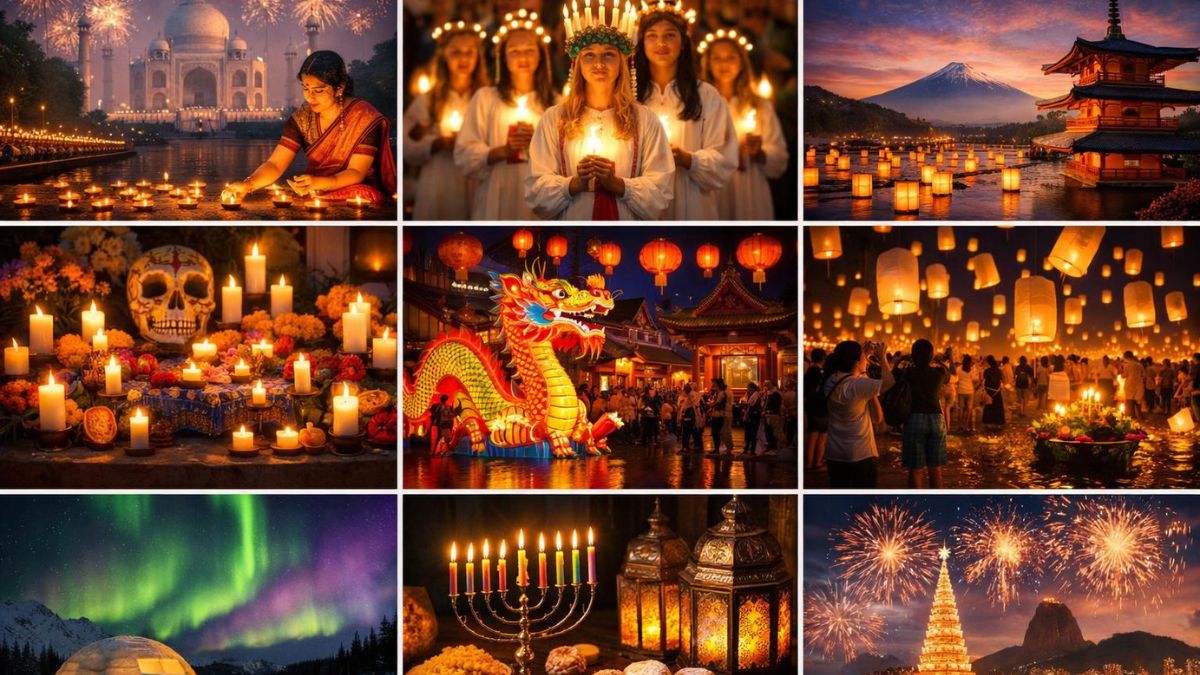
There is something undeniably primal about the onset of winter. As the axis of the Earth tilts us away from the sun, and the shadows stretch longer and leaner across the pavement, a very ancient, lizard-brain panic sets in. We are creatures of the day. We are phototropic; we bend toward the light like houseplants. When the light fades, we get nervous. We start to wonder if the sun is actually coming back or if it has finally decided to quit its job.
To combat this encroaching gloom, humanity has collectively decided—across continents, cultures, and millennia—to set things on fire.
Well, maybe not just set things on fire. We light candles, we float lanterns, we string LEDs, and yes, sometimes we swing giant balls of flame around our heads. The method varies, but the impulse is universal: we are raging against the dying of the light. We are carving out small spaces of illumination to tell the universe, “We are still here, and we are not afraid of the dark.”
Today, we are going on a global tour of these luminous rebellions. We aren’t just looking at the pretty lights; we are looking at why we light them. From the icy mornings of Sweden to the vibrant streets of Mumbai, the story of light is the story of human resilience.
St. Lucia’s Day: The Girl with the Crown of Candles
Let’s start in Scandinavia, where winter is not just a season; it is a lifestyle choice. In Sweden, Norway, and parts of Finland, the darkness in December is heavy. It presses against the windows. The sun is a lazy guest who shows up at 10:00 AM and leaves by 2:00 PM.
Enter Saint Lucia. On December 13th, one of the darkest days of the year, the Nordic countries celebrate a saint who, ironically, was a martyr from Syracuse, Italy. The tradition involves a procession led by a young girl wearing a white gown, a red sash, and—here is the kicker—a crown of real, burning candles on her head.
Now, in our modern, safety-obsessed world, placing open flames in the hair of a teenager seems like a violation of several fire codes. But that danger is part of the point. St. Lucia represents the bearer of light in the deepest darkness. She walks through the gloom, carrying the fire, unharmed. She brings saffron buns (lussekatter) and coffee, waking the household from its slumber.
The symbolism here is potent. It is about service and defiance. It is a reminder that warmth and sustenance don’t just appear; someone has to brave the dark to bring them. It is a celebration of life returning, even when the snow is three feet deep and the sun is a distant memory.
Diwali: The Victory of Knowledge Over Ignorance
Let’s swing the globe toward India. While often associated with October or November, the festival of Diwali is the quintessential “Festival of Lights.” It is celebrated by Hindus, Jains, Sikhs, and some Buddhists, making it a massive, cross-cultural phenomenon.
Diwali commemorates the return of Lord Rama to Ayodhya after defeating the demon king Ravana. To guide him home, the people lit diyas (oil lamps). But the metaphor goes much deeper than a GPS system made of clay pots. Diwali is about the victory of light over darkness, good over evil, and—most importantly—knowledge over ignorance.
In the West, we often treat light as a symbol of hope. In the East, specifically in this tradition, light is a symbol of awareness. Darkness represents ignorance—the inability to see the truth of reality. When you light a diya, you aren’t just decorating your porch; you are symbolically dispelling the fog of your own mind. You are asking for clarity.
The visual spectacle of Diwali is overwhelming in the best way. Entire cities glow. The air is thick with the smoke of firecrackers (which are meant to drive away evil spirits, though nowadays they mostly drive away air quality). It is a sensory explosion that demands you pay attention to the present moment. It is joy weaponized against despair.
Kwanzaa: The Light of Community Resilience
Now, let’s move to a tradition that is relatively young but deeply rooted. Kwanzaa is not a religious holiday; it is a cultural one. Created in 1966 by Dr. Maulana Karenga, it was designed to help African Americans reconnect with their African cultural and historical heritage following the Watts riots in Los Angeles.
Kwanzaa runs from December 26th to January 1st. Central to the celebration is the Kinara, a candle holder that fits seven candles (Mishumaa Saba): three red, one black, and three green. These colors represent the people, the struggle, and the future.
This is a different kind of light. It isn’t about chasing away winter demons or celebrating a deity. It is the light of identity. Each day of Kwanzaa is dedicated to a specific principle, the Nguzo Saba: Unity, Self-Determination, Collective Work and Responsibility, Cooperative Economics, Purpose, Creativity, and Faith.
When a family lights the Kinara, they are engaging in an act of community building. They are saying, “In a world that often tries to erase us or marginalize us, we will shine a light on who we are.” It is a deliberate, constructed tradition, which makes it fascinating. It proves that we don’t need ancient history to create sacred meaning; we can build new rituals that serve our current needs for solidarity and dignity.
Hogmanay: Purifying the Past with Fire
If Kwanzaa is about dignified reflection, Hogmanay is about visceral, chaotic purification. We are heading to Scotland. The Scots take New Year’s Eve (Hogmanay) very seriously—arguably more seriously than Christmas.
The roots of Hogmanay are Viking. The Norse invaders brought their celebration of the winter solstice, and the Scots kept the best parts—specifically, the fire. In Stonehaven, there is a ceremony where strong men and women swing heavy wire cages filled with burning combustibles around their heads. They march through the streets, creating literal halos of fire, before throwing the burning balls into the sea.
This isn’t just pyromania. It is purification. The fire burns away the “old year.” It destroys the bad luck, the grudges, and the stale energy of the past twelve months so that the New Year can enter clean.
There is something psychologically healthy about this. We often drag our baggage from one year to the next. The Scots suggest we should incinerate it. The fire is aggressive; it creates heat and noise. It forces the demons of the past year to flee. It is a way of saying, “You cannot follow me into January.”
Loi Krathong: Releasing the Heaviness
Finally, let’s look at a gentler form of release. In Thailand, the festival of Loi Krathong (and the associated northern festival of Yi Peng) usually takes place in November, under the full moon.
Loi Krathong involves releasing small, lotus-shaped baskets (krathongs) decorated with candles, incense, and flowers onto rivers. Yi Peng involves releasing thousands of paper lanterns into the sky.
If Hogmanay is a scream, Loi Krathong is a whisper. The act of placing the candle on the water is an act of letting go. You place your anger, your grief, and your mistakes into the basket and watch them drift away into the dark. The light doesn’t fight the darkness here; it navigates through it.
The visual of thousands of lanterns drifting into the night sky is one of the most breathtaking sights on Earth. It symbolizes the collective release of heaviness. It reminds us that we are not the only ones carrying burdens; everyone around us is launching their own lantern, trying to let go of something. It is a shared vulnerability that transforms into a galaxy of artificial stars.
The Common Filament
What ties the Swedish girl with the candle crown to the Scottish man swinging a fireball? What connects the quiet clay lamp in Mumbai to the Kinara in Chicago?
It is the refusal to surrender to the void.
The world is often a scary, dark, and indifferent place. Nature is brutal. History is cruel. But the human response to this reality is consistently, stubbornly luminous. We do not hide in the dark. We make our own suns. We gather together, we share food, and we push back the shadows.
Whether you are celebrating a religious miracle, a cultural identity, or just the fact that you survived another year, the act of lighting a light is a declaration of hope. It is the ultimate assertion of life. So, whatever tradition you find yourself in this season, strike the match. The world needs all the light it can get.
Focus on Language
Let’s take a closer look at the machinery of the language we just used. When we write about culture and atmosphere, we want to use words that aren’t just descriptive, but evocative—words that make you feel the temperature of the room or the mood of the crowd.
We started by calling humans phototropic. This is a biological term usually used for plants. A sunflower is phototropic because it turns its head toward the sun. By using it for humans, we are using a metaphor. We are saying that, instinctively, we crave the light. You can use this in daily life to describe someone who is always looking for the positive: “He’s emotionally phototropic; he always finds the silver lining.”
We talked about the encroaching gloom. To encroach means to intrude on a person’s territory or rights gradually. It implies a slow, steady, unwanted advance. Winter darkness doesn’t just happen; it encroaches. It creeps in. You might say, “Work is starting to encroach on my weekends,” meaning your job is slowly taking over your free time.
We described these traditions as luminous. This simply means full of or shedding light; bright or shining. But it sounds much more elegant than “bright.” A smile can be luminous. An idea can be luminous. It suggests a glow that comes from within.
We mentioned the visceral nature of Hogmanay. Visceral refers to deep inward feelings rather than to the intellect. It comes from “viscera,” which means your internal organs—your guts. A visceral reaction is a gut reaction. Watching someone swing a fireball is a visceral experience; you feel the heat and the danger in your body, not just your mind.
We talked about the quintessential Festival of Lights. Quintessential means representing the most perfect or typical example of a quality or class. Diwali is the quintessential light festival. A bagel is the quintessential New York food. Use this when you want to define the absolute standard of something.
We discussed the Diaspora. We talked about Kwanzaa and the African Diaspora. This word refers to the dispersion of any people from their original homeland. It creates a sense of a scattered community that is still connected by roots. You will hear about the Irish diaspora, the Jewish diaspora, the Indian diaspora. It’s a key word for understanding global culture.
We used the word resilience. This is the capacity to recover quickly from difficulties; toughness. We called the lights a story of human resilience. In a difficult year, your ability to bounce back is your resilience. “The team showed great resilience after losing the first half.”
We described Kwanzaa as a deliberate tradition. Deliberate means done consciously and intentionally. It wasn’t an accident; it was a choice. You can make a deliberate mistake (on purpose) or a deliberate effort to be nicer.
We talked about marginalizing people. To marginalize is to treat a person, group, or concept as insignificant or peripheral—pushing them to the margins (edges) of society. Kwanzaa fights against marginalization.
Finally, we used the word solidarity. This is unity or agreement of feeling or action, especially among individuals with a common interest. Lighting the candles is an act of solidarity. Standing with your coworkers during a strike is solidarity. It means “we are in this together.”
Now, let’s move to the speaking section.
The words we just learned are powerful, but only if you can deliver them with the right weight. Today, I want to talk about the speaking technique of Atmospheric Contrast.
When you are describing a memory or a holiday, don’t just list what happened. Contrast the feeling of the environment with the feeling of the action.
Look at how we described St. Lucia: “The darkness presses against the window… She brings saffron buns.”
Cold vs. Warmth. Dark vs. Light.
Here is your challenge:
I want you to think of a holiday tradition you have—it can be anything, even just watching a movie or eating pizza on Fridays. I want you to describe it using contrast. Describe the “negative” state before the tradition (boredom, cold, hunger, stress) and then the “positive” state during the tradition.
Don’t say: “We eat soup on Tuesdays.”
Say: “After a chaotic, stressful day at work where everyone is shouting… [pause]… the silence of chopping vegetables for the soup feels like a sanctuary.”
See the difference? You used the stress to make the soup sound better. Try to record yourself describing one tradition using this contrast technique. It will instantly make you sound more engaging and sophisticated.
Let’s Discuss
Here are five questions to spark some deep thinking. I want you to take these not just as questions to answer, but as starting points for a debate with yourself or others in the comments.
1. Is it better to preserve old traditions or create new ones?
We looked at Hogmanay (ancient) and Kwanzaa (modern). Some people argue that traditions only have value if they are old. Others argue that “old” traditions often carry outdated baggage and we should design rituals that fit our modern values. Does a tradition need to be 100 years old to be “real”?
2. Does the commercialization of light festivals destroy their meaning?
Diwali and Christmas have become massive shopping events. Does buying endless strings of electric lights and expensive gifts dilute the spiritual message of “victory of light over darkness”? Or does the economic boost actually help preserve the culture by funding it?
3. Is “fighting the darkness” a healthy metaphor?
We often talk about “driving away” the dark. But ecologically and psychologically, darkness is necessary for rest and balance. By constantly trying to illuminate everything, are we avoiding necessary periods of rest and reflection? Should we embrace the dark instead of fighting it?
4. Can you celebrate a tradition that isn’t yours?
This touches on cultural appreciation vs. appropriation. Can a non-Hindu light a diya for Diwali? Can a non-Swede celebrate St. Lucia? Where is the line between sharing in the universal human experience of light and commodifying someone else’s sacred history?
5. Why is fire such a universal symbol for humans?
Almost every culture uses fire in rituals. Is it just because it provides heat? Or is there something evolutionary about the safety of the campfire that is hardwired into our DNA? With modern electric lights, are we losing the “danger” and “life” that real fire provides in these rituals?
Critical Analysis
Let’s take a step back and look at this article with a skeptical eye. I’ve painted a very romantic picture of these global traditions—humanity holding hands and lighting candles against the void. It’s a nice image. But is it the whole truth?
First, we need to address the environmental elephant in the room. We talked about the beauty of thousands of lanterns released in Thailand for Yi Peng. It looks magical. But where do those lanterns go? They land in rivers, they choke wildlife, they start forest fires. The “beauty” of these light festivals often leaves a massive footprint of trash and pollution. Diwali firecrackers cause severe smog crises in India every year. We are celebrating “life” while simultaneously choking the planet. It’s a contradiction we didn’t spend enough time on.
Secondly, the article focuses on the “Universal” nature of these festivals—the idea that “we are all the same.” While comforting, this can sometimes erase the very specific, often painful histories behind them. Kwanzaa was born out of racial trauma and the struggle for civil rights, not just a generic desire for candles. Hanukkah (which we didn’t detail but fits the theme) celebrates a violent resistance against assimilation. By smoothing them all out into a “festival of light,” do we risk ignoring the specific political and historical struggles that created them?
Also, there is a privilege in “fighting the darkness.” For many people in war zones or poverty, “lights” aren’t a celebration; they are a target, or a luxury they can’t afford. The article assumes a reader who has the safety and resources to sit back and philosophize about light, rather than someone who is genuinely living in a power outage.
Finally, we romanticized the “danger” of the St. Lucia candles or the Scottish fireballs. In reality, traditions change because safety matters. Romanticizing the “old, dangerous ways” can be a form of nostalgia that ignores why we evolved past them. We don’t need to set our hair on fire to prove we are resilient.
So, while the message of hope is valid, we should be careful not to let the brightness of the lights blind us to the complexities—environmental, political, and social—that simmer underneath these celebrations.







0 Comments