Listening & Reading Tips
Before we jump into the fray, let’s sharpen your skills. Whether you are reading this text or listening to the audio version, keep these strategies in mind to maximize your comprehension and retention, specifically for this type of mythological narrative.
1. Visualize the Imagery (Visualization):
Mythology relies heavily on sensory details. When the text describes “shining armor” or “blood-soaked fields,” pause for a micro-second and create a mental movie. This aids memory retention.
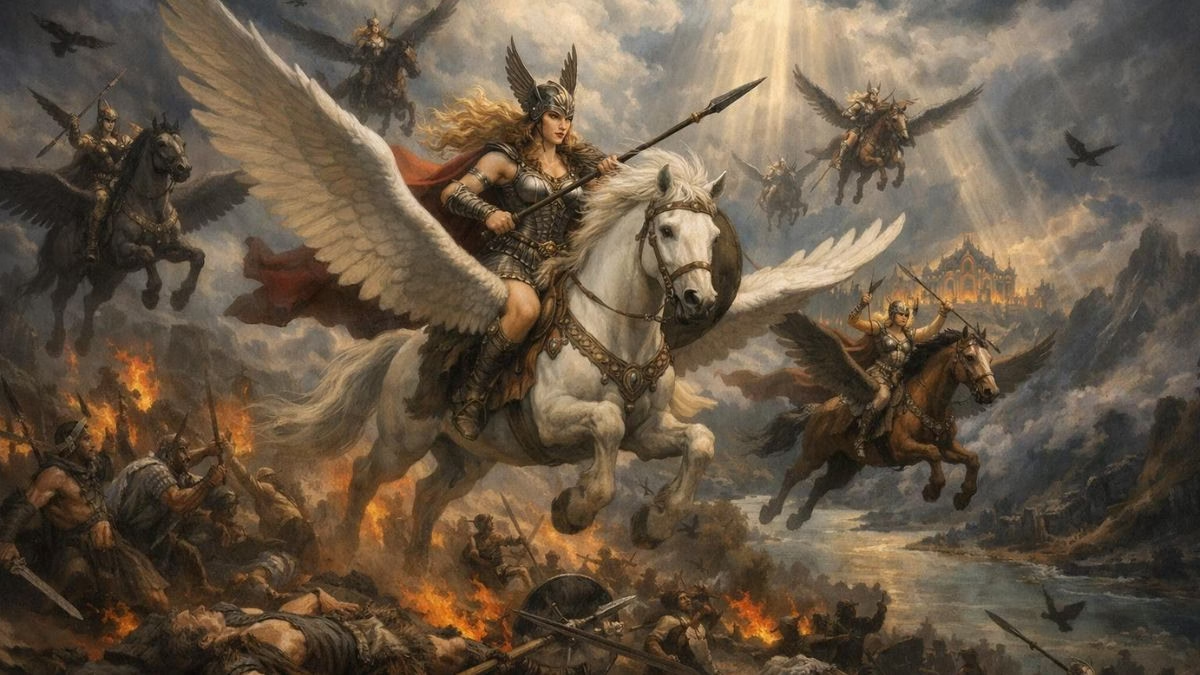
- Practice: When we describe the arrival of the Valkyries, try to picture the contrast between the grime of battle and the supernatural light of the figures.
2. Identify the Author’s Tone (Tone Analysis):
This piece mixes educational content with a conversational, slightly humorous tone. Distinguishing between the factual mythological details and the narrator’s commentary is crucial for standard tests like the TOEFL or SAT.
- Practice: Look for moments where the narrator breaks the “fourth wall” or uses modern slang to explain ancient concepts.
3. Contextual Vocabulary (Inference):
You will encounter high-level vocabulary (e.g., martial, inevitable, stoicism, sovereignty). Do not stop if you don’t know a word.
- Practice: Use the surrounding sentences to guess the meaning. If we talk about “martial prowess” in the context of a sword fight, you can infer it relates to war or fighting skills.
4. Tracking Cause and Effect (Logic):
Myths often have a distinct internal logic.
- Practice: As you read, ask yourself why the Valkyries choose the dead. It isn’t random; it is for a specific future event (Ragnarok). Connecting these dots creates a stronger understanding of the main idea.
The Valkyries and the Art of Choosing the Slain
Audio Article
Have you ever found yourself standing at a crossroads, paralyzed by the sheer weight of a decision, wishing that someone—or something—else would just swoop down and make the choice for you? It is a universally human feeling, that desire to surrender control to fate. Now, imagine that the decision isn’t about what to have for dinner or which college to attend, but rather whether you live or die in the next five minutes of a sword fight. In the grim and frosty world of Norse mythology, that heavy responsibility fell to a group of terrifyingly impressive figures known as the Valkyries, a name that literally translates to “Choosers of the Slain.” And believe me, you wanted them on your side—or perhaps, depending on your retirement plans, you didn’t.
We often picture these figures through the lens of pop culture or Richard Wagner’s intense operas: buxom women in horned helmets bellowing high notes while riding flying horses. While that image certainly has a flair for the dramatic, the reality of the Norse myth is far grittier, more complex, and frankly, a lot more interesting. To understand the Valkyries, we have to strip away the Hollywood gloss and step onto the muddy, chaotic battlefields of the Viking Age. The Vikings were a martial society; war wasn’t just a hobby or a way to acquire new land—it was the highest form of existence. In a world where life was brutal and often short, the manner of one’s death defined one’s worth. But here is the kicker: dying bravely wasn’t enough to guarantee a VIP pass to the afterlife. You needed an invite.
Enter the Valkyries. These weren’t just celestial taxi drivers ferrying souls to the other side; they were the ultimate spectral headhunters. Serving the All-Father, Odin, their job was to hover over the din of battle, observing the chaos with a critical eye. They were looking for the best, the bravest, and the most skilled warriors to draft into Odin’s personal army, the Einherjar. Why did Odin need an army of dead guys? Well, because in Norse mythology, the gods weren’t immortal or all-powerful. They knew that one day, the world would end in a cataclysmic event called Ragnarok. Odin was essentially a doomsday prepper on a cosmic scale, hoarding the souls of elite fighters to stand with him against the giants and monsters at the end of time.
This context changes how we view these warrior maidens. They represent a terrifying mixture of beauty and slaughter. In some older poems, they aren’t even described as human-looking women but as ravenous spirits associated with ravens and wolves, the beasts of carrion. Over time, the poets softened them into the noble, shield-bearing women riding through the air that we recognize today. But the core concept remains chilling: they are the manifestation of fate. In the heat of battle, a Viking warrior might believe that his survival depended on his skill with an axe, but deep down, the culture taught him that his thread was already measured. If a Valkyrie looked his way and decided he was “too good to live,” no amount of dodging would save him. Paradoxically, being chosen to die was the highest honor. It meant you made the cut.
Let’s zoom in on one of the most famous of these figures to see how this played out in the stories: Brynhildr. Her story is a tangled web of romance, betrayal, and magic fire that puts modern soap operas to shame. Brynhildr wasn’t just a spectral observer; she was an active participant who dared to defy Odin. In one legend, she struck down a king to whom Odin had promised victory. That is a major workplace infraction in the pantheon of Asgard. As punishment, Odin didn’t fire her; he condemned her to a mortal life and trapped her in a sleep surrounded by a ring of fire, stipulating that only a man who knew no fear could rescue her. This leads to the saga of Sigurd the dragon slayer, a tale that explores the vulnerability of these demigoddesses.
The tragedy of Brynhildr highlights a fascinating aspect of the Valkyrie myth: they occupy a liminal space between the divine and the human. They have power—immense power—yet they are bound by the will of Odin and the threads of fate woven by the Norns. They are powerful women in a patriarchal mythos, yet their primary function is to serve a male god and select male warriors. However, don’t let that fool you into thinking they were subservient. The imagery of the Valkyrie is one of the few places in Norse lore where feminine power is overtly armed and dangerous. They are not mothers or wives in the traditional sense; they are agents of death and destiny.
There is also a misconception that all the dead warriors went to Valhalla. We tend to forget the other half of the equation. The Valkyries actually split the draft picks. Half went to Odin in Valhalla, but the other half went to Fólkvangr, the field of the goddess Freya. It’s an interesting detail that suggests a balance of power, even in the afterlife. But regardless of their destination, the agency lay with the Choosers. This removed the fear of death for the Vikings. If death is not an accident, but a selection, it infuses the end of life with meaning. It turns a tragedy into a promotion.
So, what can we take away from these spear-shaking spirits today? Aside from a cool aesthetic for video games and movies, the myth of the Valkyries asks us to confront our relationship with control. We live in an era where we obsess over optimizing every aspect of our lives, believing we can engineer our own destiny if we just work hard enough or buy the right app. The Vikings, through the Valkyries, embraced a kind of rugged stoicism. They accepted that some things are simply out of their hands. They did their best, fought their hardest, and let the Choosers decide the rest. There is a strange comfort in that—in realizing that you control your actions, but you cannot always control the outcome.
Moreover, the Valkyries serve as a reminder of the power of storytelling to transform trauma. War is ugly. It smells like iron and fear. But by inventing the Valkyries, the Norse people painted over that ugliness with a layer of gold and glory. They turned the random brutality of a battlefield into a stage for divine judgment. It forces us to ask: what stories do we tell ourselves to make sense of the chaos in our own lives? Do we view our struggles as random bad luck, or do we, like the Vikings, try to frame them as trials preparing us for something greater?
As we leave the halls of Valhalla and return to the safety of the modern world, keep the image of the Valkyrie in mind. Not just as a lady in a helmet, but as a symbol of the inevitable, the intersection of terror and beauty, and the ultimate test of worthiness. It makes you wonder, doesn’t it? If the Choosers of the Slain were hovering over you right now, judging your battles, your struggles, and how you handle the daily grind, would you make the cut for the final army? I’d love to hear your thoughts on that—drop a comment below and let me know if you think you’re Valhalla material, or if you’d prefer a quieter afterlife!





0 Comments