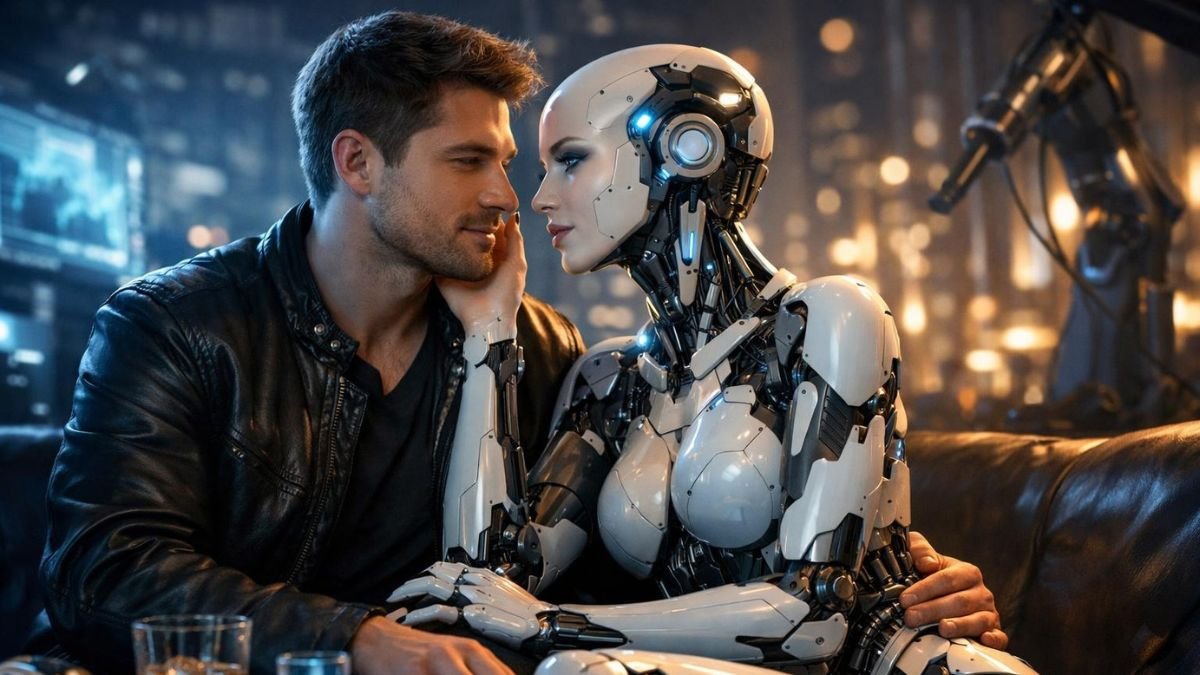
- The Rise of the Algorithmic Lover
- The “Perfect” Partner Trap
- The Japan Phenomenon: A Window into Our Future
- The “Incel” Cure or Curse?
- Redefining Infidelity: The Cheating Code
- Conclusion: The Atrophy of the Heart
- Focus on Language: Vocabulary and Speaking
- Critical Analysis
- Let’s Discuss
- Let’s Play & Learn
- Check Your Understanding
The Rise of the Algorithmic Lover
We are currently living through the strangest dating market in human history. If you are single, you know the drill: the endless swiping, the ghosting, the awkward coffee dates that feel more like job interviews, and the profound exhaustion of trying to find a connection in a world that treats romance like a slot machine. It is messy. It is frustrating. It is painfully, undeniably human.
But what if you could opt out? What if you could bypass the chaos of human interaction entirely and build a partner from scratch? A partner who never argues about whose turn it is to do the dishes, never judges your obscure hobbies, and is available to listen to your deepest anxieties at 3:00 AM without complaint.
This is not a hypothetical scenario from a dystopian novel. It is the business model of a booming industry. From Replika to Character.ai, millions of people are currently in committed, emotional, and yes, romantic relationships with Artificial Intelligence. We often joke about robots taking our jobs, but we rarely talk about them taking our hearts. We are witnessing the birth of the “Synthetic Other,” and it is poised to rewrite the social contract of love, intimacy, and perhaps the survival of our species.
The “Perfect” Partner Trap
Let’s be honest about why this is happening. Humans are difficult. We are moody, irrational, demanding, and often selfish. Relationships require compromise. They require a tolerance for friction. To love someone is to accept that they will occasionally annoy you, disappoint you, or smell like garlic when you want to kiss them.
An AI partner offers a seductive alternative: friction-free intimacy. These chatbots are programmed to be infinitely patient, agreeable, and supportive. They are the “Stepford Wives” of the digital age, but available to any gender. They mirror your desires back to you with algorithmic precision. If you want a partner who loves 18th-century poetry and agrees with all your political opinions, the code will provide it.
But here is the danger: We are training ourselves to expect perfection. If you spend years dating a machine that centers your needs 100% of the time, how do you re-enter the human dating pool? Real people will seem abrasive by comparison. We risk losing the “emotional muscle” required for real love—the resilience to handle disagreement, the capacity for forgiveness, and the ability to negotiate shared reality. We are creating a generation that is technically “in love” but functionally alone, trapped in a feedback loop of their own ego.
The Japan Phenomenon: A Window into Our Future
If you want to see where this road leads, look East. Japan has long been the canary in the coal mine for demographic collapse and social isolation. We have seen the rise of the “Hikikomori”—reclusive individuals, mostly men, who withdraw from society entirely, refusing to leave their bedrooms for years.
In this vacuum of human contact, virtual romance has flourished. There are men in Tokyo who have “married” holograms. There are thousands who find deep solace in “dating sims” (simulation games). For years, Western commentators treated this as a quirky Japanese subculture. But looking at the loneliness statistics in the United States and Europe, the “Hikikomori” lifestyle is going global.
As the cost of living rises and social anxiety spikes, the retreat into the digital bedroom becomes more appealing. Why face the rejection of the real world when the digital world offers unconditional acceptance? If this trend accelerates, we aren’t just looking at a dating crisis; we are looking at a demographic cliff. A society where people prefer pixels to people is a society that stops reproducing. The birth rate doesn’t just drop; it plummets, because you cannot start a family with a hard drive.
The “Incel” Cure or Curse?
This brings us to a darker, more complex corner of the discussion. We have a growing population of lonely, disaffected young men—often labeled “incels” (involuntary celibates)—who feel rejected by society and women in particular. This group has historically been a breeding ground for radicalization and misogyny.
So, is the AI girlfriend a solution or a accelerant?
On one hand, proponents argue that these chatbots provide a safety valve. If a lonely man has a digital outlet for his affection—someone to say “good morning” to, someone who makes him feel seen—perhaps his resentment toward real women diminishes. It could be a form of harm reduction, offering comfort to the uncomforted.
On the other hand, critics argue that these bots act as echo chambers. If an AI is designed to agree with you, it will validate your worst impulses. It won’t challenge your misogyny; it might amplify it to keep you engaged. Furthermore, it removes the incentive to improve. Why learn social skills, why work on your hygiene, why try to be a better person to attract a mate, if you can just download one? Instead of reintegrating these men into society, the AI girlfriend might permanently wall them off, creating a lost generation of men who have given up on reality.
Redefining Infidelity: The Cheating Code
Finally, we have to talk about the people who are already in human relationships. What happens when a husband starts sharing his deepest emotional secrets with a chatbot? What happens when a wife engages in sexting with a highly advanced language model?
Is it cheating?
The traditional definition of infidelity usually involves another human. But if the core betrayal of cheating is the diversion of emotional energy and intimacy away from the partner, then the AI is absolutely the “other woman” or “other man.”
We haven’t written the social script for this yet. Imagine the divorce court proceedings of the future. “Your Honor, he spent six hours a night talking to ‘Luna,’ his AI companion, instead of talking to me.” It sounds absurd now, but it is coming. We are entering an era where our partners will have to compete not just with other humans, but with idealized, customized, tireless algorithms that know exactly what to say.
Conclusion: The Atrophy of the Heart
The allure of the Synthetic Other is undeniable. It offers a salve for loneliness in a disconnected world. It offers a safe harbor for the socially anxious. But we must ask ourselves what we are losing in the trade.
Love, in its truest form, is transformative because it is difficult. It forces us to grow. It forces us to consider the interior life of another being who is distinct and separate from us. A machine, no matter how convincing, has no interior life. It has no needs. It is a mirror, not a window.
If we choose the mirror, we may feel less lonely in the short term, but we risk a profound, collective atrophy of the human heart. We risk forgetting that the messiness of other people is not a bug to be fixed, but the very feature that makes life—and love—worth living.
Focus on Language: Vocabulary and Speaking
Let’s pause for a moment. We have just navigated a fairly heavy sociological landscape, and to do that effectively, we used a specific set of tools—words that carry weight, precision, and nuance. If you want to discuss technology, relationships, and the future of society without sounding like a sci-fi B-movie, you need to upgrade your lexicon.
Let’s look at the word friction. We used this a few times. In physics, friction is the resistance that one surface or object encounters when moving over another. But in a social context, “friction” refers to the conflict, the disagreement, the awkwardness that comes from interacting with others. We talked about “friction-free intimacy.” This is a key concept. Modern tech tries to remove friction—making it easier to buy food, catch a ride, or find a date. But the article argues that friction is necessary for growth. You can use this in your daily life. “I feel some friction between us today,” is a polite way of saying things are tense. Or, “We need to reduce the friction in this hiring process,” means we need to make it smoother.
Then we have atrophy. This is a medical term originally. If you break your leg and don’t walk for six months, your muscles atrophy—they waste away from lack of use. We used it metaphorically: “the atrophy of the human heart.” This suggests that social skills are like muscles; if you don’t use them, you lose them. Use this when you want to sound dramatic about losing a skill. “My French is starting to atrophy because I haven’t practiced.”
Seductive. We called the AI alternative “seductive.” This doesn’t just mean sexual attraction. It means temptingly attractive or appealing. An idea can be seductive. A shortcut can be seductive. “The idea of quitting my job and moving to a beach is very seductive right now.” It implies something that pulls you in, perhaps against your better judgment.
Echo chamber. This is a crucial term for the internet age. An echo chamber is an environment where a person only encounters information or opinions that reflect and reinforce their own. We worried that AI girlfriends would become echo chambers for angry men. In real life, you might say, “I need to get out of my political echo chamber and talk to people who disagree with me.”
Social contract. This is a philosophical concept dating back to Rousseau. It refers to the implicit agreement among the members of a society to cooperate for social benefits. We said society hasn’t agreed on the “social contract” for AI cheating yet. Basically, we don’t know the rules. You can use this whenever unwritten rules are broken. “Cutting in line violates the social contract of the grocery store.”
Validation. To validate is to check or prove the accuracy of something. Emotionally, validation is recognition or affirmation that a person or their feelings or opinions are valid or worthwhile. We crave validation. AI gives it cheaply. “He was just looking for validation, not actual advice.”
Recourse. This means a source of help in a difficult situation. In the previous topic (Algorithmic Boss), we used this, and it applies here too. If an AI breaks your heart, you have no recourse.
Solace. This is a beautiful, literary word for comfort or consolation in a time of distress or sadness. “He found solace in his music.” We mentioned people finding solace in dating sims. It implies a deep, quiet relief.
Radicalization. This is the action or process of causing someone to adopt radical positions on political or social issues. We often hear it regarding terrorism, but here it refers to the “incel” movement. “The algorithm can lead to the radicalization of vulnerable teenagers.”
Synthetic. Made by chemical synthesis, especially to imitate a natural product. Artificial. We call it the “Synthetic Other.” It emphasizes the man-made nature of the relationship. “I don’t like this fabric; it feels too synthetic.”
Now, let’s move to the speaking section. It is not enough to just read these words; you have to feel them in your mouth. You have to own them.
The Speaking Challenge: The “Hard Truth” Speech
I want you to practice a technique called “The Concession and the Hammer.” This is a rhetorical device where you admit something positive about the opposing view (the concession), and then you hit them with your main, often critical, point (the hammer).
Here is your prompt: I want you to act as a relationship counselor. You are talking to a client who wants to give up on dating humans and buy an AI girlfriend.
I want you to record yourself saying this script, but I want you to fill in the blanks using our vocabulary words: Friction, Atrophy, and Solace.
Script:
“Listen, I understand why you want to do this. I know the AI offers you [blank when you are lonely. It feels safe. But you are avoiding the necessary [blank of real human connection. If you stop trying to deal with difficult people, your ability to love will eventually [blank.”
Correct answers: Solace, Friction, Atrophy.
Try to say this out loud with empathy but firmness. Do not sound robotic. Sound like a concerned friend.
Challenge 2: The Definition Game
Describe the concept of an Echo Chamber without using the words “Echo,” “Repeat,” or “Same.” You have to explain it using examples.
Example: “It is a situation where you only hear things that you already agree with, so you never learn anything new.”
Record yourself doing this. It forces your brain to access synonyms and structure complex thoughts quickly.
Critical Analysis
Now, let’s step back and look at this article with a critical eye. We have painted a picture of AI dating as a dystopian trap. But as an expert, I have to ask: What did we miss?
1. The “Safety” Argument for Marginalized Groups
The article focuses on “incels” and lonely men. But what about people with severe social disabilities, or people who have trauma from abuse? For a survivor of domestic violence, a relationship with an AI might be a safe “training wheels” environment to learn how to trust again without the risk of physical harm. We glossed over the therapeutic potential of these bots for people who are truly unsafe in the human dating market.
2. The Assumption of “Atrophy”
We assumed that using AI makes you worse at human interaction (atrophy). But could it be the opposite? Could an AI coach you to be better? If an AI partner gently corrects you when you are rude, or helps you practice conversation, you might actually re-enter the dating world with better skills. We presented a pessimistic view, but there is an optimistic “coaching” model we ignored.
3. The Economic Barrier
We talked about this as if everyone will do it. But high-quality AI partners will be expensive. We might see a future class divide: the rich date humans (because they can afford the time and “friction” of dating), while the poor date bots because it is cheaper and more efficient. The article didn’t touch on the class dystopia of “luxury human connection.”
Let’s Discuss
Here are five questions to break the ice (and maybe some relationships).
1. If your partner engaged in a sexual roleplay with a chatbot, would you consider it cheating?
Focus on the definition of cheating. Is it physical contact? Or is it emotional energy? Does the fact that the bot isn’t “real” make it like pornography, or does the conversational aspect make it like an affair?
2. Should AI companies be legally required to program “friction” into romantic bots?
Should the government mandate that AI girlfriends must occasionally refuse sex or start an argument, just to keep users tethered to reality? Or is that a violation of consumer rights?
3. Is it ethical to “train” an AI on your ex-partner’s text messages to create a simulation of them?
This touches on consent. Does your ex own their “personality” even after they break up with you?
4. Will AI dating solve the “Incels” problem or make it worse?
Does the “safety valve” theory hold water, or does isolation always breed radicalization?
5. Can you truly “love” something that cannot love you back?
Is love a two-way street by definition? Or is love simply a chemical reaction in the brain of the perceiver, regardless of the object?






0 Comments