Hello, friends, and welcome back to a brand new episode of English Plus. I’m your host, Danny, and I am so incredibly happy you decided to stop by today.
Let me start with a question. A dangerous question, maybe. If I gave you a button—a big, red, glowing button—that could permanently delete your most embarrassing memory, would you press it?
You know the one I’m talking about. Maybe it’s that time you waved at someone who wasn’t actually waving at you. Maybe it’s the time you confidently said, “You too!” after the waiter told you to enjoy your meal. Or maybe… maybe it’s something heavier. A heartbreak that keeps you up at night. A failure that makes you afraid to try again.
If you could trade that pain—just hand it over across a counter—and in exchange, you instantly became a virtuoso pianist, or a charismatic public speaker, or a fearless CEO… would you make the deal?
That is the question at the heart of our story today.
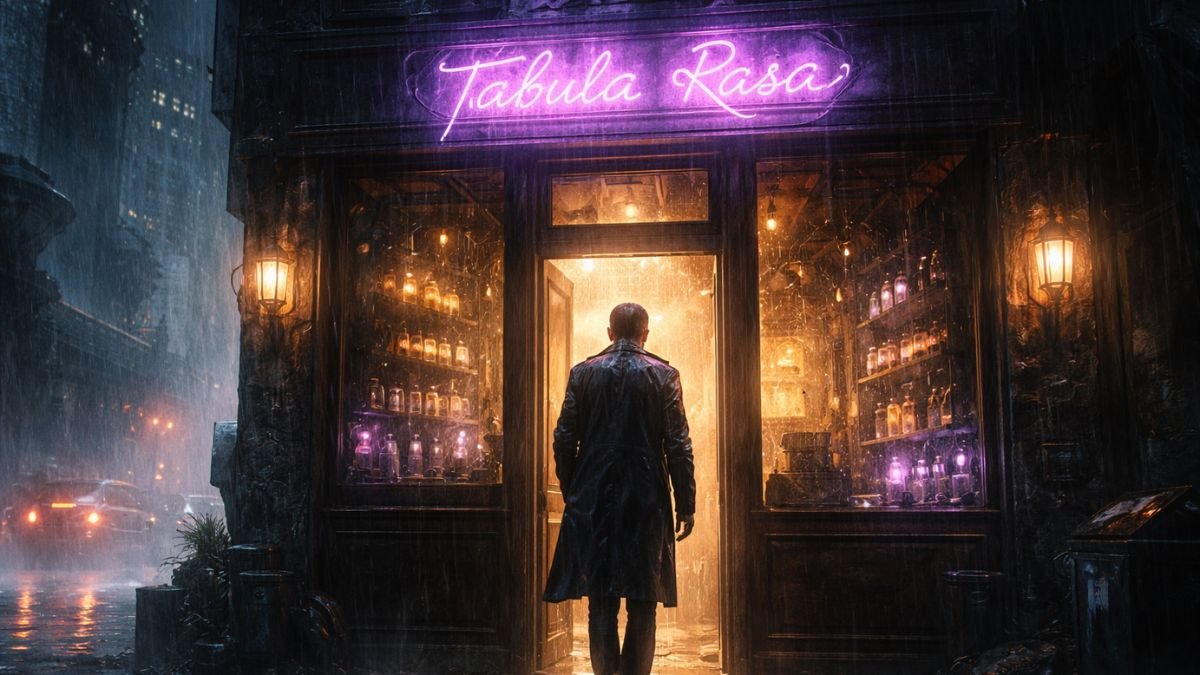
This is a special episode. We are doing things a little differently. In the first half, I’m going to take you to a rain-slicked, neon-lit city to visit a little shop called Tabula Rasa in my new short story, “The Memory Pawnshop.” It’s a tale about the high price of perfection and the strange value of our scars.
But do not go anywhere when the story ends. Because right after the fiction, we are opening the doors to “The Crucible.” That’s our new segment where we melt the story down. I’ll be sharing my own author confessionals, we’ll hear secret diaries from the characters themselves, we’ll geek out over the vocabulary and themes, and I’ll even answer some of your burning questions.
So, wherever you are—whether you’re commuting, drinking your morning coffee, or winding down for the night—get comfortable. Turn down the lights. Let’s step out of the real world and into the rain.
Here is “The Memory Pawnshop.”
The Memory Pawnshop | A Short Story by Danny Ballan
The neon sign for Tabula Rasa flickered with a rhythmic, dying buzz—a harsh violet heartbeat against the bruised darkness of the rain-swept city. It was the kind of rain that didn’t wash things clean; it just made the grime slicker, coating the gargoyles of the Gothic skyscrapers and the chrome of the hovering transports in the same oily sheen.
Matt stood under the awning, his trench coat soaked through the shoulders. He checked his reflection in the darkened window. He saw a man of thirty-four who looked fifty. Shoulders hunched, eyes darting, the permanent etch of a wince around his mouth. He was carrying the weight of the morning’s meeting—the stuttering presentation, the silence in the boardroom, the pitying look from the senior partner. It was just the latest stone on a cairn of failures that had been building since childhood.
He pushed the door open. A bell jingled, not distinct and clear, but dull, like a coin dropped into mud.
The interior smelled of ozone, old paper, and something metallic—like the taste of a battery on the tongue. Shelves lined every wall, stretching up into shadows that defied the physics of the low ceiling. They were cluttered not with goods, but with glass vials, each glowing with a faint, swirling luminescence.
“We’re closing, Matt.”
The voice came from behind a heavy mahogany counter that looked like it had been salvaged from a drowned galleon. Jeremy sat there. The proprietor was ageless in the way a statue is ageless; he had wrinkled skin that looked like parchment, but his eyes were bright, hard chips of obsidian. He was polishing a pair of brass spectacles with a rag that looked suspiciously like a memories-fogged handkerchief.
“I have money this time,” Matt said, his voice cracking. He hated that crack. He hated his voice.
Jeremy didn’t look up. “We don’t take credits here. You know the currency.”
“I have… inventory,” Matt corrected himself. He approached the counter, his hands trembling. “I want to get rid of today. The presentation. The humiliation.”
Jeremy finally looked up. He sighed, a sound that carried the weariness of tectonic plates shifting. “Just the presentation? Or the feeling of inadequacy that caused it?”
“All of it,” Matt snapped. “And in return… I want the voice. The charisma. I want to be able to speak and have them listen.”
Jeremy stood up, his joints popping like dry twigs. He reached under the counter and produced a heavy, crystalline decanter and a small, terrifyingly sharp silver siphon.
“The trade is valid,” Jeremy said softly. “But you understand the depreciation, Matt. You trade the memory, you lose the lesson. You trade the pain, you lose the callus.”
“I don’t need calluses,” Matt whispered, thinking of the boardroom silence. “I need to be perfect.”
Jeremy nodded slowly. He placed the siphon against Matt’s temple. It was cold, colder than the rain outside. “Close your eyes. Think of the shame. Hold it tight. Now… let go.”
A sensation of rushing water filled Matt’s ears. A sudden, violent vertigo, as if he were falling backward off a cliff. Then, a pop.
Matt opened his eyes. The headache was gone. The tremors in his hands had ceased. He looked at Jeremy, confused. “Did it work?”
“How was your meeting this morning?” Jeremy asked.
Matt frowned. He remembered he had a meeting. He remembered the topic. But the crushing weight of the silence? The shame? It was gone. It felt like reading a biography about someone else. He shrugged. “It was fine. A stepping stone.”
“And the payment?” Jeremy pushed a small vial across the counter. It glowed with a golden, confident light. “Drink.”
Matt uncorked it and swallowed. It tasted like champagne and adrenaline.
Immediately, his posture straightened. He felt a fire in his chest. He looked at his reflection in the glass of a cabinet. He didn’t look fifty anymore. He looked hungry.
“Thank you,” Matt said, his voice deep, resonant, smooth as velvet.
“Don’t thank me,” Jeremy said, turning back to his polishing. “Just try not to come back too soon. The shelves are getting full.”
***
It took three months for Matt to become the youngest Vice President in the history of Sterling-Halloway.
The first trade had been the gateway. The “Charisma” trade had worked so well that the minor inconveniences of life became intolerable. Why suffer the memory of a rejection from a woman at a bar when he could trade it for “Wit”? Why remember the tedious hours of failing to learn the piano when he could trade the memory of his frustration for “Dexterity”?
He became a frequent patron of Tabula Rasa.
He traded the memory of his mother’s funeral—the crushing, debilitating grief that had haunted him for years—for “Unwavering Focus.”
He traded the memory of a childhood bullying incident for “Physical Grace.”
He traded the guilt of a lie told to a friend for “Persuasion.”
He was sculpting himself, chipping away the marble of his flaws to reveal the god underneath.
Six months in, Matt stood on the balcony of his penthouse. The neon rain of the city fell below him now. He held a glass of scotch he didn’t drink—he had traded the memory of enjoying intoxication for “Mental Clarity”—and watched the hover-cars stream like red and white blood cells through the arteries of the city.
“You’re doing it again,” a voice said.
Elena stood in the doorway. She was a painter, messy and vibrant, with paint permanently stained under her fingernails. She was the only thing from his “old life” he had kept, mostly because he hadn’t found a trait worth trading her for yet.
“Doing what?” Matt asked, not turning. His voice was perfect, modulated to a soothing baritone.
“Posing,” she said. She walked out into the rain, unbothered by the wetness ruining her silk dress. “You look like a render, Matt. You’re too smooth. You don’t twitch. You don’t blink enough.”
“I am optimizing,” Matt said. “I have eliminated the inefficiencies of anxiety.”
“You’ve eliminated you,” Elena snapped. She grabbed his arm. Her hands were warm, but Matt felt the touch only as a tactile pressure, devoid of the emotional resonance it used to carry. “My gallery opening is tonight. Are you coming?”
“Of course,” Matt said. “I will be the perfect partner.”
“I don’t want a perfect partner,” she whispered, searching his eyes. “I want the guy who cried when we found that stray cat. I want the guy who gets nervous meeting my dad.”
“That guy was weak,” Matt stated flatly.
Elena pulled back as if burned. “No. That guy was real.”
At the gallery, Matt was a sensation. He charmed the critics, laughed at the right moments, and critiqued the art with vocabulary he had bought with the memory of a broken leg.
He stood before Elena’s masterpiece—a chaotic, violent swirl of reds and grays titled The Ache. It was raw. It was painful.
“It’s technically competent,” Matt said to the head critic, loud enough for Elena to hear. “But the composition lacks balance. It’s too emotional. It screams when it should whisper.”
The critic nodded, mesmerized by Matt’s authority.
Elena walked up to him. Her eyes were red. “You don’t feel it, do you?”
“Feel what?”
“The pain in it. I painted this when my father died. You were there, Matt. You held me.”
Matt searched his mind. He found the data file: Elena’s father died. Date: November 14th. But the file was corrupted. The shared grief, the empathy, the night he held her while she shook? Gone. He had traded that night for “Strategic Detachment” to close a merger.
“I recall the event,” Matt said calmly. “But grief is a non-productive emotion, Elena. You should really consider… processing it.”
Elena looked at him with a horror that transcended anger. “You’re hollow,” she whispered. “You’re just a golden shell.”
She left him there, amidst the champagne and the praise. Matt felt a momentary flicker of confusion—a logic error—but he quickly suppressed it. He was successful. He was admired. He was perfect.
***
The crisis arrived on a Tuesday, carried on the back of a rounding error.
It was a minor regulatory shift in the Asian markets. Unpredictable. Unavoidable. But it caused a ripple effect that tanked the stock of Matt’s company by forty percent in three hours.
Matt sat in his office, the walls of which were transparent aluminum, looking out at the city. His datapad screamed with notifications. Calls from the board. Calls from investors.
He needed to act. He needed to pivot. He needed to rally the troops, admit the setback, and forge a new path.
He reached for his resilience.
He reached for that grit one develops after failing a math test in fourth grade and studying harder. He reached for the callus formed when a high school crush rejects you and you survive. He reached for the muscle memory of hitting rock bottom and climbing back up.
He grabbed at air.
There was nothing there.
He had traded every failure. He had bartered away every moment of recovery for a moment of instant success. He had no reference point for “bad things happening.” To his optimized mind, success was the default state. Deviation from the default was not a challenge; it was a system crash.
Panic, cold and absolute, poured into the vacuum where his resilience used to be.
His heart began to hammer—a chaotic rhythm he couldn’t control with “Physical Grace.” His breath came in short, jagged gasps that “Eloquence” couldn’t smooth.
I don’t know what to do.
The thought was alien. It was a virus.
He stood up, knocking over his expensive chair. He stumbled. He actually stumbled. He looked at his hands. They were perfect, manicured, steady—but he felt like they were dissolving.
The phone rang. It was the Chairman.
Matt stared at the blinking light. He couldn’t answer. If he answered, he might have to apologize. He might have to admit he was wrong. And he literally, physically, did not possess the capacity to process the concept of being wrong.
He ran.
***
The rain was heavier now, a torrential downpour that turned the neon streets into rivers of liquid light. Matt ran until his lungs burned, his expensive Italian loafers splashing through puddles of oil and grime.
He didn’t know where he was going until he saw the sign.
Tabula Rasa.
The violet light buzzed, struggling against the storm.
Matt burst through the door, the bell giving a wet, dull clunk.
Jeremy was there, exactly as he had been a year ago. Or ten years ago. He was reading a book with blank pages.
“I need help,” Matt gasped, collapsing against the counter. He was soaked, his hair plastered to his skull. The veneer of the perfect CEO was washing away, revealing something terrified and infantile underneath.
“We don’t sell help, Matt,” Jeremy said, turning a page. “We sell trade.”
“I… I can’t handle it,” Matt stammered. “The company. The crash. I don’t know how to fix it. I need… I need ‘Ingenuity.’ I need ‘Crisis Management.’ Take something! Take my memory of Elena! Take my childhood home! Anything!”
Jeremy closed the book. The sound was like a coffin lid slamming.
“You have nothing left to trade, Matt.”
Matt froze. “What?”
“You’ve traded your regrets. Your fears. Your griefs. Your embarrassments,” Jeremy gestured to the shelves behind him. “You are clean. You are the Tabula Rasa. The blank slate.”
“Then give me something on credit!” Matt screamed. “I am a VIP!”
“You misunderstand the economy of the soul,” Jeremy said, standing up. He walked to a specific shelf, dusty and tucked away in the corner. He ran a finger along a row of dull, grey jars. They didn’t glow like the others. They swirled with a murky, dark smoke.
“Resilience,” Jeremy said softly, “is not a gift. It is a callous. You cannot buy a callous; you must grow it by rubbing your skin against the rough edges of the world. You traded away the friction, so you have no skin left.”
Matt slid down the front of the counter, sitting on the dirty floor. He was shaking. “I’m scared,” he whispered. “I’m so scared I think I’m going to die.”
“That,” Jeremy said, looking down at him, “is the first real thing you’ve felt in months.”
“I want it to stop.”
“There is only one way to make it stop,” Jeremy said.
He reached up and pulled down a large, heavy jar. It was labeled simply: Matt MATTIS. Inside, a storm of dark clouds raged—flashes of lightning, swirls of grey fog, jagged shards of black glass.
“What is that?” Matt asked.
“Your inventory,” Jeremy said. “Every failure you sold me. The time you wet the bed. The time you were fired. The time you broke Elena’s heart because you were too cowardly to commit. The grief for your mother. The shame. The pain.”
Matt recoiled. “Keep that away from me.”
“It’s the only currency that buys back your humanity, Matt,” Jeremy said. “You are currently a car with a Ferrari engine and no brakes, steering toward a cliff. You have ‘Trait: Intelligence’ but no ‘Wisdom.’ You have ‘Trait: Charisma’ but no ‘Empathy.’ You are breaking because you are brittle. Only the broken can bend.”
“If I take it back…” Matt stared at the swirling darkness. “What happens to the skills? The piano? The eloquence? The focus?”
“The transaction is reversed,” Jeremy said. “The skills return to the ether. You go back to being who you were. Flawed. Mediocre. Scared. But… capable of enduring it.”
“I can’t go back to being a loser,” Matt sobbed. “I can’t.”
“Then go back out that door,” Jeremy pointed to the rain. “Go back to your office. Face the board. And see what happens when a man who has never felt pain is forced to feel it all at once for the first time.”
Matt looked at the door. He imagined the boardroom. He imagined the faces of the investors. He realized, with a jolt of absolute clarity, that if he walked out that door as he was, he wouldn’t go to the office. He would go to the bridge. He would jump. Because he lacked the muscle to hold on.
He looked back at the jar. The jar of scars.
“Will it hurt?” Matt asked, his voice small.
Jeremy smiled, a sad, ancient smile. “Oh, yes. It will hurt excruciatingly. It will be all the grief of a lifetime, crashing down in a single second.”
He placed the jar on the counter and unscrewed the lid. The smell of rain, stale beer, funeral lilies, and fear wafted out.
“But,” Jeremy added, “after the pain… you will be able to cry. And only after you cry, can you sleep.”
Matt stood up. He felt the weight of his perfect Italian suit, the lightness of his perfect body. He looked at his hands—the hands of a virtuoso who felt nothing.
He reached out and took the jar. It was heavy. It was cold. It felt like holding a grenade.
“To the broken,” Matt whispered.
“To the broken,” Jeremy agreed.
Matt lifted the jar to his lips and drank the darkness.
***
The scream didn’t leave the shop. It was absorbed by the heavy books and the dust.
When Matt woke up, he was lying on the floor. The bell above the door was ringing as a gust of wind rattled the frame.
He sat up. His head throbbed with a migraine so severe it blinded him for a moment. His back ached. His knees popped as he tried to stand.
He looked at his hands. They were shaking.
He remembered.
He remembered the meeting this morning. He remembered the shame. He remembered his mother’s cold face in the casket. He remembered the look in Elena’s eyes when he told her he didn’t love her enough. He felt the crushing weight of the stock market crash, the fear of the future, the stinging realization of his own mediocrity.
It hit him like a physical blow, doubling him over. He retched, dry and painful.
He was a mess. He was a failure. He was a disappointed, frightened man in a wet trench coat.
He began to weep. Ugly, snot-nosed, heaving sobs that racked his entire body. He cried for his mother. He cried for Elena. He cried for the time he wasted trying to be a god.
He cried for ten minutes, curled on the floorboards.
And then, slowly, the sobbing stopped. His breathing evened out. The pain was there—a dull, heavy ache in the center of his chest—but it was familiar. It was his.
He wiped his face with his sleeve, smearing snot and tears. He looked up.
The counter was empty. The shop was dark, save for the neon sign buzzing outside. Jeremy was gone.
Matt stood up. He felt heavy. He felt tired. He felt incredibly, beautifully distinct.
He walked to the door and opened it. The rain hit his face—cold, shocking, and real. He stepped out onto the sidewalk. He had a company to save. He would probably fail. He would probably be fired. He would probably lose the penthouse and the car.
He took a deep breath, tasting the ozone and the grime.
“Okay,” he said to the empty street. His voice cracked. It was a terrible, shaky, human voice.
“Okay.”
He buttoned his coat, turned up his collar against the wind, and began the long walk home, one imperfect step at a time.
The Crucible
Hello friends, and welcome back to a very special edition of the podcast. You’ve just heard “The Memory Pawnshop,” and if you’re anything like me, you’re probably looking out the window right now, maybe watching the rain—or wishing it was raining—and thinking about that one thing you did in high school that still makes you cringe at 3:00 AM.
This is “The Crucible.” This is the space where we take the story we just told, put it under the heat, and melt it down to see what it’s really made of. We’re going to look at the nuts and bolts, the heart and soul, and the secrets hidden in the ink. Grab your coffee—mine is steaming hot and pitch black today—get comfortable, and let’s dig in.
1. Author Confessional
Let’s be honest with each other for a second. We all have a “Jeremy” living in the back of our heads. We all have that little voice that whispers, “Wouldn’t it be nice if I could just… delete that?”
The inspiration for “The Memory Pawnshop” didn’t come from a grand philosophical debate I had at a university. It came from a much smaller, much more humiliating place. A few months ago, I was trying to learn a new piece of software for music production. I’m 45 years old, I’ve been doing this a long time, but this interface was just… alien. I felt stupid. I felt slow. I made a mistake that deleted about four hours of work, and I remember sitting there, staring at the screen, thinking, “I would give anything to just know this. I would trade the memory of this frustration to just wake up and be an expert.”
And that’s the seed. That’s the “what if.” We live in a world of instant gratification. We can order food in ten minutes, we can find the answer to any trivia question in three seconds. But character? Resilience? Skill? Those things are agonizingly slow. You have to earn them. And frankly, earning them sucks sometimes.
So, I wanted to create a place where you could cheat. A place where the “skip tutorial” button exists for real life.
Now, writing this was tricky. The biggest challenge was the protagonist, Matt. How do you write a character who is becoming less interesting the more “perfect” he gets? Usually, in fiction, you want your character to grow, to gain depth. Matt does the opposite—he flattens out. I had to make sure that his “perfection” felt unsettling, not aspirational. I struggled with the dialogue when he was in his “Golden Phase.” I kept writing him as arrogant, but then I realized—arrogance implies insecurity. A truly “perfect” person with no memory of failure wouldn’t even be arrogant; they would just be… robotic. Detached. So, I had to strip his dialogue of any emotional jaggedness. That was harder than it sounds! We rely on emotional jaggedness to make conversation interesting.
There were choices I almost made that would have changed everything. In an early draft, Jeremy wasn’t a magical proprietor. He was a scientist, and the shop was a high-tech clinic. It was very “Black Mirror,” very sterile white walls and tablets. But it felt too cold. It felt too clinical. I wanted the magic of the dusty shop, the smell of old paper and rain. I wanted it to feel like a fairy tale gone wrong, not a medical procedure.
Another huge change was the ending. I wrestled with this for days. There was a version where Matt doesn’t take the memories back. There was a version where he walks out of the shop, perfect and hollow, and the story just ends with him staring at a sunset he can’t appreciate. It was bleak. It was a “tragedy of success.” But I couldn’t do it to him. And I couldn’t do it to you. I believe in redemption. I believe that pain is the pathway to being real. I needed him to crash. I needed him to feel the rain.
The hardest scene to write was the climax with the “Jar of Scars.” Describing the physical sensation of taking back grief… how do you describe that? I had to tap into my own moments of grief. I had to remember what it felt like to lose people, to fail at projects I loved. I had to sit in that feeling while I wrote, which is exhausting. Writers are masochists in that way. We hurt ourselves on purpose so you can feel it on the page.
But the surprise for me—the thing I didn’t expect—was how much I ended up liking Jeremy. He isn’t the villain. He’s just the cashier. He actually tries to warn Matt. There’s a weariness to him that I found really compelling. He’s seen a million Matts. He knows how the story ends. I think, in a way, Jeremy is the personification of Time. Time takes our memories, softens them, but if we try to cheat Time? Time always wins.
2. Character Confessionals
You know, sometimes after I finish a story, the characters don’t just leave. They hang around in my head, complaining about how I wrote them, or whispering things they didn’t get to say in the final draft. I like to imagine I found their journals, or maybe I received a letter from them after the events of the story.
Here is what I think they would say if they could talk to us directly, right now.
The Journal of Matt Mattis
Dated three weeks after “The Crash”
“I still wake up shaking. It’s not a panic attack—well, maybe it is—but it feels different. It feels like a thaw. You know when your hands are freezing cold, numb, and you put them under warm water? It hurts. It burns. That’s what my brain feels like every morning.
The author, Danny, he made it sound like the walk home in the rain was the end. It wasn’t. It was the beginning of the hardest month of my life. I went into that board meeting the next day. I didn’t have a plan. I didn’t have a ‘strategy.’ I stood up there, and my voice shook. I told them I was scared. I told them I messed up.
And you know what? They fired me.
Yeah. No fairy tale ending where vulnerability saves the company. They fired me. I lost the penthouse. I sold the car. I’m living in a studio apartment in the East End now. It smells like boiled cabbage and damp plaster.
But last night, I listened to a piece of music—some old jazz record. And I cried. I just sat on my cheap rug and wept because the saxophone sounded so lonely. And it was the most beautiful thing I have ever felt. When I was ‘Perfect Matt,’ I heard the notes, I identified the key, I analyzed the tempo. But I didn’t hear it.
I saw Elena yesterday. I didn’t try to win her back. I just apologized. She looked at me, really looked at me, and said I looked tired. I told her I was exhausted. She smiled. It was a sad smile, but it was real. I’d rather be this exhausted, broke mess than the golden statue I was. The statue couldn’t feel the cold, but it couldn’t feel the warmth either. I’m cold now. But I think… I think I’m warming up.”
A Letter from Elena to her Sister
Found tucked in a sketchbook
“You asked about Matt. It’s… complicated. You remember how he was for that year? It was like living with a simulation. He said all the right things. He bought the perfect gifts. He never forgot an anniversary. And it made my skin crawl.
It’s hard to explain, but there’s a specific kind of loneliness you feel when you’re sleeping next to someone who is ‘perfect.’ Because if they have no flaws, they have no hooks for you to hold onto. He was smooth glass. I would try to fight with him—just to get a reaction, just to see a spark—and he would just de-escalate the situation with this calm, therapeutic logic. It made me want to scream.
I realized that I fell in love with Matt’s cracks. I loved the way he got insecure about his receding hairline. I loved how he got irrationally angry at sports. I loved that he needed me. When he ‘fixed’ himself, he didn’t need me anymore. He didn’t need anyone.
He came by the gallery the other day. He looked terrible. Bags under his eyes, wet hair, cheap suit. He was shaking. And honestly? He’s never looked more handsome. He looked like a human being again. I don’t know if we’ll get back together. Too much damage. But at least now, when I look at him, I see a person, not a reflection.”
The Ledger Notes of Jeremy, Proprietor of Tabula Rasa
Entry #4,502
“They always come back. That is the tragedy of this business. They think the burden is the memory itself. They think, ‘If I just didn’t remember the embarrassment, I would be confident.’ They do not understand that the embarrassment is the fuel.
Matt was a classic case. High ambition, low tolerance for discomfort. He wanted the view from the summit without the climb. I tried to warn him. I always try. But the young… they are so eager to be efficient. They treat their souls like software to be optimized.
I have a jar on the shelf now. It contains the ‘Perfect Pitch’ and ‘Orator’s Voice’ that Matt returned. They are useless to me. Skills without the struggle to earn them are just party tricks. They have no weight.
I sit here and I polish the brass, and I wait. The next one will come in soon. A girl who wants to forget a breakup, perhaps. A man who wants to forget a war. I will take their pain, because that is my service. But I always keep the jars ready for their return. Because eventually, they all realize that a life without shadows has no depth. I am not a monster. I am a librarian. I just keep the books they are too afraid to read, until they are brave enough to open them again.”
3. Thematic & Literary Deep Dive
Alright, let’s put on our literary detective hats—but like, the cool fedora kind, not the stuffy academic kind.
The central theme here is pretty clear, right? The Necessity of Failure. We live in a culture that is obsessed with “hacks.” Life hacks, productivity hacks, bio-hacking. We want to skip the line. But this story argues that the “line”—the waiting, the struggling, the failing—is actually the destination. Matt’s “perfection” is portrayed as a form of death. When he stops failing, he stops learning. When he stops hurting, he stops loving. It’s the idea that our scars are basically the topography of our souls. Without them, we’re just flat maps.
I used a lot of Magical Realism here. If you’re not familiar with the term, it basically means a world that is 100% realistic—gritty, dirty, normal—except for one magical element that everyone just kind of accepts. The shop, Tabula Rasa, isn’t explained with sci-fi technology. It just is. This allows us to focus on the metaphor rather than the mechanics. I didn’t want to get bogged down in “how” the memory extraction works. It works because the story needs it to.
Let’s talk about Symbolism. The most obvious one is the Rain. In Noir and literature, rain usually symbolizes one of two things: cleansing (baptism) or obscuring (hiding things). Here, it’s both. At the start, the rain is just miserable. It hides the city. But at the end, when Matt steps out, the rain is “shocking and real.” It wakes him up. It washes away the golden veneer of his perfection.
Then there are the Jars/Vials. Notice how the “Skills” are described? Golden, glowing, champagne-like. Attractive. But the “Memories”? Stormy, grey, jagged glass. It’s a visual representation of how we see these things. We see talent as shiny; we see trauma as ugly. But Jeremy reveals that the “ugly” jar is the one with the real value.
And finally, the name of the shop: Tabula Rasa. This is a Latin philosophical term meaning “Blank Slate.” It comes from the idea that we are born without built-in mental content and that all knowledge comes from experience or perception. By trading his memories, Matt is trying to return to a “Blank Slate,” but for an adult, being a blank slate is a horror story. It means you have no history, no context, no self.
I also played with the Unreliable Narrator trope, but in reverse. Usually, the narrator is crazy or lying. Here, Matt becomes too reliable. He becomes objective. He describes Elena’s grief as “non-productive.” That shift in his internal monologue was meant to show you, the reader, that he is losing his mind not by going crazy, but by going sane to a pathological degree.
4. Key Vocabulary & Language Craft
I love words. I collect them like Jeremy collects memories. Let’s look at a few I chose for this story and why.
1. “Tabula Rasa”
We just talked about this, but I want to emphasize it. It’s such a cool phrase. It sounds mysterious, ancient. Using Latin in a gritty futuristic setting bridges the gap between the old world (history) and the new world (Matt’s ambition).
2. “Cairn”
I wrote: “It was just the latest stone on a cairn of failures.”
A cairn is a mound of rough stones built as a memorial or landmark, typically on a hilltop or skyline. I could have said “pile” or “mountain.” But “cairn” implies intention. It implies a burial. Matt has been burying his failures, piling them up like a monument to his own inadequacy. It feels heavier than just a “pile.”
3. “Visceral”
I didn’t use this word in the text, but the story is designed to be visceral. Visceral relates to the “viscera”—the internal organs, the guts. When Matt takes the memories back, he retches. It’s a physical reaction. I wanted to use language that felt bodily. Words like “callus,” “siphon,” “shaking,” “bruised.” I wanted you to feel this story in your stomach, not just your head.
4. “Ozone”
The shop smells of “ozone, old paper, and something metallic.” Ozone is that sharp, clean smell you get right after a lightning storm (or from old photocopiers). It represents energy, electricity, and the volatile nature of the magic in the shop. It’s a “cold” smell, contrasting with the “warm” human smells of sweat and rain.
5. “Siphon”
Jeremy uses a “silver siphon” to take the memories. A siphon is a tube used to convey liquid upwards from a reservoir and then down to a lower level. It implies draining. It’s a parasitic word. It sounds like a mosquito, or a medical procedure. It’s not a “wand” or a “remote.” It’s a tool for extraction. It makes the process feel invasive.
6. “Virtuoso”
Matt becomes a “virtuoso.” This is an Italian word meaning a person highly skilled in music or another artistic pursuit. But the root comes from “virtu” (virtue/strength). The irony is that Matt gains the skill of a virtuoso but loses the virtue of the artist—the soul.
5. Fan Engagement
This is my favorite part. I threw this story out to our “English Plus” family earlier this week, and the responses have been incredible. Let’s dive into the mailbag.
From Sarah in Seattle (The City of Rain itself!):
Sarah writes: “Danny, the descriptions of the neon and the rain really hit home for me. But I have a question about the color violet. You mentioned the violet neon sign a few times. Why violet?”
My thoughts: Sarah, great catch! You know I love my color theory. Violet (or purple) is traditionally the color of royalty and wisdom. But in color psychology, it’s also associated with the supernatural and madness. It’s the highest frequency on the visible spectrum before you go invisible (ultraviolet). I chose it because Tabula Rasa sits on that edge between reality and the invisible world. Also, purple neon against a rainy black street just looks cool, doesn’t it? It’s that classic “Cyber-Noir” aesthetic.
From Ahmed in Cairo:
Ahmed asks: “I felt bad for Jeremy. Do you think he ever traded his own memories? Is that why he runs the shop? Maybe he traded his freedom for immortality?”
My thoughts: Ahmed, that is a fantastic theory. I love that. Maybe Jeremy was the first customer. Maybe he traded a memory so terrible—a crime, or a loss so deep—that the “cost” was becoming the shopkeeper forever. He’s stuck in the shop, timeless, because he refused to deal with his own time. I didn’t write that explicitly, but I think you might be right. He’s definitely serving a sentence of some kind.
From Kenji in Kyoto:
Kenji says: “This reminded me of RPG video games where you re-spec your character stats. Matt basically did a ‘respec’ but realized that ‘Charisma’ is useless without ‘Wisdom.’ It’s like having a Level 99 sword but Level 1 armor.”
My thoughts: Kenji! Exactly! I’m a gamer too, and that logic was definitely in the back of my mind. You can min-max a character in a game—put all points into Strength and zero into Intelligence—and it works in the game. But in life? In life, if you min-max, you break. You need balance. Matt tried to create a “broken build” (in gaming terms) to win at capitalism, but the game of life requires a balanced build to survive.
From Maria in Buenos Aires:
Maria writes: “I cried at the end. Not because it was sad, but because I’ve been trying to be ‘perfect’ for my family for years. This story made me feel like it’s okay to be a little broken. Thank you.”
My thoughts: Maria… thank you. That is exactly why I wrote it. We are all holding up these heavy shields, trying to protect everyone from our cracks. But the light gets in through the cracks. Put down the shield, Maria. It’s heavy, and you don’t need to carry it all the time.
And that brings us to the end of The Crucible for this week.
I hope “The Memory Pawnshop” stays with you a little bit. I hope the next time you fail at something—the next time you trip over your words, or burn dinner, or get rejected—you take a second to pause. Instead of wishing you could delete it, try to see it as a deposit. You’re putting a coin in your own jar. You’re buying resilience. You’re buying wisdom. You’re buying a story to tell later.
Don’t trade your scars, my friends. They’re the only things that are truly yours.
I’m Danny Ballan. This has been English Plus. Until next time, keep learning, keep feeling, and keep it real.






0 Comments