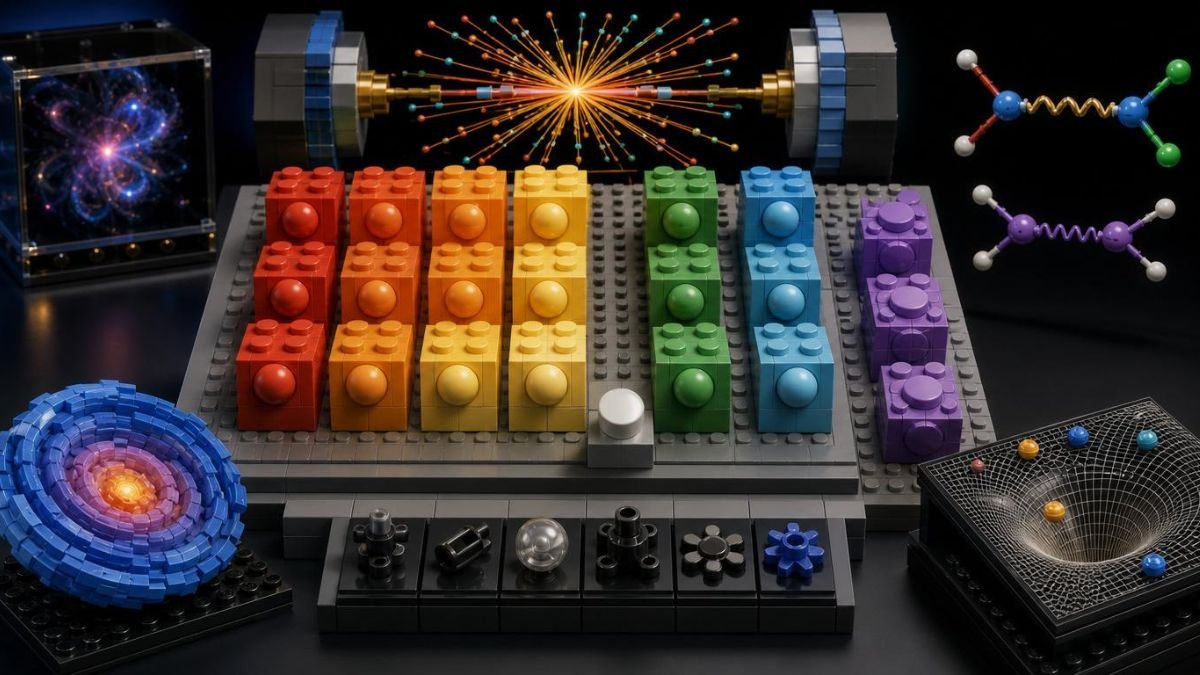
Everything Is Made of Something Smaller — And Then We Run Out
At some point in your life, probably during a science class that you either loved or survived, someone told you that matter is made of atoms. Atoms are made of protons, neutrons, and electrons. Protons and neutrons are made of quarks. And quarks — as far as we can currently tell, using the most powerful instruments humanity has ever built — are not made of anything. They appear to be genuinely, irreducibly fundamental.
This is the claim of the Standard Model of particle physics: that beneath all the complexity of the observable universe, there is a relatively small set of truly elementary particles, interacting through a set of forces, and that these components account for everything you can see, touch, smell, or measure.
It is simultaneously one of the most successful theories in the history of science and one of the most conspicuously incomplete. But we'll get to the embarrassing part. Let's start with what the Standard Model actually says.
The Cast of Characters — Particles All the Way Down
The Standard Model organizes all fundamental particles into two broad categories: fermions (the particles of matter) and bosons (the particles of force). If that sentence made you want to close the tab, stay with me, because this is genuinely simpler than it sounds.
Fermions — The Stuff Everything Is Made Of
Fermions are the building blocks. They are the particles that make up all material objects. They come in two varieties: quarks and leptons.
Quarks are the constituents of protons and neutrons. There are six types — known, charmingly, as flavors — with the names up, down, charm, strange, top, and bottom. The up and down quarks are the ones that actually matter for everyday matter: a proton is made of two up quarks and one down quark; a neutron is made of one up quark and two down quarks. The other four flavors are heavier, unstable relatives that appear in high-energy environments and decay quickly into more stable forms.
Here is something immediately strange about quarks: you cannot isolate one. If you try to separate two quarks, the force between them gets stronger as the distance increases — unlike, say, gravity or electromagnetism, which weaken with distance. Pull hard enough, and you put enough energy into the system to create new quarks, so you end up with more particles rather than an isolated one. Physicists call this property "confinement," and it means that quarks always travel in groups. The particles formed by bound quarks — protons, neutrons, and more exotic relatives — are called hadrons.
Leptons are the other matter particles. The most familiar lepton is the electron, which surrounds the nucleus of every atom and is responsible for chemistry, electricity, and therefore for essentially everything in your daily life. There are also muons and tau particles, which are heavier and unstable versions of the electron, and three types of neutrinos — ghost-like, nearly massless particles that interact with almost nothing and which pass through ordinary matter in incomprehensible numbers. Approximately 100 trillion neutrinos from the sun pass through your body every single second. You do not notice this. Neither do they.
Bosons — The Particles That Carry Forces
The second major category is bosons. While fermions are the matter particles, bosons are the force carriers — the particles exchanged between matter particles that produce the effects we call forces.
The photon is the most familiar boson. It is the carrier of the electromagnetic force — the particle of light, yes, but also the entity responsible for all electromagnetic interactions, which includes the forces between charged particles, the behavior of electrical circuits, and the reason your hand doesn't pass through this screen.
The gluon carries the strong nuclear force — the force that binds quarks together inside protons and neutrons, and that binds protons and neutrons together inside the nucleus. It is called the strong force for an understatement-free reason: it is by far the most powerful of the four fundamental forces.
The W and Z bosons carry the weak nuclear force — the force responsible for radioactive decay and for the nuclear reactions that power the sun. Despite being called "weak," the weak force plays an essential role in the nuclear processes that make stellar energy possible, which means it is indirectly responsible for all life on Earth.
And then there is the Higgs boson — discovered experimentally at CERN's Large Hadron Collider in 2012 after being predicted theoretically in 1964. The Higgs boson is associated with the Higgs field, a quantum field that permeates all of space, and it is the mechanism by which most fundamental particles acquire mass. Without the Higgs mechanism, particles like the electron and quarks would be massless, moving at the speed of light and incapable of forming the stable structures — atoms, molecules, people — that make the universe interesting.
The Forces — What Holds It All Together (and Apart)
The Standard Model describes three of the four fundamental forces of nature: the electromagnetic force, the strong nuclear force, and the weak nuclear force. The fourth force — gravity — is conspicuously absent, and this absence is the model's most profound limitation, which we will address shortly.
The Strong Nuclear Force and the Problem of the Nucleus
Before the Standard Model, physicists faced a puzzle: the atomic nucleus consists of positively charged protons packed into an incredibly small space. Electromagnetism, which causes like charges to repel each other with enormous force at close range, should rip every nucleus apart instantly. The fact that nuclei exist at all, that they don't explode in a shower of protons, implies a force that is strong enough to overcome electromagnetic repulsion at short range.
That force is the strong nuclear force, mediated by gluons, and the Standard Model provides a complete description of how it works through a framework called Quantum Chromodynamics. The name comes from "color charge" — not actual color, but an internal quantum property of quarks that comes in three types (labeled red, green, and blue, for reasons that are entirely metaphorical and possibly the result of physicists having a sense of humor).
Electroweak Unification — Where It Gets Beautiful
One of the Standard Model's genuine intellectual achievements is the electroweak theory — the discovery that what appear to be two separate forces (electromagnetism and the weak nuclear force) are actually different manifestations of a single underlying force at high energies. At everyday energies, they look different because the symmetry between them is broken. At the high-energy conditions that existed in the very early universe, they were unified into a single electroweak force.
This kind of unification — finding that apparently different things are deep-down the same thing — is one of the recurring themes of fundamental physics, and it points toward the tantalizing (if currently unrealized) possibility that all four forces might be unified into a single framework.
What the Standard Model Gets Spectacularly Right
The Standard Model's predictive accuracy is, in certain domains, almost unspeakably precise. The anomalous magnetic moment of the electron — a measure of how strongly the electron interacts with a magnetic field — has been calculated using the Standard Model to an accuracy of better than one part in a trillion. This is, roughly speaking, like calculating the distance between New York and London and getting the answer right to within a fraction of a millimeter.
The prediction of the W and Z bosons, the experimental confirmation of the Higgs boson exactly where the model predicted it, the precise properties of nuclear decay processes — the Standard Model has accumulated a catalogue of successful predictions that is unmatched by any other physical theory. It works. Extraordinarily well.
What the Standard Model Gets Wrong (or Simply Won't Touch)
Despite its triumphs, the Standard Model has significant limitations that physicists are the first to acknowledge — sometimes with visible frustration, sometimes with barely concealed excitement, because limitations are also opportunities.
The most glaring absence is gravity. The Standard Model describes three of the four fundamental forces, but it has no place for gravity. Einstein's General Relativity describes gravity brilliantly at the large scales of everyday physics and cosmology. Quantum mechanics — of which the Standard Model is an expression — governs the subatomic world brilliantly. The two theories are fundamentally incompatible with each other in their current forms, and resolving this incompatibility is the central unsolved problem of fundamental physics.
There is also dark matter. About 27 percent of the universe, by mass-energy, consists of something that interacts gravitationally with ordinary matter but is not made of any Standard Model particle. We know it exists from its gravitational effects on galaxies and galaxy clusters. We have no idea what it is. The Standard Model simply has nothing to say about it.
Similarly, dark energy — which accounts for approximately 68 percent of the universe's total energy and is driving the accelerating expansion of the universe — is entirely absent from the Standard Model.
Then there is the matter-antimatter asymmetry problem. The Standard Model predicts that the Big Bang should have produced equal amounts of matter and antimatter, which would have annihilated each other, leaving a universe of pure energy and no stuff whatsoever. The obvious fact that stuff exists — that you, the planet, and the article you're reading all exist — implies that something broke this symmetry. The Standard Model can account for some CP violation (the technical term for matter-antimatter asymmetry) but not nearly enough to explain why there is a universe full of matter.
Why This Is the Right Kind of Incomplete
What's remarkable about the Standard Model is not just what it gets right, but how its failures point the way forward. The matter-antimatter asymmetry, the absence of gravity, the mystery of dark matter — these are not embarrassments to be hidden. They are the precise outlines of what remains to be discovered. They are the shape of the physics that doesn't yet exist.
Particle physicists sometimes compare the Standard Model to a map of a continent that is drawn with extraordinary precision in the middle but has here be dragons written at the edges. The detailed part is extraordinarily detailed. The edges are genuinely unknown. And the fact that we can draw the edges at all — that we know enough to know what we don't know — is itself a remarkable achievement.
Whatever comes next — supersymmetry, string theory, some entirely new framework that nobody has thought of yet — it will have to contain the Standard Model as a limiting case, the way General Relativity contains Newtonian gravity as a limiting case. The Lego bricks of particle physics have been catalogued. The instructions for the full model still have pages missing.
LET'S GET CRITICAL
The article presents the Standard Model as physics' greatest triumph combined with its most tantalizing incompleteness, and that framing is broadly accurate. But there are several ways in which it simplifies, over-celebrates, or omits perspectives that complicate the picture significantly.
Let's start with the "Lego bricks" metaphor itself, which is the article's organizing conceit and which is worth interrogating. Lego bricks are discrete, solid, clearly defined, spatially located objects. You can hold them. You can count them. You can see exactly where one brick ends and another begins. Fundamental particles are none of these things.
In quantum field theory — which is the actual mathematical framework underlying the Standard Model — particles are not little balls. They are excitations of quantum fields that permeate all of space. An electron is not a tiny marble with a charge. It is a localized disturbance in the electron quantum field, with no precise spatial boundary, no continuous trajectory, and no determined properties until measured. The "particle" language is a useful approximation, a conceptual scaffolding that helps us build intuition about a mathematical reality that has no direct analog in human sensory experience. Using the word "particle" at all involves an irreducible distortion of the underlying mathematics.
This matters because it affects how we think about what the Standard Model is describing. It is not a catalogue of little things. It is a framework of quantum fields and their symmetries — and the "particles" are what you see when you look at those fields from a particular experimental perspective. The Lego metaphor is useful, but it should not be mistaken for an accurate picture of the territory.
Second, the article's presentation of the Higgs boson discovery as a triumph deserves some nuance. Yes, finding the Higgs boson exactly where the Standard Model predicted it was a profound confirmation. It was also, for many physicists, a disappointment — because the Standard Model predicted the Higgs, but it didn't predict its mass particularly precisely, and the mass it was found to have (about 125 GeV) is, for complex technical reasons related to quantum corrections, a value that requires extraordinary fine-tuning of the model's parameters. This is sometimes called the "hierarchy problem" — the fact that the Higgs mass is many orders of magnitude smaller than it ought to be if higher-energy physics affects it in the way naive calculations suggest.
The hierarchy problem was one of the primary motivations for supersymmetry, a theoretical extension of the Standard Model that predicts a "superpartner" for every known particle. Supersymmetry would solve the fine-tuning problem elegantly. It would also naturally provide dark matter candidates. The Large Hadron Collider was designed in significant part to find supersymmetric particles. As of now, it has found none. The absence of supersymmetry at the energies the LHC can probe is a significant blow to the most popular class of theoretical extensions of the Standard Model, and it leaves the hierarchy problem without an obvious solution.
Third, let's talk about the nature of "fundamental." The article asserts that quarks and leptons appear to be genuinely, irreducibly fundamental — the bottom of the ladder. But this claim has been made before in the history of physics, and it has always proven premature. In the late 19th century, atoms were considered fundamental. Then we found protons, neutrons, and electrons. Then we found quarks inside protons and neutrons. Each time, what looked like the bottom was not. Is there any principled reason to think we've finally hit the floor this time? The Standard Model is extraordinarily successful within its domain, but nothing in the mathematics of the Standard Model proves that quarks are not themselves composite — made of something smaller still, which our current instruments simply cannot resolve.
There are, in fact, theories called "preon" models that attempt to describe quarks and leptons as composite particles made of more fundamental constituents. None of these models has compelling experimental support at present. But the history of physics suggests that "we haven't found anything smaller yet" and "there is nothing smaller" are two different claims, and that the former has been mistaken for the latter at every previous level of the hierarchy.
Fourth, the Standard Model's mathematical beauty deserves both celebration and skepticism. The article implicitly celebrates the elegance of electroweak unification — the discovery that electromagnetism and the weak force are the same force at high energies. This is genuine intellectual beauty, and it is a real feature of the mathematics. But there is a risk in using beauty as an epistemological guide in physics. String theory is arguably the most mathematically beautiful framework ever constructed for fundamental physics. It is also, after fifty years of intense development, almost entirely devoid of experimental predictions that have been confirmed. Mathematical beauty and physical truth are correlated, but they are not the same thing, and the history of physics includes beautiful theories that turned out to be wrong.
Finally, let's acknowledge something the article mentions but doesn't dwell on: the Standard Model has approximately 19 free parameters — numbers like particle masses, coupling constants, and mixing angles that must be determined experimentally rather than derived from theory. A truly fundamental theory, one might argue, should have no free parameters — it should predict everything from first principles. The Standard Model's 19-parameter flexibility means it describes reality beautifully but does not fully explain it. Why is the electron mass what it is? Why are there exactly three generations of fermions? Why is the strong force so much stronger than the weak force? The Standard Model tells you the values. It has very little to say about why they are those values and not others.
These are not criticisms that undermine the Standard Model's achievements. They are the precise intellectual landscape of frontier physics — the questions that keep theoretical physicists productively obsessed and experimentalists building ever-larger machines.
FANTASTIC GUEST — RICHARD FEYNMAN
Wait! There's a lot more to learn...
This is only the first part of the CSP (Comprehensive Study Package), but there's still a lot more to learn. If you want to take it to the next level, you can access the premium comprehensive learning package with all the contents above plus the following sections:
Fantastic Guest Interview
Edustory + Author's Commentary
Let's Discuss | Discussion Questions
What Now? | Action Plan
Language Focus: Vocabulary & Speaking
Language Focus: Grammar & Writing
Comprehensive Quiz (Comprehension & Vocabulary + Detailed Feedback)
Activity Worksheets with Answer Keys
And Much More...
These extra sections are available to my Patreon subscribers. You can find the full article on my Patreon page.







0 Comments