Stand still for a moment. Feel the solidity of the floor beneath you. Whatever you are standing on — concrete, wood, tile, carpet — it rests on something that feels immovably permanent. The ground. Solid. Reliable. Absolutely still.
Except it isn't.
Right now, at this moment, the ground beneath you is in motion. You are standing on an enormous slab of rock called a tectonic plate, and it is moving. Slowly — probably at something between two and fifteen centimeters per year, roughly the speed at which your fingernails grow. But moving. Relentlessly, continuously, in a direction and at a rate determined by forces operating deep within the Earth's mantle, forces that have been operating for billions of years and show no sign of stopping.
Plate tectonics is the scientific theory that describes this motion, its causes, and its consequences. It is one of the great unifying frameworks of Earth science — the geological equivalent of Darwin's theory of evolution or Einstein's general relativity in terms of its explanatory power and its transformative effect on how we understand the planet we live on. And like both of those theories, it was initially met with something between skepticism and outright mockery before the evidence became impossible to argue with.
The Idea That Was Laughed At
In 1912, a German meteorologist and geophysicist named Alfred Wegener proposed something that seemed, to most of his scientific contemporaries, to be the product of either imaginative speculation or wishful thinking: that the continents had once been joined together in a single landmass, and that over hundreds of millions of years they had drifted apart to reach their current positions.
Wegener called this former supercontinent Pangaea, from the Greek for 'all earth.' His evidence was, by any reasonable standard, compelling. The coastlines of South America and Africa fit together like puzzle pieces. Identical fossil species appeared on both sides of the Atlantic, in rock formations of the same age, in places now separated by thousands of kilometers of ocean. Matching geological formations — the same mountain chains, the same rock types, the same age signatures — could be traced across continents that are today separated by ocean.
The scientific establishment was not impressed. The problem was not the evidence — it was the mechanism. Wegener could not convincingly explain how continents moved. The prevailing assumption was that the Earth's crust was too rigid, and the forces required to move continents too impossibly large, for his proposal to be physically plausible. He died in 1930 on the Greenland ice sheet, his theory still largely dismissed.
The vindication came decades later, in the 1950s and 1960s, through the mapping of the ocean floor. What researchers found was extraordinary: a continuous mountain range running through the middle of all the world's oceans — the mid-ocean ridge system — along which new oceanic crust was being continuously created from molten rock rising from below. The ocean floor was not the ancient, static thing it had been assumed to be; it was geologically young, and it was moving, spreading outward from the ridges. Continental drift wasn't the right framework: the entire ocean floor was moving, carrying the continents with it. The new theory — plate tectonics — was formally established by the late 1960s and has been the foundational framework of geology ever since.
What Plates Are and How They Move
The Earth is structured in layers. The innermost region is the solid inner core, composed primarily of iron and nickel and existing under pressure so immense that it remains solid despite temperatures high enough to melt metal. Surrounding it is the liquid outer core, whose convective motion generates Earth's magnetic field. Above that is the mantle, a layer of rock that is solid but — over geological timescales — behaves viscously, flowing very slowly under heat and pressure. The outermost layer is the crust, which together with the uppermost rigid part of the mantle forms a layer called the lithosphere.
It is the lithosphere that is broken into tectonic plates — roughly a dozen major ones and several smaller ones, fitting together like irregular tiles across the surface of the planet. The plates are not all the same: oceanic plates are thin (typically around five to ten kilometers) and composed of denser, darker rock called basalt, while continental plates are thicker (up to seventy kilometers in some places) and composed of lighter, granitic rock.
The Engine Beneath
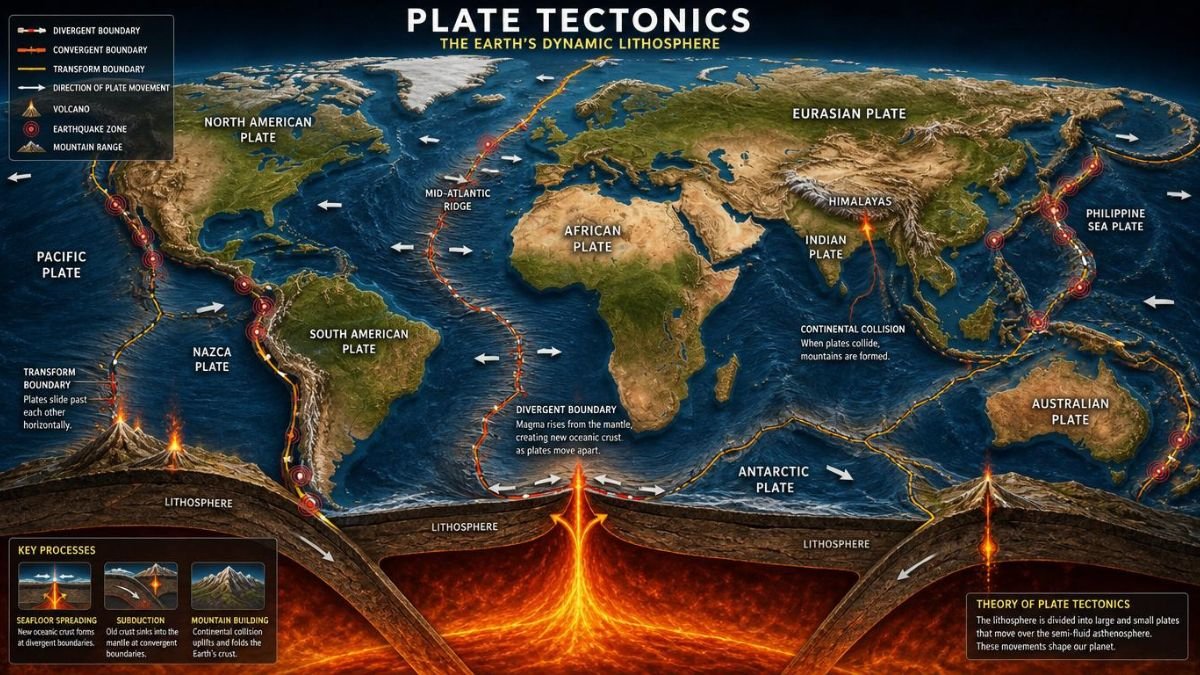
What drives the plates? The answer is the Earth's internal heat — a combination of heat left over from the planet's formation billions of years ago and heat produced by the ongoing radioactive decay of elements in the mantle and core. This heat drives convection currents in the mantle: hot rock rises, spreads laterally as it cools, and eventually sinks again where it becomes denser and colder. The tectonic plates ride on top of this convective system, carried along partly by the flow of the mantle beneath them and partly by the weight of the leading edge of the plate as it sinks into the mantle at subduction zones — a process geologists call slab pull, which may actually be the dominant driving force.
Types of Plate Boundaries
The most geologically active and dramatic places on Earth are found where plates meet, and what happens at those meetings depends entirely on what kind of plates are involved and how they are moving relative to each other.
Divergent boundaries are where plates move apart. At mid-ocean ridges, oceanic plates are pulling away from each other, and the gap is filled by magma rising from the mantle, creating new oceanic crust. The Mid-Atlantic Ridge, which runs down the center of the Atlantic Ocean, is creating new seafloor at a rate of a few centimeters per year, slowly widening the Atlantic. On land, divergent boundaries produce rift valleys — the East African Rift is a dramatic example of a continent being slowly pulled apart; in tens of millions of years, eastern Africa may become a separate landmass.
Convergent boundaries are where plates collide. The outcome depends on the plates involved. When two continental plates collide, neither is dense enough to sink, so they crumple and pile up into mountain ranges. The Himalayas are the most spectacular current example: the result of the Indian subcontinent colliding with Eurasia over the past fifty million years, a collision that continues today and is why the Himalayas are still rising. When an oceanic plate collides with a continental plate, the denser oceanic plate is forced beneath the continental plate in a process called subduction, creating deep ocean trenches, volcanic arcs, and significant seismic activity. The Cascadia Subduction Zone off the coast of the Pacific Northwest of North America is one of the most carefully monitored fault systems in the world.
Transform boundaries are where plates slide horizontally past each other. No crust is created or destroyed, but the friction and stress generated by the grinding motion produces some of the world's most significant earthquake zones. The San Andreas Fault in California, where the Pacific Plate is sliding northward past the North American Plate, is the most famous example in the world.
Earthquakes — When the Stress Breaks
Tectonic plates do not move smoothly. The rock surfaces of adjacent plates are rough and irregular, and for most of the time they are locked together by friction — stress builds along the fault line as the plates continue trying to move but cannot. When the accumulated stress eventually exceeds the frictional resistance, the locked sections release suddenly, generating seismic waves that radiate outward as an earthquake.
The point underground where the rupture initiates is called the focus or hypocenter. The point on the Earth's surface directly above it is the epicenter, which is the location typically reported in news coverage. Earthquakes vary enormously in magnitude and in depth, and both factors affect their impact. A deep earthquake — one occurring hundreds of kilometers underground — releases enormous energy but produces less surface disruption than a shallower one of similar magnitude. The depth and the nature of the rock and soil through which seismic waves travel both critically affect how much damage an earthquake causes at the surface.
Megaquakes and Subduction
The largest earthquakes in recorded history have all occurred at subduction zones, where one tectonic plate is being forced beneath another. The 1960 Valdivia earthquake in Chile — the largest ever recorded, at a magnitude of 9.5 — was a subduction zone event. The 2004 Indian Ocean earthquake, which triggered the devastating tsunami that killed over 200,000 people, was a subduction event off the coast of northern Sumatra. The 2011 Tohoku earthquake and tsunami in Japan, which caused the Fukushima nuclear disaster, was a subduction event along the Japan Trench.
These megathrust earthquakes are so large because subduction zones can lock two enormous plates together over a vast area, allowing stress to accumulate over decades or centuries before it releases in a single catastrophic rupture. The Cascadia Subduction Zone, which has been generating such megathrust events roughly every three to five hundred years, last ruptured in January 1700. The accumulated stress since then is a subject of serious concern for Pacific Northwest communities and emergency planners.
The Deep Consequences — Mountains, Oceans, and Life
Plate tectonics is not just the mechanism behind earthquakes and volcanoes — it is the foundational process that has shaped everything about the planet, including the conditions that made life possible.
Mountain ranges created by plate collisions affect global weather patterns, creating rain shadows, monsoon systems, and temperature gradients that determine the distribution of biomes. The Himalayas, for example, are responsible for the monsoon patterns that water most of South and Southeast Asia. Ocean currents — which distribute heat around the planet and regulate climate — are shaped by the positions and shapes of continents and ocean basins, which are determined by plate tectonics over geological time.
Subduction zones recycle carbon dioxide into the mantle, and volcanic activity returns it to the atmosphere — a process that, operating over hundreds of millions of years, has regulated Earth's climate and maintained conditions within the range that life requires. The distribution of species across continents — the great biogeographical puzzles that Darwin and others puzzled over — makes sense only in the context of where continents were and when they were separated.
The ground is not just beneath us. It is the platform on which everything else happens — the climate, the ecosystems, the distribution of resources that have shaped human civilization. Understanding that it is moving, that it has always moved, and that its movement is the engine of so much that we take for granted, is one of the genuinely humbling insights that modern science provides.
LET'S GET CRITICAL
The article you just read presents plate tectonics as a settled, well-established, and essentially complete scientific theory. And in its broad outlines, it is. But that framing — 'we understand this' — glosses over some genuinely fascinating areas of active research, ongoing scientific debate, and important nuance. Let's poke at a few of them.
Start with the driving mechanism. The article presents mantle convection and slab pull as the explanation for what moves tectonic plates. This is accurate as a summary of current understanding, but it significantly undersells the degree to which the precise mechanisms are still being actively researched and debated. The relative contributions of mantle convection, slab pull, ridge push (the force exerted as new oceanic crust is created at mid-ocean ridges and pushes plates laterally), and basal drag (friction between the moving mantle and the overlying plate) are still being quantified. Different tectonic settings appear to be dominated by different forces. The simple 'the Earth's heat drives convection, which moves the plates' is true but collapses a great deal of complexity into a comfortable narrative.
Second, the article does not engage with the question of when plate tectonics started. The standard teaching version implies that it has been operating since the early history of the Earth. The actual scientific picture is considerably more uncertain. Some researchers believe modern-style plate tectonics began only about one billion years ago. Others argue for an earlier onset, perhaps three billion years ago. Still others suggest that the style of tectonics may have changed over geological time — that early Earth may have had a different, less mobile tectonic regime before modern-style subduction was established. This question has enormous implications for understanding early Earth's habitability, the emergence of life, and the composition of the early atmosphere.
Third, the article discusses earthquake prediction primarily in terms of understanding the mechanisms and identifying high-risk zones. What it does not engage with is the much more contentious question of short-term earthquake prediction — the aspiration to predict specific earthquakes in terms of magnitude, location, and time. This remains one of the most challenging problems in all of science. The chaotic, nonlinear dynamics of fault systems mean that small changes in initial conditions can lead to dramatically different outcomes. Some researchers believe short-term probabilistic prediction may become possible with better sensor networks and machine learning; others argue that the fundamental physics of fault systems makes deterministic short-term prediction inherently impossible. The distinction matters enormously for emergency planning and public policy.
Fourth, the article presents the story of Wegener's vindication in a satisfying arc: dismissed by the establishment, proved right by later evidence, theory triumphant. This is true, but it is a simplified version of a messier history. Several researchers before and after Wegener had similar ideas and were similarly dismissed. The actual process by which plate tectonics became accepted was not a single moment of revelation but a gradual accumulation of evidence across multiple disciplines, with considerable resistance from established geologists throughout — some of whom had invested their careers in alternative frameworks. The history is actually a rich lesson in how scientific consensus forms and reforms, and how social and institutional factors shape which ideas get taken seriously and when.
Fifth — and this is a genuinely important omission — the article doesn't discuss the relationship between plate tectonics and human risk in ways that reflect current urgency. Beyond earthquake zones, volcanic risks associated with subduction zones (including supervolcanic systems like Yellowstone, whose eruptive history is understood only through the tectonic context), tsunami generation mechanisms, and the long-term climate implications of changes in tectonic activity are all areas where the science is active and the human implications are significant. The article frames plate tectonics largely as a wonder of nature. It is also a risk framework for much of the world's population, and that dimension deserves more than it received.
FANTASTIC GUEST: ALFRED WEGENER
Wait! There's a lot more to learn...
This is only the first part of the CSP (Comprehensive Study Package), but there's still a lot more to learn. If you want to take it to the next level, you can access the premium comprehensive learning package with all the contents above plus the following sections:
Fantastic Guest Interview
Edustory + Author's Commentary
Let's Discuss | Discussion Questions
What Now? | Action Plan
Language Focus: Vocabulary & Speaking
Language Focus: Grammar & Writing
Comprehensive Quiz (Comprehension & Vocabulary + Detailed Feedback)
Activity Worksheets with Answer Keys
And Much More...
These extra sections are available to my Patreon subscribers. You can find the full article on my Patreon page.








0 Comments