- Everything Is Made of Something Smaller — And Then We Run Out
- The Cast of Characters — Particles All the Way Down
- The Forces — What Holds It All Together (and Apart)
- What the Standard Model Gets Spectacularly Right
- What the Standard Model Gets Wrong (or Simply Won't Touch)
- Why This Is the Right Kind of Incomplete
- LET'S GET CRITICAL
- FANTASTIC GUEST — RICHARD FEYNMAN
- EDUSTORY — THE INVENTORY
- AUTHOR'S COMMENTARY
- LET'S DISCUSS
- WHAT NOW? — FRAMEWORK & 7-DAY ACTION PLAN
- LANGUAGE FOCUS: VOCABULARY & SPEAKING
- LANGUAGE FOCUS: GRAMMAR & WRITING
Everything Is Made of Something Smaller — And Then We Run Out
At some point in your life, probably during a science class that you either loved or survived, someone told you that matter is made of atoms. Atoms are made of protons, neutrons, and electrons. Protons and neutrons are made of quarks. And quarks — as far as we can currently tell, using the most powerful instruments humanity has ever built — are not made of anything. They appear to be genuinely, irreducibly fundamental.
This is the claim of the Standard Model of particle physics: that beneath all the complexity of the observable universe, there is a relatively small set of truly elementary particles, interacting through a set of forces, and that these components account for everything you can see, touch, smell, or measure.
It is simultaneously one of the most successful theories in the history of science and one of the most conspicuously incomplete. But we'll get to the embarrassing part. Let's start with what the Standard Model actually says.
The Cast of Characters — Particles All the Way Down
The Standard Model organizes all fundamental particles into two broad categories: fermions (the particles of matter) and bosons (the particles of force). If that sentence made you want to close the tab, stay with me, because this is genuinely simpler than it sounds.
Fermions — The Stuff Everything Is Made Of
Fermions are the building blocks. They are the particles that make up all material objects. They come in two varieties: quarks and leptons.
Quarks are the constituents of protons and neutrons. There are six types — known, charmingly, as flavors — with the names up, down, charm, strange, top, and bottom. The up and down quarks are the ones that actually matter for everyday matter: a proton is made of two up quarks and one down quark; a neutron is made of one up quark and two down quarks. The other four flavors are heavier, unstable relatives that appear in high-energy environments and decay quickly into more stable forms.
Here is something immediately strange about quarks: you cannot isolate one. If you try to separate two quarks, the force between them gets stronger as the distance increases — unlike, say, gravity or electromagnetism, which weaken with distance. Pull hard enough, and you put enough energy into the system to create new quarks, so you end up with more particles rather than an isolated one. Physicists call this property "confinement," and it means that quarks always travel in groups. The particles formed by bound quarks — protons, neutrons, and more exotic relatives — are called hadrons.
Leptons are the other matter particles. The most familiar lepton is the electron, which surrounds the nucleus of every atom and is responsible for chemistry, electricity, and therefore for essentially everything in your daily life. There are also muons and tau particles, which are heavier and unstable versions of the electron, and three types of neutrinos — ghost-like, nearly massless particles that interact with almost nothing and which pass through ordinary matter in incomprehensible numbers. Approximately 100 trillion neutrinos from the sun pass through your body every single second. You do not notice this. Neither do they.
Bosons — The Particles That Carry Forces
The second major category is bosons. While fermions are the matter particles, bosons are the force carriers — the particles exchanged between matter particles that produce the effects we call forces.
The photon is the most familiar boson. It is the carrier of the electromagnetic force — the particle of light, yes, but also the entity responsible for all electromagnetic interactions, which includes the forces between charged particles, the behavior of electrical circuits, and the reason your hand doesn't pass through this screen.
The gluon carries the strong nuclear force — the force that binds quarks together inside protons and neutrons, and that binds protons and neutrons together inside the nucleus. It is called the strong force for an understatement-free reason: it is by far the most powerful of the four fundamental forces.
The W and Z bosons carry the weak nuclear force — the force responsible for radioactive decay and for the nuclear reactions that power the sun. Despite being called "weak," the weak force plays an essential role in the nuclear processes that make stellar energy possible, which means it is indirectly responsible for all life on Earth.
And then there is the Higgs boson — discovered experimentally at CERN's Large Hadron Collider in 2012 after being predicted theoretically in 1964. The Higgs boson is associated with the Higgs field, a quantum field that permeates all of space, and it is the mechanism by which most fundamental particles acquire mass. Without the Higgs mechanism, particles like the electron and quarks would be massless, moving at the speed of light and incapable of forming the stable structures — atoms, molecules, people — that make the universe interesting.
The Forces — What Holds It All Together (and Apart)
The Standard Model describes three of the four fundamental forces of nature: the electromagnetic force, the strong nuclear force, and the weak nuclear force. The fourth force — gravity — is conspicuously absent, and this absence is the model's most profound limitation, which we will address shortly.
The Strong Nuclear Force and the Problem of the Nucleus
Before the Standard Model, physicists faced a puzzle: the atomic nucleus consists of positively charged protons packed into an incredibly small space. Electromagnetism, which causes like charges to repel each other with enormous force at close range, should rip every nucleus apart instantly. The fact that nuclei exist at all, that they don't explode in a shower of protons, implies a force that is strong enough to overcome electromagnetic repulsion at short range.
That force is the strong nuclear force, mediated by gluons, and the Standard Model provides a complete description of how it works through a framework called Quantum Chromodynamics. The name comes from "color charge" — not actual color, but an internal quantum property of quarks that comes in three types (labeled red, green, and blue, for reasons that are entirely metaphorical and possibly the result of physicists having a sense of humor).
Electroweak Unification — Where It Gets Beautiful
One of the Standard Model's genuine intellectual achievements is the electroweak theory — the discovery that what appear to be two separate forces (electromagnetism and the weak nuclear force) are actually different manifestations of a single underlying force at high energies. At everyday energies, they look different because the symmetry between them is broken. At the high-energy conditions that existed in the very early universe, they were unified into a single electroweak force.
This kind of unification — finding that apparently different things are deep-down the same thing — is one of the recurring themes of fundamental physics, and it points toward the tantalizing (if currently unrealized) possibility that all four forces might be unified into a single framework.
What the Standard Model Gets Spectacularly Right
The Standard Model's predictive accuracy is, in certain domains, almost unspeakably precise. The anomalous magnetic moment of the electron — a measure of how strongly the electron interacts with a magnetic field — has been calculated using the Standard Model to an accuracy of better than one part in a trillion. This is, roughly speaking, like calculating the distance between New York and London and getting the answer right to within a fraction of a millimeter.
The prediction of the W and Z bosons, the experimental confirmation of the Higgs boson exactly where the model predicted it, the precise properties of nuclear decay processes — the Standard Model has accumulated a catalogue of successful predictions that is unmatched by any other physical theory. It works. Extraordinarily well.
What the Standard Model Gets Wrong (or Simply Won't Touch)
Despite its triumphs, the Standard Model has significant limitations that physicists are the first to acknowledge — sometimes with visible frustration, sometimes with barely concealed excitement, because limitations are also opportunities.
The most glaring absence is gravity. The Standard Model describes three of the four fundamental forces, but it has no place for gravity. Einstein's General Relativity describes gravity brilliantly at the large scales of everyday physics and cosmology. Quantum mechanics — of which the Standard Model is an expression — governs the subatomic world brilliantly. The two theories are fundamentally incompatible with each other in their current forms, and resolving this incompatibility is the central unsolved problem of fundamental physics.
There is also dark matter. About 27 percent of the universe, by mass-energy, consists of something that interacts gravitationally with ordinary matter but is not made of any Standard Model particle. We know it exists from its gravitational effects on galaxies and galaxy clusters. We have no idea what it is. The Standard Model simply has nothing to say about it.
Similarly, dark energy — which accounts for approximately 68 percent of the universe's total energy and is driving the accelerating expansion of the universe — is entirely absent from the Standard Model.
Then there is the matter-antimatter asymmetry problem. The Standard Model predicts that the Big Bang should have produced equal amounts of matter and antimatter, which would have annihilated each other, leaving a universe of pure energy and no stuff whatsoever. The obvious fact that stuff exists — that you, the planet, and the article you're reading all exist — implies that something broke this symmetry. The Standard Model can account for some CP violation (the technical term for matter-antimatter asymmetry) but not nearly enough to explain why there is a universe full of matter.
Why This Is the Right Kind of Incomplete
What's remarkable about the Standard Model is not just what it gets right, but how its failures point the way forward. The matter-antimatter asymmetry, the absence of gravity, the mystery of dark matter — these are not embarrassments to be hidden. They are the precise outlines of what remains to be discovered. They are the shape of the physics that doesn't yet exist.
Particle physicists sometimes compare the Standard Model to a map of a continent that is drawn with extraordinary precision in the middle but has here be dragons written at the edges. The detailed part is extraordinarily detailed. The edges are genuinely unknown. And the fact that we can draw the edges at all — that we know enough to know what we don't know — is itself a remarkable achievement.
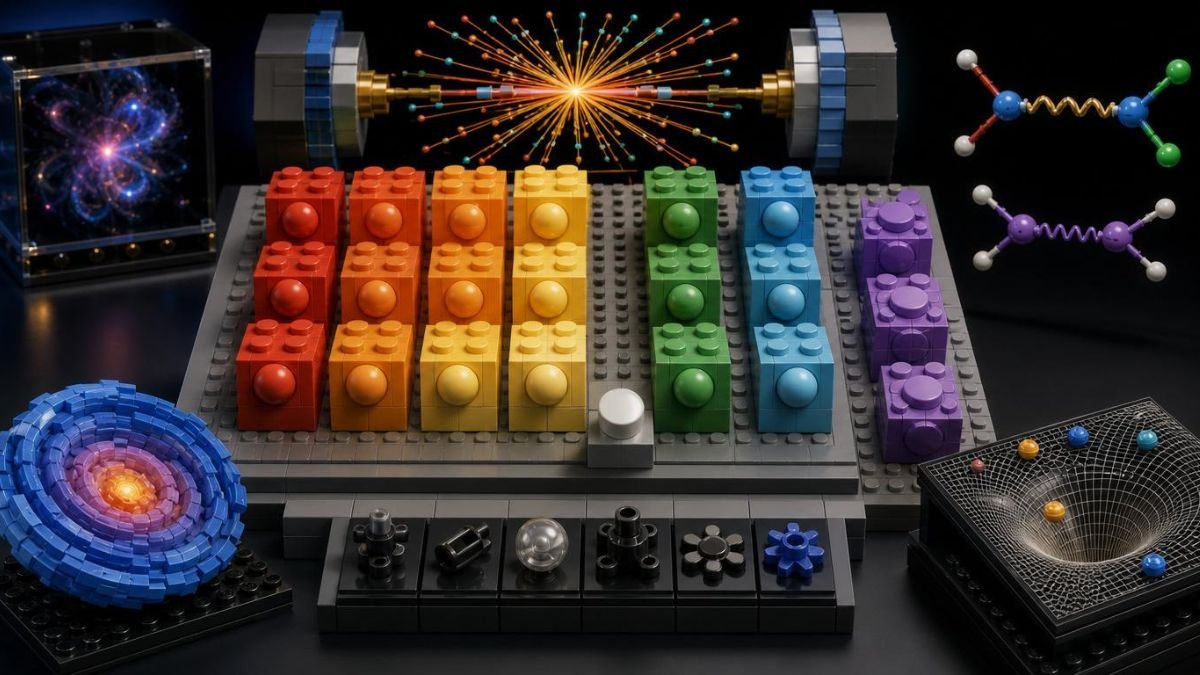
Whatever comes next — supersymmetry, string theory, some entirely new framework that nobody has thought of yet — it will have to contain the Standard Model as a limiting case, the way General Relativity contains Newtonian gravity as a limiting case. The Lego bricks of particle physics have been catalogued. The instructions for the full model still have pages missing.
Take This Package With You
Read this study package free below, or get the clean, ad-free PDF and EPUB, plus extra worksheets and audio, on Patreon.
LET'S GET CRITICAL
The article presents the Standard Model as physics' greatest triumph combined with its most tantalizing incompleteness, and that framing is broadly accurate. But there are several ways in which it simplifies, over-celebrates, or omits perspectives that complicate the picture significantly.
Let's start with the "Lego bricks" metaphor itself, which is the article's organizing conceit and which is worth interrogating. Lego bricks are discrete, solid, clearly defined, spatially located objects. You can hold them. You can count them. You can see exactly where one brick ends and another begins. Fundamental particles are none of these things.
In quantum field theory — which is the actual mathematical framework underlying the Standard Model — particles are not little balls. They are excitations of quantum fields that permeate all of space. An electron is not a tiny marble with a charge. It is a localized disturbance in the electron quantum field, with no precise spatial boundary, no continuous trajectory, and no determined properties until measured. The "particle" language is a useful approximation, a conceptual scaffolding that helps us build intuition about a mathematical reality that has no direct analog in human sensory experience. Using the word "particle" at all involves an irreducible distortion of the underlying mathematics.
This matters because it affects how we think about what the Standard Model is describing. It is not a catalogue of little things. It is a framework of quantum fields and their symmetries — and the "particles" are what you see when you look at those fields from a particular experimental perspective. The Lego metaphor is useful, but it should not be mistaken for an accurate picture of the territory.
Second, the article's presentation of the Higgs boson discovery as a triumph deserves some nuance. Yes, finding the Higgs boson exactly where the Standard Model predicted it was a profound confirmation. It was also, for many physicists, a disappointment — because the Standard Model predicted the Higgs, but it didn't predict its mass particularly precisely, and the mass it was found to have (about 125 GeV) is, for complex technical reasons related to quantum corrections, a value that requires extraordinary fine-tuning of the model's parameters. This is sometimes called the "hierarchy problem" — the fact that the Higgs mass is many orders of magnitude smaller than it ought to be if higher-energy physics affects it in the way naive calculations suggest.
The hierarchy problem was one of the primary motivations for supersymmetry, a theoretical extension of the Standard Model that predicts a "superpartner" for every known particle. Supersymmetry would solve the fine-tuning problem elegantly. It would also naturally provide dark matter candidates. The Large Hadron Collider was designed in significant part to find supersymmetric particles. As of now, it has found none. The absence of supersymmetry at the energies the LHC can probe is a significant blow to the most popular class of theoretical extensions of the Standard Model, and it leaves the hierarchy problem without an obvious solution.
Third, let's talk about the nature of "fundamental." The article asserts that quarks and leptons appear to be genuinely, irreducibly fundamental — the bottom of the ladder. But this claim has been made before in the history of physics, and it has always proven premature. In the late 19th century, atoms were considered fundamental. Then we found protons, neutrons, and electrons. Then we found quarks inside protons and neutrons. Each time, what looked like the bottom was not. Is there any principled reason to think we've finally hit the floor this time? The Standard Model is extraordinarily successful within its domain, but nothing in the mathematics of the Standard Model proves that quarks are not themselves composite — made of something smaller still, which our current instruments simply cannot resolve.
There are, in fact, theories called "preon" models that attempt to describe quarks and leptons as composite particles made of more fundamental constituents. None of these models has compelling experimental support at present. But the history of physics suggests that "we haven't found anything smaller yet" and "there is nothing smaller" are two different claims, and that the former has been mistaken for the latter at every previous level of the hierarchy.
Fourth, the Standard Model's mathematical beauty deserves both celebration and skepticism. The article implicitly celebrates the elegance of electroweak unification — the discovery that electromagnetism and the weak force are the same force at high energies. This is genuine intellectual beauty, and it is a real feature of the mathematics. But there is a risk in using beauty as an epistemological guide in physics. String theory is arguably the most mathematically beautiful framework ever constructed for fundamental physics. It is also, after fifty years of intense development, almost entirely devoid of experimental predictions that have been confirmed. Mathematical beauty and physical truth are correlated, but they are not the same thing, and the history of physics includes beautiful theories that turned out to be wrong.
Finally, let's acknowledge something the article mentions but doesn't dwell on: the Standard Model has approximately 19 free parameters — numbers like particle masses, coupling constants, and mixing angles that must be determined experimentally rather than derived from theory. A truly fundamental theory, one might argue, should have no free parameters — it should predict everything from first principles. The Standard Model's 19-parameter flexibility means it describes reality beautifully but does not fully explain it. Why is the electron mass what it is? Why are there exactly three generations of fermions? Why is the strong force so much stronger than the weak force? The Standard Model tells you the values. It has very little to say about why they are those values and not others.
These are not criticisms that undermine the Standard Model's achievements. They are the precise intellectual landscape of frontier physics — the questions that keep theoretical physicists productively obsessed and experimentalists building ever-larger machines.
FANTASTIC GUEST — RICHARD FEYNMAN
About This Conversation
For this edition of Fantastic Guest, there is really only one human being you call when the topic is particle physics, the nature of reality, and the intersection of rigorous science with genuine intellectual wonder: Richard Feynman — Nobel Prize–winning theoretical physicist, bongo drummer, safe cracker, and arguably the most charismatic explainer of complex physics the twentieth century produced. Feynman was a central figure in the development of Quantum Electrodynamics (QED), a core component of what became the Standard Model, and his Feynman diagrams — elegant graphical representations of particle interactions — are still used by physicists today. He was also spectacularly honest about the limits of understanding, once saying that if you think you understand quantum mechanics, you don't understand quantum mechanics. He would have thoughts about the Standard Model.
The Interview
Danny: Richard, welcome. I should warn you that I'm going to ask you to explain things that most people find incomprehensible, and I expect you to make it sound easy.
Richard Feynman: That's fine. Though I should warn you that making it sound easy is not the same as making it simple. The nature actually is complicated. The best I can do is make it beautiful.
Danny: Let's start with the Standard Model. You were there for a significant part of its development. When you look at it now — as a complete framework — what do you see?
Richard Feynman: I see a catalogue of embarrassing successes. It's embarrassing because it works so well and we don't know why it works so well. We have this beautiful theory, and it makes predictions that come out right to ridiculous precision — the magnetic moment of the electron is the number I always point to, calculated to ten decimal places and measured to match — and yet the theory has these free parameters we just had to put in by hand. Why does the electron have the mass it has? Nobody knows. We measured it. We put the number in. The theory doesn't derive it. That's not entirely satisfying.
Danny: You developed Feynman diagrams as a way to calculate particle interactions. What do they actually represent?
Richard Feynman: They're calculational shorthand that physicists have probably over-literalized. A Feynman diagram shows a particle interaction — two electrons exchanging a photon, for instance — as a picture with lines and vertices. Each line and vertex corresponds to a mathematical term in the calculation. The picture isn't meant to be a photograph of what happens. It's a mnemonic for the mathematics. The trouble is, the pictures are so elegant that people start thinking the little lines are trajectories of little balls, and they get confused when the quantum mechanics doesn't behave like a ball rolling from here to there. A particle doesn't travel from A to B. In quantum mechanics, it explores all possible paths simultaneously, and the calculation is a sum over all those paths. The diagram shows you one contribution to that sum.
Danny: That's the path integral formulation, which is yours.
Richard Feynman: Well, Dirac pointed the way. I made it work. That's often how physics goes — someone has a beautiful insight, and then someone else does the actual calculation and finds out what the insight was worth.
Danny: The Standard Model doesn't include gravity. Does that bother you?
Richard Feynman: It bothers everyone. I spent time on quantum gravity. It's hard. The short version is that when you try to apply the quantum field theory methods that work so brilliantly for electromagnetism and the nuclear forces to gravity, you get infinities that you cannot tame. In QED and the rest of the Standard Model, we have a technique called renormalization — a controlled way of dealing with the infinities that appear in the calculations — and it works. For gravity, it doesn't work. The infinities multiply faster than you can subtract them. So we're stuck.
Danny: There are physicists who argue that renormalization is itself a sign that something is wrong with the theory — that you're hiding a problem rather than solving it.
Richard Feynman: I thought that for a while. I was not immediately comfortable with renormalization. The procedure — subtracting one infinity from another to get a finite answer — looks suspicious if you examine it carelessly. But it works, and it works in a specific, mathematically consistent way, and the answers it gives match experiment to enormous precision. At some point the honest position is: this is what the mathematics requires, the answers are right, and the deeper reason why it works is something we don't fully understand yet. That is an honest position. Physics is full of honest positions like that.
Danny: The Higgs boson was confirmed in 2012. In your day, the Higgs field was a theoretical prediction. What would you make of finding it?
Richard Feynman: I would make exactly what any sensible physicist would make: great, now let's figure out what the Higgs is actually doing at a deep level. The Higgs mechanism explains how particles acquire mass, and that's wonderful. But the Higgs field is a scalar field — a type of field with different symmetry properties from all the other fields in the Standard Model — and it sits in the theory somewhat awkwardly, without a deep fundamental justification. It's there because we need it. Finding it is confirmation. Explaining why it should be there at a deeper level is the next question. Finding the particle is the beginning, not the conclusion.
Danny: Let me push you on something philosophical. The Standard Model describes particles as excitations of quantum fields. You once described quantum field theory as the most precise theory in the history of science and also as something nobody truly understands. Is that a problem?
Richard Feynman: It's a fact. Understanding, in the sense of having an intuitive classical picture that maps onto what the mathematics says — that doesn't exist for quantum mechanics, and it's going to exist even less for quantum field theory. The world at those scales genuinely does not behave like anything we have experience with. An electron is not small in the way a marble is small. It doesn't have a trajectory the way a baseball has a trajectory. When two electrons interact, they don't exchange a photon the way you and I would pass a ball. The mathematical description is precise and extraordinarily successful. The intuition — the mental picture — is fundamentally limited by the fact that our intuitions were built for middle-sized dry goods at ordinary temperatures and velocities.
Danny: "Middle-sized dry goods." That's an expression I've heard you use. Where does it come from?
Richard Feynman: I think I stole it from a philosopher. Most of the best insults come from philosophers. Anyway — human intuition is calibrated for the world we evolved in: things you can see, throw, eat, run from. Quantum mechanics operates far outside that domain. The mathematics works. The physical picture — the "what is actually happening" — is either beyond our current understanding or possibly not even a well-formed question in the way we usually ask it.
Danny: So you're saying reality might be fundamentally unvisualizable?
Richard Feynman: I'm saying that our demand for visualizability may be a feature of our neurology rather than a feature of reality. The universe doesn't owe us a picture we can draw on a chalkboard. It owes us mathematics that agrees with experiment. The Standard Model provides that, to remarkable precision. The picture — the "what is really going on under the hood" — is either a deep open question or a category error. I find both possibilities interesting.
Danny: The article mentions the fine-tuning problem — the idea that the Standard Model requires careful adjustment of its parameters to produce a universe where stable matter can exist. Does the fine-tuning bother you philosophically?
Richard Feynman: Fine-tuning bothers people who feel that the universe owes them an explanation. The universe doesn't owe us anything. The parameters are what they are. Now, if we had a deeper theory that derived the parameters from something more fundamental, that would be progress — and we should try to find one. But if we found one tomorrow, someone would immediately ask why the deeper theory has the parameters it has, and we'd be back to the same question one level deeper. The questions in fundamental physics don't have endpoints. They have successor questions.
Danny: On that note — if you were a physicist today, where would you be looking?
Richard Feynman: I would be at the interface between quantum mechanics and gravity. Not because I think string theory is necessarily right, but because that's where the mathematics breaks down, and where the mathematics breaks down is usually where the interesting physics is. The Standard Model works beautifully in its domain. Its domain ends where gravity becomes important — at the Planck scale, near black hole singularities, at the beginning of the universe. Those are the edges of the map. That's where I'd be looking.
Danny: You also mentioned the free parameters. The fact that there are nineteen numbers we had to put in by hand.
Richard Feynman: Twenty, depending on how you count. It's a count that embarrasses the tidy-minded. A fundamental theory, ideally, shouldn't have free parameters. It should derive everything. The fact that we have nineteen or twenty numbers we can only measure, not calculate — that tells you the Standard Model, as beautiful as it is, is not the final theory. It's the best theory we have. Those are two different things, and keeping them distinct is important.
Danny: Richard Feynman, thank you. I should note that this conversation has made me feel that I understand particle physics less well than when we started, which I mean as a compliment.
Richard Feynman: That is the correct response to an honest conversation about particle physics. If you understood it better, I wasn't being honest.
EDUSTORY — THE INVENTORY
The shop had been in the family for three generations, and nobody had ever counted everything in it.
Dr. Vasile Oprea had tried twice — once when he inherited it from his uncle at age thirty-four, and once five years ago when the insurance company demanded a comprehensive inventory. Both times he had made it approximately two-thirds of the way through the back room before giving up. The back room contained, as best anyone could estimate, somewhere between forty and sixty thousand distinct items: antique instruments, old scientific apparatus, things that looked like machines and things that looked like art and things that refused to be either.
His daughter Sofia had grown up in the shop. She was twenty-six now, finishing a PhD in theoretical physics, and when she came home for her mother's birthday she did what she always did: she went to the back room.
"I'm going to finish the inventory," she said.
Vasile, who was making coffee in the kitchen behind the counter, laughed once, briefly.
"I said that at your age," he said.
"I have a systematic approach."
"So did I."
---
The back room smelled of wood polish and something electrical that had no name. Sofia set up a table near the door with a laptop and a notepad and began from the left shelf.
The first hour was straightforward. Voltmeters. A barometer. Several antique telescopes in varying states of completeness. She labelled and photographed everything and felt very productive.
The second hour was less straightforward. She found a glass sphere approximately the size of a large orange, filled with a yellowish gas, that had an electrical connector at the base and a label in Romanian that she couldn't fully read. She photographed it, labelled it "unknown gas-filled globe," and moved on.
In the third hour she found a wooden box containing forty-seven identical brass cylinders, each the size of a fingertip, each engraved with a different two-digit number. She could not determine what they were for. She labelled them "forty-seven numbered cylinders — purpose unknown" and felt slightly defeated.
"Papa," she called.
He appeared in the doorway with a cup of coffee.
"The brass cylinders."
He looked at them and shrugged in the specific way that meant: I have looked at these many times and concluded nothing. "They were here when I inherited the shop. My uncle said they were measuring standards of some kind. I've never been able to find what they measured."
"And nobody ever threw them away?"
"They might be important."
"Or they might be redundant. Forty-seven identical cylinders of slightly different weights — this is someone's calibration set."
"For what instrument?"
"I don't know. But the fact that we don't know what they're for doesn't mean they're not for something."
She put them back in the box and continued.
---
By the time she reached the middle of the room — which was genuinely the middle, she had measured — she had catalogued two hundred and thirty-seven items and found seven that she could not categorize at all. Not just items whose purpose was unclear, but items that seemed to be part of a system she couldn't identify: things with connectors that matched nothing else in the room, things that had the shape of components without the context of the larger machine.
She was examining one of these — a metal disc about fifteen centimeters across, precision-machined, with four mounting holes and a surface that appeared to have been polished to optical tolerances — when her colleague Radu called.
Radu was also finishing a PhD, in experimental physics at a different university, and they had known each other since they were sixteen and had been arguing productively since approximately the first week.
"How's the inventory?" he said.
"I've found a component for something I can't identify."
"Join the club. The LHC is a component for something the universe hasn't finished explaining."
"That's possibly the most Radu thing you have ever said."
"Are you going to describe the component or are you going to make fun of me?"
She described it. Radu listened.
"Without seeing it," he said, "I'd say: precision component from a high-quality optical instrument. Probably a spectroscope or an interferometer. Maybe 1920s, 1930s, precision-machined before computer-aided manufacturing. The mounting holes and the polished surface are characteristic."
"But where's the rest of the instrument?"
"Probably not in your shop. These things get separated. Someone buys the main body, someone else gets the auxiliary components, and then both sit in different attics for a century."
Sofia looked at the disc.
"It's a beautiful object," she said.
"Most precision instruments are. The beauty comes from the constraints — everything that's not necessary gets removed, and what remains is exactly what's needed."
She put the disc on the separate table she'd set up for things requiring further identification and moved on.
---
Her father brought her dinner at seven.
"How many do you have left?"
"About a third of the room. A third more than I expected to have left by now."
He looked at her two tables: the main inventory and the things-requiring-further-identification table, which had grown to twenty-three items.
"You could skip those," he said.
"I don't skip things."
"No." He sat on a stool near the door. "Your mother used to say you catalogued even the things that didn't fit into any catalogue."
"The things that don't fit into the catalogue are usually the most interesting things."
"They're also the hardest to value. For insurance purposes."
"For physics purposes too." She accepted the plate he offered. "In the Standard Model, there are particles that don't fit neatly into the framework — properties that seem arbitrary, masses that require fine-tuning, a force that's absent from the model entirely. You can't just skip those because they're inconvenient."
Vasile ate his own dinner in the thoughtful silence of a man who had learned to follow his daughter's conversational transitions.
"You're saying the twenty-three items on the second table are the interesting part of the inventory."
"They're the part that tells you the most about the limits of the system. If everything fit neatly into the catalogue, the catalogue would be both complete and closed. The things that don't fit tell you what the catalogue is missing."
"But some of them might just be junk."
"Some of them are definitely junk. There's a corroded battery connector on that table that belongs in the bin. But there's also a component for an instrument I can't identify yet, and that instrument might be significant."
"Or it might be missing three additional components, all in three different countries, and you'll never find them."
"That's also possible," she said. "But I'd rather know that than assume the component is meaningless because I can't immediately place it."
---
She finished the inventory at eleven-thirty PM, which was two hours later than she'd planned. The final count was six hundred and twelve catalogued items and twenty-nine items requiring further identification.
Her father was in the kitchen. She came through the doorway and stood in the light.
"Finished," she said.
"And?"
"Six hundred and twelve items, classified. Twenty-nine items with questions attached."
"What kind of questions?"
"Three items that are clearly components of larger instruments — I've sent photos to two colleagues who specialize in historical scientific apparatus and they might be able to identify the full instruments. Four items that I think are calibration references but can't match to specific instruments. Six items that appear to be samples or specimens of materials and I don't know what the materials are yet — I'll need to look into that."
"And the other sixteen?"
She paused.
"Genuinely unknown. Not unknown because I haven't found the context yet — unknown because I suspect the context doesn't survive. Parts of systems that are probably gone."
Vasile poured two glasses of wine and pushed one toward her.
"The previous inventory stopped at two-thirds," he said. "The two-thirds they could identify."
"I know."
"The other third was the problem."
"The other third was the interesting part."
They sat quietly for a moment.
"What will you do with the twenty-nine?" he asked.
"Research the three components. Try to find what instruments they belonged to. The rest I'll mark as open questions in the database and add whatever partial information I have. Some questions don't get answered immediately. Some might not get answered in my lifetime." She drank. "That's fine. At least we know what we don't know."
Vasile looked at his daughter — her mother's directness, his father's patience, something that belonged to neither of them and entirely to herself.
"My uncle," he said, "would have liked you."
"Did he never finish the inventory either?"
"He started it twice. Stopped both times at the same place — in the middle of the back room, in front of those brass cylinders." He looked at his wine. "He said it felt dishonest to complete an inventory that he knew was incomplete. That a catalogue with known gaps was preferable to a catalogue with hidden gaps."
Sofia set down her glass.
"He was a good scientist," she said.
"He was an antique dealer."
"It's the same thing, mostly."
Outside, the street was quiet in the way small streets are quiet late at night — not absent of sound but resting, full of potential activity that had, for the moment, chosen not to happen.
AUTHOR'S COMMENTARY
The shop was the idea I was most committed to from the beginning. A physical space full of accumulated objects, many of whose purposes are unclear, in which the act of cataloguing reveals not a clean list but a structured set of known knowns, known unknowns, and items that fall outside existing classification — this is the Standard Model. It is also any serious intellectual enterprise. I wanted the analogy to be structural rather than explicit, which meant resisting every opportunity to have Sofia say "this is like the Standard Model" out loud. She doesn't. She's a physicist. The connections are just how she thinks.
Vasile is the character who required the most care. He needed to be intelligent without being academically trained, curious without being technically fluent, and capable of following Sofia's thinking without simply being a passive receptacle for her explanations. His line "they might be important" about the brass cylinders — offered as a genuine reason not to discard them despite their apparent redundancy — is the most important thing he says in the story's first half. It is the correct scientific disposition toward unexplained data: incomprehensibility is not evidence of worthlessness. You don't discard what you don't understand. You put it on the second table.
The second table is the story's central structural metaphor. The inventory has two tables: things that are classified and things that require further identification. This is the Standard Model divided into its successes (the six hundred and twelve catalogued items) and its acknowledged limits (the twenty-nine items with questions). The difference is that the inventory's second table contains both items that will eventually be resolved and items whose resolution may never come. This is the honest situation in frontier physics: some of the open questions will yield to future experiments, and some may require conceptual frameworks that don't exist yet.
Radu's comment — "the LHC is a component for something the universe hasn't finished explaining" — is the story's most explicit engagement with the article's content, and I placed it in a phone call precisely because it feels like something you'd say to a friend on the phone, not something you'd say in the scene's primary action. It also serves to characterize Radu as someone who thinks in exactly that register: scientific phenomena as components of larger systems whose shape isn't fully visible yet.
The disc — precision-machined, optically polished, mounting holes — is a deliberate choice of object. Its beauty comes from constraint, as Radu observes: everything that isn't necessary has been removed. This is the aesthetic quality that draws physicists to the Standard Model: it is beautiful because it is minimal, and it is minimal because every unnecessary element has been eliminated by the demand that it agree with experiment. The disc is also incomplete — it belongs to an instrument whose other parts are elsewhere, possibly lost. The Standard Model is also incomplete in exactly this sense: it is a piece of a larger apparatus whose full form hasn't yet been assembled.
Sofia's exchange with her father over dinner is the story's philosophical center. Her argument — that the things that don't fit the catalogue tell you the most about the catalogue's limits — is the argument that gives the article's critical section its organizing logic. The twenty-nine unresolved items are not failures of the inventory. They are the inventory's most important contribution: a precise delineation of what is unknown rather than a comfortable pretense that everything is known.
The ending — Vasile's uncle who stopped his inventory at the same point, in front of the brass cylinders, because it "felt dishonest to complete an inventory he knew was incomplete" — is meant to reframe the story's stakes. The uncle's scruple was not obstruction. It was integrity. A catalogue with acknowledged gaps is epistemologically more honest than a catalogue whose gaps are hidden or pretended away. The Standard Model, with its nineteen free parameters and its absent gravity and its unaccounted dark matter, is exactly this: a catalogue that has had the scientific integrity to mark its own known edges rather than claim completeness it doesn't have.
The final paragraph — the street "full of potential activity that had, for the moment, chosen not to happen" — is my most deliberate piece of quantum-mechanical writing. The quantum vacuum is not empty. It is full of potential, of fields in their ground state, of virtual particles flickering in and out of existence. The quiet street that is not absent of activity but resting, full of potential that has chosen not to manifest — this is as close as I can get to a felt experience of the quantum vacuum in prose, and it is deliberately the final image, the moment where the physical analogy and the human story meet without either one explaining the other.
LET'S DISCUSS
Talking about what you've learned is not optional if you want it to stick. Physics in particular — with its counterintuitive claims and its enormous gap between mathematics and intuition — lives differently in the mind after you've tried to put it in words for someone else. The friction of articulation is where real understanding gets built. So let's use it.
Question 1
The article uses the "Lego bricks" metaphor for the Standard Model's fundamental particles, and the critical section argues this metaphor is misleading — particles are excitations of quantum fields, not tiny discrete objects. Does the usefulness of a scientific metaphor depend on its accuracy, or can a technically inaccurate metaphor be genuinely valuable as a bridge to understanding? Think about other scientific metaphors you've encountered — electrons in orbits, genes as blueprints, the brain as a computer — and consider what each gets right, what each distorts, and whether the distortion matters.
Question 2
Feynman says that our demand for visualizability may be a feature of our neurology rather than a feature of reality — that the universe doesn't owe us a picture we can draw on a chalkboard. If the deepest layer of physical reality is fundamentally unvisualizable, what are the implications for how we understand "understanding"? Is there a meaningful difference between calculating something with extraordinary precision and truly understanding it? Can you understand something you cannot picture?
Question 3
The Standard Model has approximately nineteen free parameters — numbers that must be measured rather than derived from deeper principles. Feynman finds this embarrassing. Some physicists argue that a truly fundamental theory should have no free parameters. But is this expectation reasonable? Who decided that nature should be fully derivable from pure logic? Is the desire for a parameter-free fundamental theory a legitimate scientific goal, or is it a philosophical preference dressed up as a scientific criterion?
Question 4
The critical section notes that at every previous level of physical description — atoms, nuclei, protons — we declared what we'd found to be fundamental, and then found something smaller. There are theoretical models (preon theories) proposing that quarks are themselves composite. The absence of evidence isn't evidence of absence. At the same time, the Standard Model is extraordinarily precise at current energies. How should we think about claims of fundamentality in physics? Is "fundamental" a property of nature or a property of our current experimental capacity?
Question 5
The story's Sofia argues that a catalogue with acknowledged gaps is preferable to one with hidden gaps — and that the things that don't fit the catalogue are the most interesting parts. Apply this principle beyond physics: in what other fields of knowledge, inquiry, or life do we tend to hide the gaps in our understanding rather than acknowledge them? And what would it look like — in education, in medicine, in public policy — to operate with the same intellectual honesty about known limits that good science demands?
WHAT NOW? — FRAMEWORK & 7-DAY ACTION PLAN
The Framework
The Standard Model is a useful case study for thinking about how scientific knowledge works — not just as a collection of facts about particles, but as a model of how models work. Here's a balanced framework.
First: precision and completeness are different virtues. A theory can be extraordinarily precise (the Standard Model calculates the electron's magnetic moment to twelve significant figures) while being demonstrably incomplete (it has nothing to say about gravity or dark matter). These two facts don't contradict each other. In most fields of knowledge, precision and completeness are similarly separable. A doctor's diagnosis can be precisely correct about what is present while being silent about something else entirely. An economic model can predict specific market behaviors with high precision while ignoring variables that turn out to matter. Evaluating any model requires distinguishing what it is precise about from what it doesn't address.
Second: the edges of a model are its most valuable parts for future progress. The Standard Model's failures — matter-antimatter asymmetry, missing gravity, dark matter — are not embarrassments. They are the precise specification of what the next theory must explain. In any field of knowledge, the boundaries of what a model cannot explain are the most productive intellectual territory. Knowing what you don't know is more useful than knowing what you know, because what you know is already known.
Third: mathematical success doesn't guarantee physical completeness. The Standard Model is extraordinarily mathematically successful. This does not mean it is the final answer. Mathematical beauty and experimental precision are evidence for a theory, not proof of its completeness. Hold this in all your intellectual life: agreement with evidence so far is not the same as being right about everything.
Fourth: the free parameters problem is actually a generative gift. The nineteen numbers the Standard Model can't derive are an invitation to deeper investigation. Every field has its unexplained numbers, its constants that are what they are without deeper justification. In medicine, in economics, in psychology, these are the places where the next generation of understanding is waiting to be found.
7-Day Action Plan
Day 1 — Explore the basics. Look up the Standard Model particle table (it's on Wikipedia and in dozens of good explainer videos). Spend twenty minutes just looking at the table and noticing which particles you recognize and which you've never heard of. You don't need to understand all of them today.
Day 2 — Pick one particle and go deeper. Choose one particle from the Standard Model — the Higgs boson, the neutrino, or the gluon are all fascinating — and spend thirty minutes learning specifically about that particle: how it was discovered, what it does, and what mysteries remain about it.
Day 3 — Find a good explainer video. There are excellent YouTube channels (PBS Space Time, Fermilab's educational content, various university lecture recordings) that explain particle physics at different levels. Watch one video on the Standard Model — no note-taking, just listening.
Day 4 — Engage with the philosophical dimension. Read or listen to something about the interpretation of quantum mechanics — not the Standard Model specifically, but the broader question of what quantum theory tells us about the nature of reality. The PBS Space Time channel has excellent episodes on this, as does Sean Carroll's podcast.
Day 5 — Try explaining it. Explain the Standard Model to someone who knows nothing about it. You don't need to be accurate at every technical detail — you need to explain the organizing ideas. What are the two types of particles? What do bosons do? What is the Higgs field for? The act of explaining will show you exactly where your understanding is solid and where it is vaguer than you thought.
Day 6 — Explore the open questions. Research one of the Standard Model's known limitations: dark matter, dark energy, the matter-antimatter asymmetry, or the hierarchy problem. What do physicists currently think is the most promising approach to solving it? What experiments are currently running or planned to address it?
Day 7 — Connect it to something bigger. Think about one other field of knowledge — history, biology, economics, linguistics, whatever you care about — and apply the Standard Model framework: what are its fundamental constituents? What forces/interactions does it describe? What are its known limitations? What are its free parameters (numbers it takes as given rather than deriving)? This exercise is not about physics. It's about how models work in general.
LANGUAGE FOCUS: VOCABULARY & SPEAKING
Let's spend some time with the language of particle physics, because this article uses a remarkable vocabulary — one that is precise, evocative, and full of words that have been borrowed from everyday language and given very specific technical meanings.
The first term worth pausing on is "fundamental," which the article uses carefully. In everyday English, fundamental means essential, basic, or important. In particle physics, it means something much more specific: a particle is fundamental if it has no internal structure — if it is not composed of smaller constituents. The claim that quarks and electrons are fundamental is a claim that, at the current limits of experimental resolution, these particles have no parts. This is different from claiming they are important or essential. A molecule is important to biochemistry without being fundamental in the particle physics sense — it is composed of atoms, which are composed of protons, neutrons, and electrons, and so on. When the article uses "fundamental," it means "irreducibly basic at the current level of investigation." Keep this precision when you use the word.
"Quantum field" is the conceptual heart of the Standard Model, and it's worth understanding what it means. A field, in physics, is a mathematical quantity that has a value at every point in space. Temperature is a field — every point in a room has a temperature. The electromagnetic field has a value at every point in space. A quantum field is a field that has been subjected to quantum mechanics — meaning its values are not fixed but are described probabilistically, with fluctuations even at the "empty" vacuum. Every particle in the Standard Model corresponds to a quantum field: there is an electron quantum field, a quark field, a photon field, and so on. What we call particles are localized excitations of these fields — ripples, so to speak, in an underlying fabric. This framework — Quantum Field Theory — is the mathematical language of the Standard Model.
"Renormalization" is a term that Feynman discusses honestly in the interview, and it deserves a plain-language description. In quantum field theory calculations, certain quantities come out as infinite — the electron's self-energy, for instance, when you try to calculate how it interacts with its own electromagnetic field, gives you infinity. Renormalization is the mathematical procedure by which these infinities are absorbed into redefinitions of measurable quantities like mass and charge, leaving finite, experimentally testable predictions. Feynman himself was initially uncomfortable with it because it involves subtracting one infinity from another. But it works — the answers it produces agree with experiment to extraordinary precision. The discomfort with renormalization points toward something deeper: the infinities it tames may be indicating that quantum field theory breaks down at very short distances, and that a more fundamental theory is needed.
"Confinement" is the technical term for the property of quarks that makes them impossible to isolate. The force between quarks, mediated by gluons, does not weaken with distance the way gravity and electromagnetism do — it actually grows stronger. This means that if you try to pull two quarks apart, at some point it becomes energetically cheaper for the universe to create new quark-antiquark pairs than to continue stretching the force. So you end up with more hadrons rather than an isolated quark. The energy you've invested in separating quarks materializes, literally, as new matter. This is a specific example of E=mc² in everyday (well, high-energy physics laboratory) operation.
"Symmetry breaking" is one of the most important concepts in modern physics, and it's used in the article to describe the Higgs mechanism. A symmetry in physics means that the laws of nature look the same after some transformation — rotation, reflection, particle-antiparticle exchange, and so on. Symmetry breaking occurs when a system's ground state (lowest energy state) does not share all the symmetries of the underlying laws. The Higgs field is the Standard Model's most important example: the electroweak symmetry — the symmetry that unifies electromagnetism and the weak force — is broken at the energies of everyday physics, which is why the two forces appear different. Above a certain energy threshold (corresponding to the early universe), the symmetry is restored. Symmetry breaking is also why particles have mass: massless particles obey the full symmetry, and the Higgs field's symmetry-breaking ground state is what endows them with mass.
"Dark matter" and "dark energy" are terms that have entered popular culture but are worth being precise about. Dark matter is a form of matter that interacts gravitationally but does not interact electromagnetically — it neither emits, absorbs, nor reflects light. We know it exists from its gravitational effects on the motion of stars in galaxies, the lensing of light, and the large-scale structure of the universe. We don't know what it is. Dark energy is different: it's a form of energy distributed throughout space that is causing the expansion of the universe to accelerate. The two are completely different phenomena that happen to share the word "dark" — meaning "not visible to us through electromagnetic radiation." Neither is explained by the Standard Model.
"Fine-tuning" refers to a situation in physics (or elsewhere) where the parameters of a theory must take very specific values — with high precision — for the theory to produce outcomes consistent with observation. The Standard Model has several fine-tuning problems: the Higgs mass is many orders of magnitude smaller than naive calculations suggest it should be, and the cosmological constant (associated with dark energy) is smaller than quantum field theory predicts by roughly 120 orders of magnitude. The concern with fine-tuning is not that the values are what they are — they clearly are — but that a truly fundamental theory should predict these values rather than requiring them to be inserted by hand at precisely the right magnitude.
"Coupling constant" is a term from quantum field theory that measures the strength of an interaction between a particle and a field. The electromagnetic coupling constant, for instance, is a number (approximately 1/137) that determines how strongly charged particles interact with the electromagnetic field. These coupling constants are among the Standard Model's free parameters — numbers that must be measured experimentally. The fact that the strong force coupling constant is much larger than the electromagnetic coupling constant is what makes the strong force stronger. Explaining why these coupling constants have the values they have is one of the unanswered questions in fundamental physics.
"Antimatter" deserves to be distinguished from science fiction. Every particle in the Standard Model has a corresponding antiparticle with the same mass but opposite charge (and other quantum numbers). The antiparticle of the electron is the positron. The antiparticle of the quark is the antiquark. When a particle and its antiparticle meet, they annihilate, converting their combined mass into energy (photons or other particles). The matter-antimatter asymmetry problem is the question of why the Big Bang produced slightly more matter than antimatter — about one extra matter particle for every billion antimatter-matter pairs — leaving the universe full of the surplus matter that makes up everything we can observe.
"The Planck scale" refers to the energy and distance scales at which quantum gravitational effects are expected to become significant. At distances of approximately 10^-35 meters (the Planck length) and energies of approximately 10^19 GeV (the Planck energy), both quantum mechanics and general relativity should be simultaneously important, which means neither can be applied independently. The current Standard Model is expected to break down at or before the Planck scale, and any theory that unifies quantum mechanics with gravity must give predictions that match the Standard Model at lower energies. This is the domain of speculative but serious theoretical physics: string theory, loop quantum gravity, and other approaches attempt to describe physics at the Planck scale.
Speaking Section — Explaining Abstract Concepts to Non-Specialist Audiences
The particle physics vocabulary in this article gives you a toolkit for a specific and valuable speaking skill: explaining technical concepts from one domain to an audience that has no background in that domain. This is one of the most demanded skills in scientific communication, in education, in journalism, and in any professional setting where specialists must communicate with non-specialists.
The key technique is the double explanation: first use an analogy that makes the concept accessible, then immediately specify where the analogy breaks down. "A quantum field is a bit like a temperature field — every point in space has a value. But unlike temperature, a quantum field has inherent fluctuations even at absolute zero, and what we call particles are ripples in these fields rather than separate objects. The temperature analogy gets you to the basic idea; the where it breaks down tells you something genuinely new." Both steps are necessary. The analogy without the correction misleads. The correction without the analogy loses the audience.
Your speaking challenge: explain quantum field theory in ninety seconds to an audience with no physics background. Use one analogy and explicitly state where the analogy fails. Record yourself. Check: does your analogy actually illuminate the concept, or does it just sound as if it does? Does your correction of the analogy add genuine information, or is it a pro forma disclaimer? Do it again, with a different analogy. The second version is almost always better.
LANGUAGE FOCUS: GRAMMAR & WRITING
The Writing Challenge
Write a 400–600 word explanatory essay in which you explain one concept from the Standard Model to a general audience. Your audience is intelligent but has no physics background. Your goal is genuine comprehension, not the appearance of it. Choose one of: quantum field theory, the Higgs mechanism, quark confinement, or the matter-antimatter asymmetry problem.
Making the Explanation Work — Grammar and Style for Science Writing
Science writing for general audiences is one of the most technically demanding forms of writing, because it must be simultaneously accurate and accessible — two demands that frequently pull against each other. The grammar and style tools that make it work are worth understanding explicitly.
The first essential grammar structure is the appositive — a noun phrase placed immediately after another noun to define or clarify it. "The Higgs boson, the particle associated with the field that gives matter its mass, was confirmed experimentally in 2012." The appositive (the particle associated with the field that gives matter its mass) does the definitional work right where the term appears, without interrupting the flow with a separate sentence. Appositives are the working horse of science writing — they allow you to use technical language and define it simultaneously.
The second structure is the concessive clause for managing the analogy problem. As discussed in the vocabulary section, scientific analogies always break down at some point. The concessive clause lets you use the analogy and flag its limitation without abandoning the main thought: "Although a quantum field is often compared to a continuous medium filling space, unlike any classical medium it can exist in superpositions of states and its fluctuations are irreducibly quantum." The "although" construction acknowledges the comparison while the main clause corrects it.
Third, learn to use the passive voice purposefully in explanatory writing. The passive voice is often maligned in writing instruction, but it serves a specific function in science writing: it allows you to describe processes without attributing them to agents when the agent is either irrelevant or unknown. "The Higgs boson was predicted theoretically in 1964 and confirmed experimentally in 2012" focuses the sentence on the discovery rather than on who made it, which is appropriate when the discovery is the point. Use passive voice when the process or result is more important than the agent. Use active voice when the agency matters.
Fourth, develop a vocabulary for degrees of certainty. Science writing fails when it presents all claims with the same level of confidence. Expressions like "is confirmed," "appears to be," "is currently thought to be," "remains an open question," and "is speculated but unconfirmed" are not hedging — they are epistemological precision. The Standard Model's confirmed predictions, its theoretical extensions like supersymmetry, and speculative frameworks like string theory have very different epistemic statuses, and good writing reflects this.
Finally, the organization of an explanatory essay for a non-specialist audience follows a specific logic: start with the phenomenon that needs explaining (why do particles have mass?), introduce the mechanism (the Higgs field), explain the mechanism at the relevant level of detail (symmetry breaking, the ground state of the Higgs field), give the evidence (the 2012 Higgs boson discovery), and end with the remaining questions (what determines the Higgs mass? what does the Higgs tell us about deeper physics?). This phenomenon-mechanism-evidence-open questions structure is the backbone of most successful popular science writing.
Take This Package With You
If this package helped you, you can take it with you. Become a Companion on Patreon for $5 a month to get the clean, ad-free PDF and EPUB, along with extra worksheets, workbooks, and audio. Everything here stays free either way.






0 Comments