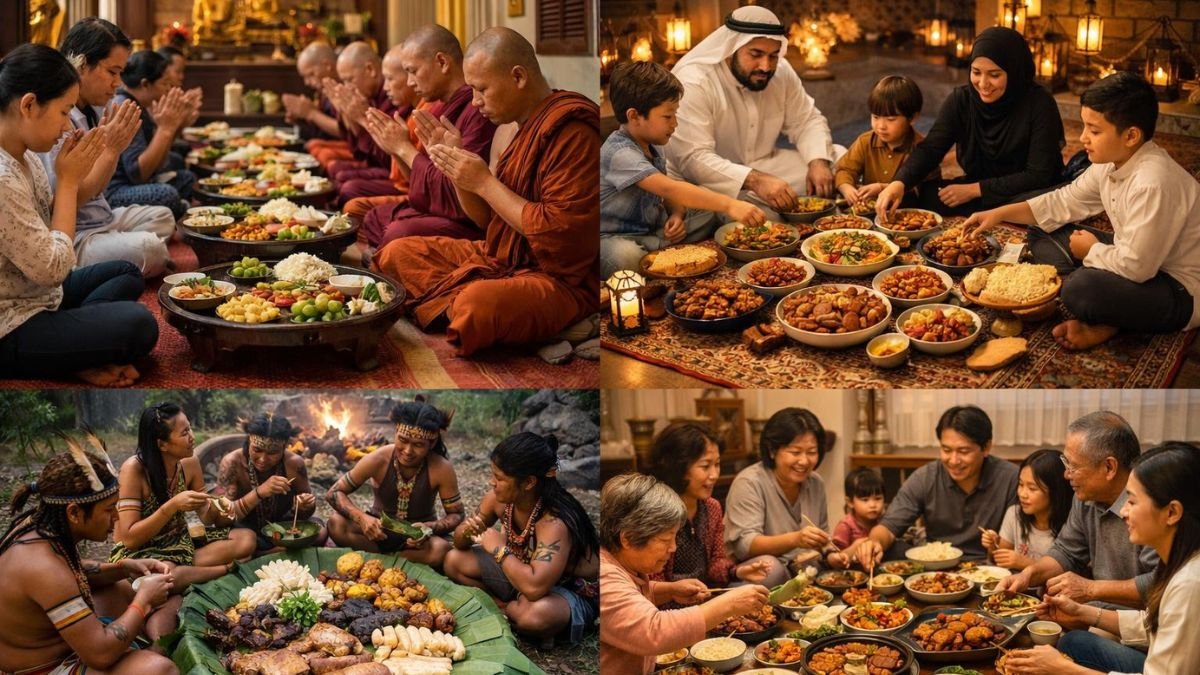
There is a biological mandate that governs our existence: we must eat to survive. If we were solitary creatures, like leopards or spiders, we would drag our kill into a dark corner, consume it in silence, and move on. But we are not solitary. Somewhere in the dusty annals of our evolution, we made a collective decision that turned the mere intake of calories into a theater of connection. We decided that the act of fueling our bodies should also be the primary method for fueling our relationships.
The dinner table is not just a piece of furniture; it is the original social network. Long before we had digital feeds to scroll through, we had communal platters to pass around. It is the only place where biology and sociology collide so violently and so beautifully. Whether you are tearing naan in a bustling street in Mumbai, passing the turkey in a heated dining room in Ohio, or sharing Iftar dates in Cairo as the sun dips below the horizon, the underlying grammar of the meal is the same. We are saying, “I am safe with you. I will not harm you while your hands are busy feeding your mouth.”
The Anthropology of the Table
Let’s look at the mechanics of this. Why do we sit facing each other? Why is the circular table—King Arthur’s great equalizer—such a profound symbol? It is about vulnerability. Eating is an inherently vulnerable act. You are opening your body to the outside world, taking a piece of the environment, and putting it inside you. To do this in the presence of others requires a suspension of defense mechanisms.
When we break bread, we are engaging in an ancient, non-verbal peace treaty. Anthropologists call this commensality—the practice of eating together. It creates a bond that is difficult to replicate in a boardroom or a coffee shop. There is a reason why the most significant business deals are closed over dinner, and why the most devastating breakups often happen over brunch. The presence of food lowers our guard. It triggers the parasympathetic nervous system—the “rest and digest” mode—which physically prevents us from being in “fight or flight.” You cannot effectively wage war while you are chewing.
The Diplomacy of Digestion
History is littered with examples of “gastro-diplomacy.” Think of the state dinners held at the White House or Buckingham Palace. These aren’t just about showing off fancy china; they are strategic maneuvers. When leaders share a meal, they are humanizing themselves to one another. It is hard to view someone as a faceless enemy when you have watched them struggle with a lobster claw or get a bit of spinach stuck in their teeth. The shared meal acts as a leveler. It reminds everyone present that, regardless of nuclear codes or GDP, we are all just organic machines that need sustenance.
But this isn’t just for presidents. Think about your own life. How do you welcome a new neighbor? You bring a casserole. How do you comfort a grieving friend? You bring a lasagna. When words fail us—when the tragedy is too deep or the joy too high—we outsource our emotions to food. We let the basil and the garlic do the talking. The dish becomes a tangible manifestation of empathy. It says, “I know you are hurting, and I cannot fix it, but I can ensure you do not go hungry while you hurt.”
The Sacred Rhythms: Shabbat, Ramadan, and Christmas
While the biological need is constant, the cultural expression is where things get fascinating. Take the Jewish tradition of Shabbat. For thousands of years, every Friday evening, the world stops. Electronics are turned off, candles are lit, and the family gathers. In a world that glorifies hustle and grind, Shabbat is a radical act of stopping. The meal is the anchor. It is not a quick bite before running to the movies; the meal is the event. The challah bread is braided, representing unity, and the wine is poured, representing joy. It turns the dining room into a sanctuary in time.
Then look at Ramadan. For an entire month, the day is defined by the absence of food. The fast strips away the trivial, focusing the mind on the spiritual. But the release—the Iftar—is an explosion of community. It is rarely a solitary affair. You break the fast with community, often with strangers. The hunger shared during the day translates into a profound gratitude and camaraderie at night. The food tastes better not just because of the hunger, but because of the solidarity.
And, of course, the Christmas feast. Or Thanksgiving. Or Hanukkah. These winter festivals share a common DNA: battling the dark. Ancient humans looked at the dying sun, the freezing ground, and the scarcity of winter, and they defied it with a feast. To feast in the middle of winter is an act of hope. It is a declaration that we have enough to survive, enough to share, and enough to be joyful despite the cold. The roast beast, the heavy puddings, the rich gravies—these are caloric armors against the bleakness.
The Recipe as a History Book
We often think of history as something written in dusty textbooks, but real history—the history of families and migrations—is written in grease stains on index cards kept in a tin box. Food is memory. The specific way your grandmother made tomato sauce is not just a recipe; it is a map of her life. Did she add sugar? Maybe she came from a region where tomatoes were acidic. Did she use dried oregano instead of fresh? Maybe she lived through a war where fresh herbs were a luxury.
When we cook traditional dishes, we are engaging in a séance. We are summoning the ghosts of our ancestors to the table. We are tasting what they tasted. This is why immigrants hold onto food traditions longer than language or dress. You might lose your native tongue within a generation, but you will fight to the death to keep the recipe for your mother’s empanadas. The food becomes the identity. It is the edible heritage that tells the story of who you are and where you came from.
The Modern Erosion of the Feast
However, we have to look at the empty chair in the room: modern life is dismantling the shared meal. We are witnessing the rise of the “dashboard diner”—eating a burrito while driving 70 miles per hour. We see the “desktop lunch,” eating salad over a keyboard while answering emails. And perhaps most insidious, the “fragmented dinner,” where a family sits in the same room but stares at four different screens, consuming four different meals delivered by four different gig-economy drivers.
We are gaining convenience, but what are we losing? We are losing the art of conversation. The dinner table is the training ground for civil discourse. It is where children learn to listen, to wait their turn, to debate, and to tell stories. It is where we learn to negotiate (“Eat your peas and you can have dessert”). When we replace the shared table with solitary grazing, we erode the social fabric of the family unit. We become roommates who share a refrigerator rather than a family that shares a life.
The Salt Covenant
In ancient Middle Eastern culture, there was a concept known as the “Salt Covenant.” If you ate salt with someone—meaning, if you shared a meal with them—you were bound to protect them. You could not be their enemy. The salt, which preserves food, also preserved the relationship.
We need to bring back the Salt Covenant. In a polarized world where we are increasingly screaming at each other from behind digital avatars, the physical act of breaking bread is a revolutionary act of peace. It is hard to hate someone when you are passing them the potatoes. It humanizes the “other.”
So, this holiday season, or this Friday night, or next Tuesday, treat the meal with the reverence it deserves. Put the phone away. Light a candle, even if you’re just eating takeout pizza. Look the people you are with in the eye. Ask them a question that isn’t about their schedule. Recognize that the food on the plate is not just fuel; it is a bridge. Walk across it.
Focus on Language
Let’s take a walk through the linguistic landscape of the article we just wrote. You know, when we talk about food, we usually stick to words like “delicious,” “yummy,” or “spicy.” But if we want to talk about the sociology of food—the deep, human meaning of it—we need a different toolkit. We need words that carry weight, words that connect the stomach to the soul.
First, let’s look at the word commensality. I used this early on. It comes from the Latin com (together) and mensa (table). Literally, it means sharing a table. But in English, we use it to describe the act of eating together as a social relationship. You wouldn’t say, “I have commensality with my cat.” It implies a human exchange. You can use this in a sentence like, “The decline of family commensality is hurting our communication skills.” It sounds much more sophisticated than saying “people aren’t eating together anymore.”
Then we have visceral. We talked about the “visceral” connection of food. This word refers to the viscera—the internal organs, the guts. When something is visceral, it is felt deep in the body; it’s not intellectual, it’s instinctual. Hunger is visceral. The reaction to a smell that reminds you of your childhood home is visceral. Use this when you want to describe a feeling that bypasses the brain and hits you right in the chest (or stomach).
We used the word egalitarian. We called the round table an egalitarian symbol. This means believing in the principle that all people are equal and deserve equal rights and opportunities. A rectangular table has a “head,” implying hierarchy. A round table has no head; it is egalitarian. You can use this at work: “We try to keep our meetings egalitarian, so the intern’s opinion is valued just as much as the manager’s.”
Let’s talk about sacrament. We used this in the title of a section. In a religious context, a sacrament is a ceremony regarded as imparting divine grace. But in a secular context, like our article, it refers to a thing of mysterious and sacred significance. When we treat dinner as a sacrament, we are saying it’s holy, it’s special, it’s not just a biological function. You might say, “Morning coffee is my daily sacrament; don’t talk to me until I’ve had it.”
We described the meal as a crucible. A crucible is a ceramic or metal container in which metals or other substances may be melted or subjected to very high temperatures. Metaphorically, it means a place or occasion of severe test or trial, or a place where different elements interact to produce something new. The dinner table is a crucible for family dynamics—it’s where the heat is turned up, and relationships are forged or tested.
We mentioned camaraderie. This is mutual trust and friendship among people who spend a lot of time together. It’s that feeling of brotherhood or sisterhood. You often hear it used in sports or the military, but it fits perfectly for a meal shared after a long fast, like Ramadan. “The camaraderie at the office party was surprisingly good.”
We used the word insidious. This is a darker word. We talked about the “insidious” rise of the fragmented dinner. Something insidious proceeds in a gradual, subtle way, but with harmful effects. It sneaks up on you. A disease can be insidious. A bad habit is insidious. It suggests a slow rot rather than a sudden explosion.
We talked about sustenance. This is a fancy word for food and drink regarded as a source of strength; nourishment. But it can also mean the maintaining of something in life. “The artist found spiritual sustenance in nature.” It elevates the concept of food from just “stuff we eat” to “fuel for life.”
We used the word amalgamation. I didn’t use this in the text, but it fits the theme perfectly. An amalgamation is the action, process, or result of combining or uniting. Fusion cuisine is an amalgamation of cultures. A potluck dinner is an amalgamation of everyone’s efforts.
And finally, protocol. We talked about the “grammar” or the rules of the meal. Protocol refers to the official procedure or system of rules governing affairs of state or diplomatic occasions. But families have protocol too. “The protocol in our house is that no one leaves the table until Mom is finished.”
Now, let’s shift gears to speaking.
Learning these words is useless if they just sit in your brain collecting dust. You have to get them out of your mouth. The topic today is “Descriptive Narrating.” When we talk about food or memories, we often fall into the trap of being boring. “The food was good. We had fun.”
That kills the conversation.
To improve your speaking, I want you to practice the “Three Sense Rule.” When you describe a meal or a gathering, you must engage at least three senses. Don’t just tell me it tasted good. Tell me about the clatter of the silverware (sound), the warmth of the steam rising off the soup (touch/temperature), or the sharp scent of lemon (smell).
Here is an example. Instead of saying: “We had a nice dinner.”
Try this: “It was a visceral experience. The room was loud with the cacophony of laughing cousins, the air smelled like roasted garlic and woodsmoke, and the bread was so hot it almost burned my fingers.”
See the difference? It transports the listener.
Here is your challenge:
Think of the last memorable meal you had. It doesn’t have to be a fancy holiday; it could be a burger in a parking lot. I want you to record yourself speaking for one minute describing it. But here is the catch: You cannot use the words “good,” “delicious,” or “tasty.” You have to use descriptive, sensory language. Try to use the word commensality or visceral in your description. Listen to it back. Do you sound more engaging? I bet you do.
Let’s Discuss
Here are five questions to spark some deep thinking. I want you to take these not just as questions to answer, but as starting points for a debate with yourself or others in the comments.
1. Does the “Peace of the Table” actually silence necessary conflict?
We often hear “no politics at the dinner table.” While this keeps the peace, does it also prevent us from having difficult, necessary conversations with the people we love? If we only prioritize harmony while eating, are we creating a superficial relationship where we ignore the elephant in the room just to enjoy the roast chicken?
2. Is “foodie culture” a form of appreciation or appropriation?
When we eat foods from other cultures, we often say we are celebrating diversity. But is there a line where it becomes consumption without understanding? If we love tacos but vote against policies that help Mexican immigrants, are we engaging in true cultural exchange, or just “eating the other”?
3. Does the labor of the feast fall disproportionately on women?
The article talks about the magic of the grandmother’s recipe. But historically, and even today, the immense labor of shopping, chopping, cooking, serving, and cleaning usually falls on women. Is the “sacred shared meal” actually a burden for one gender while it’s a relaxation for the other?
4. Is the decline of the family dinner strictly a bad thing?
We mourn the loss of the family table, but for some, that table was a place of trauma, strict control, or patriarchal dominance. Does the “dashboard diner” style of eating offer a kind of freedom and autonomy that the rigid 1950s dinner table didn’t?
5. Can community exist without food?
Food is the easiest way to gather people. But is it a crutch? Can we form deep bonds without the sensory pleasure of eating? What about communities based on fasting, or online communities that never physically meet? Is food essential for bonding, or just a shortcut?
Critical Analysis
Okay, let’s take a step back and look at this article with a colder, sharper eye. I’ve read through the piece, and while it paints a beautiful, Norman Rockwell-esque picture of humanity holding hands over a turkey, we need to acknowledge the blind spots.
First, the article suffers from a heavy dose of “romanticism of the past.” It frames the ancient or traditional way of eating as inherently superior to modern convenience. But let’s be real: ancient food systems were also defined by scarcity, starvation, and lack of variety. The “dashboard diner” might be lonely, but it’s also a miracle of calorie abundance that our ancestors would have killed for. We shouldn’t be so quick to demonize convenience when it frees up time for other pursuits—like science, art, or leisure.
Secondly, the article assumes a level of food security that is not universal. It talks about “feasting” and “abundance” as if they are choices we make. For a massive chunk of the global population, and even in wealthy nations, the “shared meal” is a source of anxiety, not connection. If you don’t have enough food to put on the table, the “sociology of the dinner table” becomes a sociology of survival and shame. The article barely touches on the privilege required to host a “sacred feast.”
Also, let’s talk about the biological argument. The article claims eating together triggers the parasympathetic nervous system and reduces aggression. While that’s a nice evolutionary theory, history is full of “Red Weddings.” People have been poisoned at dinner tables, betrayed at banquets, and stabbed in the back while toasting. The Mafia loves a good lunch meeting. The proximity required for eating also provides the proximity required for violence. Food can be a weapon just as easily as it can be an olive branch.
Finally, the article focuses heavily on the “nuclear family” or the “tight-knit community.” What about the neurodivergent experience? For people with misophonia (hatred of chewing sounds), social anxiety, or eating disorders, the “communal table” is a torture chamber, not a sanctuary. Forcing “commensality” can be exclusionary. We need to broaden our definition of connection to include those for whom the noise and pressure of a dinner party is alienating rather than welcoming.









0 Comments