INTRODUCTION
In the spring of 541 CE, the Emperor Justinian I was at the peak of his power. His general Belisarius had reconquered North Africa from the Vandals and much of Italy from the Ostrogoths. His lawyers had produced the Corpus Juris Civilis, the greatest legal codification in history. His architects were putting the finishing touches on the Hagia Sophia in Constantinople, the most magnificent building on earth. The Roman Empire, in its eastern Byzantine form, appeared to be on the verge of genuine restoration to its former glory.
And then the rats arrived.
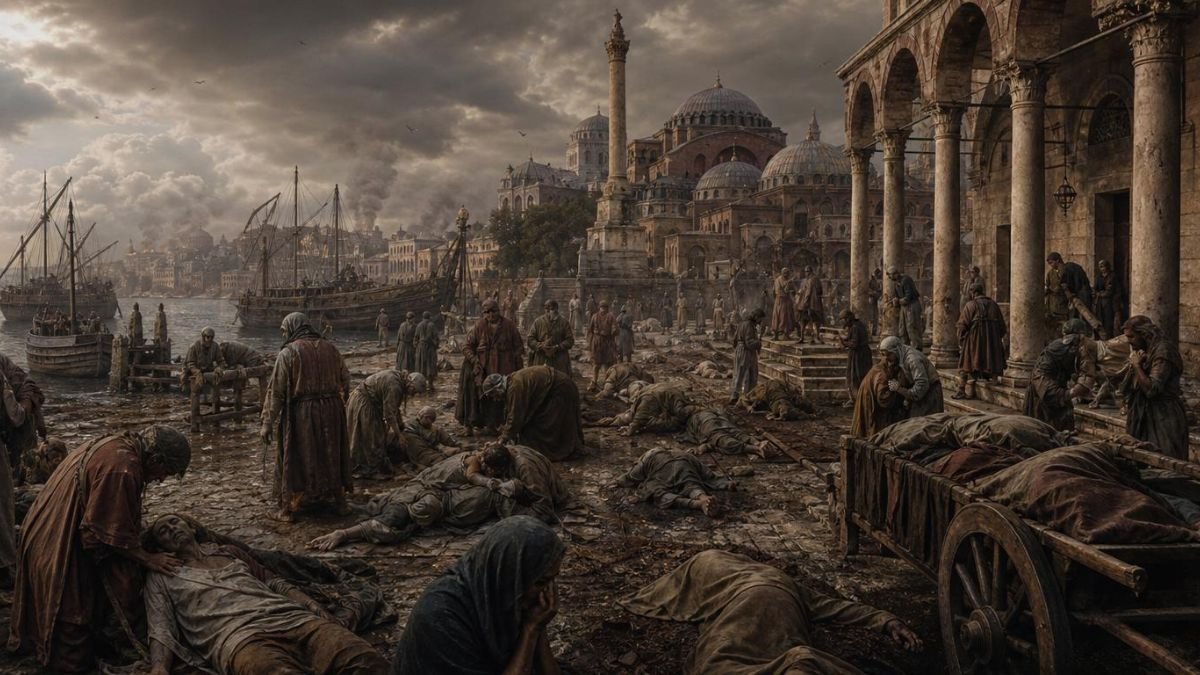
The Plague of Justinian — the first pandemic in recorded history — arrived in Constantinople in the summer of 541 CE and proceeded to do what no barbarian army, no political rival, and no financial crisis had managed to do to Justinian's ambitions: it dismantled them. Over the next two centuries, in waves that historians are still mapping, the plague is estimated to have killed between 25 and 50 million people — perhaps a quarter of the population of the known world at the time. It helped end Justinian's reconquest of the West. It contributed to the political and economic conditions that made the Islamic expansion of the seventh century possible. It reshaped the demographic, economic, and cultural landscape of the Mediterranean world in ways that are still visible in how Europe and the Middle East developed over the following centuries.
Why read about this carefully today? Because pandemic history — the history of disease as a political and civilizational force — is one of the most important and most underappreciated areas of historical analysis. Learning to read it well requires distinguishing between causes and contributing factors, between short-term disruption and long-term transformation, and between the human drama of the individual experience and the vast, impersonal patterns of epidemiology and demography. These distinctions are exactly what close reading develops: the ability to hold complexity, to resist oversimplification, and to think about causation with the precision and humility that serious historical analysis demands.
The Article
What happens to an empire's ambitions when its workforce and its army are dying faster than they can be replaced? The Plague of Justinian early pandemic impact is a story about exactly that — about the collision between one of history's most grandiose imperial visions and a microscopic organism that had no interest whatsoever in Justinian's plans for restoring Rome. The plague did not care about the Corpus Juris Civilis. It did not respect the walls of Asgard — or Constantinople, as the case was. It simply moved through the world doing what Yersinia pestis does, and left the human beings to sort out the consequences.
The disease arrived by ship in Pelusium, an Egyptian port city, in the late summer of 541 CE. The primary vector was the rat flea, Xenopsylla cheopis, which fed on infected black rats that traveled on grain ships from Egypt — then, as now, one of the most agriculturally productive regions on earth and a critical food supply for the empire. Once in a human, Yersinia pestis attacks the lymphatic system, producing the characteristic swollen lymph nodes — buboes — that give bubonic plague its name, along with fever, delirium, and in many cases rapid death. The historian Procopius, who was in Constantinople during the plague's peak and described it in detail in his History of the Wars, records that the city was dying at a rate of up to ten thousand people per day at the height of the outbreak. This figure is likely an exaggeration, but even at a fraction of that rate, the mortality was catastrophic.
The plague reached Constantinople in 542 CE and found a city uniquely ill-suited to contain it. Constantinople was the commercial and administrative hub of the eastern Mediterranean — ships from Egypt, Syria, and throughout the empire arrived constantly, carrying grain, goods, and, invisibly, infected fleas. The city's population, estimated at half a million to perhaps eight hundred thousand people, was densely concentrated. The urban infrastructure — the granaries, the forums, the port facilities — created exactly the conditions in which rat populations and human populations interacted closely. There was no understanding of germ theory, no concept of quarantine as a public health measure, and no effective treatment. The theological framework of the time interpreted the plague as divine punishment, which shaped the response: prayer, processions, religious observance. These were not ineffective at building social cohesion and managing collective grief, but they did nothing to interrupt transmission.
Justinian himself contracted the plague and survived — one of history's more consequential recoveries, since his death in 542 CE would have accelerated the political disintegration that was already beginning. But the empire that survived the plague's first wave was significantly diminished. The reconquest of Italy, which had been proceeding under Belisarius's generalship with genuine momentum, stalled as soldiers died and reinforcements could not be found. The economic apparatus that funded the military campaigns — the taxation system, the agricultural workforce, the trading networks — was severely disrupted as population loss reduced both productive capacity and the pool of taxpayers. The eastern frontier, which faced the Sasanian Persian Empire, became harder to defend. The administrative capacity of the state shrank as trained officials and bureaucrats died and could not be replaced at the rate required.
The longer-term consequences of the Plague of Justinian are among the most debated questions in early medieval history, and historians continue to argue about the degree to which the plague caused subsequent events versus contributed to conditions that made them more likely. The demographic collapse associated with the plague's recurring waves — which continued through the seventh century — created labor shortages, agricultural disruption, and economic contraction across the Mediterranean world. Whether this weakening of the Byzantine Empire was a primary cause of the remarkably rapid Arab Muslim expansion of the 630s and 640s CE — when Islamic forces conquered Syria, Egypt, and Mesopotamia within a generation — or merely a contributing factor among many, remains contested. The simplistic claim that "the plague caused Islamic expansion" is an oversimplification. The more defensible claim is that the plague created conditions of demographic and economic weakness that made Byzantine resistance to the Arab forces less effective than it might otherwise have been.
One of the most remarkable aspects of the Plague of Justinian as a historical event is the window it provides into how pre-modern societies understood and responded to catastrophic disease. Procopius's account is extraordinary in its detail and its emotional honesty — he describes the social breakdown that accompanied the plague: the abandonment of the dead, the collapse of normal social duties, the generalization of grief so total that the distinction between personal loss and collective catastrophe became meaningless. John of Ephesus, a contemporary church historian, recorded his observations traveling through Asia Minor during the plague's spread with a similar combination of horror and careful observation. These accounts remind us that behind the demographic statistics — the millions of estimated deaths — are individual human experiences of loss, fear, abandonment, and survival that we can partially reconstruct from the sources.
The Plague of Justinian was the world's first clearly documented pandemic. It predates the Black Death of the fourteenth century by eight hundred years and is caused by the same organism, Yersinia pestis, which DNA analysis of ancient burial sites has confirmed. It demonstrates that pandemic disease is not a modern phenomenon produced by modern conditions of globalization and density — it is a recurrent feature of human history that has shaped the course of empires, religions, and civilizations in ways that historians are still unpacking. The conditions that enabled it — connected trade routes, dense urban populations, inadequate understanding of disease transmission — are variations on conditions that have enabled pandemics in every subsequent century.
When you look at the list of conditions that made the Plague of Justinian possible and so catastrophic — connected trade routes, dense urban centers, no understanding of transmission, inadequate response capacity — how many of those conditions were genuinely unique to the sixth century, and how many do you recognize?
Close Reading Analysis
Paragraph 1: "What happens to an empire's ambitions when its workforce and its army are dying faster than they can be replaced?"
Question: the opening question frames the plague in terms of a collision between "imperial ambitions" and a "microscopic organism." What does this framing accomplish, and why is the observation that the plague "had no interest whatsoever in Justinian's plans" more than just a rhetorical flourish?
Framing the plague as a collision between human ambition and biological indifference is a sophisticated historical move: it places the plague in the category of what historians call "contingent" historical forces — things that happen without reference to human intention or significance. The observation that the plague "had no interest whatsoever in Justinian's plans" is not merely rhetorical. It encodes an important epistemological point: human history is not solely the product of human intention and decision. Enormous biological, climatic, geological, and epidemiological forces shape history continuously without caring about the goals, plans, or ideologies of the people they affect. This is the perspective of historical materialism in its most basic form — recognizing that material forces (organisms, climate, geography) shape human events alongside and sometimes in spite of human agency. Stating it through the plague's indifference rather than through academic language makes it accessible without sacrificing the insight.
Paragraph 2: the disease mechanism:
Question: the paragraph provides the Latin names for the organism (Yersinia pestis) and the flea (Xenopsylla cheopis). What is the function of including scientific nomenclature in a popular historical article, and what would be lost if these terms were omitted?
Scientific nomenclature serves several functions simultaneously in popular historical writing. First, it signals precision and credibility: the use of correct scientific names tells the reader that the writer has done rigorous research, not just popular summary. Second, it allows the curious reader to follow up — knowing the organism's name opens access to a vast scientific literature. Third, it distinguishes between different levels of description: "the rat flea" and "Xenopsylla cheopis" are both accurate, but the scientific name conveys that we are speaking of a specific, precisely identified biological entity, not a general category. What would be lost by omitting the terms is not just precision but the signal of intellectual seriousness that precision carries.
Paragraph 3: Constantinople's vulnerability:
Question: the paragraph says the city's theological response — prayer, processions, religious observance — "were not ineffective at building social cohesion and managing collective grief, but they did nothing to interrupt transmission." What is the analytical structure of this sentence, and what kind of claim is it making about the relationship between religion and public health?
This sentence uses a concessive structure: it first acknowledges what the religious response accomplished ("not ineffective at building social cohesion") before specifying what it could not accomplish ("did nothing to interrupt transmission"). The concession is important: it prevents the analysis from becoming a simple dismissal of religious response. The religious practices were genuinely functional — social cohesion and collective grief management are real and important needs during a catastrophe, and communal ritual addresses them. But at the biological level of transmission, they were irrelevant. The sentence is making a sophisticated point about the relationship between different levels of human need and response: a practice can be effective at one level (social, psychological) and ineffective at another (epidemiological) simultaneously, and both assessments can be correct at the same time. This is the kind of multi-level analysis that distinguishes nuanced historical writing from simplistic one-dimensional assessment.
Paragraph 4: Justinian's survival and its consequences:
Question: the paragraph calls Justinian's recovery from the plague "one of history's more consequential recoveries." What does the understated phrase "more consequential" accomplish tonally, and what does this demonstrate about the use of understatement in analytical writing?
"One of history's more consequential recoveries" is an understatement that works by ironic contrast: the recovery from a disease that killed up to half the people it infected is, baldly stated, an extraordinary stroke of luck. But "more consequential" is deadpan — it presents the enormous importance of this medical outcome in the driest possible register. The effect is a form of wit: the careful reader recognizes the gap between the magnitude of the event and the restraint of the description, and that gap produces a kind of dry humor. In analytical writing, understatement of this kind creates tone and personality without sacrificing precision. It is a mark of authorial confidence — a writer who knows their material thoroughly enough to present it with studied calm. Overstatement (calling the recovery "miraculous" or "world-changing") would feel sensationalist. The understatement is more effective precisely because it requires the reader to supply the sense of significance themselves.
Paragraph 5: the Islamic expansion debate:
Question: the paragraph carefully distinguishes between "the plague caused Islamic expansion" (too simple) and "the plague created conditions that made Byzantine resistance less effective" (more defensible). What logical distinction is being drawn between cause and contributing factor, and why does this distinction matter for historical reasoning?
The distinction is between necessary causation and contributory causation. "The plague caused Islamic expansion" is a claim of necessary causation: it implies that without the plague, Islamic expansion would not have occurred, or would have occurred very differently. This is not supported by evidence because the Islamic expansion had many independent causes — religious motivation, superior cavalry tactics, the appeal of the new faith to subject populations resentful of Byzantine taxation, and Sasanian exhaustion from decades of war with Byzantium. "The plague created conditions that made Byzantine resistance less effective" is a claim of contributory causation: the plague was one factor among several that combined to produce the outcome. Distinguishing between necessary and contributory causes is one of the most important analytical skills in historical reasoning — and in most forms of complex causation analysis. Overclaiming causation produces historical narratives that feel satisfying but mislead; recognizing contributory causation produces more honest and more useful analysis.
Closing question:
"When you look at the list of conditions that made the Plague of Justinian possible and so catastrophic — connected trade routes, dense urban centers, no understanding of transmission, inadequate response capacity — how many of those conditions were genuinely unique to the sixth century, and how many do you recognize?"
The closing question does not need to name COVID-19 or any specific modern pandemic because the question makes the parallel so clear that naming it would be redundant. The implied comparison is both the article's final analytical move and its most powerful one: it asks the reader to do the comparison themselves, which makes the insight more durable than if it had been delivered as a conclusion. The phrase "how many do you recognize?" is deliberately casual and slightly provocative — "recognize" implies familiarity, proximity, relevance to your own experience. The question ends the article in the same posture it maintained throughout: neither sensationalizing the historical event nor pretending it is fully in the past.
Speaking & Writing Challenges
Writing Challenge
Research any historical pandemic, epidemic, or disease event — the Black Death, the 1918 influenza pandemic, the AIDS crisis, or any other — and write a 400–500 word analytical paragraph that: (1) describes the event and its immediate impact accurately, (2) distinguishes clearly between what the disease caused (necessary causation) and what it contributed to (contributory causation), (3) acknowledges at least one piece of the historical debate that remains contested, and (4) draws a specific, defensible connection to a contemporary condition or pattern. Use scientific terminology at least once, and use at least one concessive sentence structure ("while X was true... it did not... ").
Speaking Challenge
Prepare a two-minute spoken historical analysis of the Plague of Justinian aimed at a general audience. Structure it: thirty seconds establishing what the plague was and how it arrived, forty-five seconds describing its immediate effects on the Byzantine Empire, thirty seconds discussing its longer-term consequences and why historians debate them, and fifteen seconds drawing the connection to what you believe is the most relevant contemporary lesson. Focus on the distinction between cause and contributing factor when discussing long-term consequences, and practice speaking with appropriate epistemic humility ("historians debate," "the evidence suggests," "one plausible interpretation is").









0 Comments