INTRODUCTION
Somewhere in human history — tens of thousands of years ago, almost certainly — a person stood after a rainstorm, looked at the arc of color in the sky, and wondered what it was. Every culture that has ever existed has had to make sense of the rainbow: the Norse called it Bifröst, the bridge between the human world and the world of the gods; the Bible made it a covenant between God and humanity; the Irish put a leprechaun and a pot of gold at its end; the Greeks personified it as Iris, a divine messenger. The rainbow has been too beautiful and too regular and too inexplicable to simply leave alone.
And then, in the seventeenth century, René Descartes and Isaac Newton worked out what it actually was. They showed that the rainbow is not a divine message or a supernatural bridge. It is the visible result of light doing something perfectly ordinary — bouncing and bending inside billions of spherical water droplets — and producing, by the simple operation of the laws of optics, something so precisely and consistently beautiful that it looks like it was designed. The explanation did not diminish the rainbow. It deepened it.
Today we are going to understand, fully and correctly, what a rainbow is. Not at the superficial level of "light bends in raindrops" but at the level of the specific physics: refraction, reflection, dispersion, the geometry of the angle, why the arc is always the same radius, and why you can never get to the end of a rainbow no matter how fast you drive toward it. All of this is more interesting than the mythology, in my honest opinion — though the mythology is pretty good too. This is also a close reading episode, and the precision, the analogy, and the step-by-step logical structure of scientific explanation will give you rich material for building advanced analytical English.
The Article
Have you ever stopped to wonder why rainbows are always the same shape? Not approximately the same, not roughly similar — always the precise same arc, always the same color sequence from red on the outside to violet on the inside, always at the same angular distance from the point exactly opposite the sun in the sky? That consistency is not poetic coincidence. The physics of rainbows refraction and reflection is a story about light obeying a very specific set of physical laws in a very specific geometric configuration, and the result is an optical phenomenon so perfectly reproducible that you could predict exactly where a rainbow would appear before looking at the sky — if you knew where the sun was and where the rain was falling.
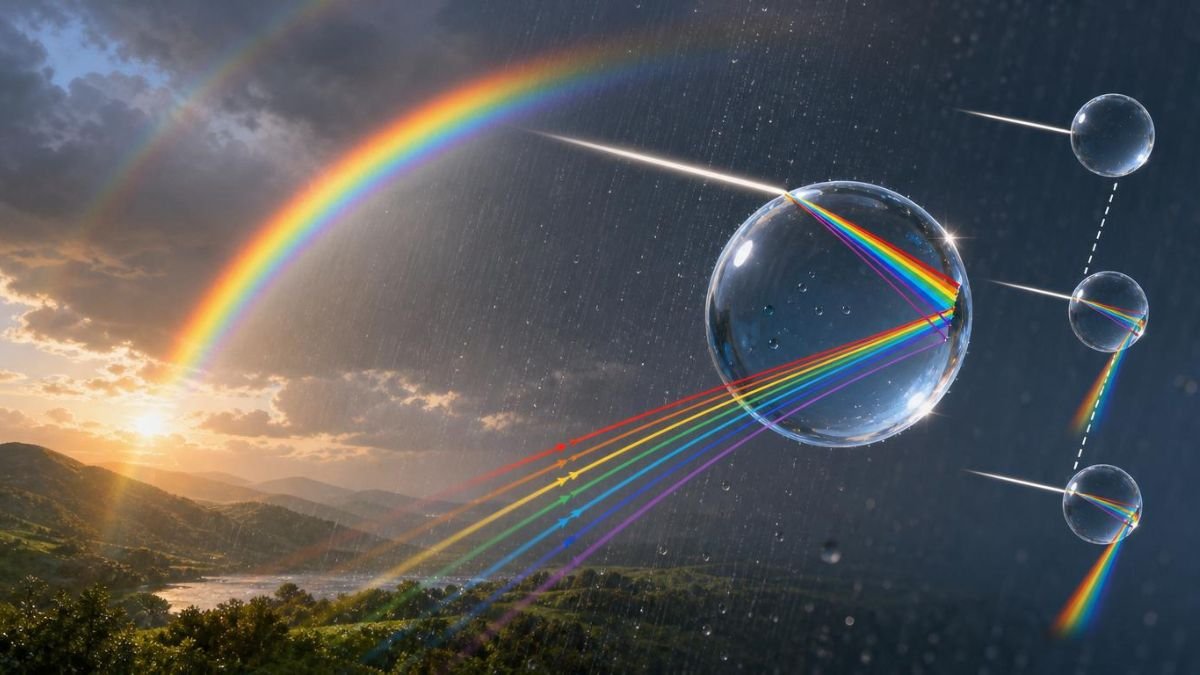
A rainbow begins with a droplet. A single, approximately spherical droplet of water suspended in the air after rain. When a ray of sunlight enters the droplet, it encounters a boundary between air (which has a relatively low refractive index) and water (which has a higher one). At this boundary, two things happen: most of the light enters the droplet, and as it does, it bends — this bending is called refraction. The amount of bending depends on the wavelength of the light: shorter wavelengths (violet and blue) bend more than longer ones (red and orange). This is why white sunlight, which contains all wavelengths, is separated into its component colors when it enters the droplet. The refraction at entry is the first step in creating the color separation that makes a rainbow visible.
Inside the droplet, the separated light travels to the back surface. There, some light passes through and exits — contributing nothing to the rainbow you see. But some of the light is reflected back toward the front of the droplet. This internal reflection is the second critical step. The reflected light then travels to the front surface of the droplet again, where it refracts a second time as it exits from the denser water into the less dense air. This second refraction adds additional separation to the colors that were already separated at entry. The combined effect of refraction at entry, reflection at the back, and refraction at exit produces a ray of colored light emerging from the droplet at a specific angle relative to the incoming sunlight.
That specific angle is the key to everything. For red light, the exit angle is approximately 42 degrees relative to the direction of the incoming sunlight. For violet light, it is approximately 40 degrees. These angles are not arbitrary — they are the result of the geometry of the sphere combined with the refractive index of water, and they are the same for every spherical water droplet in the atmosphere regardless of where it is. This means that for an observer standing in the rain, the red light they see is coming from all the droplets that are located at 42 degrees from the direction of the sun relative to their eye. The violet light comes from all the droplets at 40 degrees. The other colors come from the droplets between those angles. The rainbow arc is not a physical object located somewhere specific in the sky. It is the set of directions from your eye at which you receive colored light from raindrops. It is an optical phenomenon centered on your eye, which is why you can never reach the end of it — as you move toward where the rainbow appears to be, the angles adjust, and the rainbow moves with you.
This also explains why no two people ever see exactly the same rainbow. You and a person standing two meters away are seeing light from different sets of raindrops — the droplets at 42 degrees from your eye are not the same as the droplets at 42 degrees from theirs. The rainbow is not an objective feature of the sky at a specific location. It is a relationship between a specific observer, a specific light source, and the ensemble of water droplets between them. In a profound sense, every rainbow is private — it exists for the observer who is standing in the right geometric relationship to see it.
Sometimes, if conditions are right, you can see a secondary rainbow outside the primary one — fainter, with its color sequence reversed (red on the inside, violet on the outside), and with the space between the two rainbows appearing darker than the surrounding sky. This darker band is called Alexander's dark band, after the ancient Greek philosopher Alexander of Aphrodisias who first described it. The secondary rainbow is produced by light that undergoes two internal reflections inside the droplet rather than one — the extra reflection reverses the color sequence and loses more light intensity through additional reflection losses. Alexander's dark band is dark because the light that would fill it has been directed into the primary and secondary rainbow angles instead.
The fact that we can predict all of this — the color sequence, the arc angle, the existence and position of the secondary rainbow, the darkness of Alexander's band — from the laws of optics derived in the seventeenth century is one of science's most satisfying demonstrations. A rainbow is not mysterious. It is not random. It is not a miracle or a message. It is light behaving exactly as the laws of refraction and reflection require, producing an arc of color that exists at a specific and calculable angle from every observer who stands in the right relationship to the sun and the rain. And knowing this does not make the rainbow any less beautiful. It makes it more: the beauty is not diminished by understanding but deepened by it. The arc is the same arc it has always been, and now you know why.
The next time you see a rainbow, will you look at it differently — knowing that the arc you see is centered on your own eye, that the person standing next to you is seeing a slightly different rainbow, and that what you are actually watching is billions of tiny spherical water droplets individually performing the same optical operation at precisely the right angle to reach you? Does the explanation make it more wonderful, or has something changed?
Close Reading Analysis
Paragraph 1: "Have you ever stopped to wonder why rainbows are always the same shape?"
Question: the opening question focuses specifically on the consistency of rainbows ("always the same shape," "always the same color sequence," "always at the same angular distance"). Why is consistency — rather than beauty or rarity — the chosen focus for the opening hook?
Focusing on consistency is a specific choice that targets the scientifically productive aspect of the phenomenon. Beauty and rarity are qualities that invite admiration but not necessarily investigation. Consistency invites a specific scientific question: what law produces this consistent outcome? The question "why is this always the same?" is the question that science is designed to answer, and it is more cognitively activating than "isn't this beautiful?" because it has a specific answer that the article is about to provide. This is a technique in science writing of identifying the aspect of a phenomenon that opens the door to explanation — the hook is not just "this is interesting" but "this is interesting in a specific way that has a specific, discoverable answer." That specificity respects the reader's intelligence by offering them something to genuinely learn.
Paragraph 2: entry into the droplet:
Question: the paragraph says "shorter wavelengths (violet and blue) bend more than longer ones (red and orange)." Then it says "white sunlight, which contains all wavelengths, is separated into its component colors." What logical structure connects these two claims, and what does understanding this connection teach you about how to follow a scientific argument?
These two sentences form a logical chain: premise → consequence. The premise is the differential bending property of different wavelengths. The consequence follows necessarily from that premise: if different wavelengths bend by different amounts, then mixed light (white sunlight = all wavelengths mixed) will be separated into its components. The word "This is why" at the beginning of the second sentence explicitly marks the causal logical connection. In scientific explanation, the mark of genuine understanding is being able to reconstruct these logical chains — not just knowing that white light separates into colors in a raindrop, but knowing why it does (because different wavelengths have different refractive behaviors), and following the chain from physical property (wavelength-dependent refraction) to observable phenomenon (color separation). Practicing this chain-following is exactly what close reading of scientific explanation trains.
Paragraph 3: the internal reflection:
Question: the paragraph notes that some light passes through the back of the droplet and "contributes nothing to the rainbow you see." Why does the writer include this detail about what does not contribute to the rainbow, and what does it teach about how to write precise explanatory prose?
Including what does not produce the rainbow alongside what does is a precision move: it prevents a common misunderstanding (that all the light bouncing around inside the droplet creates the rainbow), and it specifically isolates the mechanism that matters (internal reflection rather than transmission). The inclusion of "contributing nothing to the rainbow you see" is a negative specification — it defines the relevant subset by excluding the irrelevant one. This is a valuable technique in explanatory writing: when a process has multiple possible outcomes but only one produces the effect you are explaining, name and dismiss the others explicitly. This prevents the reader from constructing a false model in which everything happening in the droplet contributes equally to the rainbow, which would then lead to confusion about why the color separation is so precise.
Paragraph 4: the 42-degree angle:
Question: the paragraph states "the rainbow arc is not a physical object located somewhere specific in the sky. It is the set of directions from your eye at which you receive colored light from raindrops." What is this definition doing philosophically, and why might this be the most important sentence in the article?
This sentence performs an ontological revision — it changes the category of thing the rainbow is. Most people experience the rainbow as an object in the sky: something located "there," with a position you could theoretically walk to. The sentence revises this: the rainbow is a set of directions from a specific observer's eye, not an object with an independent location. This is important because it explains why you can never reach the end of a rainbow (the directions adjust as you move), why no two people see the same rainbow (the set of directions is different for each observer), and why rainbows are not there when there is no one to see them (in the sense that a physical object is there). It is also a philosophically interesting statement about the relationship between observation and reality: the rainbow is observer-dependent in a way that most physical objects are not. This is a subtle but important point about the nature of perception, and it connects the physics lesson to the broader philosophical themes that characterize the best science writing.
Paragraph 5: "In a profound sense, every rainbow is private":
Question: the phrase "every rainbow is private" is a remarkable claim for a natural phenomenon. What does it mean, and why does the word "private" rather than "individual" or "personal" produce a stronger effect?
"Private" carries connotations of possession, intimacy, and exclusivity that "individual" or "personal" do not. "Individual" would mean "each person's rainbow is different." "Personal" would mean "each person has their own rainbow." "Private" implies that the rainbow belongs to you — that it exists in a relationship between you and the light and the rain that is not shared with anyone else. "Private" also suggests something that others cannot access, which is precisely correct: your rainbow is composed of light from droplets at specific angles relative to your eye, and no other observer stands in exactly the same relationship to those droplets. The choice of "private" over blander alternatives is a word-choice decision that adds emotional resonance without sacrificing accuracy — the rainbow is genuinely private in the specific sense the word implies.
Closing question:
"Does the explanation make it more wonderful, or has something changed?"
The final question is deliberately open-ended and somewhat provocative. "Or has something changed?" does not specify what has changed — it leaves open the possibility that understanding the mechanism might have altered the experience of beauty, removed some quality of mystery or transcendence that made the rainbow meaningful. This is an honest question: some people genuinely feel that scientific explanation diminishes the emotional experience of natural phenomena. The article has implicitly argued that explanation deepens rather than diminishes wonder, but the closing question does not force that conclusion — it holds the question open for the reader's own honest reflection. This is intellectually respectful: it presents an argument but does not demand agreement.
Speaking & Writing Challenges
Writing Challenge
Choose any natural phenomenon that you find beautiful or striking — a sunset, a lightning bolt, a tide, an eclipse, ice forming on a window — and write a 400–500 word explanatory paragraph that: (1) identifies the specific aspect of the phenomenon that invites a scientific question (focusing on consistency, pattern, or regularity), (2) explains the mechanism step by step, using at least one logical chain of premise-to-consequence, (3) includes at least one negative specification (what does not cause the effect), and (4) ends with a statement that revises the reader's category for what the phenomenon actually is. Avoid the word "beautiful" — show the beauty through precise description rather than asserting it.
Speaking Challenge
Prepare a two-minute explanation of rainbow optics for someone standing next to you while you both look at a rainbow. Your challenge: start with "look at that" and work from the observation to the explanation, going through refraction, reflection, dispersion, and the 42-degree angle in natural, accessible spoken language. At some point, include the observation that the person you are speaking to is seeing a slightly different rainbow than you are. The goal is to practice translating technical scientific understanding into the kind of spontaneous, engaged explanation that marks genuine comprehension — not recitation, but understanding communicated naturally.







0 Comments