
DANNY: There's a thing that happens when you correct someone about history at a dinner party. You say, casually, "You know nobody in the Middle Ages thought the Earth was flat," and the table goes quiet. And then somebody says, "No, come on. Columbus proved it was round." And you say, "He didn't. Everyone already knew. And the experts who argued with him were right about the thing they were actually arguing about." And now you're the difficult one. You've ruined the pudding.
But here's what gets me. That myth isn't ancient. It isn't some fog that rolled in over centuries. It has a birthday. It has an author. It has a publisher and a price and a print run. And tonight, the author is sitting across from me.
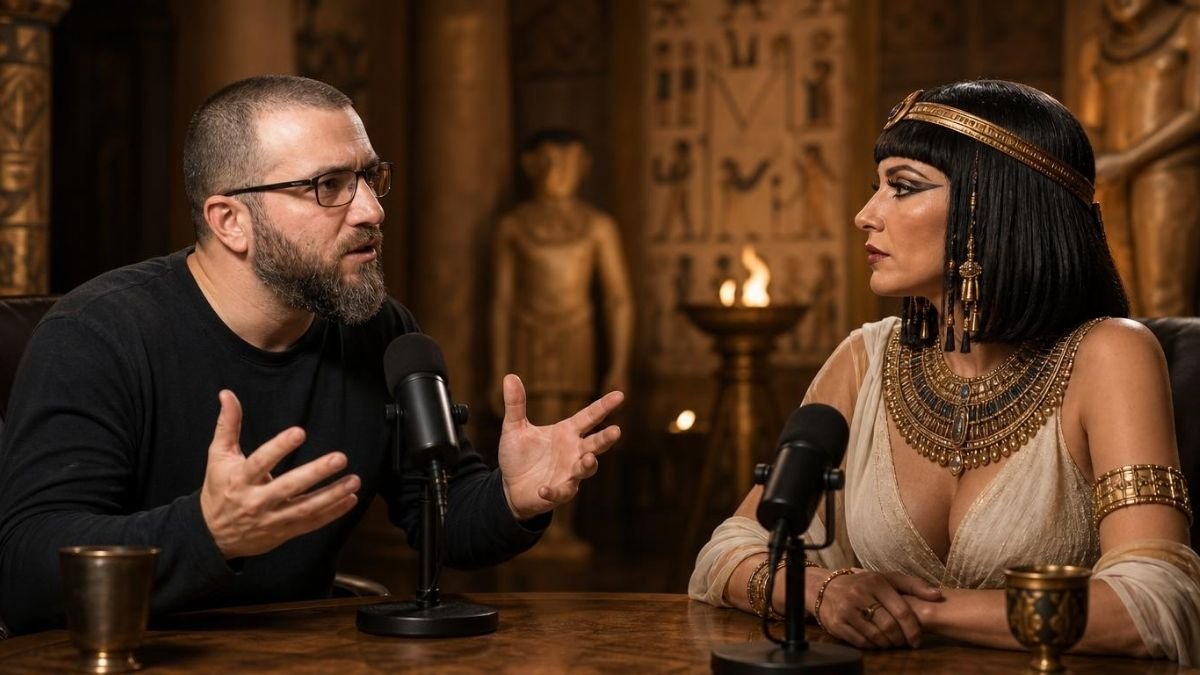
Welcome back to Danny's Debates. Tonight's guest is one of the most charming men who ever put a pen to paper in the English language. He's the reason you know what a headless horseman is. He's the reason there's a guy who fell asleep for twenty years in your cultural memory. He was the first American writer that Europe took seriously, and he did it by writing ghost stories about a valley outside New York and making the whole world believe those stories had always been there.
And in 1828, he wrote a biography of Christopher Columbus. A real one. Archival. Footnoted. Sourced. Four volumes. And somewhere in the middle of it, he staged a scene in a hall in Salamanca, where a lone visionary with a globe faces down a bench of churchmen who insist the world is a pancake. That scene has never been fact. It has also never stopped being true, in the way that only fiction gets to be true.
So. We're going to talk about what happens when a great storyteller is handed a stack of real documents. We're going to talk about whether you're responsible for what people do with your sentences after you're dead. And we're going to talk about the bigger, uglier question underneath all of it, which is whether it's ever okay to lie about somebody you have good reason to distrust.
Let's step into the void.
***
DANNY: Mr. Irving. Thank you for coming.
IRVING: The pleasure is mine, and I say that with the full understanding that you have not invited me here to be pleased with me.
DANNY: You caught that.
IRVING: I wrote for a living, sir, in an age when a man could be ruined by a bad notice. I know the sound of a knife being sharpened under a compliment. You called me charming. Charming is what a prosecutor calls a defendant before he calls him a liar.
DANNY: That's fair. Let me start somewhere easier, then. How did you end up writing about Columbus at all? Because you were not, by trade, a historian. You were the guy writing sketchbooks and folk tales and satires. You had a career. Nobody was waiting for your four-volume life of a Genoese navigator.
IRVING: No. Nobody was. In 1826 I was in Europe, and I was, if we are being honest, drifting. My family's business had collapsed some years before and taken the last of my illusions about commerce with it. I was living on my pen. And I received a letter from Alexander Everett, who was then our minister to Spain, telling me that a Spanish scholar named Navarrete was publishing a collection of documents concerning the voyages of Columbus. Original papers. Letters. Ships' records. Things nobody outside a Spanish archive had ever laid eyes on. Everett suggested I come to Madrid and render them into English.
DANNY: Translate them.
IRVING: Translate them. That was the commission. I went. I lodged in the house of Obadiah Rich, our consul, who had assembled a library of Spanish Americana that I think may have been the finest private collection on that subject in the world. I sat down with Navarrete's volumes and I read them, and I understood two things almost immediately. The first was that they contained an extraordinary human story. The second was that in the form they were in, no living creature outside a university would ever read a page of them.
DANNY: So you made an executive decision.
IRVING: I made a decision. I wrote to Everett and told him I would not translate the documents. I would write a life. A narrative. Something a man could take up in the evening and not put down.
DANNY: And there it is. Right there. That's the moment.
IRVING: That is the moment of what?
DANNY: That's the moment where the accident happens. Not the lie. The lie comes later. That's the moment where a man whose entire genius is for making things feel real gets handed the raw material of something that actually was real, and decides his job is the feeling.
IRVING: You say that as though it were a confession.
DANNY: I say it as though it were a diagnosis.
IRVING: Then permit me to complicate your diagnosis. I did not sit in Madrid inventing. I worked. I spent the better part of three years on that book. I read Navarrete. I read Ferdinand Columbus, the admiral's own son. I read Las Casas, whom almost nobody had read. I read Herrera, Muñoz, Peter Martyr. I obtained access to papers held by the family of the Duke of Veragua, who is Columbus's own descendant. I learned enough Spanish to quarrel in it. I produced a work with an apparatus of notes and appendices that ran to hundreds of pages, in which I argued about the location of landfall and the reliability of witnesses and the arithmetic of leagues. Whatever else that was, sir, it was not laziness.
DANNY: I'm not accusing you of laziness. Nobody's ever accused you of laziness. I'm accusing you of something much worse, which is competence.
IRVING: Competence.
DANNY: You were good at it. That's the problem. If you'd been a hack, if you'd written some breathless nonsense with no footnotes, it would have died in a decade. Instead you built a thing that looked like scholarship, sounded like scholarship, had all the furniture of scholarship, and then you put a piece of theater in the middle of it. And because everything around the theater was solid, the theater got treated as solid too. You laundered a scene through an archive.
IRVING: Which scene.
DANNY: You know which scene.
IRVING: I want to hear you say it. I want the charge read.
DANNY: Salamanca. 1486, roughly. Columbus is summoned before a commission convened by Ferdinand and Isabella to evaluate his proposal. In your telling, he walks into a hall, and arrayed against him are churchmen and professors, and they come at him with scripture. They quote him Lactantius, who mocked the very idea that there could be people on the other side of the Earth walking with their feet above their heads. They tell him that a round Earth is contrary to the faith. And Columbus, alone, patient, luminous, holds the line for reason against a wall of ecclesiastical fog.
IRVING: That is not what I wrote.
DANNY: That's what everyone read.
IRVING: Those are two different sentences and you have just let them touch as if they were one. I will not accept that.
DANNY: Then correct me.
IRVING: I will. I described the assembly. I noted that it included professors of astronomy, of geography, of mathematics, and that it included men of the Church, because in that century the two were not separate professions. I recorded that some of the objections raised were theological and some were geographical. I quoted Lactantius, yes, because Lactantius was quoted, and because his passage is a marvel of confident foolishness and I could not resist it, and I will not pretend otherwise. But I also wrote, in that same book, that there were learned men in that room who raised objections that were not foolish. That the question of distance was pressed against him. That he was met by men of real attainment.
DANNY: You did. That's in there. I'll say it on the record, because it's true and because half the people who attack you have never opened you. Your book is more careful than your reputation.
IRVING: Thank you.
DANNY: And it doesn't matter.
IRVING: Of course it matters.
DANNY: It doesn't, and I'll tell you why. Because you're a professional. You know exactly how a reader's memory works. You've built a career on it. When you write a scene, you know that the scene survives and the qualification evaporates. You know that a man can put a hedge in a subordinate clause on page 118 and no human being on Earth will carry that clause out of the building. What they carry out is the picture. The hall. The bench. The old men in robes. The globe. You gave them a painting and a caption, and you knew, because you're you, that nobody remembers captions.
IRVING: You are accusing me of understanding my craft.
DANNY: I'm accusing you of using it. Those aren't the same thing.
IRVING: Then what would you have had me do? Write a book so dull that its accuracy was safe because it was unread? There is a species of virtue in that, I grant you. It is the virtue of a locked door.
DANNY: I would have had you not stage the trial.
IRVING: The trial happened!
DANNY: The trial happened. The trial was about something else. And this is the part that kills me, Irving, this is the part I actually want people listening to hear, because it's better than the myth. Do you know what the commission at Salamanca actually said to Columbus?
IRVING: I know it very well.
DANNY: Say it.
IRVING: They said the ocean was too wide.
DANNY: They said the ocean was too wide. That's it. That's the whole objection. Nobody in that room stood up and said the world is a plate. What they said was: sir, we've read Ptolemy, we've read the Arab geographers, we've done the sums, and the distance you're proposing to sail is not the distance that exists. It is roughly four times the distance that exists. You will be at sea for months. Your men will die of thirst somewhere in an empty ocean and we will never hear from you again.
IRVING: And I recorded that objection.
DANNY: And they were right.
IRVING: They were right.
DANNY: Say it louder for the people at the back, because this is the whole ballgame. The Church committee was right, and the visionary was wrong. Columbus had done his arithmetic and his arithmetic was garbage. He'd taken al-Farghani, this ninth-century astronomer, who gives you a figure of about fifty-six and two-thirds miles for a degree of latitude. Perfectly good figure. In Arabic miles. Columbus read it in Italian miles. Those are not the same length. He shrank the planet by a quarter with a unit conversion error.
IRVING: And then he took Marinus of Tyre for the extent of Asia.
DANNY: And then he took Marinus of Tyre, who stretched Asia out to about two hundred and twenty-five degrees of the globe, when it's closer to a hundred and thirty. So he shrinks the Earth and then stretches the continent, and the ocean between them gets crushed down to almost nothing. He figured on maybe two thousand four hundred nautical miles from the Canaries to Japan. The real number is over ten thousand. He was not off by a rounding error. He was off by an ocean and a hemisphere.
IRVING: You are enjoying this a great deal.
DANNY: I'm enjoying it enormously. And I haven't even got to the good part. Do you want to tell them what else he was using? Because you read his marginalia. You know what was in his library.
IRVING: He used Pierre d'Ailly.
DANNY: He used Pierre d'Ailly's Imago Mundi, which he annotated so heavily his copy is basically a diary, and one of the things he took from it was a line out of the Book of Esdras saying that six parts of the Earth are dry land and one part is water. Which is scripture. He was using scripture as a source of navigational data. The man your book turns into the lonely rationalist facing down the superstitious clergy was doing sums with an apocryphal book of the Bible in his lap.
IRVING: He was a man of his time.
DANNY: He was more a man of his time than the clergy were. That's my point. Later in his life he wrote a compilation of prophecies. He believed he was an instrument of the end of days. He signed his name Christo Ferens. Christ-bearer. He thought the gold from the Indies was going to fund the recapture of Jerusalem and bring on the Last Days. That's not a proto-scientist. That's a mystic with a boat.
IRVING: You say that as if it diminishes him.
DANNY: I say it because you left it out.
IRVING: I did not leave it out. I found him strange and I said he was strange. I wrote that his imagination was of a kind that touched on the visionary. But you are asking me why I did not center the book on the least interesting version of him.
DANNY: I'm asking why you centered it on a version that never existed.
IRVING: Because a man in a room full of clever people who cannot see what he can see is a story that human beings have needed since we lived in caves! Because it is the shape of every conversion, every discovery, every act of courage anyone has ever committed! I did not invent that shape, sir. I found it lying in the material and I picked it up.
DANNY: You found it because you brought it with you.
IRVING: What?
DANNY: You brought it with you. That's what I think happened. You went to Madrid with the shape already in your pocket, because you'd used it before. As a joke.
IRVING: Ah.
DANNY: 1809. Nearly twenty years earlier. You publish a satirical history of New York under the name of a fictional Dutchman, Diedrich Knickerbocker, and to sell it you plant fake notices in the newspapers about a missing lodger. Actual hoax. Actual invented person. And in that book, in the mock-scholarly section where you're taking apart how Europeans justified taking America, you've already got the gag. The flat Earth. The learned fools. You'd been running that bit for two decades before you put it in a history.
IRVING: In a comic work.
DANNY: In a comic work. And then you moved it into a serious one and left the laugh track off.
IRVING: That is a very good line and it is not an argument.
DANNY: It's both.
IRVING: It is not, because you are supposing that a man who has made a joke about a thing may never afterward believe the thing. I quoted Lactantius because Lactantius exists. He is not my invention. Cosmas exists. The men who believed the Earth was a flat plain beneath a tented heaven were not conjured out of my inkwell.
DANNY: Okay. Let's do this properly, because this is the part where the audience actually learns something, and I want it clean. Lactantius. Fourth century. North Africa. Writes the Divine Institutes. And in it he mocks the idea of the antipodes, people on the underside, and he does it with real gusto. All true. Here's what's missing. He's writing around the year 310. That is not the Middle Ages. That's before the Middle Ages have arrived. And he wasn't a mainstream authority on the natural world. He was a rhetorician. His theology was considered shaky by people who came right after him. Jerome had notes.
IRVING: You are cherry-picking his reception.
DANNY: I'm giving him his actual size. Then Cosmas. Cosmas Indicopleustes. Sixth century, Alexandria. Writes the Christian Topography, in which the universe is shaped like the Tabernacle from Exodus, flat floor, vaulted lid. Genuinely a flat-earth cosmology, and a Christian one. Except it's written in Greek, it circulates in something like a handful of manuscripts, it has essentially no readership in the Latin West, and it doesn't get printed in the West until 1706. So when we say the medieval Church taught a flat Earth and we cite Cosmas, what we're saying is that a book almost nobody in medieval Europe could read taught a flat Earth to almost nobody.
IRVING: And Augustine? You will not put Augustine on my side of the ledger?
DANNY: No, and you know I won't, because Augustine doesn't say what people want him to say. He questions whether the far side is inhabited. That's a different argument. He's worried about whether anyone could have walked there from Adam, whether the apostles could have preached there. It's a theological anthropology problem, not a geometry problem. He isn't disputing the shape.
IRVING: Then give me your side of the ledger and let us see it.
DANNY: Gladly. Bede. Eighth century, a monk in Northumbria, about as deep in the so-called Dark Ages as you can get. He writes that the Earth is a globe. Not a disc, not a shield, a ball. And he works out that the tides are tied to the moon, which is a stunning piece of observation for a man in a monastery in the north of England. Then Sacrobosco, thirteenth century, writes a little book called On the Sphere, and it opens by demonstrating that the Earth is round, and it becomes the standard astronomy textbook at Paris, Oxford, Bologna, Vienna, for something like four hundred years. Every university student in Christendom for four centuries was taught the Earth is a sphere out of a book that begins by proving it.
IRVING: I am aware of Sacrobosco.
DANNY: Then Aquinas. And this one I love. In the Summa Theologiae, right at the start, first question, he needs an example of a fact that two different sciences can prove by two different methods. What does he reach for? The roundness of the Earth. The astronomer proves it one way, the physicist another. He reaches for it because it's the most obvious, uncontroversial, everybody-knows-this fact he can find. He's using it the way you'd use "water is wet."
IRVING: And Dante.
DANNY: And Dante, which is the one that finishes it for me. The entire architecture of the Divine Comedy requires a sphere. They climb down through Hell to the center of the Earth and gravity flips on them, because they've passed the middle, and they come out the other side under a different sky with different stars. That's a poem. That's popular literature. That's the medieval equivalent of a blockbuster, and it assumes a spherical Earth so completely it doesn't even bother to explain it, because the audience already knows.
IRVING: You have made your case.
DANNY: And the kings were holding the thing.
IRVING: The orb.
DANNY: The orb! Every coronation portrait for a thousand years. The monarch is sitting there holding a ball with a cross on it, and the ball is the world, and everyone in the room understands the symbol instantly, because everyone in the room knows what shape the world is. It's in their hands. Literally.
IRVING: And so you conclude that I fabricated.
DANNY: I conclude that you had all of this available to you and you built the scene anyway.
IRVING: No. Now you go too far, and I will not have it. You conclude that I had all of this available to me because you can see it laid out in three centuries of scholarship that had not been written when I sat down in Madrid. The correction you have just delivered so elegantly was assembled by men who came after me. Some of them came a hundred and sixty years after me. You are handing me a bill for a debt that was calculated long after my death and demanding I should have paid it in advance.
DANNY: That's a fair hit.
IRVING: It is more than a fair hit, it is the whole of the—
DANNY: It's a fair hit and I'll take it. But it doesn't get you out, and here's why. Because you didn't need three centuries of scholarship. You needed to read Ferdinand Columbus, who you did read, and notice that the objections he records are about distance and about whether a ship could sail back up the curve of the water. Which, incidentally, is an objection that only makes sense if the water is curved.
IRVING: That is —
DANNY: That's the funniest part of the whole thing, actually. One of the real objections at the time was: fine, the world is round, but if you sail down the bulge of it, how do you climb back up? That's an anti-Columbus argument that requires a round Earth to work. It's in the sources. You read the sources. And you still built a hall full of men who think the world is flat.
IRVING: I built a hall full of men who were wrong. Which they were.
DANNY: About the wrong thing!
IRVING: And you believe the distinction survives contact with a reader.
DANNY: I believe you're the one person alive who knew it wouldn't.
IRVING: Then let us speak plainly about what you actually think I did, because we are circling. You think I knew the scene was better than the truth, and I chose the scene, and I dressed the choice in footnotes so that no one would examine it.
DANNY: Yes.
IRVING: And you think I did it for money.
DANNY: I think Murray paid you three thousand pounds for that book and you were a man who had lost everything and was living off his pen in a rented room in Madrid, and I think if you tell me that number had nothing to do with the temperature of your prose, I'm going to have a hard time with it.
IRVING: I will not tell you that. I was poor. I had been rich and then I was poor, which is a particular flavor of poor. I needed the book to sell. I have never once claimed to be above that and I find the men who claim it to be liars of a more contemptible kind than any I have been accused of being.
DANNY: Thank you.
IRVING: But you must not confuse the motive with the method. A man may need money and also be careful. The two are not opposites. Most careful work in the history of the world has been done by people who needed money.
DANNY: Then let me put the thing that I actually can't get past. Because everything so far, I can argue myself out of. The commission, the poverty, the scholarship that didn't exist yet, all of it, I can build you a defense. But there's one fact I keep coming back to and it's the reason I wanted you here.
IRVING: Then produce it.
DANNY: A year after the four volumes came out, you produced an abridgment. Yourself. One volume. Cut down for schools and for general readers. And you made the cuts.
IRVING: I did.
DANNY: You sat with that manuscript and you decided what got to live and what got to die. You cut appendices. You cut the arguments about landfall. You cut the wrangling over sources and leagues. The apparatus went. All that careful furniture went. And the scene at Salamanca survived.
IRVING: ...
DANNY: You could have cut it. It's not load-bearing. The narrative works without it. You had a knife in your hand and a specific instruction to make this thing shorter and simpler and suitable for children, and you left in the one part that wasn't true and took out the parts that were the proof you'd done your homework.
IRVING: You have thought about this a great deal.
DANNY: I've thought about almost nothing else for a month.
IRVING: Then I will answer it honestly, and the honest answer will not please you. I left it because it was the best scene in the book. That is the whole of it. There is no darker motive underneath. A man cutting his own work cuts what is weak and keeps what is strong, and he does it by feel, in an afternoon, and he does not sit in judgment over each paragraph as though eternity were watching. I was not thinking of 1892. I was not thinking of your century. I was thinking that a boy of twelve would remember the hall and would not remember the appendix on leagues, and I was right, and I kept the hall.
DANNY: That's the confession.
IRVING: It is not a confession, it is a description of editing. Every man who has ever shortened anything has done what I did. Including you. You will cut this conversation.
DANNY: I'll cut this conversation.
IRVING: And you will keep the part where I raised my voice.
DANNY: I'll keep the part where you raised your voice.
IRVING: There. We are the same animal. The difference between us is two hundred years and a microphone.
DANNY: Then let's follow it downstream, because what happens after you is where this stops being a literary argument and starts being something worse. Your scene doesn't stay in your book. In 1834 a French scholar named Letronne publishes an essay on the cosmology of the Church Fathers, and he takes the handful of genuine oddballs, your Lactantius, your Cosmas, and presents them as if they were the standard view. Now the myth has an academic passport as well as a popular one. Then 1874, John William Draper, an American, publishes a book called the History of the Conflict Between Religion and Science. And the title is the thesis. It's not a study of a relationship, it's an indictment. Then 1896, Andrew Dickson White, first president of Cornell, publishes A History of the Warfare of Science with Theology in Christendom. Warfare. That's the word he picks.
IRVING: And you hold me responsible for two men I never met, one of whom was born after my book was published.
DANNY: I hold you responsible for the ammunition.
IRVING: Ammunition is not a crime. A man who sells a knife is not the man who used it.
DANNY: A man who sells a knife didn't write the story about how good it would feel.
IRVING: Then let us examine your two gentlemen, because you have introduced them and I will not let them stand there looking respectable. Draper writes in the eighteen seventies. What has just happened in Rome, sir?
DANNY: The First Vatican Council. Papal infallibility, 1870.
IRVING: The doctrine of infallibility. And Draper is an American Protestant of a scientific cast of mind watching the See of Rome declare itself incapable of error in matters of faith, and he responds with a book announcing a war. That book is not a work of history that happened to become polemic. It is a polemic that put on the clothes of history, and it did so in a decade when anti-Catholic feeling in your country was a political force with torches. And White, at Cornell, is founding a university that has taken the position of being nonsectarian and is being attacked for it by the pulpits, and he writes a book proving that the pulpits have always been on the wrong side of everything. These men had their own furnaces. They did not need mine to keep warm.
DANNY: No. But they were glad it was burning.
IRVING: Everyone is glad of a fire they did not have to light. That is not the same as arson.
DANNY: Okay, so let's have the real argument, because this is the one I actually care about and it's bigger than you. The question is whether an attack on religion gets a free pass on accuracy because the target has it coming. And I want to be careful here, because I don't want anybody listening to think this is a defense of the institution. It isn't. I'm not carrying water for anybody's chancery.
IRVING: Then what are you defending?
DANNY: The rules. I'm defending the rules. My position is that if you're going to indict something, and the something has genuinely done monstrous things, you still have to indict it for what it did.
IRVING: And what did it do? Say it. Do not let it stand as a shape in the fog. If you are defending the rules, you must lay the true charges out, or you are simply another man arranging a scene.
DANNY: Fine. Bruno gets burned alive in the Campo de' Fiori in 1600. Not for heliocentrism, whatever the posters say, he was condemned on theological grounds, the Trinity, the divinity of Christ, transmigration of souls. But he was still burned alive in a public square by a court, and the fact that the charge sheet was theological rather than astronomical does not make the fire cooler. Galileo is genuinely tried, genuinely forced to abjure, genuinely spends the last years of his life under house arrest, and the fact that he was also arrogant and picked a fight and put the Pope's argument in the mouth of a character called Simplicio doesn't make that acceptable. The Index existed. Books were burned. And on the Protestant side, before anybody gets comfortable, Calvin's Geneva burned Servetus, so nobody's hands are clean. And witch trials killed tens of thousands of people, most of them women, most of them poor, across confessional lines, for a crime that does not exist.
IRVING: Good. Now you have said it, and having said it, tell me why you have spent an hour defending the men at Salamanca.
DANNY: Because none of what I just listed is the flat Earth. That's the point. The bill of indictment is long and real and horrifying and you could read from it for an hour without repeating yourself, and out of that entire list, the single thing that lodged in the popular mind, the one every schoolchild can recite, is the one thing that never happened.
IRVING: And you find that a scandal.
DANNY: I find it a catastrophe. Because when the famous charge is the false one, you've handed the defense their whole case. Anybody who wants to dismiss the true charges now has a lever. They say, you people told us they thought the Earth was flat and that was a lie, so why would we believe you about the rest of it? You've made every real crime deniable by attaching them to a fake one.
IRVING: Then we agree.
DANNY: Do we?
IRVING: We agree entirely, and you should have seen it an hour ago. A false accusation is the greatest service you can render to a guilty man. I have made that argument my whole life in a hundred forms. Every counterfeit charge you lay is a receipt the accused can produce the next time a true one arrives. If the object is to hold power to account, then the lie is not a weapon in that cause. It is a defection to the other side.
DANNY: Then why did you write the scene?
IRVING: Because I did not believe I was writing an accusation!
DANNY: You were writing a trial scene about the Church.
IRVING: I was writing a scene about ignorance! And ignorance in that century wore a cassock because in that century everything wore a cassock! The lawyers wore it, the astronomers wore it, the men who kept the records and taught the boys their letters and copied out the ancients wore it! If I set a scene of learning in 1486 and the men in it are clerics, that is not an indictment of the Church, it is a fact about who could read!
DANNY: That's actually a great point and it cuts the other way.
IRVING: How does it cut the other way?
DANNY: Because if the Church was the institution that contained everyone who could read, then the Church was also the institution that funded, housed, and paid for basically all the science. That's not a defense I invented, that's just arithmetic. The universities are church foundations. Bologna, Paris, Oxford. Buridan working out impetus theory, which is a real step toward inertia, is a cleric. Oresme, who argues seriously about whether the Earth rotates and can't find a knockdown objection to it, is a bishop. Grosseteste is a bishop. Copernicus is a canon of a cathedral, and he does the work on church time, and he dedicates the book to the Pope. Mendel is an abbot in a monastery garden inventing genetics with pea plants. And the Big Bang, the actual expanding universe model, is proposed by Georges Lemaître, who is a Belgian priest.
IRVING: You are building me a monastery.
DANNY: I'm building a fact. And here's my favorite one, because it's so perfectly the opposite of the story. The Church needed to fix the date of Easter, which means they needed extremely precise solar observation. So they took cathedrals, actual cathedrals, and turned them into observatories. Drilled a hole in the roof, laid a brass meridian line across the floor, and used the building itself as a giant instrument to track the sun. There's one in San Petronio in Bologna. You could walk into a church and the church was a telescope.
IRVING: And this pleases you.
DANNY: It delights me. Because it destroys both cartoons at once. It's not the Church against science, and it's not the Church as the patron saint of science. It's just people, in an institution, doing what people in institutions do, which is fund what they need, suppress what frightens them, and take credit for whatever survives.
IRVING: Then I will ask you the question you have been avoiding.
DANNY: Go on.
IRVING: If the picture is as complicated as you say, why has your century, with all its instruments, not fixed it? The correction you gave me so beautifully, the Bede, the Sacrobosco, the Aquinas, that has been available in a popular book for over thirty years. A historian named Russell wrote it plainly. Others followed. It is not hidden. It is not expensive. In your age a child can retrieve it in the time it takes to speak a sentence into a machine. And yet you began this evening by telling me that if you say it at a dinner party you are the difficult one.
DANNY: Yeah.
IRVING: So the myth is not surviving on my strength. It has been dead thirty years and it will not lie down. Why?
DANNY: Because it's a better story.
IRVING: Louder, sir, for the people at the back.
DANNY: Because it's a better story. That's the answer.
IRVING: It is a better story, and there is your whole century's crisis in a sentence, and you have said it and not felt it. You imagine that the correction fails because people are lazy or because the schoolbooks are old. They are not. The correction fails because the truth of the matter is a committee saying the ocean is too wide, and the falsehood is one man against a wall of fools, and no arrangement of facts has ever defeated that shape and none ever will. I did not give the story its power. I found the power lying in the story and I was the man who happened to be holding the pen.
DANNY: And you'd do it again.
IRVING: I would write it better. I would not do it differently.
DANNY: That's a hell of a thing to say.
IRVING: It is an honest thing to say, and you have had very little honesty this evening because you have been too busy enjoying yourself. Now. I have listened. I have taken your charges. May I lay one?
DANNY: The floor's yours.
IRVING: You have spent this hour accusing me of taking a complicated age and reducing it to a single scene that is memorable and unjust. Of taking centuries of argument, of Bede in his cold cell and Aquinas in his lecture hall and Dante climbing through the center of the world, and flattening all of it into a picture of old men who did not know the shape of the ground under their feet. That is the charge. Have I stated it fairly?
DANNY: You've stated it fairly.
IRVING: Then tell me. What have you done to me?
DANNY: ...
IRVING: I wrote for fifty years. I wrote sketches and satires and tales and travels and four volumes on Columbus and a life of Mahomet and a life of Washington in five volumes that took me to the end of my strength and very nearly killed me, and I served my country as its minister in Madrid, and I was the first man of my nation whom Europe consented to read, and I opened a door for every American who came after me and wanted to be taken seriously with a pen in his hand. And you have come here tonight with one paragraph. One scene, from one book, out of a shelf of them. And you have built your Washington Irving entirely out of it. You have taken a life and reduced it to a single memorable and unjust picture.
DANNY: That's fair.
IRVING: It is more than fair, it is exact, and you know that it is exact, because it is the same crime, committed by the same method, for the same reason. You did it because the scene is better than the shelf. You did it because a man who invented a lie is a better guest than a man who wrote a great many books of which one contained an error. You have flattened me precisely as you accuse me of flattening the Middle Ages, and you have done it in an age that has every one of my volumes in its pocket, free, searchable, in an instant. I had to cross an ocean and learn a language and beg a duke for his papers. You had to type a name.
DANNY: You're right.
IRVING: I know I am right.
DANNY: No, listen. I want this on the record properly, because this is the part where I'm supposed to squirm and change the subject and I'm not going to. You're right. That's the actual method of the thing, and I do it. This show does it. I take a person, I find the sharpest edge of them, and I make the edge stand for the whole. And the reason I do it isn't malice, it's the same reason you kept Salamanca in the abridgment. Because a boy of twelve remembers the hall and not the appendix. Because I've got a listener with a commute and a limited amount of attention and I've got to earn it in the first ninety seconds or they're gone. So I reach for the scene.
IRVING: Then you understand me.
DANNY: I understand you completely. That's what's been bothering me all night. I came in here thinking I was going to prosecute a fabulist and about forty minutes in I realized I was interviewing my own job description.
IRVING: And what will you do with the realization?
DANNY: Nothing. That's the honest answer. I'll notice it and then I'll do it again next week, because the alternative is a show nobody listens to, which teaches nobody anything, which is a virtue like a locked door. Your phrase.
IRVING: My phrase.
DANNY: But I want to hold one thing back, because I don't think the symmetry is total and I don't want to give it away just because you made a beautiful speech.
IRVING: Then hold it.
DANNY: The difference is the correction. When somebody comes on this show and I've been unfair, or I get a hundred messages telling me I've butchered something, I can go back on the record and say I got it wrong. It's built in. The whole medium is a running argument with itself. Your book went out into a world where it was the only book on the subject that anybody was going to read, and it stayed the only book for the better part of a century, and there was no mechanism at all. You didn't have a correction. You had a reprint.
IRVING: That is true, and it is the only thing you have said tonight that I cannot answer.
DANNY: Then let me push it one more inch, because there's a second charge and I've been holding it.
IRVING: I thought there might be.
DANNY: Columbus in Hispaniola.
IRVING: Ah.
DANNY: Your Columbus is a noble dreamer, and when things go wrong on the islands, the wrongs are done by lesser men around him, by greedy settlers and jealous rivals and a Crown that abandons him. He's betrayed. He's a tragic figure. He's put in chains and shipped home and the chains are the great injustice of the story.
IRVING: He was put in chains. That is not an embellishment.
DANNY: He was put in chains. By a royal investigator named Bobadilla, who was sent out because the complaints coming back had gotten so bad the Crown had to act. And in 2006, a scholar found Bobadilla's actual report in the archive at Simancas. Forty-odd pages of testimony. And the testimony is not about jealousy. It's about a governor's regime that mutilated people. Cut hands off. Cut a woman's tongue out for saying the wrong thing about his ancestry and paraded her naked through the streets. Hanged Spaniards without trial. That's not the settlers. That's the administration, and he was the administrator.
IRVING: I did not have that document.
DANNY: You didn't have that document. You had Las Casas.
IRVING: I had Las Casas.
DANNY: You had Las Casas, who watched it happen, who wrote it down in appalling detail, who described the tribute system, the quotas of gold, the punishments for failing the quota, the collapse of an entire people inside a generation. You read him. You cite him. And in the book, the horror is a shadow at the edge of a portrait of a great man.
IRVING: Because I was writing a life of Columbus and not a history of the islands.
DANNY: That's a choice about what a life is.
IRVING: Every life is a choice about what a life is! You cannot write the life of a governor and also the life of everyone he governed, the book has covers, sir, it ends!
DANNY: And you wrote a saint.
IRVING: I wrote a man who I believed was great and who I believed was ruined, and I will tell you why that book was written in the shape it was written, since you insist on my motives. My country had no past. You must understand what that is. A nation of two generations with a heroic future and an empty behind. Everything ancient in our inheritance belonged to England, and we had just fought England twice. We needed a beginning that was ours and that was not Plymouth Rock, because Plymouth Rock belonged to New England and to one narrow kind of Protestant and not to the Dutch or the Irish or the Catholics or the men arriving every week on ships. And I gave them a Genoese, sailing under Spanish colors, a Catholic, a foreigner, a man of no nation, and I made him the first American. Do you understand what that did? I built a founder who did not exclude the newcomer, because he was a newcomer.
DANNY: And in 1892 they threw a party.
IRVING: I imagine they did.
DANNY: Four hundredth anniversary. Enormous. There's a world's fair in Chicago the next year that basically invents the modern idea of a world's fair. And a man writes a short pledge for schoolchildren to recite at the flag as part of the celebration, and that pledge is still being said in classrooms this morning. Your figure went from being a character in a book to being load-bearing in the national religion.
IRVING: And now?
DANNY: And now they're taking the statues down.
IRVING: I see.
DANNY: All over the country. Some cities have swapped the holiday out entirely. And the argument for taking them down is exactly the Bobadilla report and exactly Las Casas, which means it's an argument you had access to and softened.
IRVING: So I am blamed for building him up and blamed again for the violence of his coming down.
DANNY: Yes. And I don't think that's unfair, actually. If you put a man on a pedestal that high using materials that good, you own some of the fall. The higher the pedestal, the more it costs to remove it, and the cost is being paid now by people arguing with a version of him that you assembled.
IRVING: Then let me say the last thing I have to say on it, and you may keep it or cut it as you like, since we have established that you will cut it. I did not lie about the islands. I chose. And a choice is a smaller sin than a lie but it is a longer one, because a lie can be found out and corrected in an afternoon and a choice about what a story is has to be argued about for two hundred years. Yours is the generation doing the arguing. That is not a punishment. That is the work. Every generation gets handed the previous one's choices and has to decide what to do with them, and the ones who complain about it are the ones who have not yet noticed they are making choices of their own that someone will be furious about in 2226.
DANNY: What do you think they'll be furious about?
IRVING: I have no idea, and neither do you, and that is precisely why you should be gentler with me than you have been.
DANNY: I've been pretty rough.
IRVING: You have been rough and you have been fair, which is a rarer combination than either alone, and I would rather be cross-examined by a man who has read me than praised by a man who has not.
DANNY: Then let me give you the last word on the big one. The real question. Is it ever okay to lie about something you're sure is bad? Because that's the thing underneath all of this, and it's not a question about the fifteenth century, it's a question about Tuesday.
IRVING: No.
DANNY: That's it? No?
IRVING: I will give you the reason and then you may have the elaboration if you want it, but the answer is no, and I say that as a man who has spent his life in the manufacture of pleasing untruths and who is therefore, I would suggest, better qualified to answer it than the honest men.
DANNY: Give me the reason.
IRVING: Because you cannot aim it. That is the reason. A lie is not a tool, it is a weather. You release it believing it will fall on the guilty, and it does, for a while, and then it drifts. My scene was aimed, insofar as it was aimed at anything, at the pleasure of a reader on an evening in 1828. It fell on the Church, which was not innocent, and I confess I did not lose sleep. But it did not stop there. It fell on an entire age, and on every man in that age who did his work by candle and kept the ancients alive through centuries when it would have been easier to let them go. It fell on the students of Salamanca who did the arithmetic correctly and have been laughed at for two hundred years for being right. It fell on Bede, and on Sacrobosco, and on Aquinas, and on Dante, and none of them were the target and all of them were hit. And it fell on you, sir, on your century, which now cannot make a true accusation against that institution without someone in the room saying, ah, but you also told us they thought the Earth was flat.
DANNY: So the lie protects the thing it was aimed at.
IRVING: Every time. Given time. That is the mechanism and it has never once failed. If you wish to destroy a great institution, tell the exact truth about it slowly for fifty years. If you wish to preserve one for a thousand, tell one memorable lie about it and let its defenders find the lie.
DANNY: That's a better argument than I was expecting.
IRVING: You expected me to defend the falsehood.
DANNY: I expected you to defend the falsehood.
IRVING: I have never defended it. I have defended the man who wrote it, which is a different client, and I have defended the necessity of narrative, which is a different case again. You may find me guilty on the first count. I plead to it. What I will not accept is the sentence you came in with, which is that a man who tells a story is the enemy of a man who tells the truth. We are the same trade. We differ in our discipline, and discipline is a real thing and I lacked it in a particular paragraph on a particular afternoon in Madrid when I was poor and tired and the scene was good.
DANNY: And a boy of twelve remembers the hall.
IRVING: A boy of twelve remembers the hall. God help us all.
DANNY: Washington Irving. Thank you. Genuinely.
IRVING: You said you would avoid that word.
DANNY: I did say that.
IRVING: Keep it in. It is the only unguarded thing you have said all evening and your listeners will know it.
DANNY: And we're out.
***
DANNY: Okay. So. Let me tell you what I actually think, now that he's gone and can't take a swing at me for it.
I went into that wanting a villain. I had the whole thing mapped. Charming fraud writes fake scene, fake scene eats the world, we hang him. And about halfway through, the floor moved, because he made the one argument I didn't have an answer for, which is that I do the same thing. I do. This show is built on it. I take a life and I find the sharpest inch of it and I hold up the inch, because the inch is what you'll remember on your drive home. That's the deal. That's the whole business model, and he named it in about nine seconds.
But here's where I still think he's guilty, and I want to be precise about it, because precision is sort of the entire point of the episode. It's not the scene. The scene, on its own, is a novelist's flourish in 1828 and I can live with it. It's the abridgment. It's the moment he had the knife and cut out the proof of his own carefulness and left in the part that wasn't true, and sent it to schools. That's the moment the thing becomes load-bearing. That's the moment it stops being literature and becomes furniture in millions of heads.
And the bit I want you to actually take away, if you take one thing: the true story is better. It's better. A committee of experts telling a guy his math is wrong, and being right, and him going anyway, and finding two entire continents that neither he nor they knew were there, and dying still insisting he'd reached Asia. That's a stranger and funnier and more human story than the cardboard one about the brave man and the superstitious priests. He was wrong. They were right. He got lucky in the most spectacular way anyone has ever gotten lucky. And luck is a much more interesting engine of history than genius, because luck is honest about how the world works.
And the last thing, the one that isn't about Columbus at all. If you're going after something powerful, and it deserves it, and a lot of them do, use the real charges. Use the documents. Use the boring ones. Because the false accusation is the best gift you can hand your enemy, and they will keep it in a drawer, and they will produce it on the day you finally have something true.
So who took it? Did Irving walk out of here as a man who made an editing decision on a Tuesday and got unlucky with two centuries? Or is he the guy who put a lie in a schoolbook with his own hands and knew exactly what he was doing? Tell me. Wherever you found this, come and argue with me.
I'm Danny. That was Washington Irving, sort of. Go read a footnote.




0 Comments