Introduction
Have you ever looked up at the night sky and wondered whether someone, somewhere, once looked at the same stars and saw not points of light but a battlefield? That someone was a storyteller. And those stories — shaped over millennia across the mountains and deserts of ancient Persia — gave the stars names, gave the winds personalities, and gave heroes the weight of the entire cosmos on their broad, battle-scarred shoulders.
Persian mythology is one of the most overlooked treasure chests in the world's literary heritage. Sandwiched between the more familiar Greek pantheon and the endlessly discussed Norse legends, the myths of ancient Iran rarely get the spotlight they deserve. That's unfortunate, because Persian mythological tradition is staggeringly rich — cosmologically complex, morally sophisticated, and lit through with a dramatic intensity that rivals anything Homer ever wrote. At its heart is a cosmic dualism: the eternal war between Ahura Mazda, the lord of light and wisdom, and Angra Mainyu, the force of destruction and chaos. Every hero, every monster, every star in these stories is a piece in that grand chess game.
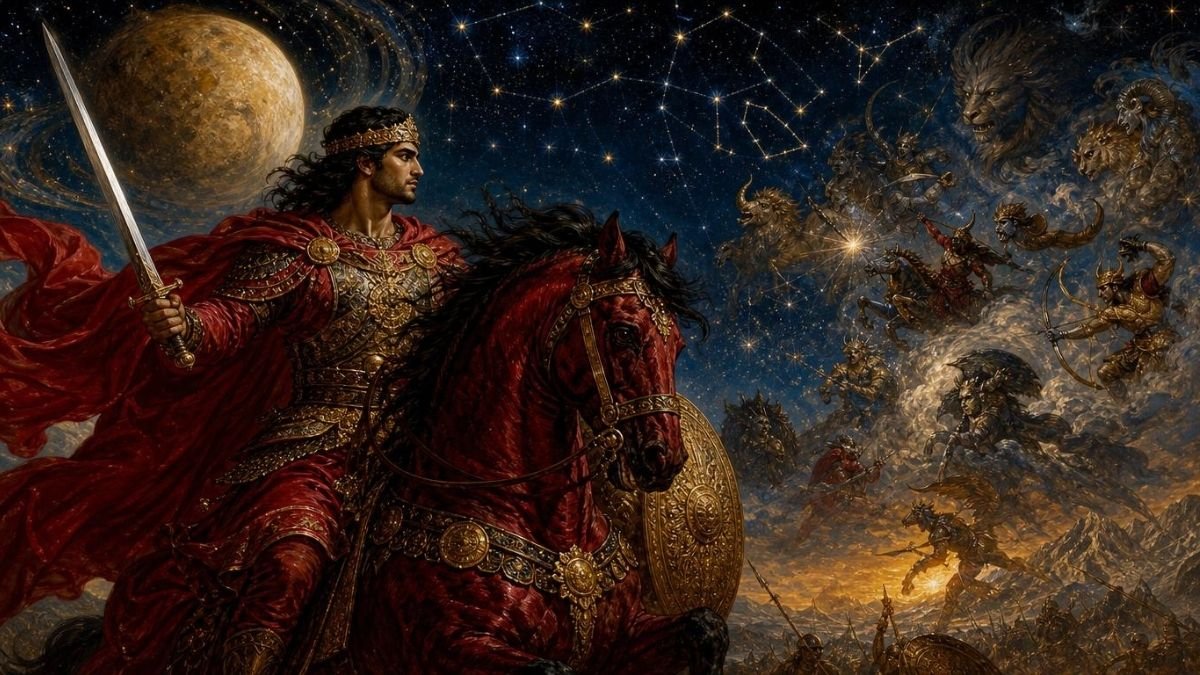
Enter Garshasp — the Crimson Warrior. His story, preserved in Persian epic poetry and Zoroastrian religious texts, is one of fire-lit courage, celestial battles, and a heroism so fierce it scorches the very sky. He is not a polished, philosophical hero. He is raw power in human form, the kind of hero who drags monsters across the landscape and fights demons with a club the size of a small tree. But underneath that spectacular violence is a carefully constructed worldview about what it means to live on the right side of the cosmos.
Today, we are going to do two things at once. First, we are going to tell you a genuinely good story — because that is always the first priority. But we are also going to peel back the layers of that story and learn something about how language, imagery, and structure work together to create meaning. This is close reading: the art of slowing down with a text, asking it hard questions, and listening carefully to what it says back. It is the single most effective practice for crossing that plateau that so many English learners get stuck on — somewhere between upper intermediate and truly advanced fluency. Skimming gets you through a page. Close reading gets you inside a mind. And right now, you are about to get inside the mind of an ancient Persian storyteller. Hold on.
The Article
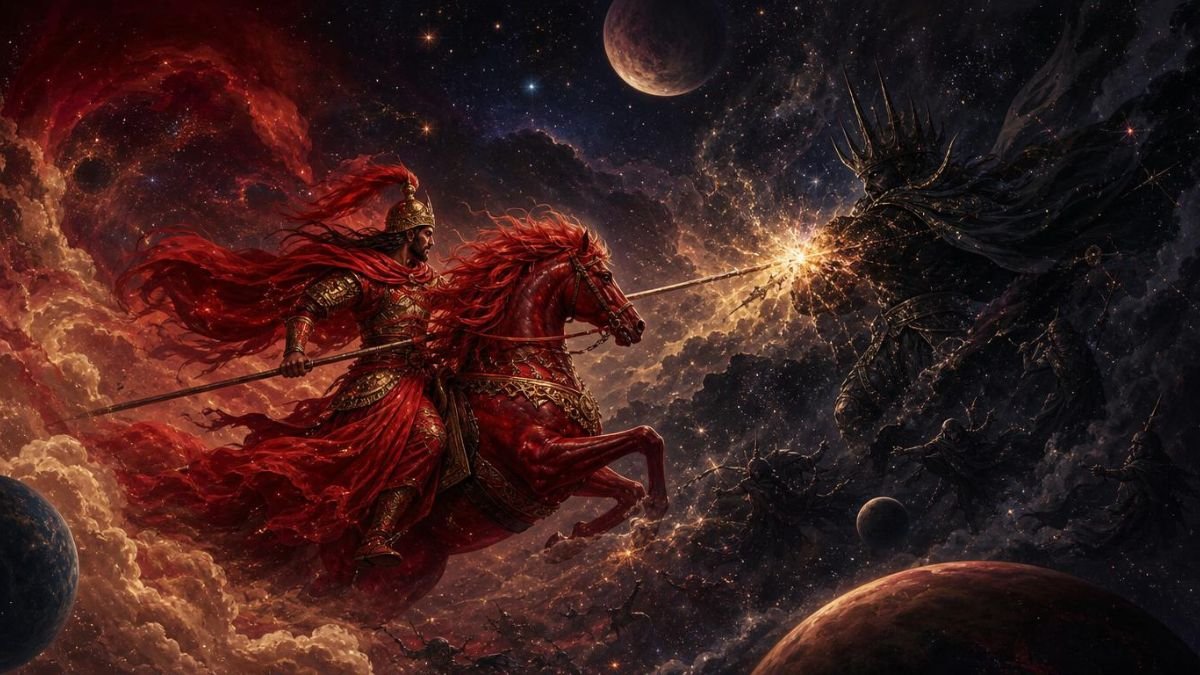
What if the greatest battles in history were never fought on the ground at all — but up there, among the wheeling stars, in a darkness so absolute that only a warrior blazing with divine fire could find his way through it? Persian mythology, one of humanity's oldest and most luminous storytelling traditions, has been asking that question for thousands of years. And the answer it gives us comes wrapped in the blood-red armor of Garshasp, the Crimson Warrior — a hero as ancient as the mountains of Iran and as vivid as a night sky on fire.
The Persian mythological universe is built on a foundation of cosmic dualism. Light fights darkness. Order fights chaos. Ahura Mazda, the Wise Lord, breathes life, wisdom, and truth into a universe that Angra Mainyu — the Destructive Spirit — endlessly seeks to corrupt and shatter. Every hero in the Persian tradition is, in some sense, a soldier in this cosmic war. But Garshasp is something else entirely. He is not a king managing a kingdom. He is not a sage puzzling through the nature of existence. He is a force of nature in human skin, the embodiment of righteous fury, and his battlefield stretches from the earth beneath your feet to the constellations wheeling overhead.
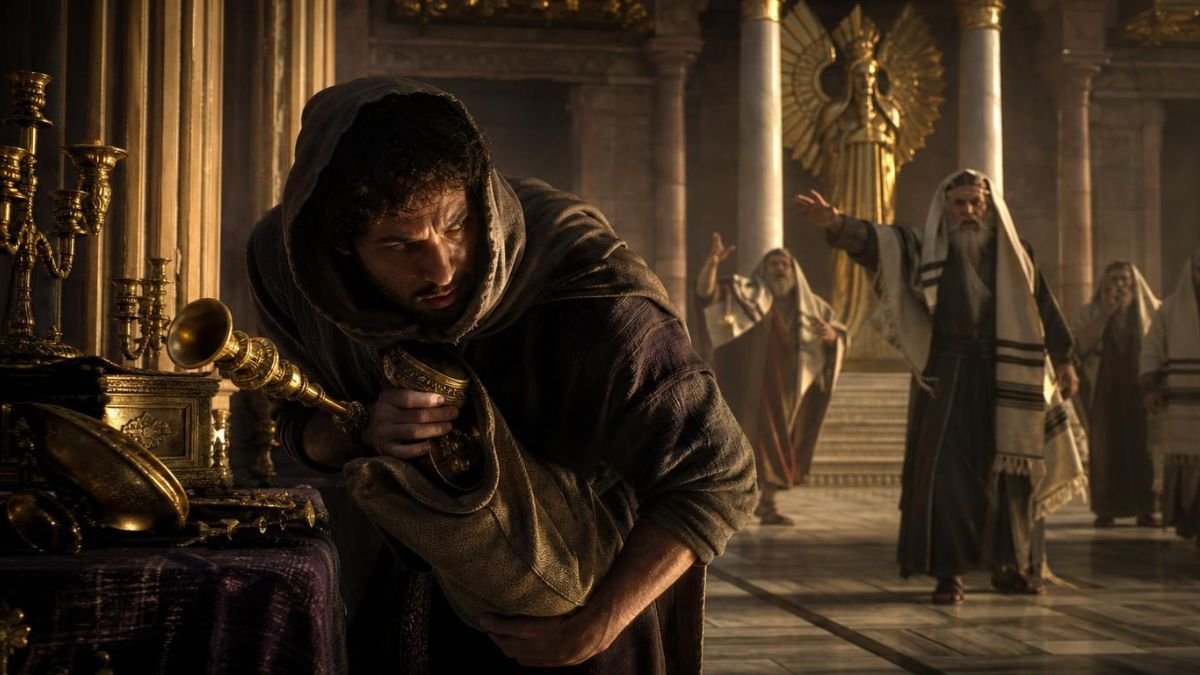
The legends of Garshasp come to us primarily through the epic poem Garshaspnama, written by the eleventh-century Persian poet Asadi Tusi, though the character himself is far older — rooted in the Avesta, the sacred Zoroastrian scriptures, where he appears as a semi-divine champion appointed by the gods to fight the creatures that threaten the order of creation. His name, often translated as referring to his tousled or rough hair, carries within it the wildness that defines him. This is not a man who combs his hair before battle. This is a man who arrives at battle like a storm.
The story of the Crimson Warrior and his battles among the stars centers on one of the most dramatic motifs in world mythology: the hero who must journey to the edge of the known world — and then beyond it — to face enemies that exist in a dimension ordinary mortals cannot reach. Garshasp, guided by the divine blessing of Ahura Mazda and armed with a legendary club passed down from the first heroes of creation, pursues a great serpent-dragon — the azi — not merely through the deserts and mountains of the physical world but into the celestial realm itself. The azi is no ordinary monster. In Zoroastrian cosmology, the serpent represents the corruption of divine order, the poisoning of truth. To destroy it is not merely an act of heroism. It is an act of cosmic maintenance.
What makes the celestial battle sequence in the Garshasp legends so compelling is the way the ancient storytellers understood the sky. For them, the stars were not passive decorations on the ceiling of the universe. They were active participants in the divine order, each constellation a position in the army of light. When Garshasp ascends into the heavenly realm to continue his pursuit of the great serpent, he is not merely performing a supernatural feat. He is taking his rightful place in the cosmic hierarchy — a mortal hero elevated by divine purpose to fight alongside the angels of light themselves. The battle he wages scorches the sky, which is, if you think about it, a magnificent explanation for why we see the stars arranged as they are: they are the marks of an ancient war that never fully ended.
The deeper wisdom in this myth is not about supernatural heroism at all. It is about the relationship between individual moral courage and the health of the cosmos. In Zoroastrian thought — the religious framework underpinning these myths — every human being participates in the cosmic battle between good and evil through their thoughts, words, and deeds. Garshasp is not a distant divine figure who fights so that ordinary people do not have to. He is an amplified reflection of the choice every person faces every day: to carry the fire of righteousness into the dark, or to let the dark win by default. His club is symbolic. His fire is symbolic. What they symbolize is the unconquerable will to choose the light.
There is also something deeply humanizing about Garshasp that distinguishes him from the impossibly perfect heroes of some other traditions. He makes mistakes. He offends the gods. In certain versions of his legend, he unknowingly commits a sacred transgression — killing a creature under divine protection — and must atone for it through extraordinary deeds. This is a morally complex portrait. The greatest hero in the Persian tradition is also a man who gets things wrong and must reckon with that. There is a modern resonance here that is hard to ignore: the idea that heroism is not the absence of error but the courage to keep going in spite of it.
The celestial imagery in the Garshasp cycle — the blazing battles among the stars, the serpent writhing through the heavens, the hero lit like a torch against the cosmic dark — has echoes in the shared mythological language of the ancient world. You can trace threads from Persian astral mythology into the later iconography of Mithraism, which swept through the Roman Empire, and into the Islamic poetic tradition that inherited and transformed so much of what Persia built. The Crimson Warrior did not stay politely inside the borders of one culture's imagination. Like all great myths, he escaped.
So what do you do with a story like this? You could simply admire it as a beautiful artifact of human imagination. Or — and this is the invitation the myth itself extends — you could ask what it says about your own battles. Not the ones fought with clubs in celestial realms, but the quieter, harder ones: the choices to be honest when dishonesty is easier, to protect when abandoning is simpler, to carry fire into the corners of your own life that have grown cold and dark. Garshasp fought among the stars. But the war he was really fighting has always been closer than the sky.
When you look up tonight and trace the slow arc of constellations across the dark, ask yourself: what would you fight for with that kind of fire? And more importantly — are you already fighting for it, even now, in the small and ordinary moments that nobody records in an epic poem?
Close Reading Analysis
Let's dig in, paragraph by paragraph. Get comfortable, because this is where the real work — and the real reward — happens.
Paragraph 1: "What if the greatest battles in history were never fought on the ground at all..."
Here's your first question: notice that the article opens with a hypothetical question rather than a statement. Why might a writer make that choice, and what effect does it have on you as a reader before you've read a single fact?
Second question: the phrase "wheeling stars" — what kind of word is "wheeling" grammatically, and why is it more effective here than simply writing "moving stars"?
The opening question is a deliberate rhetorical strategy called a hook — specifically, a speculative or hypothetical hook. Rather than announcing "Today we are going to talk about Persian mythology," the writer pulls you into a thought experiment. This works because questions activate the reader's mind differently than statements do. A statement delivers information. A question demands participation. You can't read "What if..." without your brain leaning forward. In close reading — and in your own writing — this is a crucial technique to internalize: engagement is not created by telling people things; it is created by making them think alongside you.
Now, "wheeling stars." The word "wheeling" is a present participle used as a modifier — an adjective derived from a verb. Its root verb is "to wheel," meaning to move in a circular or spinning path. By choosing "wheeling" over a static adjective like "bright" or even a simpler motion word like "moving," the writer gives the stars kinetic energy. They are not hanging there passively. They are turning, revolving, alive with motion. This matters thematically: the article is about a cosmology in which the stars are active participants, not passive scenery. Even the first paragraph's word choice is already doing that thematic work. That is sophisticated writing, and recognizing it is the beginning of sophisticated reading.
Paragraph 2: "The Persian mythological universe is built on a foundation of cosmic dualism..."
Question one: the sentence "Light fights darkness. Order fights chaos." consists of two very short, parallel sentences placed inside a longer paragraph. What is the rhetorical effect of this sudden shift in sentence length and structure?
Question two: Garshasp is described as "a force of nature in human skin." What kind of figurative language is this, and what does it reveal about how the writer wants you to visualize the character?
Those two short sentences — "Light fights darkness. Order fights chaos." — are an example of a rhetorical device called asyndeton combined with parallel structure. Asyndeton means the deliberate omission of conjunctions (you might expect "Light fights darkness and order fights chaos"), and parallelism means both sentences follow the same grammatical pattern (subject-verb-object). The effect of shortening the sentences so drastically is to create a drumbeat rhythm. It feels binary, absolute, like the clash of two forces that cannot coexist. This is not accidental. The writer is using sentence rhythm to mirror the content: dualism expressed through dual, symmetrical sentences. When you write about opposition, conflict, or contrast, consider whether your sentence structure can perform that opposition, not just describe it.
"A force of nature in human skin" is a metaphor — specifically a compressed one, which is sometimes called a conceit. It takes two normally incompatible categories (forces of nature, which are vast and inhuman, and human skin, which is intimate and finite) and fuses them. The effect is paradox: Garshasp is simultaneously bigger than human and unmistakably embodied. This is how the myth actually works too — the hero is a mortal vehicle for divine or cosmic energy. The metaphor is doing theology in six words. Watch for this technique in advanced writing: the ability to pack a complex idea into a tight metaphorical phrase is one of the clearest markers of C1 to C2 level writing ability.
Paragraph 3: "The legends of Garshasp come to us primarily through the epic poem Garshaspnama..."
Question: the phrase "This is not a man who combs his hair before battle. This is a man who arrives at battle like a storm." What makes this pair of sentences work so well, and what is the tone shift they introduce?
This couplet is doing something quite clever: it uses negative definition before positive definition. First we are told what Garshasp is not (the kind of hero who grooms himself, who is polished, controlled, concerned with appearance), and then we are told what he is (a storm). Defining something by what it is not first is a rhetorical technique that primes the reader — it clears away one image before installing a more vivid one. The contrast is also tonal: the image of combing hair is almost comically mundane, and placing it against "arrives at battle like a storm" makes the second phrase land with greater force. This is a technique you can use deliberately: establish a low-key, deflationary image first, then hit with your real description. The gap between the two creates the impact.
The simile "arrives at battle like a storm" is also worth unpacking. A storm is not chosen randomly. In Persian cosmological thinking, storms are associated with the divine power that disrupts and cleanses — the gods are often storm-linked. So the simile is culturally resonant, not just visually vivid.
Paragraph 4: "The story of the Crimson Warrior and his battles among the stars centers on one of the most dramatic motifs..."
Question: the article describes the azi's destruction as "an act of cosmic maintenance." What does the word "maintenance" usually describe, and why is it a surprising and interesting word choice here in the context of myth?
"Maintenance" is typically a technical or practical word — you do maintenance on a car, a building, a computer system. It suggests routine upkeep, the unglamorous work of keeping things functional. Placing it in the context of a cosmic heroic battle is deliberately jarring, and that jarring quality is the point. It reframes heroism: what looks from the outside like spectacular, mythic violence is, from the inside of the Zoroastrian worldview, simply the necessary work of keeping the universe running properly. This is a sophisticated critical insight — mythology often glamorizes what is, at its core, maintenance work. The hero is the cosmos's repairman. Recognizing that irony — and the word choice that produces it — is exactly the kind of analytical move that separates surface reading from deep reading.
Paragraph 5: "What makes the celestial battle sequence in the Garshasp legends so compelling..."
Question: the paragraph ends with a parenthetical thought: "which is, if you think about it, a magnificent explanation for why we see the stars arranged as they are: they are the marks of an ancient war that never fully ended." How does this parenthetical function, and what does it tell you about the writer's relationship with the reader?
The parenthetical — "if you think about it" — is an invitation. It signals that what follows is not an established fact but an interpretive observation, and it invites you to do your own thinking rather than simply receiving the writer's conclusion. This is a conversational, inclusive move: the writer is not lecturing, they are musing aloud with you. In your own writing, this kind of transparent reasoning — showing your thought process rather than just delivering your conclusion — creates intimacy and intellectual trust. It also encourages close reading in your audience, because it models the habit of pausing to think.
Paragraph 6: "The deeper wisdom in this myth is not about supernatural heroism at all..."
Question: the paragraph pivots on the phrase "not about... at all." How is this a structural pivot in the argument, and why is it rhetorically effective?
"Not about... at all" is a pivot construction — it explicitly announces that we are about to reframe what has come before. This is a classic essay technique: spend several paragraphs establishing one reading of a text or story, then pivot to a deeper or alternative reading using a negation. It works because it mimics the reader's own thought process. You've been following the story at one level; now the writer disrupts that comfortable reading and asks you to go deeper. The word "at all" is doing important emphatic work here — it's not a gentle redirect but a firm one. Pay attention when writers use emphatic negation like this. It almost always signals that the paragraph that follows contains the core argument.
Paragraph 7: "There is also something deeply humanizing about Garshasp..."
Question: the phrase "a man who gets things wrong and must reckon with that" — unpack the specific word "reckon." What does it mean, and why is it more powerful here than alternatives like "deal with" or "face"?
"Reckon" is a fascinating word because it carries two overlapping meanings. In its older usage, "to reckon with" something meant to take account of it, to acknowledge its weight in a ledger. In its more colloquial sense, it means to face or deal with. But the ledger connotation is still alive — it implies that there is a moral accounting, a balance sheet of deeds. Garshasp doesn't just face his mistake. He accounts for it, as if a moral debt must be repaid. This is deeply Zoroastrian in spirit: the tradition emphasizes moral accountability and the weighing of good and bad deeds. The word "reckon" carries that tradition in miniature. This is why vocabulary at the advanced level is not just about knowing more words — it is about understanding the layers of meaning and cultural resonance that specific words carry.
Paragraph 8: "The celestial imagery in the Garshasp cycle..."
Question: the sentence "The Crimson Warrior did not stay politely inside the borders of one culture's imagination" — what is the tonal effect of the word "politely," and what technique is this?
This is personification combined with irony. Myths do not literally behave politely or impolitely — that is a human quality being attributed to a cultural artifact. But the word "politely" does something very specific: it implies that myths, like people, can be untamed, transgressive, resistant to containment. And by calling their spread "not staying politely within borders," the writer gently mocks the very idea of cultural ownership of stories. There is a political undertone here — the idea that the greatest stories have never respected the borders that humans draw. The irony of using such a mild, domesticated word ("politely") to describe something as wild and expansive as the spread of mythology is a tonal choice that adds wit without sacrificing intelligence.
Closing Reflection Paragraph:
Question: the article ends with the second-person address "are you already fighting for it, even now, in the small and ordinary moments that nobody records in an epic poem?" What structural and rhetorical function does this final question serve, and why is ending with a question often more powerful than ending with a statement?
Ending with a question is one of the most powerful moves in personal essay and narrative journalism. A concluding statement delivers closure — it tells the reader what to think. A concluding question delivers the opposite of closure: it opens a door and puts the reader on the threshold. The reader cannot simply nod and move on; they must step through the door and continue thinking after the text has ended. Notice also that the final question explicitly bridges the mythological with the everyday: "small and ordinary moments that nobody records in an epic poem." This is the article's full argument in miniature — the myth is not distant from your life. The war Garshasp fought among the stars is the same war you fight in the grocery store, in the office, in the quiet moments before sleep. Closing with that bridge, in question form, sends the reader back into their own life with new eyes. That is what the best writing does. That is what you are practicing every time you read closely like this.
Speaking & Writing Challenges
Writing Challenge
Think of a personal challenge you've faced — or are facing right now — that felt (or feels) much larger than it looked from the outside. Write a 300–400 word narrative paragraph describing this challenge using mythological framing: treat yourself as a hero, the obstacle as a creature or force from a mythic universe, and the resolution (or the ongoing struggle) as a celestial battle. Use at least two of the rhetorical techniques discussed in today's analysis: a speculative hook question, parallel short sentences for impact, a compressed metaphor, or a closing question that opens outward rather than closes down.
Speaking Challenge
Choose any myth you know from your own cultural tradition — it does not have to be Persian. Prepare a two-minute spoken summary of the myth in which you: (1) tell the core story engagingly, (2) identify one key symbolic element and explain what it represents in the culture's worldview, and (3) make one explicit connection between the myth's themes and something in modern life. The goal is fluency AND depth — not just recounting the story but interpreting it as you speak. Record yourself if possible, and listen back for moments where your vocabulary became vague or your argument became unclear. Those are your growing edges.





0 Comments