
Magtalk Audio Podcast
The Winged Shadows Over the Battlefield
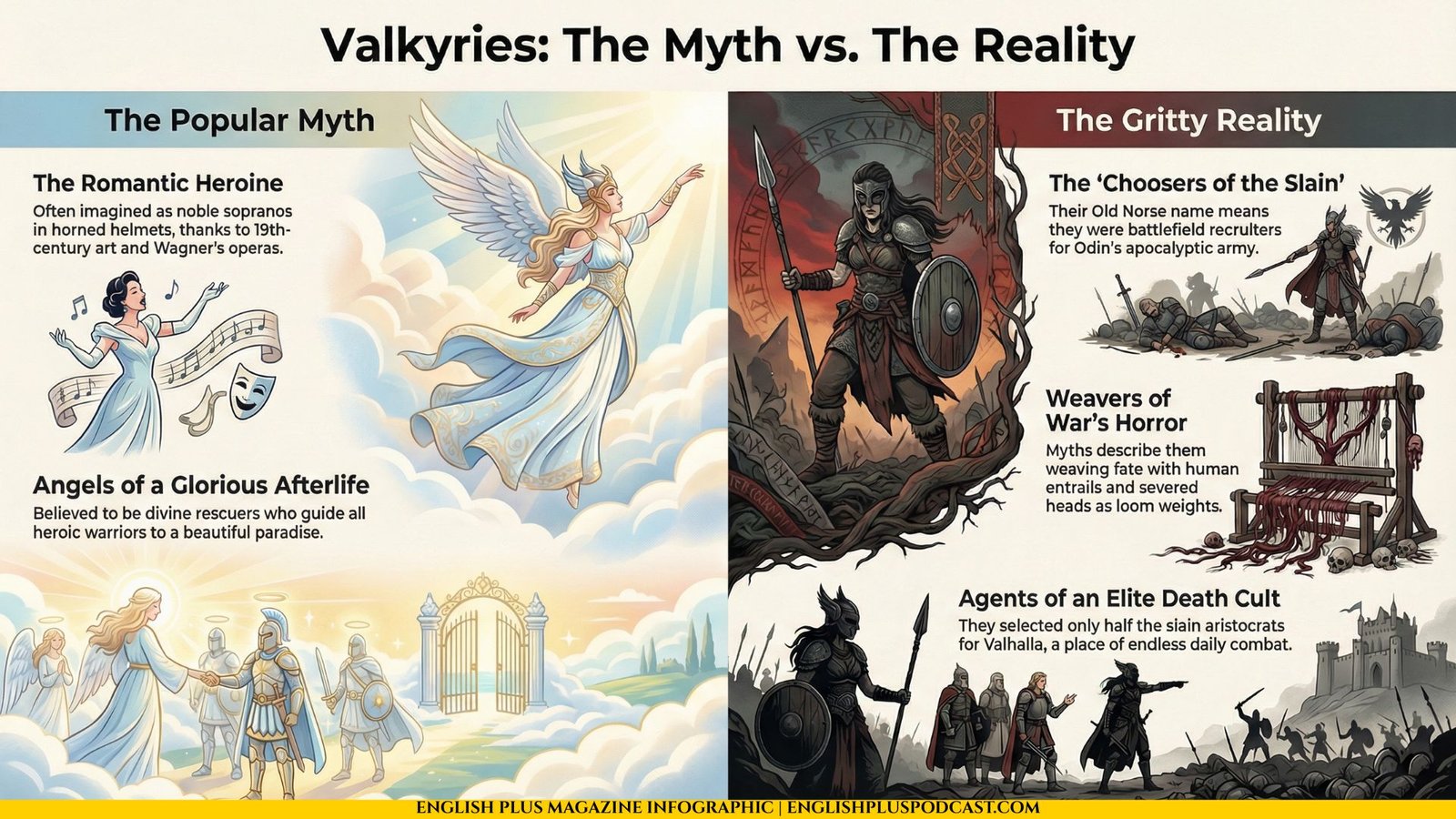
Let’s be honest, when most people think of Valkyries, they picture a hefty soprano in a horned helmet belting out high C’s until the glass in the opera house shatters. Thanks, Wagner. But the reality—if we can call mythology reality—is significantly grittier, darker, and frankly, much cooler than the Viking-themed cabaret act pop culture has sold us. We are talking about the “Choosers of the Slain,” a title that sounds less like a job description and more like a threat. These weren’t just celestial waitresses refilling mead horns in Valhalla; they were the terrifying arbiters of fate who decided who lived to see another sunrise and who ended up as a spirit warrior preparing for the end of the world.
To understand the Valkyries is to understand the Viking mindset. In a world where death was as common as a cold draft in a longhouse, you needed a system to make sense of the carnage. You needed to believe that getting an axe to the chest wasn’t just bad luck, but a divine appointment. Enter the Valkyries. They are the ultimate expression of fatalism wrapped in armor. They are the spirits that haunt the edge of your vision when the shield wall breaks. And while they serve Odin, the Allfather, they possess a fierce agency that makes them some of the most fascinating figures in the Norse pantheon.
The Etymology of Doom
Language tells us everything we need to know about the nature of these beings. The word “Valkyrie” comes from the Old Norse valkyrja. It is a compound word: valr referring to “the slain on the battlefield,” and kjósa, meaning “to choose.” They are literally the choosers of the slain. It is a functional name. It doesn’t imply mercy, kindness, or beauty. It implies a bureaucratic function of war. They are the selection committee for Odin’s private army, the Einherjar.
This etymology strips away the romanticism. They weren’t angels descending to save your soul; they were recruiters scanning the resume of your violence. Did you fight well? Did you die facing your enemy? Good, you’re hired. Did you cower behind a rock? Sorry, you go to Hel—quite literally, the realm of the dishonorable dead. This distinction is crucial because it highlights the transactional relationship the Norse had with their gods. You give blood and bravery; they give you immortality and free flowing ale. The Valkyries were the brokers of this deal.
Servants of the One-Eyed God
You cannot talk about the Valkyries without talking about Odin. The Allfather is a complex, often morally grey deity. He is obsessed with wisdom and preparation for Ragnarök, the twilight of the gods. He knows the world is going to burn, and he knows he needs an army to fight the wolf Fenrir and the giants. He can’t just have any rabble defending Asgard; he needs the elite.
The Valkyries are his extension on the mortal plane. Odin is often busy wandering the world in disguise or hanging from Yggdrasil to learn runes, so he delegates the battlefield management to the Valkyries. They are often depicted as his “wish maidens,” doing his bidding. But don’t let the word “maiden” fool you into thinking they were passive. In the poem Darraðarljóð, found in Njal’s Saga, Valkyries are described as weaving the web of war using human entrails for warp and weft, and severed heads for weights. It is a grotesque, visceral image that reminds us that war, for the Vikings, wasn’t glorious in a clean, cinematic way. It was bloody, messy, and terrifying. The Valkyries presided over this gore with a stoic detachment that is both chilling and awe-inspiring.
The Psychopomp Function
In mythology, a psychopomp is a creature or deity responsible for escorting newly deceased souls from Earth to the afterlife. The Grim Reaper is a psychopomp. Hermes in Greek mythology played this role. For the Norse, the Valkyries served this function, but with a VIP list. They didn’t take everyone. They only took half of those slain in battle.
Wait, only half? Yes. This is a detail often missed in the Marvel movies. Odin gets half the slain for Valhalla, but the goddess Freya gets the other half for her field, Fólkvangr. This split suggests a hierarchy or perhaps a division of labor that we don’t fully understand because so much of Norse mythology was lost or only written down centuries later by Christians like Snorri Sturluson, who may have tidied things up a bit. Regardless, the Valkyries were the ferrying agents. Imagine the battlefield falling silent, the crows descending, and then, the spectral arrival of these warrior women, picking through the corpses to find the “lucky” ones. It frames death not as an end, but as a transfer of station.
Shield-Maidens vs. Supernatural Specters
There is a blurry line in the sagas between human shield-maidens (skjaldmö) and supernatural Valkyries. Occasionally, human royalty or particularly fierce female warriors are conflated with Valkyries. This suggests that the Valkyrie wasn’t just a species of spirit, but a state of being that a woman could ascend to—or descend into—through immense rage or martial prowess.
Take the story of Brynhildr, perhaps the most famous Valkyrie. Her story is a tragedy of Shakespearean proportions, long before Shakespeare picked up a quill. She defies Odin—a career-limiting move if there ever was one—by striking down the wrong king in battle. Odin, being the stern father figure he is, punishes her. But he doesn’t kill her. Instead, he condemns her to sleep in a ring of fire until a hero brave enough (or foolish enough) to cross the flames wakes her up.
This narrative arc humanizes the Valkyrie. Brynhildr isn’t a faceless drone of fate; she has opinions. She makes choices. She suffers. When the hero Sigurd finally wakes her, it sets off a chain of betrayal, jealousy, and murder that eventually leads to the downfall of the entire Burgundian royal house. It shows that even the Choosers of the Slain are subject to the whims of fate themselves. It’s a delicious irony: the ones who decide destiny are trapped by it.
The Swan Maiden Trope
Another recurring motif is the Valkyrie as a swan maiden. In several eddic poems, we see Valkyries taking off their “swan skins” to bathe or rest, making them vulnerable to capture by men who steal their skins to force them into marriage. This is a folklore trope found all over the world, from Japan to Ireland, but in the Norse context, it adds a layer of vulnerability to these terrifying entities. It represents the tension between the wild, divine nature of the Valkyrie and the domestic constraint of human society. A Valkyrie forced to be a wife is a ticking time bomb. You can hide the swan skin, but you can’t hide the sky from someone born to fly in it.
The Evolution of the Image
How did we get from blood-soaked weavers of intestines to the romanticized, blonde-braided heroines of 19th-century art? The Christianization of Scandinavia played a massive role. As the old gods retreated into folklore, the Valkyries lost their terrifying edge. They became poetic metaphors for heroism. By the time we get to the Romantic era in Europe, artists were looking for symbols of national identity. The Valkyrie became a symbol of purity, strength, and a specifically Germanic type of nobility.
Then came Richard Wagner. His Die Walküre cemented the image of the Valkyrie in the popular consciousness. The “Ride of the Valkyries” is a piece of music so bombastic, so adrenaline-pumping, that it makes you want to invade a neighboring country just to hear it played loud. But Wagner’s Valkyries were largely tragic figures of high drama, stripped of the grim, corpse-choosing reality of the Viking Age. They became characters in a soap opera of the gods. While the art is magnificent, it acted as a filter, removing the grit and leaving us with the gloss.
Why They Still Matter
Why are we still talking about them? Why do video games, movies, and books keep returning to the well of Norse myth? It’s because the archetype of the Valkyrie satisfies a very modern craving. We live in a chaotic world where death often feels random and meaningless. The Valkyrie represents the idea that there is a judgment, a recognition of merit. They tell us that if we struggle, if we fight our own battles—whether physical, mental, or spiritual—someone is watching. Someone is keeping score.
Furthermore, the Valkyrie is a potent symbol of female power. In a historical context that was deeply patriarchal, the Valkyries were entities that even the strongest men feared and respected. They held the keys to the ultimate VIP lounge. They were armed, they were dangerous, and they were essential. They weren’t mothers or wives first; they were warriors and judges first. That resonates. It cuts through the noise of traditional gender roles and offers a vision of power that is raw and uncompromising.
The Darker Side of Heroism
However, we shouldn’t purely idolize them without critique. The system the Valkyries uphold is one of perpetual violence. Valhalla isn’t a paradise of peace; it’s a boot camp for the end of the world. The Einherjar fight each other to the death every day for practice, get resurrected, feast, and do it all again. It celebrates a cycle of destruction. The Valkyries are the enablers of this cycle. They perpetuate the idea that the only good death is a violent one.
In our modern context, where we are trying to move away from glorifying war, the Valkyrie stands as a reminder of a time when war was the only thing that mattered. It forces us to confront our own fascination with violence. We love the aesthetic of the Viking warrior, but would we want to live in a world where our worth is determined solely by how many people we can kill before we die? Probably not. The Valkyries are cool from a distance, but up close, they are terrifying agents of a death cult.
The Shadow of the Wings
The Norse myth of the Valkyries is a rich tapestry of fate, war, and magic. They are the Choosers of the Slain, the weavers of war, and the servants of the gallows god. They remind us of a time when the sky wasn’t empty, but filled with the beating of invisible wings, waiting for us to falter. Whether you see them as angels of death or demons of war, you cannot deny their power. They inhabit that liminal space between life and death, the moment where the breath leaves the body and the story begins. And as long as humans fight, as long as we struggle against the dying of the light, we will look up and wonder if anyone is there to choose us.
Reading Comprehension Quiz
Focus on Language
Part 1: Vocabulary and Speaking
Let’s dive right into the language because, frankly, discussing mythology is useless if we can’t articulate the nuances of it. We are going to look at ten keywords that came up in our exploration of the Valkyries. These aren’t just fancy words to impress your friends at a dinner party—though they will definitely do that—but words that carry weight and precision.
First up is Visceral. We used this when describing the weaving of the war web with entrails. It’s a gut feeling, literally. “Viscera” refers to your internal organs. So, when we describe something as visceral, we mean it triggers a deep, physical reaction, not just an intellectual one. If you watch a horror movie and you physically flinch or feel sick, that is a visceral reaction. In real life, you might say, “The politician’s speech triggered a visceral reaction in the crowd,” meaning it wasn’t about policy; it was about raw emotion and instinct.
Then we have Fatalism. This is the belief that all events are predetermined and therefore inevitable. The Vikings were fatalists; they believed their death day was written the moment they were born. In a modern context, you might meet someone who says, “There’s no point in applying for that job; if it’s meant to be, it’ll happen.” That is fatalism. It can be comforting because it removes responsibility, but it can also be paralyzing. Using it in a sentence, you could say, “His fatalism prevented him from trying to change his unhealthy habits.”
Next is Arbiters. An arbiter is a person who settles a dispute or has ultimate authority in a matter. The Valkyries were arbiters of fate. In our world, a judge is an arbiter of the law. A fashion designer might be an arbiter of taste. It implies a power to decide that others must accept. You might complain that “Social media has become the arbiter of truth for many young people,” which suggests a slightly dangerous shifting of authority.
We also talked about the word Bureaucratic. This is usually a boring word involving paperwork and red tape, but using it to describe the Valkyries is a bit of ironic juxtaposition. It means relating to the business of running an organization or government. When we said the Valkyries had a “bureaucratic function,” we meant they were just following procedures. In real life, you use this to describe overly complicated processes. “I gave up on getting a refund because the process was too bureaucratic.”
Conflated is a fantastic verb. It means to combine two or more texts, ideas, or sets of information into one. We mentioned how human shield-maidens were conflated with supernatural Valkyries. We do this all the time. People often conflate “fame” with “success,” but they aren’t the same thing. You might say to a colleague, “You are conflating the project’s cost with its value; just because it’s expensive doesn’t mean it’s good.”
Let’s look at Liminal. This is a favorite of literary critics and anthropologists. It relates to a transitional or initial stage of a process, or occupying a position at, or on, both sides of a boundary or threshold. The Valkyries exist in a liminal space between the living and the dead. Teenagers exist in a liminal state between childhood and adulthood. Airports are liminal spaces; you aren’t really in a city, you’re in a transit zone. “I feel like I’m in a liminal phase of my career; I’ve left the old job but haven’t started the new one.”
Stoic or Stoicism. This refers to the endurance of pain or hardship without the display of feelings and without complaint. The Valkyries presided over gore with stoicism. In real life, being stoic is often seen as a virtue, especially in leadership. “She remained stoic during the crisis, which helped calm the rest of the team.” It’s about keeping a cool head when things are burning down around you.
Archetype. This is a very recurrent symbol or motif in literature, art, or mythology. The Valkyrie is an archetype of the warrior woman. We see archetypes everywhere: the wise old man, the rebel, the caregiver. Recognizing archetypes helps us understand stories. “The movie relied too heavily on the ‘damsel in distress’ archetype, which felt outdated.”
Bombastic. We used this for Wagner’s music. It means high-sounding but with little meaning; inflated. However, in music or art, it can just mean over-the-top, loud, and dramatic. If someone gives a speech full of big words and dramatic pauses but says nothing of substance, you’d say, “The senator’s speech was bombastic but vague.”
Finally, Juxtaposition. This is the fact of two things being seen or placed close together with contrasting effect. Putting the beautiful, winged woman next to a bloody battlefield corpse is a jarring juxtaposition. In photography or design, juxtaposition is key. “The juxtaposition of the ancient ruins against the modern skyscrapers was striking.”
Now, let’s move to the Speaking Section. I want you to imagine you are telling a story about a time you had to make a hard choice—you were the arbiter of a difficult situation. I want you to try to use at least three of the words we just discussed. Maybe you had a visceral reaction to a problem, but you had to remain stoic. Maybe you felt a sense of fatalism about the outcome.
Here is a challenge for you: Record yourself for two minutes. Describe a modern profession as if it were a mythological role. For example, describe a tax auditor as a “Bureaucratic Reaper.” Use the words conflate, procedure (or bureaucratic), and arbiter. This exercise forces you to play with the tone. You are taking something mundane and elevating it with rich vocabulary, just like we did with the Valkyries. Don’t worry about being perfect; worry about being descriptive. If you can make a tax audit sound like an epic saga, you have mastered these words.
Vocabulary & Speaking Quiz
Part 2: Grammar and Writing
We are going to transition now into a writing challenge, and through this challenge, we will explore some essential grammar and writing techniques.
The Writing Challenge:
I want you to write a 300-word “Modern Myth.” I want you to take a regular, everyday event—like catching a bus, waiting in line for coffee, or dealing with a computer crash—and write it in the style of a Norse Saga. You need to elevate the mundane to the heroic. The bus driver isn’t just a driver; he is the Charioteer of the Asphalt. The coffee isn’t just a drink; it is the Black Elixir of Wakefulness.
Grammar and Writing Lesson:
To pull this off, you need to master a few specific tools.
First, let’s talk about Kenning. This isn’t strictly grammar, but it is a stylistic device essential to Norse writing. A kenning is a compound expression in Old English and Old Norse poetry with metaphorical meaning. For example, a ship is a “wave-steed.” The sea is the “whale-road.” In your writing challenge, avoid calling things by their common names. Don’t say “laptop”; say “The Glowing Slate of Knowledge.” Don’t say “smartphone”; say “The Voice-Catcher.” This forces you to think about the function of the object, not just its label.
Grammatically, this involves mastering Compound Nouns and Hyphenated Adjectives. In English, we often jam words together to create new meanings. “Battle-worn,” “Sky-treader,” “Doom-laden.” When you are writing your modern saga, use hyphens to create density. Instead of saying “The driver who looked tired and old,” say “The heavy-lidded, gray-bearded Charioteer.” See how much more punch that has? It compresses the description into a tight, rhythmic unit.
Next, focus on the Narrative Past Tense, specifically the difference between the Past Simple and the Past Continuous. Sagas are usually told as completed actions. “He struck the shield. The sword broke.” This is Past Simple. It creates a fast, staccato rhythm. However, to build tension, you need Past Continuous. “The wind was howling. The shadows were lengthening.” Use Past Continuous to set the scene, and Past Simple to deliver the action.
Example: “The commuters were shivering (Past Continuous) on the platform, their breath forming ghosts in the air. Suddenly, the Iron Worm arrived (Past Simple). The doors hissed (Past Simple) open.”
Notice the pacing? The continuous tense sets the mood; the simple tense drives the plot.
Another technique to use is Fronting. This is where you move a part of the sentence to the beginning for emphasis. Normal word order is Subject-Verb-Object (I saw a monster in the dark). Fronting changes this: “In the dark, a monster I saw.” Or even more saga-like: “Great was his anger.” “Loud was the crash.” This inversion sounds archaic and poetic. It signals to the reader that this isn’t a normal story. In your challenge, try to start a sentence with an adjective or a prepositional phrase rather than the subject. Instead of “The coffee was hot,” write “Hot was the brew, and bitter its taste.”
Finally, let’s talk about avoiding the passive voice—mostly. Generally, writing advice tells you to kill the passive voice. “The ball was thrown by John” is weak. “John threw the ball” is strong. In heroic writing, active voice is king because heroes do things; things don’t just happen to them. However, there is a trick. You can use the passive voice to describe fate or divine intervention, things out of the hero’s control. “It was ordained by the gods.” “The path was chosen.” Use active voice for your hero’s actions (“I snatched the last donut”), and passive voice for the obstacles fate throws at them (“The train was delayed”).
Tips for Success:
- Exaggerate: Hyperbole is your friend. A traffic jam is not annoying; it is “The Great Stagnation.”
- Remove “I think” or “I felt”: Sagas are about external actions, not internal whining. Don’t say “I felt sad that the wifi was down.” Say “A great darkness fell upon the house as the signal vanished.”
- Use Strong Verbs: Ban the verb “to be” (was/were) as much as possible. Don’t say “He was angry.” Say “He raged.” Don’t say “The bus was fast.” Say “The bus thundered.”
By applying these techniques—kennings, compound adjectives, deliberate tense switching, fronting, and strong verbs—you will turn a boring anecdote into a legendary tale. Give it a try.
Grammar and Writing Quiz
Critical Analysis
Now, I want to step back and put on my critic’s hat. We’ve spent a lot of time hyping up the Valkyries as these badass icons of female power and fatalistic glory, but if we are being intellectually honest, we need to poke some holes in that narrative. We need to look at what the article glossed over.
First, let’s challenge the “Female Power” angle. It is very easy to look at a woman with a spear and say, “Look, feminism in the Iron Age!” But is it? The Valkyries, ultimately, have no autonomy. They are servants. They are “Odin’s Girls.” They exist solely to facilitate the patriarchal structure of Valhalla, which is essentially a giant fraternity house for dead men. Even Brynhildr, the most rebellious of them, defines her existence entirely in relation to men—Odin, Sigurd, Gunnar. Are they agents of power, or are they just tools of a male-dominated hierarchy? It’s a perspective we didn’t explore enough. They reinforce the system; they don’t rule it.
Secondly, we need to talk about the classism of the afterlife. The article mentions that Valkyries choose the “slain.” But historically, who got to be “slain” in a way that mattered? The aristocracy. The Jarls. The professional warriors. If you were a peasant farmer who got stabbed while trying to protect your sheep, did a Valkyrie come for you? Probably not. You likely went to Hel. Valhalla was an elitist club. The myth of the Valkyries served to validate the ruling warrior class. It told the poor farmers that their deaths were meaningless, while the deaths of their lords were divine. It’s a propaganda tool for a military aristocracy, and we should be critical of how we romanticize that today.
Thirdly, consider the Psychological Trauma. We treat the “Chooser of the Slain” role as a job. But imagine the psychology of a being that only exists to witness death. The Valkyries never see peace. They never see construction, birth, or harvest. They only see the moment of destruction. If we analyze this through a modern psychological lens, the Valkyrie is a tragic figure of trauma. They are desensitized to suffering. Is that strength? Or is that a form of spiritual damage? The myth presents this detachment as divine, but a critical reader might see it as horrific.
Finally, let’s look at the Erasure of the Vanir. We briefly mentioned Freya getting half the dead, but we focused heavily on Odin. This is a common problem in Norse mythology studies—the “Odin-washing” of the myths. Freya is of the Vanir tribe of gods, while Odin is Aesir. The fact that the Valkyries (who serve Odin) have to share the dead with Freya suggests an older, perhaps matriarchal tradition that was assimilated by the Odin cult. By focusing so much on the Valkyries as Odin’s servants, we might be missing the older layer of myth where the goddess of death and fertility held the primary power.
Let’s Discuss
Here are five questions to spark some deep conversation. I want you to take these to the comments section or just mull them over with your morning coffee.
Is the “Valkyrie” an icon of empowerment or subservience?
Don’t just look at the armor. Look at who they work for. Can you be powerful if you don’t own your own destiny? Compare them to modern figures who have power but answer to a higher, perhaps oppressive, authority.
Does the concept of “Fate” (Wyrd) liberate us or enslave us?
If the Valkyries have already chosen your death day, does that make you brave (because you can’t change it) or lazy (because why bother trying)? Discuss the pros and cons of believing in destiny versus free will.
Why do we romanticize the “Warrior Culture” of the past?
We love Vikings in movies, but they were raiders and pillagers. Why do we filter out the suffering they caused and focus on the “glory”? Is it dangerous to glorify a culture built entirely on violence?
If you could design a modern “Valkyrie” for our society, what would they choose people based on?
The Norse valued martial bravery. What do we value? Kindness? Innovation? Wealth? If a spirit came to take the “best” of us today, what criteria would they use? This is a critique of modern values.
How does the “Beautiful Death” trope affect our understanding of mortality?
Valkyries make death look dramatic and meaningful. Real death is often quiet, painful, and ugly. Does mythology help us cope with death, or does it set us up for disappointment by promising a glory that doesn’t exist?



0 Comments