
Podcast Episode
The Funeral of the Corner Office
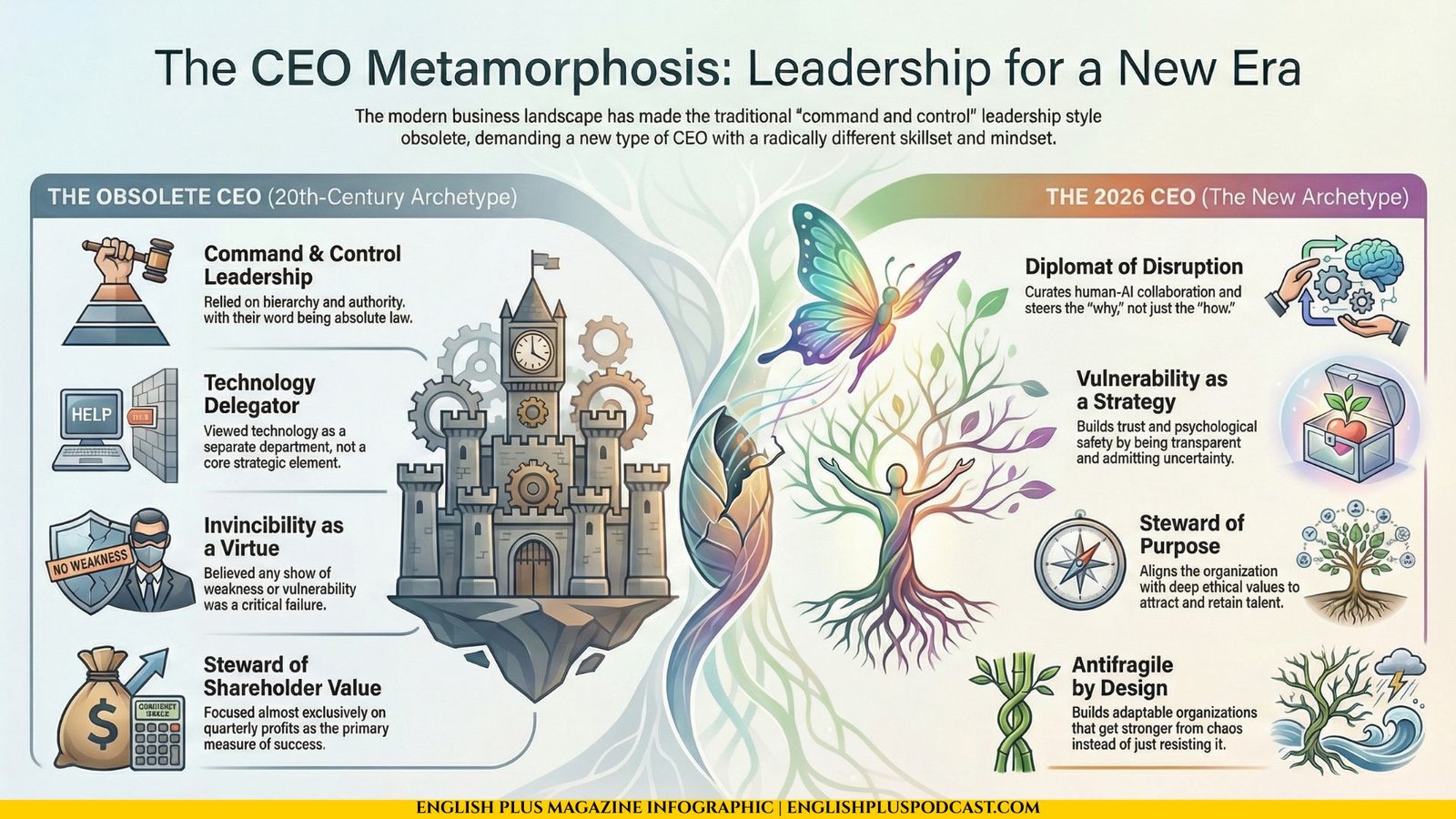
Let’s pour one out for the archetype of the 20th-century Chief Executive Officer. You know the one. The silver-haired patriarch sitting behind a mahogany desk the size of a small aircraft carrier, barking orders into a landline, surrounded by a fortress of secretaries. He was stoic, he was distant, and he was terrifying. He was the “Great Man” theory of history personified in a pinstripe suit. His word was law, his strategy was war, and his primary emotion was “quarterly profit.”
That man is obsolete. In fact, if you dropped him into a boardroom in 2026, he wouldn’t just fail; he would be eaten alive by the ecosystem.
The business landscape has shifted so violently in the last few years that the very definition of leadership has had to undergo a complete metamorphosis. We aren’t just talking about a change in style; we are talking about a change in substance. The tectonic plates of artificial intelligence, remote work dynamics, climate urgency, and a workforce that refuses to be treated like cogs have created a new continent. To survive here, the New CEO cannot be a general commanding troops. They have to be something far more complex: a diplomat, a tech-native philosopher, and a vulnerable human being, all rolled into one highly caffeinated package.
We often mistake titles for competence, assuming that because someone occupies the C-Suite, they know what they are doing. But right now, we are watching a real-time extinction event for the “Command and Control” leader. The hierarchy is flattening. The ivory tower has been demolished, and the New CEO is standing in the rubble, wearing sneakers, trying to figure out how to lead a team that is half-human, half-algorithm, and entirely distributed across six time zones.
The Diplomat of Disruption
The first and perhaps most jarring shift is the relationship with technology. For decades, it was acceptable for a CEO to say, “I have people for that,” when it came to tech. They handled the vision; the CIO handled the wires. That excuse is now a resignation letter.
In 2026, technology is not a department; it is the water the business swims in. The New CEO doesn’t need to know how to code Python, but they need a deep, intuitive understanding of the symbiotic relationship between human creativity and artificial intelligence. We are past the hype cycle where leaders just threw “AI” into every press release to boost stock prices. Now, the rubber meets the road.
The New CEO is a Diplomat of Disruption. They have to negotiate the delicate treaty between efficiency and humanity. When you have algorithms that can predict market trends faster than your best analysts and generative models that can write copy faster than your marketing team, the CEO’s job isn’t to drive productivity—the machines do that. The CEO’s job is curation and judgment. They have to answer the question that AI cannot: “Just because we can do this, should we?”
This requires a level of cognitive flexibility that the old guard simply didn’t possess. It requires being comfortable with being the dumbest person in the room regarding the “how,” but the wisest person in the room regarding the “why.” It is about steering the ship when the engine is evolving while you are driving it.
Vulnerability as a Weapon
If you told a CEO in 1995 to be “vulnerable,” they would have assumed you meant exposing a flank to a hostile takeover. Weakness was death. But in 2026, the facade of invincibility is a liability. We live in the age of radical transparency. Between social media leaks, internal Slack channels, and a general cultural shift toward authenticity, you cannot hide behind a corporate veil.
The New CEO understands that trust is the new currency, and you cannot build trust if you are a robot. We have seen a rise in leaders who admit mistakes publicly, who talk about their mental health, who acknowledge when they don’t have the answer. This isn’t “soft.” It is strategic.
When a leader says, “I don’t know, let’s figure it out,” they aren’t signaling incompetence; they are signaling safety. They are creating an environment where their team feels safe to experiment and fail. In an innovation economy, if your team is afraid to fail because the boss acts like a flawless god, you will stagnate. The New CEO weaponizes vulnerability to galvanize the workforce. They show their scars so the employees don’t have to hide theirs.
However, this is a tightrope walk. It is what we might call “bounded vulnerability.” No one wants a CEO who falls apart and weeps during an earnings call. That’s not leadership; that’s a breakdown. The art form lies in being relatable enough to be trusted, but resilient enough to be followed. It is about saying, “This is hard, and I am worried,” followed immediately by, “But here is the plan.”
The Steward of Purpose
Let’s talk about the “P” word. Purpose. It used to be the fluff section of the annual report, a few nice photos of the company charity picnic. Now, it is the primary retention strategy.
The workforce of 2026, dominated by Millennials and Gen Z, has a very sophisticated BS detector. They do not want to work for a soulless profit machine. They want to work for an organization that justifies its existence on this planet. The New CEO cannot just be a steward of shareholder value; they must be a Steward of Purpose.
This goes beyond “Greenwashing”—that old trick of painting the logo green and pretending to save the rainforest. We are talking about deep, structural ethical alignment. The New CEO has to make decisions that hurt the bottom line in the short term to protect the company’s soul in the long term. They have to navigate the minefield of social and political issues. Silence is no longer neutral; silence is viewed as complicity.
This is an incredibly difficult position. If you take a stand, you alienate half your customer base. If you don’t take a stand, you alienate your employees. The New CEO needs the wisdom of Solomon and the skin of a rhinoceros. They have to articulate a set of values that are not just marketing slogans but are actually used to make hiring and firing decisions. They have to look at the supply chain not just for efficiency, but for humanity.
The Remote Maestro
The debate about “Returning to the Office” is over. The hybrid model won. But leading a hybrid team is infinitely harder than leading a visible one. The old management style relied on “management by walking around.” You could see who was working; you could feel the energy in the room.
The New CEO is a Remote Maestro. They have to create culture across digital divides. They have to sense the mood of the organization without seeing faces. This requires a hyper-development of communication skills. Writing becomes paramount. In a distributed world, the CEO is often experienced primarily as text—emails, memos, Slack messages. A CEO who cannot write with clarity and empathy is a CEO who cannot lead.
Furthermore, they have to combat the proximity bias—the tendency to favor the people you see in person. They have to design systems that are meritocratic regardless of location. They are essentially running a global digital nation-state, keeping citizens engaged and patriotic to the brand even if they never step foot in the capital city.
Antifragility
Finally, the defining trait of the 2026 CEO is antifragility. This is a concept borrowed from Nassim Taleb. Resilient things resist shocks and stay the same. Antifragile things get better with shocks.
The business world is now defined by “permacrisis.” Supply chain collapses, pandemics, geopolitical conflicts, sudden technological leaps. A CEO who tries to build a fortress to keep chaos out will eventually find their walls breached. The New CEO builds a windmill to catch the storm.
They design organizations that are modular, adaptable, and decentralized. They don’t try to predict the future because they know it is futile. Instead, they position the company to thrive no matter what the future throws at them. They love chaos because chaos kills their rigid competitors while they pivot and adapt. This requires a mindset shift from “optimization” (making things perfect for the current environment) to “adaptation” (making things capable of surviving any environment).
The New CEO is a paradox. They are humble yet bold, tech-savvy yet deeply human, principled yet pragmatic. They have abandoned the corner office not just because no one goes to the office anymore, but because they know that in 2026, leadership doesn’t happen in a room with a closed door. It happens out in the open, in the messy, chaotic, beautiful reality of a world in flux.
Reading Comprehension Quiz
Focus on Language
Vocabulary and Speaking
Let’s get our hands dirty with the language we just used. We threw around some high-level concepts, and if you want to sound like you belong in a boardroom in 2026—or just sound like the smartest person at a dinner party—you need to own these words.
We started with the word archetype. We talked about the “archetype of the 20th-century CEO.” An archetype is the original pattern or model from which all things of the same kind are copied. It’s the quintessential example. When you use this word, you are saying, “This is the standard image we all have in our heads.” You might say, “He is the archetype of the starving artist,” or “She is the archetype of a modern politician.” It’s a powerful word because it invokes a collective symbol.
Then we moved to metamorphosis. A complete metamorphosis. This isn’t just a change; it is a transformation from an immature form to an adult form, like a caterpillar to a butterfly. In business or personal growth, using “metamorphosis” implies a fundamental, irreversible change in structure. You don’t “change” your career if you go from being a lawyer to a circus performer; you undergo a metamorphosis.
We discussed the symbiotic relationship between humans and AI. Symbiosis comes from biology—two different organisms living in close physical association, typically to the advantage of both. When you describe a relationship as symbiotic, you are highlighting mutual dependence and mutual benefit. “The marketing and sales teams have a symbiotic relationship.” It sounds much more sophisticated than saying they “work together.”
We used the term galvanize. The New CEO weaponizes vulnerability to galvanize the workforce. To galvanize is to shock or excite someone into taking action. It comes from the scientific process of stimulating muscles with electricity. So, a leader doesn’t just “motivate” a team (which is boring); they galvanize them. It implies a jolt of energy. “The crisis galvanized the community to help each other.”
We talked about complicity. Silence is viewed as complicity. This is a heavy word. It means the state of being involved with others in an illegal activity or wrongdoing. If you are complicit, you are an accomplice. In modern social discourse, this word is used to say that by doing nothing, you are helping the bad thing happen. It’s an accusatory word, so use it carefully.
We mentioned meritocratic. Designing systems that are meritocratic. A meritocracy is a system where people are promoted or rewarded based on their ability and talent rather than their wealth or social status. “We strive to be a meritocratic organization.” It’s the ideal of fairness.
We brought up antifragility. This is the star of the show. As we explained, it’s beyond resilience. If you drop a glass, it breaks (fragile). If you drop a plastic cup, it doesn’t break (resilient). If you drop a magic ball and it bounces higher and becomes stronger, that is antifragile. Use this when talking about systems that benefit from stress. “My investment portfolio is designed to be antifragile.”
We also used obsolete. The old CEO is obsolete. This means no longer produced or used; out of date. It’s stronger than “old.” It means it has no purpose anymore. “Fax machines are obsolete.” calling a person obsolete is an insult, calling a strategy obsolete is a critique.
Let’s look at facade. The facade of invincibility. Literally, a facade is the face of a building. Metaphorically, it is a deceptive outward appearance. “He kept up a facade of happiness despite his troubles.” It implies that what you see is not what is real.
Finally, stewardship. The Steward of Purpose. Stewardship is the job of supervising or taking care of something, such as an organization or property. It implies a sense of duty and protection. You aren’t just the “boss”; you are the steward. It sounds humbler and more responsible.
Now, let’s transition to speaking. Knowing these words is great, but the Executive Presence comes from how you deliver them. The speaking skill for this session is The Power Pause.
In our fast-paced world, we tend to rush to fill silence because silence feels awkward. We say “um,” “uh,” or “like” to keep the airwaves full. The New CEO—and a confident speaker—embraces the silence.
When you make a strong point, stop.
“We need to completely rethink our strategy.”
(Pause for two seconds).
“Here is why.”
That silence acts like a highlighter pen for the ears. It tells the listener, “What I just said was important. Process it.” It projects immense confidence. It says, “I am comfortable enough to let you think.”
Here is your challenge. In your next conversation or meeting, I want you to use the word galvanize or antifragile correctly. But more importantly, I want you to consciously use the Power Pause three times. Make a statement. Count to two in your head. Then continue. Watch people’s eyes. You will see them engage more deeply because you have broken the rhythm of constant noise. You are taking control of the tempo, and that is what leaders do.
Vocabulary and Speaking Quiz
Grammar and Writing
For this section, we are going to channel your inner visionary. Your writing challenge is to write a Company Manifesto for a fictional startup launching in 2026. This isn’t a boring mission statement like “We want to provide quality solutions.” No. A manifesto is a public declaration of policy and aims. It is passionate, it is bold, and it breaks the rules.
I want you to write 300 words declaring what your company believes in, how it treats its people, and why it exists. Give it a name. Maybe it’s a sustainable energy firm, or a digital ethics consultancy.
To make this manifesto sing, we need to master three grammatical tools: Parallel Structure, Imperatives, and the Future Perfect Tense.
First, let’s talk about Parallel Structure (Parallelism). This is the secret sauce of rhetoric. It means using the same grammatical form for two or more parts of a sentence.
- Weak: We believe in innovation, treating people with respect, and we also think sustainability is good. (Noun, Gerund phrase, Clause – it’s a mess).
- Strong: We believe in pursuing innovation, respecting our people, and championing sustainability. (Gerund, Gerund, Gerund).
- Or: We are innovators, we are respecters, we are champions.
Parallelism creates a rhythm. It sounds like a drumbeat. It makes your ideas feel organized and inevitable. In your manifesto, when you list your values, use parallel structure. “We do not fear the future; we shape it. We do not hide from truth; we speak it.”
Second, use Imperatives. An imperative is a command. “Do this.” “Stop that.” In a manifesto, you are telling the world how to behave or how you behave.
- Examples: “Reject the status quo.” “Embrace the chaos.” “Build bridges, not walls.”
Imperatives are direct. They cut through the fluff. They show confidence. Don’t say, “We think it is a good idea to reject the status quo.” Just say, “Reject the status quo.”
Third, let’s look at the Future Perfect Tense. This is a sophisticated tense used to describe an action that will be completed before a specific time in the future.
- Structure: Will + Have + Past Participle.
- Example: “By 2030, we will have transformed the industry.”
- Example: “We will have eliminated carbon form our supply chain long before our competitors wake up.”
Using this tense projects a vision of certainty. You aren’t just hoping to do it; you are speaking from a future where it is already done. It is incredibly powerful for visionary writing.
Tips for your Manifesto:
- Start with a Hook: Don’t start with “Our company is…” Start with a problem. ” The world is broken. Here is how we fix it.”
- Define the Enemy: great manifestos often have an enemy. The enemy could be “boredom,” “waste,” “inequality,” or “old thinking.” “We declare war on mediocrity.”
- Use “We” and “You”: Make it personal. “We promise you this.” “We ask you to join us.”
- Keep sentences variable: Use a short, punchy sentence (Imperative). Then a long, flowing sentence (Parallelism). Then a forward-looking sentence (Future Perfect).
Example snippet:
“The era of greed is over. At OmniCorp, we refuse to profit from pain. We build systems that heal. We empower voices that have been silenced. By the time the world catches up, we will have redefined what success looks like. Join us. Be the change.”
See how that flows? It’s rhythmic, authoritative, and inspiring. Now, it’s your turn. Go build the company of the future on paper.
Grammar and Writing Quiz
Critical Analysis
Alright, let’s take off the rose-colored glasses. I wrote the article above, and I believe in the trends, but as an expert observer of corporate anthropology, I need to call out the elephant in the room.
We are romanticizing the “New CEO.” We are creating a superhero character—Captain Empathy—who saves the world while delivering 10% year-over-year growth. This is a dangerous fantasy.
First, the structural incentives haven’t changed. The article mentions “Stewardship,” but let’s be real: The stock market is still an algorithm that demands infinite growth on a finite planet. Until Wall Street rewards “sustainability” over “quarterly beats,” the New CEO is fighting a losing battle. They might want to be ethical, but if they miss earnings twice, they are fired and replaced by a hatchet man. The system eats the idealist. We didn’t talk enough about how the financial markets punish the very traits we just praised.
Second, the burnout factor. We are asking these human beings to be therapists, tech wizards, politicians, and profit-generators. This is cognitively impossible for one person. We are setting up a generation of leaders for massive mental health failures. The expectation of being “always on” and “always vulnerable” is exhausting. We might see a trend not of “New CEOs” but of “Co-CEOs” or decentralized leadership councils because the job is simply too big for one brain.
Third, let’s critique the “Tech-Native” requirement. There is a risk here of ageism. By insisting that the New CEO must be fluent in the vibe of 2026 tech, we might be discarding decades of wisdom held by older leaders who aren’t “digital natives” but understand human nature better than any algorithm. We risk creating a leadership class that knows how to use the tools but lacks the historical context to use them wisely.
Lastly, performative vulnerability. This is the cynic’s favorite. We are already seeing CEOs who hire PR firms to script their “authentic” apologies. Vulnerability has become a commodity. It’s a brand strategy. True vulnerability is ugly and awkward; corporate vulnerability is polished and posted on LinkedIn. We need to be very critical consumers of this “authenticity.”
So, while the shift is real, don’t expect the New CEO to save us. They are just the latest adaptation in a game that is still rigged by the rules of capital.
Let’s Discuss
We’ve covered the traits of the New CEO, but let’s stop nodding along and start poking holes. Here are five questions to ignite a debate in the comments (or at your dinner table).
1. Is the “Empathic CEO” actually just a manipulator?
We praise vulnerability and empathy, but isn’t a CEO’s job ultimately to exploit labor for profit? If a CEO uses empathy to get you to work harder for less money, is that kindness or advanced psychological manipulation? Is “corporate empathy” just the new tool for control?
2. Can an AI be a better CEO than a human?
If the job is about analyzing data, making unbiased decisions, and optimizing resources, wouldn’t an AI do it better? An AI has no ego, no greed, and no need for a private jet. Would you work for a “Chief Algorithm Officer” if it meant fair pay and logical decisions, or is the “human touch” indispensable?
3. Does the “New CEO” only exist in good times?
It’s easy to be a “Steward of Purpose” and care about the environment when interest rates are low and profits are high. But when a recession hits, does the New CEO revert to the Old CEO (layoffs, cost-cutting, ruthlessness) instantly? Is this “enlightened leadership” just a luxury item?
4. Should CEO pay be capped to a multiplier of the lowest worker’s wage?
We talked about meritocracy. In 2026, if a CEO is earning 400 times what the janitor earns, can they really claim to lead a “community”? If we redefined leadership traits, shouldn’t we redefine compensation? What would happen to talent acquisition if we capped pay?
5. Is “Radical Transparency” a privacy nightmare?
We want leaders to be open. But if a company is radically transparent, does that mean surveillance of employees? If the CEO shares everything, does that create anxiety? Is there such a thing as “Too Much Information” in leadership? Where do we draw the line between honesty and oversharing?








0 Comments