- The Silence in the Jungle
- A Civilization of Mathematical Geniuses and Blood
- The Precipice: When the Calendar Stopped
- Suspect Number One: The Scorched Earth
- Suspect Number Two: The Forever War
- Suspect Number Three: The House of Cards
- The Myth of Disappearance
- A Warning from the Past?
- Focus on Language
- Critical Analysis
- Let’s Discuss
- Let’s Play & Learn
The Silence in the Jungle
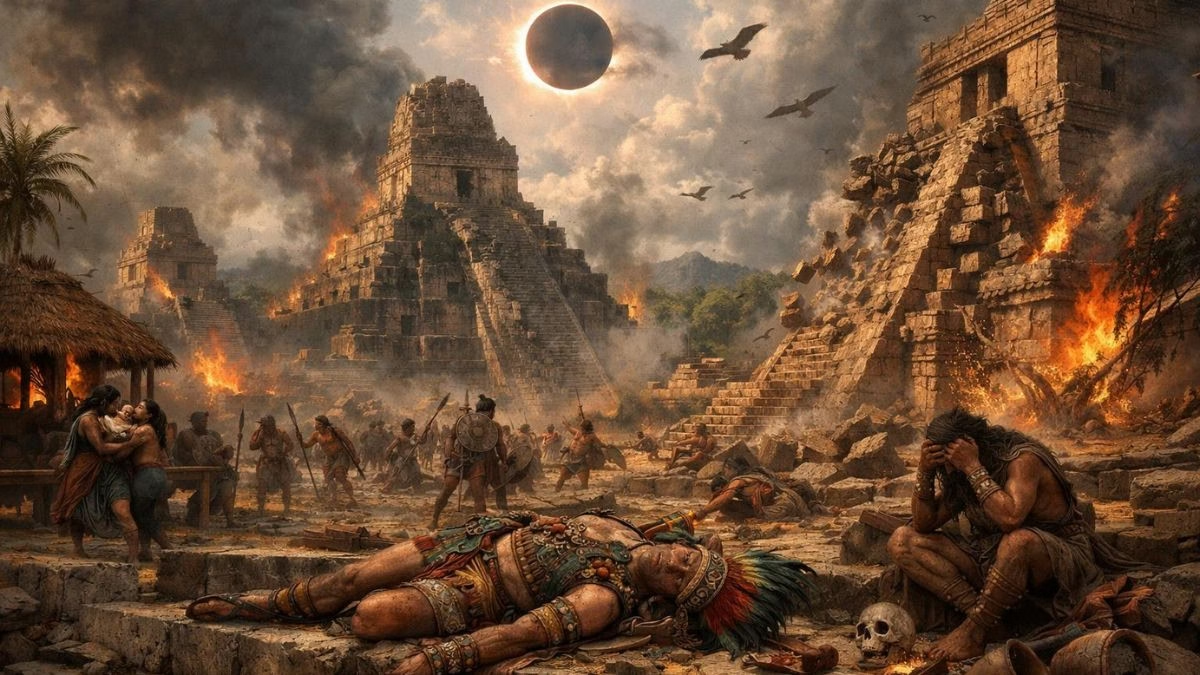
Imagine walking through the dense, suffocating humidity of the Guatemalan lowlands. The air is thick enough to chew on, buzzing with the electric hum of cicadas and the distant, guttural roar of howler monkeys. Vines choke the sunlight, and the ground is a tangle of roots and decay. Suddenly, the green curtain parts, and you are standing at the foot of a stone mountain. It is a temple, rising hundreds of feet into the canopy, impossibly steep, crowned with a roof comb that looks like it was etched by lasers, not stone tools.
This is Tikal. Or maybe it’s Calakmul, or Palenque. It doesn’t matter which one, because the story is hauntingly similar across the entire region. You are looking at the skeleton of a civilization that was, by all accounts, brilliant. We are talking about a society that tracked the movement of Venus with an accuracy that makes Renaissance astronomers look like they were just guessing. They developed a writing system of terrifying complexity. They built water management systems that would make modern civil engineers weep with envy. And then, in the blink of a historical eye, they walked away.
The silence of these cities is the loudest noise in archaeology. It isn’t the silence of a city that was conquered and burned to the ground by a foreign invader—though there was violence, certainly. It is the silence of abandonment. It is the feeling of a house where the dinner is still on the table, but the family has vanished. The “Classic Maya Collapse” of the 8th and 9th centuries is the ultimate “whodunit” of history, only the victim is a culture of millions, and the list of suspects includes everything from the weather to the kings themselves.
A Civilization of Mathematical Geniuses and Blood
Before we dissect the corpse, we have to appreciate the life. We often have this monolithic view of “The Maya,” but that is a mistake. They weren’t a unified empire like Rome or the Incas. They were a fractious, squabbling collection of city-states, much like ancient Greece. Tikal fought Calakmul; everyone fought Caracol. They were competitive, ambitious, and incredibly sophisticated.
They were obsessed with time. To the Maya, time wasn’t just a linear progression of events; it was a cyclical burden, a divine force that had to be carried, measured, and appeased. They built their entire architecture around it. The Pyramid of Kukulcán at Chichén Itzá isn’t just a temple; it’s a physical calendar. During the equinoxes, the play of shadow creates the illusion of a serpent slithering down the steps. That is not just masonry; that is special effects engineering in the 10th century.
But beneath the astronomy and the art lay a foundation of blood. Kings weren’t just political leaders; they were the conduit between the mortal world and the divine. And the currency of that transaction was bloodletting. The King would pierce his own tongue or genitals (yes, you read that right, and yes, it sounds horrific) to offer blood to the gods to keep the sun rising and the rain falling. It was a high-stakes game. As long as the rains came and the crops grew, the King was safe. But what happens when the divine contract is broken? What happens when the King bleeds, and the sky stays blue and dry?
The Precipice: When the Calendar Stopped
Somewhere around 800 AD, the lights started going out. It wasn’t simultaneous, which makes it even more confusing. It was a domino effect. One by one, the great cities of the southern lowlands stopped building monumental architecture. They stopped inscribing dates on their stelae (those tall stone monuments). The Long Count calendar, which had been ticking away meticulously for centuries, just… stopped.
Population levels plummeted. We are talking about a demographic disaster where 90% of the population in certain areas disappeared within a century. The great kings, the “Holy Lords” or K’uhul Ajaw, vanished from the record. The jungle, which had been held back by centuries of slash-and-burn agriculture and urban planning, began to reclaim the limestone plazas.
So, where did everybody go? Did they hop on spaceships? (No, please stop watching those history channels). Did they all die of a plague? Did they just decide city life was overrated? The answer is likely a “perfect storm” of catastrophes, a systemic failure where one problem exacerbated another until the whole structure collapsed under its own weight.
Suspect Number One: The Scorched Earth
Let’s talk about the weather. For decades, archaeologists argued about the role of climate change in the collapse. Then, we got better science. By analyzing sediment cores from lakes and stalagmites from caves, scientists reconstructed the rainfall patterns of the 9th century. The results were startling.
The Maya heartland was hit by a series of mega-droughts. We aren’t talking about a dry summer; we are talking about decades where the rain simply didn’t come. For a civilization completely dependent on seasonal rains to water their maize and fill their chultuns (underground cisterns), this was the apocalypse.
But here is the twist: they might have done it to themselves. The Maya were prolific builders, and to build those gleaming white limestone cities, they needed lime plaster. To make lime plaster, you need to burn limestone. To burn limestone, you need fire. To get fire, you need wood. It is estimated that it took 20 trees to produce enough plaster to cover just one square meter of a temple. Now look at a picture of Tikal. That is a lot of trees.
By deforesting their surroundings to fuel their vanity and their agriculture, they likely altered the local microclimate. Fewer trees mean less moisture released into the atmosphere, which means less rain. It also means soil erosion. So, when the natural drought cycle hit, the land was already skinned and vulnerable. The crops failed. The reservoirs turned into stagnant puddles. Hunger set in.
Suspect Number Two: The Forever War
Hungry people are angry people. And desperate kings are dangerous kings. As resources dwindled, the friendly rivalries between city-states turned into a death match.
We used to think the Maya were peaceful stargazer-priests. We were very wrong. They were fierce warriors, but for a long time, their warfare was ritualistic—you capture a rival lord, humiliate him, maybe sacrifice him, and go home. But towards the end, the archaeological record shows a shift. We find fortifications thrown up in a hurry. We find evidence of scorched-earth tactics. We find mass graves.
It seems that as the water and food ran out, the kings tried to seize resources from their neighbors. But constant warfare is expensive and destructive. It pulls farmers away from the fields to fight, which means even less food is produced, which leads to more hunger, which leads to more war. It is a classic feedback loop of doom. The prestige of the kings, which depended on their ability to protect their people and ensure abundance, shattered.
Suspect Number Three: The House of Cards
This brings us to the political collapse. Maya society was top-heavy. You had a massive elite class of nobles, priests, and royals who produced nothing but consumed everything. They relied on the tribute of the commoners—the farmers who broke their backs in the milpas (cornfields).
When the drought hit and the wars dragged on, the social contract evaporated. The commoners looked at their Holy Lords, who were draped in jade and quetzal feathers, bleeding onto parchment to call for rain that never came, and they realized something dangerous: The King is a fraud.
We see evidence of squatters moving into the royal palaces. We see monuments defaced—specifically the faces of the kings chipped away, a symbolic act of erasing their power. It wasn’t just that the people died; it’s that the people left. They voted with their feet. They abandoned the rigid hierarchy of the southern cities and migrated north to the Yucatan or into the highlands, leaving the kings to rule over empty plazas and crumbling stone.
The Myth of Disappearance
This brings us to the most important point, one that we need to hammer home because it is the most common misconception. The Maya did not disappear.
If you go to Guatemala, Mexico, Belize, or Honduras today, you will see millions of Maya people. They speak Mayan languages. They still practice variations of the ancient rituals, often blended with Catholicism. They weave the same patterns and eat the same tortilla-based diet.
What collapsed wasn’t the people; it was the system. The specific political structure of the Divine Kingship in the southern lowlands failed. The cities were abandoned, yes, but the culture survived. It transformed. It decentralized. It moved. Saying the Maya disappeared is like saying the French disappeared after the French Revolution just because they stopped having a King. It’s insulting to the survivors.
A Warning from the Past?
Why does this story grip us so tightly? Why do we keep coming back to the jungle to dig up these bones? I think it’s because we see a reflection of ourselves in the limestone mirror.
The Maya were at the peak of their power, population, and artistic achievement right before the fall. They were brilliant. They were advanced. And they were fragile. They pushed their environment to the breaking point. They engaged in endless, pointless wars. They had a political elite that seemed disconnected from the reality of the impending disaster.
Sound familiar?
The collapse of the Maya isn’t just a spooky campfire story about a lost civilization. It is a case study in sustainability. It is a reminder that societies are not immortal. They are complex, delicate engines that require maintenance. If you burn the fuel too fast, if you ignore the warning lights on the dashboard, if you let the passengers fight over the steering wheel while the cliff approaches, the engine will stall. And the jungle is always waiting to reclaim the space.
Focus on Language
Let’s dive right into the linguistic machinery we used to construct that narrative. We didn’t just use words to convey facts; we used them to paint a mood, to build tension, and to reconstruct a lost world. I want to pull out some heavy hitters from the text—words that you can slip into your next dinner conversation or business meeting to sound effortlessly sophisticated.
We started by describing the Maya not as a single empire, but as a fractious collection of city-states. This is a brilliant word. Fractious means irritable and quarrelsome, difficult to control. Think of a group of tired toddlers, or perhaps a political party that can’t agree on a leader. It implies a lack of unity and a tendency toward conflict. If your team at work is arguing constantly, you could describe the meeting as “a bit fractious.” It’s much more evocative than just saying “they were fighting.”
Then we talked about the kings being a conduit. We said they were a conduit between the mortal and divine worlds. A conduit is literally a pipe or tube for fluid or wires, but metaphorically, it is a person or organization that transmits information or influence. If you are the person who passes messages between two fighting friends, you are the conduit. It implies you are a vessel, a channel. It removes your agency a bit and focuses on what flows through you.
We used the phrase precipice. We talked about the civilization standing on a precipice. Literally, a precipice is a very steep rock face or cliff, a drop-off. Figuratively, it is a situation of great peril. We are on the precipice of disaster. We are on the precipice of a new era. It suggests that one small step forward results in a massive, uncontrollable fall. It adds a sense of vertigo to the story.
We mentioned that the problems exacerbated one another. This is a word you must have in your arsenal. To exacerbate means to make a problem, bad situation, or negative feeling worse. It comes from the Latin acerbus, meaning harsh or bitter. Scratching a mosquito bite exacerbates the itch. Yelling at an angry customer usually exacerbates the conflict. It’s the perfect word for “adding fuel to the fire.”
We discussed the untenable situation of the kings. If a position, argument, or situation is untenable, it means it cannot be defended or maintained against attack or objection. If you are paying more in rent than you earn in salary, your financial situation is untenable. It’s not just difficult; it is logically impossible to continue. The Mayan kings claimed to control the rain; when the rain stopped, their claim became untenable.
We used the word hubris. We implied that the deforestation was an act of hubris. Hubris is excessive pride or self-confidence, specifically the kind that leads to a downfall. It’s a concept from Greek tragedy. The CEO who thinks he is too smart to fail and ignores the market is suffering from hubris. It’s a word that carries a moral judgment—you aren’t just arrogant; you are dangerously arrogant.
We described the view of the Maya as monolithic. We said we shouldn’t view them as monolithic. A monolith is a single, large block of stone. Metaphorically, a monolithic organization or system is large, powerful, and intractably indivisible and uniform. We often mistakenly think of “The Government” or “The Media” as monolithic, assuming everyone inside acts the same way. Using this word shows you understand nuance.
We talked about a systemic failure. This contrasts with “isolated” or “local.” Systemic means relating to a system, especially as opposed to a particular part. If a car has a flat tire, that’s a local problem. If the car’s computer is glitching and shutting down the engine and the brakes, that’s a systemic failure. We use this often in social discussions—systemic racism, systemic corruption. It means the rot is in the bones of the structure, not just on the surface.
We saw the word proliferation—or rather, the context implied it when we talked about the fortifications. Proliferation is rapid increase in numbers. The proliferation of nuclear weapons. The proliferation of coffee shops in a city. It implies a spreading, almost like a growth or a bloom.
Finally, let’s look at reclaim. The jungle began to reclaim the plazas. To reclaim is to retrieve or recover something that was previously lost, given, or taken away. It implies ownership. The jungle owned the land first; the Maya borrowed it; the jungle took it back. You can reclaim your baggage, reclaim your dignity, or reclaim your time. It’s an empowering verb.
Now, let’s turn this into a speaking exercise. It is not enough to just nod your head and say, “Yes, I know what hubris means.” You have to feel it in your mouth.
Here is your challenge: The CEO’s Apology.
I want you to imagine you are the CEO of a company that has just failed spectacularly. You have to give a 60-second press conference. I want you to use at least three of the words we just discussed to explain why the company collapsed.
For example: “Ladies and gentlemen, our position became untenable due to systemic issues in our supply chain. We admit that our hubris regarding the market shifts exacerbated the problem. We were too fractious internally to solve it.”
Do you see how that works? It sounds professional, grave, and precise. Pause the reading right now. Stand up. Pretend you are at a podium. Give the speech. Using high-level vocabulary isn’t about showing off; it’s about compressing complex ideas into single, powerful words. If you can do that, you control the narrative.
Critical Analysis
Now, let’s take a step back and look at our own article with a critical eye. I played the role of the engaging storyteller, but did I simplify things too much? Absolutely.
First, we need to critique the very word “Collapse.” This is a loaded term. It implies a sudden, catastrophic end—like a building falling down. But the Mayan “collapse” took over a century. It was a slow, grinding decline in some areas, while other areas (like the northern Yucatan) actually flourished during this time. By focusing on the “Collapse,” we often ignore the “Transition.” Why do we love the story of the catastrophe more than the story of resilience? Is it because Western culture is obsessed with apocalyptic narratives?
Secondly, we focused heavily on Environmental Determinism. This is the idea that the environment dictates human history. “It stopped raining, so they died.” This removes the agency of the Mayan people. They weren’t just passive victims of the weather. They adapted. They dug canals. They changed their trade routes. When we say “the drought killed them,” we are simplifying the complex political and social choices they made. Maybe they didn’t just die; maybe they chose to leave a system that wasn’t working for them anymore. The “collapse” might have been a popular revolution against the elite, facilitated by the drought, not solely caused by it.
Third, we missed the role of Trade Routes. There is a strong theory that trade routes shifted from land-based (through the southern jungle) to sea-based (around the Yucatan peninsula). If the trade moves, the money moves. If the money moves, the cities in the old trade corridor die out. It’s like what happened to towns along Route 66 in the US when the Interstate highway was built. They became ghost towns. No war or drought needed—just economics.
Finally, we need to be careful about imposing our own anxieties on the past. I ended the article by comparing the Maya to us (sustainability, climate change). While valid, this can lead to confirmation bias. We look for evidence of environmental destruction in the Mayan record because we are worried about it today. We must always ask: Are we reading their history, or are we just reading our fears reflected in their ruins?
Let’s Discuss
Here are five questions to spark a fire in the comments section. These aren’t simple yes/no questions; they demand you to weigh evidence and check your biases.
Is “Collapse” a failure, or a strategy?
If a city becomes unlivable (too expensive, too violent, no water), and the people pack up and move to the countryside to live smaller, sustainable lives, is that a “collapse” of civilization, or a smart survival strategy? Why do we value big cities and monuments as the only measure of success?
Does a society need a “King” (or strong central government) to survive a crisis?
The Maya elite failed to solve the drought, and the system broke. Would a more democratic or decentralized society have handled the crisis better, or would the chaos have been worse without strong leadership?
Why are we obsessed with the “Vanished Civilization” trope?
We love stories about Atlantis and “lost” tribes. Why? Does it make us feel better about our own mortality? Or is it a way to exoticize other cultures and treat them as magical rather than human?
Can technology save a civilization from environmental overreach?
The Maya had advanced hydraulic technology, but it wasn’t enough. Today, we bank on technology (carbon capture, fusion) to save us from climate change. Are we making the same bet the Maya made? At what point does technology fail against nature?
If you were a Mayan commoner in 850 AD, would you stay or go?
This forces you to empathize. Staying means loyalty to your home and ancestors, but starvation. Going means survival, but becoming a refugee and losing your cultural center. What is the tipping point for abandonment?


0 Comments