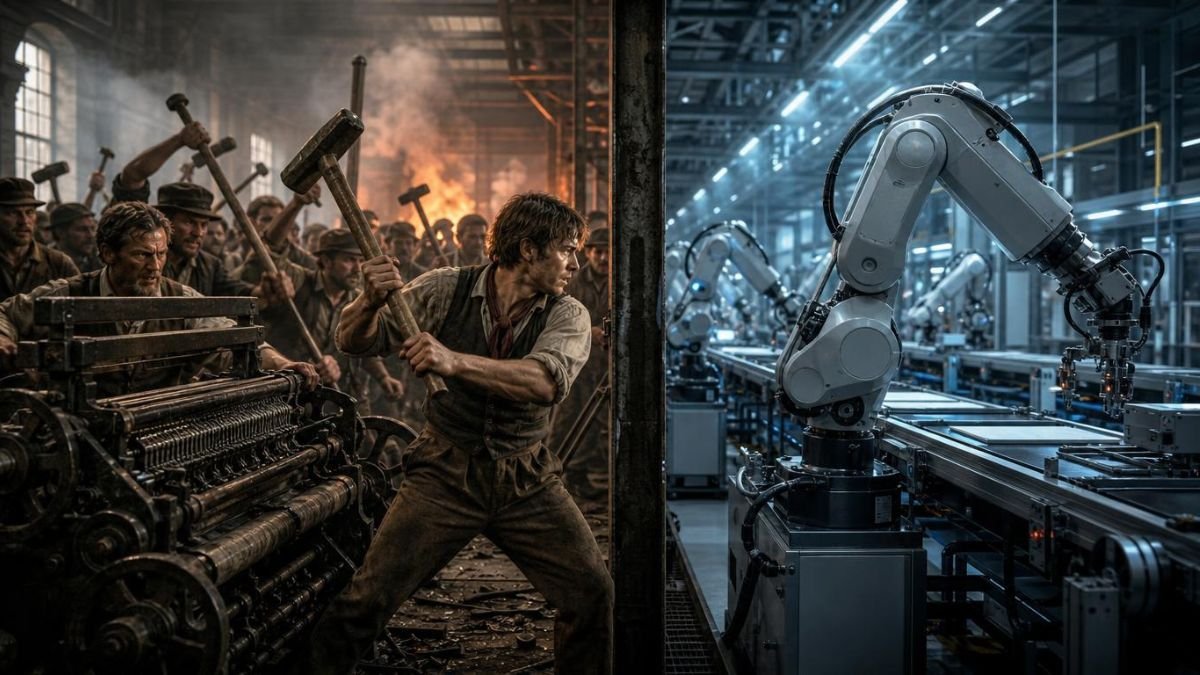
Let me ask you to do something uncomfortable. Picture the last time you heard the word "Luddite." Maybe someone said it about an uncle who refuses to use a smartphone, or about a coworker who still prints her emails, or about an entire movement of people worried that artificial intelligence might hollow out their careers. Whatever the context, the word did a very specific job. It ended the argument. It said: this person is afraid of the future, and you don't have to take them seriously, because you can't argue with progress.
Here's what should bother you. That tidy little insult is built on a lie. Not a small one, either. One of the most thorough and successful pieces of myth-making in the history of the English language. The real Luddites were not technophobes. They were not cavemen swinging hammers at the dawn of a brighter tomorrow. They were among the most skilled, literate, and economically sophisticated workers of their entire era, and when they broke machines, they did it for reasons so rational, so specific, and so eerily familiar that once you understand them, you will never be able to use the word "Luddite" as a lazy insult again.
And the reason this matters right now, in your life, today, is that we are living through the exact argument the Luddites were having. Swap the word "stocking frame" for "language model" and the questions are identical. Who benefits when a machine can do what a person used to do? Who decides how that machine gets used? And when the productivity gains arrive, where exactly does the money go? The Luddites had answers. They paid for those answers with their lives. The least we can do is actually listen to what they were saying instead of the cartoon we made of them.
Who the Luddites Actually Were
Let's get the picture right, because the details are everything here. The Luddite rebellion erupted across the English Midlands and North between 1811 and 1816, in three main trades. In Nottinghamshire, the framework knitters, called stockingers, made hosiery on intricate hand-operated frames. In Yorkshire, the croppers, also called shearmen, finished woolen cloth, raising and shearing the nap with shears that could weigh forty pounds, in a job that took years to master and produced the smooth, finished surface that made English cloth valuable. In Lancashire, the cotton weavers worked the looms that clothed half the world.
These were not unskilled laborers. The cropper in particular was a kind of aristocrat of the workshop, a man whose tacit knowledge, the feel in his hands, took an apprenticeship to build and could not be written down. His trade had customs, protections, and a sense of dignity that went back generations. This is the first thing the myth erases. When you imagine a Luddite, you probably imagine someone with nothing to lose. The truth is closer to the opposite. These were people with a great deal to lose: a craft, a status, a way of life that had a name and a history and a place in the community.
The Man Who Never Existed
The movement took its name from Ned Ludd, who, as far as anyone can tell, never existed. The story went that a young apprentice named Ludd, somewhere in Leicestershire in the 1770s, smashed a couple of knitting frames in a fit of temper, and ever after, when a frame turned up broken, people would say Ned Ludd must have done it. By 1811 this shadowy figure had been promoted. He was now General Ludd, or King Ludd, and the threatening letters that mill owners received were signed in his name, often addressed as coming from Sherwood Forest, which tells you exactly which folk hero the Luddites wanted you thinking about. Robin Hood, robbing the rich, hiding in the trees, beloved by the people. This was not the branding of men who didn't understand what they were doing. This was a movement with a sense of theater, a mythology, and a public-relations instinct that any modern campaign would envy.
So already the cartoon is falling apart. Skilled, organized, literate, strategic, with a borrowed legend and a flair for the dramatic. Now let's talk about what actually made them pick up the hammers, because this is where the story stops being history and starts being a mirror.
What They Were Actually Fighting About
Here is the sentence that should reframe everything: the Luddites did not oppose machines. They opposed a specific way of using specific machines. Read that twice, because the entire myth depends on you never hearing it.
Many Luddites had worked with machinery their whole lives. The frame, the loom, the shears were their tools. What changed in the early 1800s was not the existence of machines but the arrival of a new generation of them, deployed by a new kind of owner, under new economic pressure from the Napoleonic Wars and a brutal slump. The gig mills and shearing frames that threatened the croppers could do the finishing work faster and with far less skill. And crucially, the cloth they produced was often worse. Cheaper, shoddier, what the trade contemptuously called "cut-ups." The machine wasn't necessarily better at the job. It was better at the only thing the owner cared about, which was being cheaper.
And that cheapness had a destination. The savings didn't flow to the worker, or to the customer in the form of honest goods, or to the community. They flowed up, to the owner, who could now employ a handful of unskilled hands, often children, at a fraction of the wage, bypass the apprenticeship system that had protected the trade for centuries, and pocket the difference. The mechanization of the work was not, in itself, the crime. The crime was that the gains from that mechanization were being captured entirely by the people who already held the capital, while the people who had spent their lives building the skill were thrown into displacement, poverty, and what the period bluntly called immiseration, the grinding of a once-proud worker down into a pauper.
Machinery Hurtful to Commonality
The Luddites had a phrase for the machines they targeted. They called them machinery "hurtful to commonality," meaning harmful to the common good. And notice the precision in that. Not all machinery. Hurtful machinery. They distinguished, carefully, between automation that lifted everyone and automation that enriched a few by ruining many. They would break the shearing frames in one workshop and leave the other equipment untouched. They sent warnings before they acted. They were, in the words of the great historian Eric Hobsbawm, engaged in something he called collective bargaining by riot, a tactic of the powerless in an age when they had no unions, no vote, no legal way to negotiate, and no political representation whatsoever. Breaking the machine was not a tantrum. It was the only language management had left them.
This is the part I most want you to sit with, because it dismantles the lazy version completely. The Luddites were not asking history to stop. They were asking a question that has never stopped being relevant: when a new technology arrives, who gets to decide the terms? They appealed to old laws, to royal charters protecting their trades, to a whole tradition that the historian called the moral economy, the idea that markets should serve the community and not the other way around. They wanted the gains shared. They wanted the transition managed so it didn't destroy them. They wanted, in the most basic sense, a seat at the table where their future was being decided. And the answer they got was the answer the powerful so often give. They got soldiers.
The Empire Strikes Back
The government's response tells you how dangerous the authorities found these supposedly backward, irrelevant cavemen. In 1812, Parliament passed the Frame Breaking Act, which made the destruction of machinery a capital offense. Let that sink in. Breaking a stocking frame could now get you hanged. The state was willing to kill you for damaging property, in a country that did not extend the same urgency to the workers being starved by that same property.
At the height of the unrest, the Crown deployed around twelve thousand troops to the Luddite districts, a force, as people loved to point out at the time, larger than the army the Duke of Wellington had taken to fight Napoleon in the Peninsula. Think about the math of that fear. An empire at war with the most dangerous man in Europe sent more soldiers to suppress its own weavers and croppers than to fight the French. You do not do that to people you genuinely believe are irrelevant relics. You do that to people whose argument you find threatening precisely because, somewhere, you suspect it might be right.
The repression worked the way repression usually works. There were betrayals, spies, show trials. At the York Special Commission in January 1813, men were tried in batches. Seventeen were executed, including George Mellor, a young cropper hanged for the assassination of a mill owner named William Horsfall, who had reportedly boasted that he would ride up to his saddle in Luddite blood. Others were transported to the far side of the world, shipped to Australia, which was its own kind of death, the death of never seeing your home again. The movement was crushed, the frames kept turning, the cloth got cheaper and worse, and the men who had asked to share in the future were buried, exiled, or broken.
And then came the cleverest part, the part that affects you directly even now. The winners wrote the story.
How a Labor Movement Became an Insult
This is where psychology, my own home territory, gets interesting, because what happened to the word "Luddite" over the next two centuries is a textbook case of how the powerful control a narrative. The genuine grievance, about wages and dignity and who controls the gains from technology, was quietly deleted. In its place we got a simple, flattering, and extraordinarily useful story: the Luddites were people who were afraid of progress and tried to stop it, and they failed, because you can't stop progress, and only a fool would try.
See how much work that little story does. It turns a political argument about distribution into a personality flaw about fear. It makes the worker the problem instead of the system. And most usefully of all, it makes any future objection to any future technology automatically ridiculous. Worried about how automation is being deployed? You're a Luddite. Concerned that the gains from AI might flow entirely to a handful of companies while millions face displacement? Luddite. The word becomes a scapegoat-making machine, a way to take a serious question about power and reframe it as the whining of people too dim to embrace the future. It is one of the most efficient pieces of rhetorical jujitsu ever invented, and you have almost certainly used it yourself without knowing what you were doing.
I want to be fair here, and this is where the nuance matters, because the Luddites are not simply heroes either. Some of their tactics were violent. People died, on both sides. Romanticizing them into spotless martyrs would be its own kind of myth, just a more flattering one, and we'll push hard on that later. But the choice we're usually offered, between the cartoon villain and the spotless saint, is a false one. The truth is more interesting and more useful than either. The Luddites were ordinary, skilled, desperate people making a rational argument through the only means available to them, and losing, and then being slandered by the winners for two hundred years. That's not a fairy tale. That's just history, and it happens to be happening again.
The Mirror: Why This Is Suddenly Everyone's Problem
Now we arrive at the reason you clicked. Replace the stocking frame with the algorithm and watch how perfectly the argument rhymes.
A new generation of technology has arrived, and it can do things that used to require years of human skill. The illustrator who spent a decade learning to draw, the translator who carries two languages and two cultures in her head, the paralegal, the copywriter, the customer-service agent, the coder, the radiologist. These are not unskilled people with nothing to lose. They are, like the croppers, the aristocrats of their workshops, people whose tacit knowledge took years to build. And like the croppers, they are watching a machine arrive that produces output that is often, let's be honest, worse, but cheaper. The AI-generated article with the soul sanded off. The translation that's technically passable and quietly wrong. The "good enough" that's good enough for the only person whose opinion the budget reflects.
And here is the question that should be keeping us all up at night, the Luddite question, the one we spent two hundred years training ourselves not to ask. When the productivity gains from this technology arrive, where do they go? Because the gains will be enormous. The whole pitch of automation is that it produces more value with less human labor. That value is real. The only question, the only question that has ever actually mattered, is who captures it. If it flows, as it did in 1812, entirely to those who already own the capital, while the people whose skills are displaced are told to retrain, adapt, or get out of the way of progress, then we are not living through something new. We are living through a rerun, and we already know how the powerful prefer it to end.
The Three Questions That Never Go Away
Strip away two centuries and the Luddites leave us with three questions, and I'd argue they are the only three that matter whenever a powerful new technology shows up. First, who benefits? Not in theory, not eventually, not in the aggregate, but actually, in the next five years, in real bank accounts. Second, who decides? Who sits at the table where the technology's deployment gets planned, and who gets told about it afterward? And third, what's the alternative? Because "stop all technology" is a strawman almost nobody actually holds, then and now, but "deploy this technology in a way that shares the gains and cushions the displacement" is a real, reasonable, achievable position that the myth exists specifically to make sound impossible.
Notice that none of these are questions about the machine. They are questions about power, distribution, and choice. The technology is never really the issue. The terms are the issue. The Luddites understood this with a clarity we have largely lost, and we lost it on purpose, because a population that believes technological pain is as inevitable as the weather is a population that will never think to ask who arranged the storm.
The Trap of "Learn to Code"
You've heard the modern version of the advice the croppers got. For a decade, the standard answer to anyone displaced by automation was "learn to code." Retrain. Move up the value chain. Make yourself useful to the future instead of clinging to the past. And then, with a timing so perfect it would be funny if it weren't so cruel, the new AI tools turned out to be unusually good at writing code, and the people who had dutifully retrained discovered that the rising water had simply followed them up the hill.
This is the precarity at the heart of the modern economy, the sense that no skill is safe, that the ladder you're told to climb keeps having its rungs sawed off beneath you. And the Luddites would recognize it instantly, because they were told the same thing in different words. Adapt. Move on. The advice always sounds reasonable when you're the one giving it from a comfortable distance. It sounds rather different when you're the one whose forty years of mastery just became, overnight, a quaint historical curiosity, a victim of an obsolescence that someone else chose, scheduled, and profited from.
What the Luddites Actually Teach Us
So let me be clear about what I'm not saying, because the myth is so strong it'll try to pull this whole argument back into its gravity. I am not saying stop AI. I am not saying smash your laptop. I am not even saying the Luddites were right to break machines, exactly. What I'm saying is that they were right about the thing that actually mattered, the thing we've been trained not to see: that technology is never neutral in its effects, that the question of who controls it and who profits from it is a political question and not a technical one, and that the people who tell you a painful transition is simply inevitable are very often the same people who arranged for the pain to land on you and the profit to land on them.
The Luddites lost. But they lost a fight worth having, and they were right to have it. The croppers vanished, the trade died, the cloth got worse, and the only people who remember the croppers now are historians and, for the next few minutes, you. But the question they raised never died, because it can't. It comes back with every new machine, dressed in new language, aimed at new workers, and every single time, the powerful reach for the same old word to make the question disappear. Luddite. Technophobe. Enemy of progress. Don't let them. The next time you hear it used as an insult, you'll know what it's really doing. It's not describing a fear of the future. It's smuggling away a question about the present. And that question, who benefits, who decides, what's the alternative, is yours to ask, loudly, while it still might matter.
The hammers are long gone. The argument is not. And this time, you get to be in the room.
Let's Get Critical
I just spent quite some time rehabilitating the Luddites, and a clean rescue story should make you suspicious, including mine. So let me turn around and kick the legs out from under my own argument, because the whole point of thinking well is to keep going after you've reached a conclusion you're pleased with.
Start with the biggest one, the thing I conveniently underplayed. The Industrial Revolution that the Luddites resisted went on to lift a staggering portion of humanity out of grinding, lifelong poverty. The cheap cloth I sneered at as "shoddy cut-ups" clothed millions of people who had previously owned, quite literally, one set of clothes. The croppers suffered terribly, and that suffering was real and unjust. But their great-grandchildren lived longer, ate better, and died less often in childhood than any croppers in history, and a meaningful part of that was built on exactly the mechanization the Luddites tried to break. If you zoom out far enough, the machine breakers were standing in front of one of the greatest reductions in human misery ever recorded, swinging a hammer at it. That doesn't make them villains. But it should complicate the halo I was busy polishing.
Now let me question my favorite move, the "the cloth was worse" argument. I used it to suggest the machines weren't even better, just cheaper. But notice whose standard I borrowed to call the cloth "worse." The croppers' standard. The skilled trade defending its monopoly. There is a much less flattering reading of the whole affair, and intellectual honesty demands I put it on the table. Skilled guilds throughout history have used "quality" and "tradition" as cover for what was really price-fixing, a way to keep their craft scarce, their wages high, and their goods expensive, at the direct expense of the poor consumer who would have been delighted with a cheaper coat that lasted a few years less. From that angle, the Luddites start to look less like noble labor pioneers and more like a privileged trade protecting its turf, and the "cut-ups" they despised look like the first affordable clothing a poor family ever got to own. I don't think that's the whole truth. But I'd be lying if I said it was none of it.
Here's another crack in my own foundation, and it's the one economists would jump on fastest. My entire AI mirror leans on the assumption that displaced work simply vanishes, that the croppers' jobs were destroyed and nothing replaced them. But the broader historical record keeps embarrassing that assumption. Every wave of automation since has triggered the same confident prediction of permanent mass unemployment, and every time, against all intuition, new kinds of work emerged that nobody had imagined. The economists have a name for the mistake I may be making. They call it the lump-of-labor fallacy, the belief that there's a fixed amount of work in the world, so that every job a machine takes is a job gone forever. If that belief were true, the automation of the last two centuries should have left us with permanent armies of the unemployed, and instead employment kept finding new forms. Maybe AI is genuinely different this time. People always say "this time is different," and they are almost always wrong, and one day they will be right, and the hard part is that you can't tell which time you're in until afterward. I leaned hard on "this time is the same as 1812." I should at least admit I can't prove it.
Then there's the violence, which I waltzed past with a quick, tasteful mention. Let me stop waltzing. The Luddites didn't only break frames. Some of them shot a man off his horse and killed him. Mill owners were threatened, terrorized, in a couple of cases murdered. I framed this as "collective bargaining by riot," which is a wonderfully sympathetic phrase, but you could swap in a much uglier one and it would fit the same facts. When does the desperate violence of the powerless become simply violence? I genuinely don't know where that line sits, and I notice I drew it generously because I'd already decided to like these people. That's exactly the kind of motivated reasoning I'm supposed to be warning you against.
And let me turn the harshest light on the move at the very center of this whole piece. I accused the powerful of replacing the real Luddites with a flattering myth. Fair enough. But am I not doing precisely the same thing in the opposite direction? I took a messy, violent, internally divided movement of specific tradesmen with specific and sometimes self-interested grievances, and I smoothed them into clear-eyed prophets of labor rights who were "right about what mattered." That's a myth too. A nicer one, a more useful one for my argument, but a myth all the same. The honest version of the Luddites is grainier than either cartoon. They were neither the fools the winners painted nor the seers I just painted. They were people, which is to say they were partly right, partly self-interested, partly noble, partly brutal, and entirely unable to see the long future that would prove them both more and less correct than they knew.
Finally, the practical hole. My three sacred questions, who benefits, who decides, what's the alternative, sound magnificent until you ask the obvious follow-up: decided how, and by whom, exactly? "Give workers a seat at the table" is a lovely phrase that conceals a thousand impossible problems. Which workers? Deciding what? With what power to enforce it? The Luddites had a clear, concrete demand, the old protections of their trade, and even that couldn't survive contact with economic reality. My modern version is vaguer and therefore safer to say and harder to actually do. I raised the right questions. I should be honest that I didn't really answer them, and that answering them is the part where everything actually gets hard.
I still believe the core of what I wrote. The myth is real, the question of who captures the gains is the question that matters, and the casual use of "Luddite" as an insult really does smuggle a serious argument out of the room. But the honest version of my case is quieter and grainier than the rousing one I'd enjoy shouting from a rooftop. The Luddites weren't a verdict. They were a question that history never finished asking, and pretending I've answered it would make me exactly the kind of confident myth-maker I spent this whole article complaining about.
Wait! There's a lot more to learn...
This is only the first part of the CSP (Comprehensive Study Package), but there's still a lot more to learn. If you want to take it to the next level, you can access the premium comprehensive learning package with all the contents above plus the following sections:
Fantastic Guest Interview
Edustory + Author's Commentary
Let's Discuss | Discussion Questions
What Now? | Action Plan
Language Focus: Vocabulary & Speaking
Language Focus: Grammar & Writing
Comprehensive Quiz (Comprehension & Vocabulary + Detailed Feedback)
Activity Worksheets with Answer Keys
And Much More...
These extra sections are available to my Patreon subscribers. You can find the full article on my Patreon page.






0 Comments