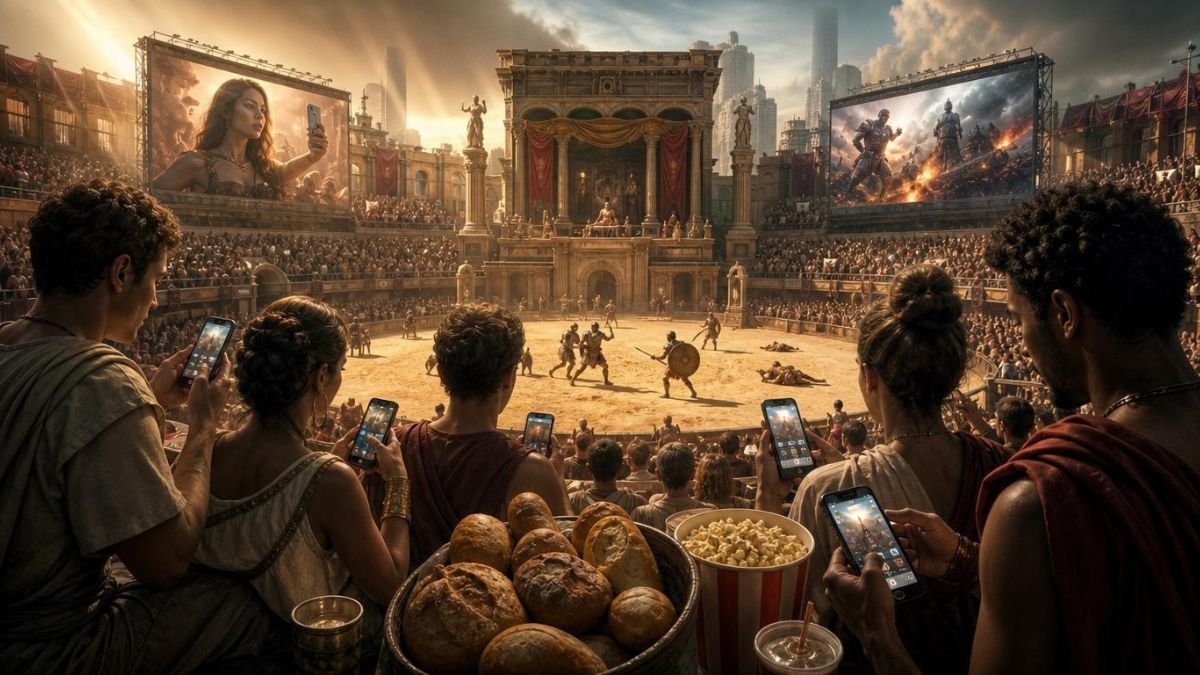
- Rome's Original Formula: Subsidized Survival, Sponsored Spectacle
- Fast Forward Two Thousand Years: Welcome to the Attention Economy
- The New "Bread": Convenience, Connection, and the Illusion of Abundance
- Who Benefits? Following the Money and the Power
- The Honest Complications: It's Not All Manipulation
- What Made Rome's System Eventually Fail
- So What Do We Do With This?
- Let's Get Critical
Let's start with a confession. Right now, as you're reading this, there's a decent chance you have at least one other tab open, a phone within arm's reach, and a notification waiting for you that you're trying very hard to ignore. I'm not judging you. I'm writing this with the exact same setup. We live in a world engineered, quite literally by teams of behavioral scientists and engineers, to make sure our attention rarely settles anywhere for long. And here's the strange part: none of this is new. The mechanism is ancient. Only the costume has changed.
About two thousand years ago, the poet Juvenal looked around at his fellow Romans and coined a phrase that has outlived empires, languages, and entire civilizations: panem et circenses, bread and circuses. He was being sarcastic, even bitter, about how easily the Roman public could be pacified. Give them free grain to fill their stomachs and violent spectacles to fill their evenings, and they'll stop caring about who's actually running the show. Today, we don't get free wheat, but we do get free apps. We don't watch gladiators hack each other apart in an arena, but we do watch creators eviscerate each other's reputations in fifteen-second videos, and somehow it scratches a similar itch.
This article is an invitation to step back and look at the architecture of distraction, both the ancient version built from grain subsidies and amphitheaters, and the modern version built from dopamine loops and infinite scroll. We're not here to be alarmist, and we're certainly not here to tell you to throw your phone into the sea (though I won't stop you if you feel inspired). Instead, we're going to dig into how these systems work, why they work so well on creatures like us, and what it might mean for a society to be, in a sense, perpetually entertained into compliance.
Rome's Original Formula: Subsidized Survival, Sponsored Spectacle
To understand why "bread and circuses" became such an enduring metaphor, you have to understand just how precarious life in ancient Rome actually was for the average citizen. Rome, especially by the late Republic and into the Imperial period, had swollen into a city of around a million people, an almost incomprehensible number for the ancient world. Most of these people were not wealthy. Many were unemployed or underemployed, crammed into multi-story apartment buildings called insulae that were poorly built, frequently caught fire, and offered approximately zero in the way of comfort.
Feeding a million people in a pre-industrial economy is a logistical nightmare. Rome solved this, in part, through the grain dole, eventually formalized into a program where citizens could receive free or heavily subsidized grain, and later bread, from the state. This wasn't charity in the modern sense. It was policy, and it was political. Politicians who controlled the grain supply controlled a significant lever of public goodwill. Julius Caesar, Augustus, and later emperors all understood that a hungry mob is a dangerous mob, and a fed mob is, if not necessarily happy, at least less likely to start burning things down.
Then came the circuses, and I don't mean clowns and trapeze artists. The "circenses" Juvenal referred to included chariot races at venues like the Circus Maximus, which could hold over a hundred thousand spectators, and the gladiatorial games held in amphitheaters like the Colosseum. These events were spectacular in the truest sense of the word. They involved elaborate staging, exotic animals brought from across the empire, condemned criminals, prisoners of war, and trained fighters facing off in scenarios designed for maximum drama. Sometimes the arena floor was even flooded for mock naval battles. This was not a quiet evening at home. This was full-spectrum sensory overload, free of charge, courtesy of whoever was currently trying to stay in power.
And here's the crucial piece: these games were almost always sponsored by politicians or the emperor himself. Hosting spectacular games was one of the most effective ways for an ambitious Roman to win public support. It was essentially political advertising, except instead of a thirty-second commercial, you got an entire afternoon of blood, sand, and roaring crowds, with the sponsor's name attached to the whole production.
Why It Worked: The Psychology Behind the Strategy
It's tempting to look at this from a distance and think, "well, ancient people were simple, easily distracted by violence and free food." But that's both condescending and, frankly, not how psychology works. The mechanisms that made bread and circuses effective in Rome are the same mechanisms that operate in any human brain, including yours and mine, right now, in the twenty-first century.
First, there's the basic principle of need fulfillment. When your most fundamental needs, like having enough to eat, are uncertain, your entire cognitive and emotional bandwidth gets consumed by that uncertainty. Anyone who has ever been truly hungry, or truly anxious about paying rent, knows how difficult it becomes to think about anything beyond the immediate problem. By guaranteeing a baseline of food security, even a modest one, the Roman state effectively freed up the population's mental energy. The question is: freed up for what?
This is where the second mechanism comes in: the redirection of that freed-up attention toward spectacle rather than toward scrutiny. Human beings are drawn to novelty, drama, and high-stakes outcomes. We are, evolutionarily speaking, wired to pay attention to things that move fast, things that involve conflict, and things that carry an element of unpredictability, because in our ancestral environment, those things often signaled danger or opportunity. A chariot race, with its genuine risk of catastrophic crashes, taps directly into that wiring. So does a gladiatorial duel where the outcome is, at least in theory, uncertain.
Combine these two mechanisms, satisfied basic needs plus a steady supply of high-arousal spectacle, and you get a population that is simultaneously placated and occupied. They're not desperate enough to revolt, and they're not bored enough to start asking uncomfortable questions about, say, why the wealth gap between senators and everyone else keeps widening, or why their sons keep getting sent off to fight wars on the frontier.
Fast Forward Two Thousand Years: Welcome to the Attention Economy
Now let's jump to the present, and let's be honest about what's actually different. We don't have a literal grain dole in most developed economies, though plenty of countries do have various social safety nets that, depending on your political views, you might see as a modern equivalent. But what we absolutely do have, in overwhelming abundance, is free entertainment.
Think about it. You can open an app right now and access, at no direct monetary cost, an essentially infinite library of videos, music, articles, games, and social interactions. The amount of content available to the average person today dwarfs anything available to even the wealthiest Roman emperor. Nero couldn't binge-watch anything. He had to commission entire productions just to be mildly entertained for an afternoon. You, on the other hand, have access to more hours of content than you could consume in several lifetimes, and it's all sitting in your pocket.
This is the foundation of what's often called the "attention economy," a term that describes an economic system where the scarce resource isn't grain, or oil, or even money in the traditional sense. The scarce resource is human attention. There are only so many waking hours in a day, and an enormous number of companies are competing for those hours, because attention can be converted into advertising revenue, subscription fees, and data that can be sold or used to refine targeting even further.
The Algorithm as the New Arena
Here's where the comparison gets genuinely fascinating, and a little unsettling if you thing about it for too long. In Rome, the spectacle was curated by human beings: editors, sponsors, and organizers who decided which fights happened, which criminals were executed in which dramatic fashion, and how the day's events would be paced to maximize emotional impact on the crowd. There was intention behind the design of the experience.
Today, that curatorial role has largely been handed over to algorithms. When you open a social media app, what you see isn't random, and it isn't simply "everything posted by people you follow, in order." It's a carefully ranked selection, determined by a system that has been trained, explicitly, to maximize engagement, meaning the amount of time you spend on the platform and the likelihood that you'll interact with content, whether through likes, comments, shares, or simply by continuing to scroll instead of closing the app.
The eerie part is that this system doesn't need to have any ideology, any political goal, or any conscious intention to "pacify" anyone. It doesn't need a Caesar at the top deciding "let's give the people something to gawk at so they stop paying attention to the senate." The algorithm simply optimizes for engagement because that's the metric it's been given, and it turns out that the content most likely to generate engagement is often the content most similar to what worked in ancient Rome: conflict, novelty, outrage, drama, and spectacle. The algorithm didn't read Juvenal. It didn't need to. It arrived at the same conclusion through trial and error across billions of data points.
This is, in a way, more troubling than the Roman version, not less. At least in Rome, you could, in theory, identify the person responsible for the spectacle and hold them accountable, or at least understand their motives. With an algorithm, the "who" becomes diffuse. Is it the engineers who built it? The executives who set the engagement targets? The advertisers whose money funds the whole system? Or is it simply an emergent property of a system that nobody fully controls anymore, including the companies that built it?
The New "Bread": Convenience, Connection, and the Illusion of Abundance
If digital entertainment is our circuses, what's our bread? I'd argue it's something broader than just food security, though food delivery apps certainly play their part in making basic survival frictionless to the point of almost feeling automatic. The modern "bread" is convenience itself, and the sense, however illusory, of abundance and connection.
Consider how much of daily friction has been engineered out of existence over the past two decades. You don't need to go to a bank during business hours. You don't need to wait for a letter to arrive. You don't need to leave your home to buy groceries, watch a movie, attend a meeting, or talk to a friend on the other side of the planet. Each of these conveniences, taken individually, is genuinely wonderful. I'm not being sarcastic here. These technologies have solved real problems and improved real lives.
But collectively, they've also done something subtler. They've removed many of the small frictions and downtimes that used to exist in daily life, the moments of forced boredom while waiting in line, the silence during a commute, the empty evening with nothing scheduled. Those moments used to be, whether we liked it or not, spaces for reflection, for daydreaming, for noticing your own thoughts, and sometimes, uncomfortably, for noticing problems in your life or your society that you might otherwise be too busy to register.
Now, every single one of those gaps can be, and very often is, filled instantly with content. The bus is late? Doesn't matter, you have fourteen unread notifications to get through. Dinner is in the microwave? Perfect time for a quick video. Can't sleep? There's a whole community of people awake right now, ready to argue with you about something that, in the cold light of morning, won't matter at all.
The Subscription Model and the New Patronage System
There's another layer here worth examining: the way modern platforms have recreated something very similar to the patron-client relationships of ancient Rome, just digitized and democratized, sort of. In Rome, wealthy patrons supported clients, who in turn provided political support, social status, and labor. It was a web of mutual obligation that structured much of Roman social life.
Today, we have creator economies, where audiences directly support content creators through subscriptions, memberships, and tips, in exchange for access, recognition, or simply the feeling of being part of a community. Platforms position themselves as the infrastructure that makes this possible, taking a cut along the way, much like how the Roman state, by controlling the grain supply and the games, positioned itself as the indispensable infrastructure of public life.
The difference, and it's a meaningful one, is that this modern system at least theoretically allows for more direct relationships and more diffuse power. A creator with a loyal audience has a kind of independence that a Roman gladiator, who was very often enslaved and had zero choice in the matter, obviously did not have. But the underlying psychological dynamics, the desire for belonging, for recognition, for being part of something bigger than yourself, are remarkably consistent across two thousand years.
Who Benefits? Following the Money and the Power
In Rome, it was relatively easy to identify who benefited from bread and circuses. Politicians gained popularity and political capital. The wealthy elite, who funded these spectacles, gained prestige and influence. And the existing power structure, broadly speaking, gained stability, because a population that's fed and entertained is a population that's less likely to organize, protest, or demand structural change.
The modern equivalent is more diffuse, but the basic shape is recognizable. Technology companies benefit enormously from sustained attention, because attention is directly convertible into advertising revenue. Advertisers benefit from access to highly engaged, highly targeted audiences. And, perhaps most controversially, existing power structures, political, economic, or otherwise, can benefit from a population that is, on average, less likely to engage in the kind of sustained, focused civic attention that meaningful political and social change typically requires.
I want to be careful here, because this is exactly the kind of claim that can tip over into conspiracy thinking if we're not careful, and we'll dig into that more in the "Let's Get Critical" section. It's not that there's a secret room somewhere with executives twirling mustaches and plotting to keep the masses docile. It's that the incentive structures of the attention economy happen to align, often accidentally, with outcomes that look very similar to what a deliberately designed "bread and circuses" system would produce. Sometimes the most effective systems of control aren't the ones anyone designed on purpose. They're the ones that simply work, and keep working, because they're profitable, regardless of their broader social effects.
The Outrage Economy as a Special Case
One particular wrinkle deserves its own spotlight: the role of outrage. The Roman games often involved violence, yes, but also a kind of moral theater, criminals being punished in ways that reinforced the audience's sense of justice, of "us" versus "them," of the social order being maintained and enemies of that order being dealt with publicly and decisively.
Modern social media has its own version of this, and it's remarkably effective. Outrage content, posts and videos designed to provoke anger, indignation, or moral condemnation, tends to spread faster and generate more engagement than almost any other type of content. We've all seen it: the clip of someone behaving badly, the take that's deliberately provocative, the controversy that everyone seems to be discussing for forty-eight hours before it vanishes entirely from collective memory, replaced by the next one.
This isn't an accident of human nature alone, though human nature certainly plays a role. It's also a structural feature of how these platforms are designed. Outrage is engaging. Engagement is the currency. And so outrage, in a sense, has become one of our most reliable forms of modern spectacle, a way of feeling like you're participating in something important, taking a side, expressing a value, while the underlying conditions that generated whatever you're outraged about often remain entirely untouched.
The Honest Complications: It's Not All Manipulation
Here's where I want to push back on my own argument a little, because if I leave things as they are, this article risks becoming exactly the kind of one-sided, "everything is a conspiracy" piece that, ironically, performs very well in the attention economy precisely because it's simple and a little bit outrageous.
The truth is messier. Entertainment is not inherently bad, and the desire for it is not a character flaw or a sign of being manipulated. Humans have always sought stories, games, competition, and shared experiences. The Roman games were horrifying by modern ethical standards, involving real death and real suffering for the entertainment of crowds, but the underlying human appetite for narrative, drama, and communal experience that they fed into is the same appetite that gives us theater, sports, novels, and yes, the shows and videos we enjoy today.
Similarly, convenience is not a trap in itself. Being able to order groceries online, video call a family member overseas, or access an entire university's worth of educational content for free is not the same thing as being pacified into political apathy. In fact, you could argue, and many people do, that these technologies have also enabled unprecedented levels of organization, awareness, and activism. Social media has been used to coordinate protests, expose injustices, and connect people across the world who would otherwise never have found each other. The same tools that can distract can also, demonstrably, mobilize.
So perhaps the most accurate framing isn't "the attention economy is bread and circuses 2.0, full stop." It's that the attention economy contains the same raw ingredients as bread and circuses, namely, satisfied basic needs and abundant spectacle, but what those ingredients produce depends heavily on how individuals and societies choose to engage with them. The Colosseum didn't have an "off" switch or a "use this for civic organizing instead" mode. Our devices, at least theoretically, do.
What Made Rome's System Eventually Fail
It's worth remembering that bread and circuses, for all their effectiveness, didn't actually save the Roman Empire. The Western Roman Empire collapsed in the fifth century, despite centuries of grain doles and spectacular games. The strategy could buy time, manage discontent, and maintain short-term stability, but it couldn't address underlying structural problems: economic inequality, overextension of military resources, political corruption, and a host of other issues that, frankly, historians still argue about to this day.
This raises an uncomfortable question for our own time. If the modern attention economy functions, even partially, as a kind of bread and circuses system, what does that mean for our ability to address our own underlying structural problems? Climate change, economic inequality, political polarization, mental health crises, these are exactly the kinds of slow-moving, complex, unglamorous issues that don't generate the kind of immediate, high-arousal engagement that algorithms favor. They're not spectacles. They're slow burns. And slow burns are notoriously difficult to maintain public attention on, especially when that attention is being actively, continuously redirected toward whatever is most immediately engaging.
I don't say this to be doom and gloom. I say it because I think it's the single most important thing this comparison can teach us. The danger isn't that we're watching too many videos or scrolling too much, in some kind of moralistic, "kids these days" sense. The danger is that the systems we've built, intentionally or not, may be systematically biased against the kind of sustained, patient, often unglamorous attention that our biggest collective challenges actually require.
So What Do We Do With This?
I promise we'll get to a practical framework and action plan later in this package, but for now, I want to leave you with a reframe rather than a prescription. The question isn't "how do I escape the attention economy entirely," because, realistically, very few of us can or even should try to do that completely. We live in a connected world, and there are genuine benefits to that connection.
The more useful question might be: "where is my attention going, and is that where I want it to go?" Not in a guilt-tripping way, but in the same way a person managing their finances might ask, "where is my money going, and does that match my actual priorities?" You can spend money on things you enjoy without going bankrupt, as long as you're aware of where it's going. The same logic applies to attention.
Rome's citizens didn't have much choice in how their bread and circuses were distributed. The grain dole and the games schedule were set by people far above their pay grade, so to speak. We, on the other hand, at least have some degree of agency, even if it doesn't always feel that way at eleven o'clock at night with our thumb hovering over the next video. That gap between "no agency" and "some agency" might not sound like much, but historically speaking, it's actually enormous. The question is whether we use it.
In the sections ahead, we're going to put this whole conversation under a microscope. We'll play devil's advocate with some of the claims made here, sit down with a guest who has a very particular perspective on spectacle and power, read a short story that might hit closer to home than expected, and then roll up our sleeves with some practical tools, vocabulary, and activities to help you process all of this, both as a thinker and as an English learner. Let's get into it.
Let's Get Critical
Alright, so we've spent some time building a pretty compelling case: ancient Rome pacified its population with bread and circuses, and we've simply traded grain for groceries delivered to our door and gladiators for algorithm-curated content. It's a clean comparison. It's satisfying. It probably made you nod along at least once or twice. And that, right there, is exactly the moment I want to hit pause, because a comparison that feels this satisfying deserves a second look.
Let's start with the most basic problem: is this comparison actually historically accurate, or are we cherry-picking the parts of Roman history that fit our modern narrative? Here's the thing about "bread and circuses" as a concept. Juvenal wasn't writing a sociological analysis. He was writing satire, and satire works by exaggeration. He was a particular kind of cranky aristocratic commentator looking down at what he saw as the moral decline of the Roman masses, and frankly, a lot of ancient writers who complained about "the mob" being distracted by spectacle were themselves part of the elite, people who had the leisure time and education to write essays about how everyone else was wasting their time. There's an irony there that's worth thinking about. The very people most likely to complain about "bread and circuses" throughout history have often been the people least affected by the actual material conditions that made bread and circuses necessary in the first place. When we uncritically adopt Juvenal's framing, are we accidentally adopting an elitist lens, one that looks down on ordinary people's desire for entertainment and rest, as if wanting to relax after a hard day is some kind of moral failing rather than, you know, a basic human need?
This matters for our modern comparison too. When commentators today wring their hands about people "wasting their lives" on their phones, how much of that concern is genuinely about wellbeing, and how much of it is an old, recycled snobbery, just updated for new technology? Every generation has had its moralists who looked at the entertainment choices of "the masses," whether that was novels in the eighteenth century, considered dangerously stimulating for impressionable minds, or television in the twentieth century, blamed for everything from violence to short attention spans, and declared it a sign of societal decay. Maybe some of that concern has always been valid. But maybe some of it has also always been a way for certain groups to feel superior to others by framing their own preferences as "culture" and everyone else's as "distraction."
Now let's flip to a different angle: power. Our article framed the modern attention economy as something that benefits tech companies, advertisers, and "existing power structures" in a way that echoes how Roman elites benefited from bread and circuses. But here's a question worth contemplating: in ancient Rome, the bread and circuses system was deliberately, explicitly designed by identifiable people with identifiable goals. Emperors literally wrote about their reasoning. Augustus boasted about the games he funded. There was intention, strategy, and a clear chain of cause and effect.
Is that actually true of the modern attention economy? Or are we engaging in a kind of pattern-matching that feels intellectually satisfying but might be overstating how coordinated or intentional the whole thing is? It's entirely possible, maybe even likely, that no one sat down and said "let's design a system that keeps people too distracted to engage in politics." Instead, you have thousands of individual decisions, made by different companies, engineers, and algorithms, each optimizing for their own narrow goals, like quarterly engagement metrics, and the resulting system happens to produce effects that resemble bread and circuses, without anyone actually intending that outcome.
Why does this distinction matter? Because if the system is the result of deliberate design by people with power, then the solution might involve confronting those people, regulation, accountability, structural reform aimed at specific actors. But if the system is more like an emergent phenomenon, arising from the interaction of many smaller incentives that nobody fully controls, then the solutions look very different. You can't simply "hold the algorithm accountable" in the same way you could hold an emperor accountable, because there's no single point of decision-making to target. This is a genuinely hard problem, and I'd argue our article, by drawing such a clean parallel to Rome, might have made the modern situation seem more tractable, more "fixable," than it actually is. Sometimes the comparison to a clearer historical villain can make a murkier modern situation feel falsely simple.
There's also a question worth asking about who actually has agency in this story. Our article ended on a relatively optimistic note: unlike Roman citizens, we have "some degree of agency" over our attention. But how much agency, really, and is it equally distributed? Someone working two jobs, with unreliable childcare, living in a "media desert" with limited access to diverse information sources, might have dramatically less actual capacity to "manage their attention" than someone with the time, education, and resources to read long-form articles about the attention economy in the first place. Isn't there something a little uncomfortable about an article like this one, which itself requires a certain amount of leisure time and a certain level of English proficiency to engage with, lecturing people about being more mindful with their attention? Who is this advice actually for, and who might it be inadvertently leaving out or even subtly blaming?
Let's also poke at the "outrage economy" section. We presented outrage content as a kind of modern equivalent to the moral theater of Roman punishments, content that reinforces in-group and out-group dynamics. But is outrage really new, or is it just more visible and more measurable now? Town squares, pubs, marketplaces, churches, and dinner tables have always been places where people expressed outrage about politics, neighbors, and perceived injustices. What's different now isn't necessarily the existence of outrage, but its scale, speed, and the fact that it's now generating data that companies can study and, yes, optimize for. Is the problem outrage itself, or is it the industrialization and monetization of a very old human behavior? And if it's the latter, does framing it through the lens of "bread and circuses," which centers on entertainment and pacification, actually obscure a more accurate framing centered on commodification, the process of turning a human emotion into a product that can be bought, sold, and optimized?
One more thread worth pulling: we talked about how Rome's bread and circuses didn't ultimately save the empire from collapse, and we drew a slightly ominous parallel to our own unresolved structural problems. But Rome's collapse, to the extent that "collapse" is even the right word, historians still debate this, took place over centuries, and was driven by an enormous number of interacting factors: military overextension, administrative challenges of governing a territory that size, economic shifts, climate events, migrations, and plenty more. Reducing any of this to "they were too distracted by entertainment to notice the empire was in trouble" is, frankly, a massive oversimplification, one that a careful historian would probably wince at. Does using Rome's fall as a cautionary tale about our own society's distraction risk borrowing the emotional weight of a dramatic historical narrative without doing justice to its actual complexity? Are we, ironically, using a kind of historical spectacle, "the fall of Rome," as our own piece of engaging content, because "ancient empire collapses due to entertainment" makes for a much better hook than "ancient empire experiences centuries of complex, multi-causal administrative and economic decline"?
None of this means the original comparison is worthless. Comparisons between past and present can be genuinely illuminating, even when they're imperfect, precisely because they help us notice patterns we might otherwise miss. But the most useful comparisons are the ones we hold loosely, turning them over, looking for where they break down, rather than ones we adopt as a complete explanation for how the world works. So as you move through the rest of this package, the interview, the story, the discussion questions, I'd encourage you to keep asking: is this framework actually explaining something, or is it just a satisfying story that happens to confirm what I already suspected? Those aren't always the same thing, and the difference matters more than we usually give it credit for.
Wait! There's a lot more to learn...
This is only the first part of the CSP (Comprehensive Study Package), but there's still a lot more to learn. If you want to take it to the next level, you can access the premium comprehensive learning package with all the contents above plus the following sections:
Fantastic Guest Interview
Edustory + Author's Commentary
Let's Discuss | Discussion Questions
What Now? | Action Plan
Language Focus: Vocabulary & Speaking
Language Focus: Grammar & Writing
Comprehensive Quiz (Comprehension & Vocabulary + Detailed Feedback)
Activity Worksheets with Answer Keys
And Much More...
These extra sections are available to my Patreon subscribers. You can find the full article on my Patreon page.






0 Comments