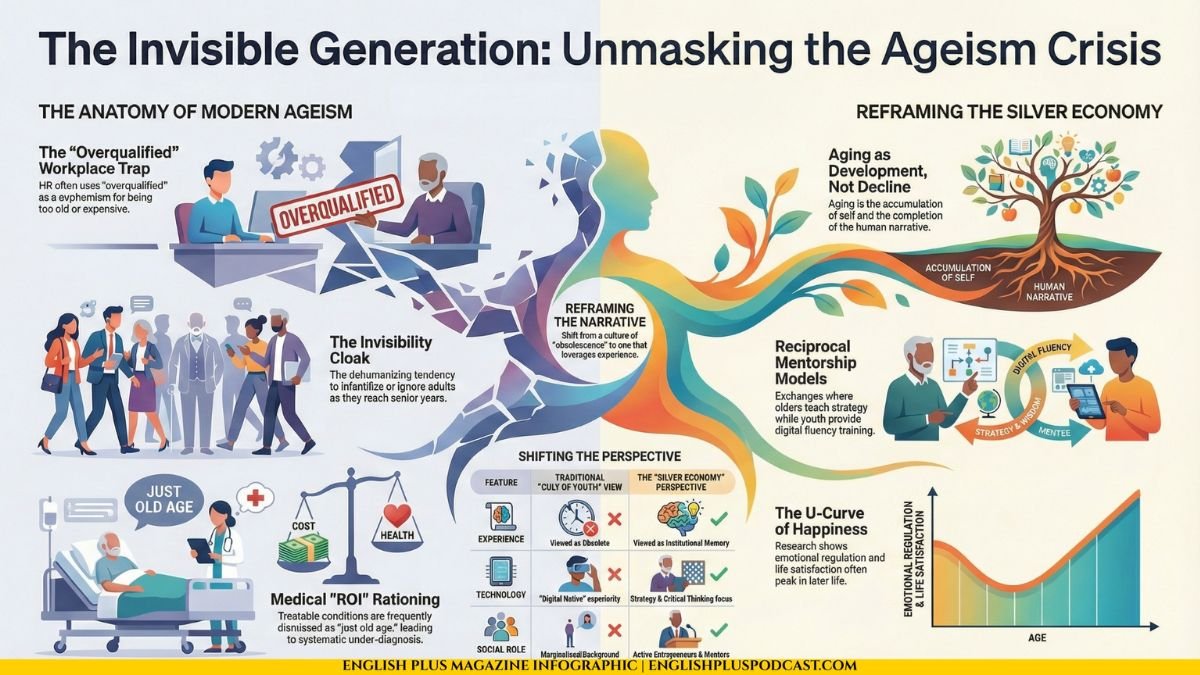
- The Cult of Youth and the Invisibility Cloak
- The Workplace: Experience vs. The Algorithm
- Healthcare: The “What Do You Expect?” Diagnosis
- The Generational Warfare: Boomers vs. Zoomers
- Reframing the Narrative: The Silver Economy
- Focus on Language
- Critical Analysis
- Let’s Discuss
- Fantastic Guest: An Interview with Oscar Wilde
- Let’s Play & Learn
- Check Your Understanding (Quiz)
We live in a culture that is absolutely terrified of time. Go to any drugstore, and you will find aisle upon aisle of products declaring war on the inevitable. We have creams to erase lines, dyes to cover the gray, and supplements that promise to keep our brains as sharp as they were when we were twenty-five (though, honestly, was your brain really that sharp at twenty-five? Mine was mostly full of bad lyrics and anxiety). We treat aging not as a natural biological process, but as a pathology—a disease to be cured, or failing that, hidden away.
This is the machinery of ageism. It is the last acceptable prejudice. We wouldn’t dream of openly mocking someone’s race or gender in polite society, but we barely bat an eye when someone makes a joke about a “senile” politician or dismisses an older colleague as a “dinosaur.” We have socially engineered a reality where value is tied to novelty. If you aren’t new, you aren’t news.
But here is the irony: if we are lucky, we will all be the victims of this prejudice. Ageism is a prejudice against our future selves. It is a form of self-sabotage where we dismantle the very safety net we will one day need to land on.
The Cult of Youth and the Invisibility Cloak
From Venerated to Vanished
There was a time, and there are still places, where gray hair was a crown. In many indigenous cultures and traditional societies, the elder is the library. They are the keepers of the lore, the adjudicators of disputes, the ones who know which mushrooms will feed you and which ones will kill you. To be old is to be a survivor, and therefore, an expert.
In the modern West, however, we have replaced the Sage with the Software Update. Because technology moves so fast, we have fallen into the trap of believing that experience is obsolete. We look at a seventy-year-old and assume they can’t possibly understand the complexities of the modern world because they might type slowly on an iPhone. We confuse “digital fluency” with “wisdom.”
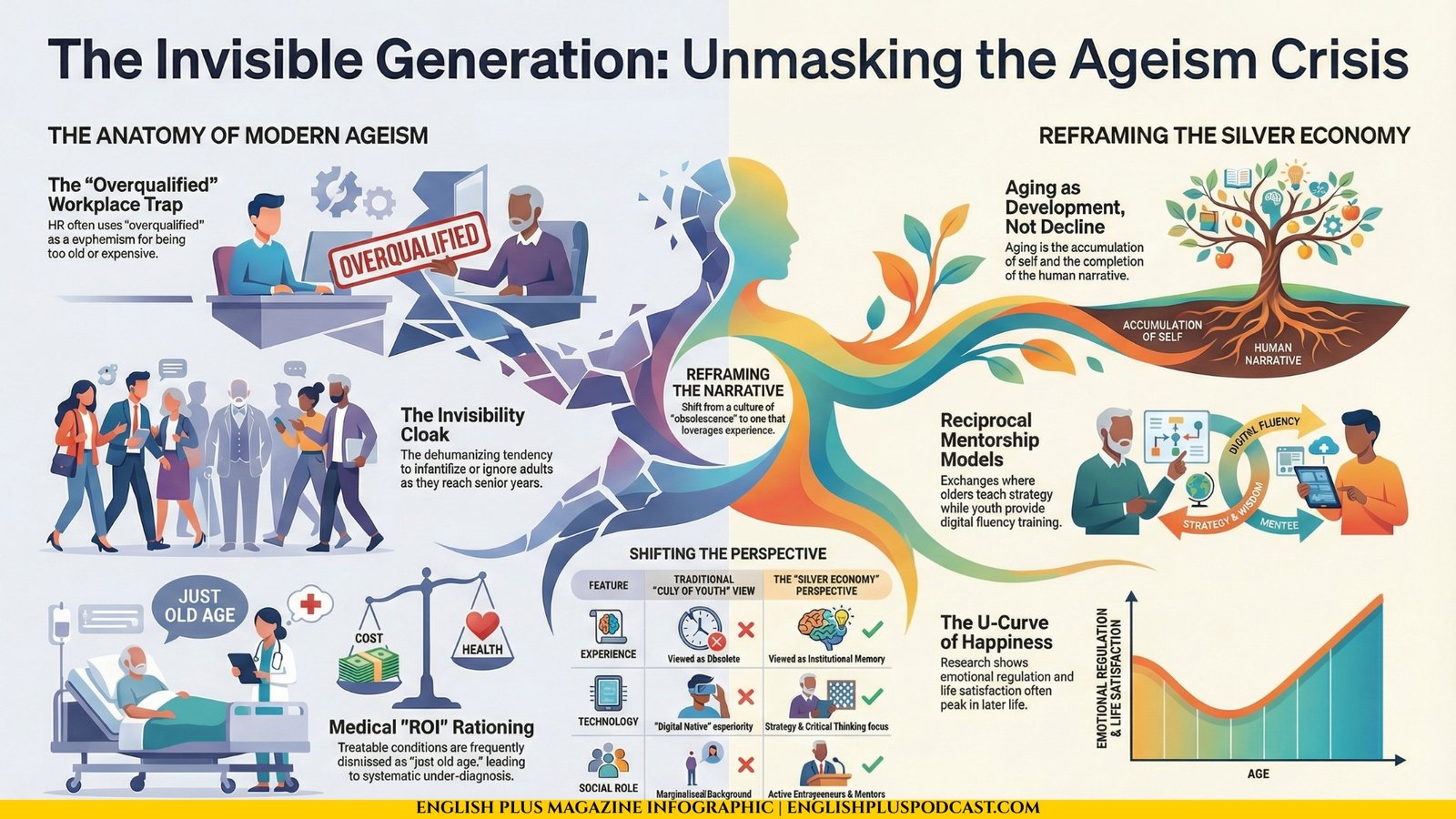
This leads to a phenomenon I call the “Invisibility Cloak.” It happens somewhere around fifty for women and maybe sixty for men. You walk into a room, and you are no longer the protagonist. You are the background texture. Waiters speak to your children instead of you. Doctors talk to your caregiver as if you aren’t in the room. This is infantilization—treating adults like children. It is one of the most dehumanizing aspects of ageism. When we use “elderspeak”—that high-pitched, slow voice people use for toddlers (“How are we doing today, sweetie?”)—on a retired professor of physics just because she is in a wheelchair, we are stripping away her dignity layer by layer.
The Aesthetics of Erasure
Media reinforces this. Look at Hollywood. The leading man is allowed to weather like an old oak tree; he gets lines, gray temples, and a young girlfriend, and we call him “distinguished.” The leading woman, however, has a strict expiration date. If she ages naturally, she is “letting herself go.” If she fights it with surgery, she is “desperate.” She cannot win.
This visual erasure matters because it trains our eyes to see aging as a failure of character. We start to believe that looking old is a moral failing, a lack of discipline. We stop seeing the human and only see the wrinkles, and in doing so, we miss the incredible richness of the lives being lived behind those lines.
The Workplace: Experience vs. The Algorithm
The “Overqualified” Trap
Nowhere is ageism more economically violent than in the workplace. We have a bizarre situation where we have an aging workforce that needs to work longer for financial reasons, and a corporate culture that wants to fire them the minute they hit a certain salary bracket.
Older workers face a wall of stereotypes. They are viewed as rigid, technophobic, expensive, and slow. If a twenty-year-old forgets a name, it’s a “brain fart.” If a sixty-year-old forgets a name, it’s “cognitive decline.” This is confirmation bias in action.
The term “overqualified” is often just a polite HR euphemism for “too old.” Companies prefer the “digital native”—a term that implies young people have a biological advantage with technology. But here is the truth: coding languages change. Platforms change. What doesn’t change? Emotional intelligence. Critical thinking. Crisis management. The ability to navigate office politics without having a meltdown. These are skills forged in the fire of time. By pushing older workers out, companies are lobotomizing their own institutional memory. They are getting faster, perhaps, but they are also getting dumber.
Healthcare: The “What Do You Expect?” Diagnosis
Medical Rationing of Care
If you think the workplace is bad, the medical system can be terrifying. There is a pervasive attitude in healthcare that equates aging with suffering, to the point where treatable conditions are dismissed as “just old age.”
An older patient goes to the doctor with knee pain. The doctor looks at the chart, sees “82,” and says, “Well, what do you expect at your age?” But if the other knee is also 82 and doesn’t hurt, clearly age isn’t the only factor. This dismissal leads to under-diagnosis of depression, malnutrition, and manageable pain. We ration care based on the “return on investment” of the patient’s remaining years. It is a brutal calculus.
Furthermore, we exclude the elderly from clinical trials. We test drugs on healthy forty-year-olds and then prescribe them to frail eighty-year-olds with different metabolisms, wondering why they have adverse reactions. It is scientific negligence born of indifference.
The Generational Warfare: Boomers vs. Zoomers
“Ok Boomer” and the Blame Game
We cannot talk about ageism without addressing the elephant in the room: the generational war. We have pitted the “Boomers” (seen as wealth-hoarding housing-market destroyers) against the “Zoomers” and Millennials (seen as avocado-toast-eating snowflakes).
The phrase “Ok Boomer” started as a dismissal of out-of-touch attitudes, but it morphed into a slur against an entire demographic. It flattens millions of individuals into a caricature of greed and ignorance. On the flip side, older generations often dismiss the valid economic anxieties of the youth as laziness.
This warfare is a distraction. It keeps us fighting each other for scraps while the actual structures of power remain untouched. Ageism cuts both ways. Dismissing a young person’s idea because they “haven’t lived” is just as toxic as dismissing an old person’s idea because they are “past it.” Both deny the person’s agency.
Reframing the Narrative: The Silver Economy
Aging as an Asset
We need a hard reset. We need to stop viewing the “Silver Tsunami” (a terrible, disaster-coded metaphor) as a catastrophe and start seeing it as an opportunity. We are entering the era of the “Silver Economy.” Older adults hold the majority of the wealth and purchasing power. They are starting businesses at higher rates than twenty-somethings. They are traveling, volunteering, and creating.
But more than economics, we need to value the perspective of age. There is a specific kind of happiness that often comes later in life—the “U-curve of happiness.” Research shows that people tend to be happiest in their youth and their old age, with a dip in middle age. Older adults often have better emotional regulation, less anxiety about social status, and a clearer sense of what matters.
Imagine a society that tapped into that. Imagine mentorship programs that weren’t just one-way streets, but reciprocal exchanges where the elder teaches strategy and the youth teaches tech. Imagine housing that mixes generations rather than segregating the old into “facilities” that look suspiciously like dormitories for the dying.
Embracing the Future Self
To fight ageism, we have to make peace with our own timeline. We have to stop saying “I feel so old” as a complaint. We have to stop complimenting people by saying, “You look great for your age.” (Just say “You look great.”)
Aging is not a decline; it is a development. It is the accumulation of self. You are not losing the person you were; you are containing them, plus all the people you have been since. To value the elderly is to value the completion of the human narrative. If we tear out the last chapter because the pages are a bit crinkled, we miss how the story ends. And usually, the ending is where the meaning lies.
Focus on Language
Let’s unpack the vocabulary we used, because the words we choose shape the reality we see. If we only have negative words for aging, we will only have negative experiences of it.
First, let’s look at Gerontocracy. This comes from the Greek geron (old man) and kratos (power). It refers to a state or society governed by old people. I used this implicitly when talking about the generational war. In political science, it’s often used negatively to describe a leadership that is out of touch. You might hear people say, “Congress is becoming a gerontocracy,” implying that the leaders are too old to understand the internet or climate change. It’s a powerful word for political debates.
Then we have Infantilize. This is a crucial concept in this topic. To infantilize someone is to treat them as a child or in a way that denies their maturity. When a nurse calls a patient “good girl” for eating her pudding, that is infantilization. In real life, you might feel infantilized by a boss who micromanages you. “Stop checking my emails; you’re infantilizing me.”
We discussed Obsolescence. This refers to the process of becoming obsolete or outdated and no longer used. In tech, we have “planned obsolescence” (when your phone dies after two years by design). In the context of people, it’s the fear that your skills are no longer needed. You can use this to describe anything fading away. “The DVD player has fallen into obsolescence.”
I used the word Venerate. This means to regard with great respect; to revere. It has a religious or almost holy connotation. We used it to describe how indigenous cultures treat elders. You don’t just “like” them; you venerate them. You can use this for heroes or mentors. “He venerates his grandfather as a war hero.”
Let’s talk about the Curmudgeon. This is a great, crusty word. A curmudgeon is a bad-tempered or surly person, usually an old man. It’s the stereotype of the “Get off my lawn!” guy. It’s often used humorously. “My uncle is a bit of a curmudgeon, but he has a heart of gold.” It captures a specific archetype of aging that isn’t necessarily evil, just grumpy.
We touched on Stereotype Threat. This is a psychological term. It refers to the risk of confirming negative stereotypes about an individual’s racial, ethnic, gender, or cultural group. If you tell an older person, “Old people have bad memories,” they become anxious about their memory, and that anxiety causes them to forget things. They fulfill the prophecy. This is useful for understanding performance anxiety in any context.
I mentioned Cognitive Dissonance (wait, we did that in the last article? Let’s switch to Cognitive Decline). Cognitive Decline is the formal term for the brain slowing down—memory loss, slower processing. It’s the medical reality we often fear. Using the clinical term makes you sound objective rather than insulting (like saying “senile”).
Let’s look at Sage. A sage is a profoundly wise person, typically an elder. It implies wisdom gained through experience, not just books. It’s the positive counterpart to the “Curmudgeon.” You might seek “sage advice” from a mentor.
We also have Intergenerational. This describes interaction between members of different generations. “Intergenerational trauma” is a heavy concept, but “intergenerational housing” is a positive one. It’s a key buzzword in sociology right now. “We need more intergenerational dialogue to solve the climate crisis.”
Finally, Longevity. This simply means long life. But the “Longevity Industry” is huge right now—biohacking, diets, exercise. It’s the pursuit of extending the lifespan. “Blue Zones are famous for the longevity of their residents.”
Now, for the speaking section. I want to challenge you on the concept of Euphemisms. We use soft words to avoid hard realities. We say “senior citizen,” “golden years,” or “mature.”
Your assignment: I want you to interview someone over the age of 60. It could be a grandparent, a neighbor, or a colleague. Ask them one question: “What is the biggest misconception young people have about your generation?”
Listen to their answer. Then, I want you to practice paraphrasing their answer using the word “Perspective.”
For example: “My neighbor thinks young people assume he is unhappy, but from his perspective, he is freer than he has ever been.”
Record yourself summarizing their answer. This practices listening comprehension and the skill of reporting speech respectfully.
Critical Analysis
Now, let’s flip the script. We have spent a lot of time defending the elderly and attacking society for devaluing them. But to be a true critical thinker, we have to look at the uncomfortable truths. Is it possible that some of our “ageism” is actually just… pragmatism? Let’s play the devil’s advocate.
First, let’s talk about The Gerontocracy Problem. We argued that older people are pushed out of the workplace, and for the average worker, that is true. But at the top of the pyramid? In politics and massive corporations? The elderly are gripping the reins of power with an iron fist. The average age of the US Senate is often nearly double the average age of the population.
Is it ageist to suggest that a leader in their 80s might not be the best person to regulate Artificial Intelligence or make 50-year climate plans they won’t live to see? There is a valid argument that the hoarding of power by the older generation is stifling innovation and ignoring the needs of the future. We need to distinguish between “discrimination against a vulnerable old lady” and “criticism of a powerful old oligarch.” They are not the same thing.
Secondly, we need to address The Economic Reality. The “Silver Economy” sounds nice, but the “Graying of the Population” is a legitimate economic crisis. In countries like Japan and Italy, there are fewer young workers to support the pensions and healthcare of the massive elderly population.
It is not “hateful” to look at the math and say, “This is unsustainable.” Younger generations are being taxed heavily to pay for the retirement of a generation that was arguably more prosperous than they will ever be. To dismiss these economic anxieties as “ageism” is to ignore the social contract. We have to be able to talk about the cost of end-of-life care and pension burdens without being accused of hating grandma.
Thirdly, let’s look at Biology vs. Bias. We talked about the “myth” of cognitive decline. But… it’s not entirely a myth, is it? Reaction times do slow down. Fluid intelligence (processing speed) does peak in young adulthood. Crystallized intelligence (wisdom/knowledge) grows, yes, but for roles requiring rapid-fire reactions (like air traffic control or surgery), is a mandatory retirement age actually discrimination, or is it public safety?
We have to be careful not to fall into “Toxic Positivity” about aging where we pretend bodies don’t change. There is a danger in denying the physical reality of aging because it prevents us from designing the accommodations (like self-driving cars or accessible housing) that are actually needed. If we pretend 80 is the new 40, we stop building ramps.
Fourth, let’s interrogate the “Respect Your Elders” Dogma. We often romanticize other cultures for their veneration of the elderly. But is respect something that should be automatic based on survival, or earned based on conduct?
There is a toxic side to “filial piety” where younger generations are forced to endure abuse, control, or financial exploitation by family members simply because they are “elders.” Blind obedience to hierarchy is not the same as genuine respect. We need to balance the dignity of the old with the autonomy of the young.
Finally, let’s look at the “Ok Boomer” sentiment again. While it is reductive, it stems from a genuine frustration with a generation that, statistically, holds the majority of housing wealth and environmental responsibility. Is it ageism to hold a demographic accountable for the legacy they are leaving? Or is that just historical analysis?
We need to separate the individual (who deserves care and respect) from the cohort (whose collective political and economic choices are fair game for criticism).
So, while ageism is a scourge, we must not let the fight against it silence legitimate conversations about power succession, economic fairness, and biological reality.
Let’s Discuss
Here are five questions to get you debating in the comments. I want you to be honest, even if it feels a bit taboo.
1. Should there be a maximum age limit for politicians?
We have a minimum age (you have to be 35 to be US President). Why is a maximum age considered discriminatory if a minimum age isn’t? Is it about ability, or about having a stake in the future?
2. Is “anti-aging” marketing inherently hateful?
Is dyeing your hair or getting Botox an act of self-care and empowerment, or is it an act of internalized ageism that upholds a broken system? Can you participate in beauty culture without hating aging?
3. When should you take the car keys away?
This is a painful one for many families. At what point does an older person’s right to independence get trumped by the public’s right to safety? Who should decide—the family or the state?
4. Should the young pay for the old?
As populations age, pension systems are straining. Is it fair to tax a struggling 25-year-old to pay the pension of a wealthy 75-year-old? Should benefits be means-tested based on wealth, not just age?
5. Is “wisdom” overrated?
We assume old people are wise. But if someone was a fool at 20, aren’t they just an older fool at 70? Does experience always equal wisdom in a world that changes this fast?
Fantastic Guest: An Interview with Oscar Wilde
Danny: Welcome back to the Fantastic Guest segment. In our main article, “The Invisible Generation,” we discussed the profound fear our society has of aging. We talked about the obsession with youth, the erasure of the elderly, and the frantic attempts to freeze time.
When I thought about who could shed light on this, I didn’t want a geriatrician. I wanted the man who wrote the ultimate horror story about the terror of aging. He is the playwright, the poet, the wit, and the author of The Picture of Dorian Gray—a novel about a young man who sells his soul so that a portrait will age while he remains forever young and beautiful. He understood vanity, celebrity, and the cruel passage of time better than perhaps anyone. Please welcome the aesthete himself, Oscar Wilde. Oscar, thank you for joining us.
Wilde: You are very kind, Danny. And might I say, you are looking… reasonably well preserved. For a modern.
Danny: “Reasonably well preserved.” I’ll take that as a compliment, I think. Oscar, I brought you here because we are in the midst of a cultural crisis regarding age. We treat it like a pathology. You wrote Dorian Gray in 1890. It feels like you predicted the Instagram filter age. Dorian looks at his portrait and says, “I am jealous of everything whose beauty does not die.” Do you think we are all Dorian Grays now?
Wilde: We are all Dorians, Danny, but we lack the magic canvas. We have only the surgeon’s knife and the pharmacist’s potions. It is a tragedy. You see, the tragedy of old age is not that one is old, but that one is young.
Danny: “The tragedy is that one is young.” That’s one of your famous paradoxes. Unpack that for me.
Wilde: The body withers. The skin begins to resemble a map of a country one no longer wishes to visit. But the soul? The desire? The passion? It often remains trapped in its teenage state. That is the cruelty. If we aged mentally as we aged physically, we would simply cease to care about beauty, and we would be happy. We would be like your “curmudgeons”—content in our decay. But to feel the fire of youth while living in a chimney that is crumbling… that is the suffering.
Danny: So you think the “anti-aging” industry—the creams, the dyes, the treatments—is driven by that mismatch?
Wilde: It is driven by the fact that the world belongs to the beautiful. I have always said that beauty is a form of genius—is higher, indeed, than genius, as it needs no explanation. It is one of the great facts of the world, like sunlight, or spring-time, or the reflection in dark waters of that silver shell we call the moon. You cannot argue with a wrinkle, Danny. A wrinkle is a fact. And facts are terribly brutal things.
Danny: But that’s exactly the attitude our article is challenging! This idea that beauty equals worth. We argue that by valuing only the “new,” we discard the “sage.” We throw away wisdom because it doesn’t have smooth skin.
Wilde: Wisdom! A horrid word. It sounds like something one puts on toast when one has run out of butter. You value “wisdom” because you have to. It is the consolation prize of the elderly. When a man is too old to set a bad example, he begins to give good advice.
Danny: That is incredibly cynical. You don’t believe that experience brings value?
Wilde: Experience is merely the name men give to their mistakes.
Danny: Okay, let’s push back on that. In the article, we discuss the “Silver Economy.” Older people starting businesses, creating art, mentoring. They aren’t just giving advice; they are active. You died young, at 46. You never got to be an “elder.” Do you think you missed out on a chapter of life that has its own specific beauty?
Wilde: I died at 46, but I had lived a thousand lives by then. I drank the cup to the dregs. Would I have liked to be eighty? I cannot imagine it. To be eighty is to be a ghost in one’s own life.
However… I do admit, there is a certain dignity in the ruin. I love ruins. A ruined castle is far more interesting than a newly built suburban villa. Perhaps, if society viewed the elderly as “ruins”—majestic, crumbling, full of history—rather than as “rubbish,” the world would be a kinder place.
Danny: That connects to the “Aesthetics of Erasure” we talked about. We don’t view them as majestic ruins; we view them as invisible. We simply stop looking.
Wilde: To be looked at is the only certainty that one exists. For a celebrity—and I was the first modern celebrity, let us be honest—invisibility is a form of death. I suspect that is why your elderly are so unhappy. It is not the hip pain; it is the eye-contact pain. No one meets their gaze. They have become part of the furniture. And usually, it is very unfashionable furniture.
Danny: So how does one fight that? If you were 80 years old today, living in a world that worships 20-year-old TikTok stars, how would you force the world to look at you?
Wilde: By being absolutely disgraceful.
Danny: Disgraceful?
Wilde: Of course. The only way to combat the invisibility of age is to refuse the “dignity” that society imposes on you. Society wants the old to be quiet, to sit in the corner, to knit, to be “sweet.” It is nauseating.
If I were 80, I would dye my hair purple. I would wear velvet suits of the most shocking yellow. I would say the most scandalous things at dinner parties. I would make love to inappropriate people.
You see, Danny, people forgive the young for being wild because they are young. But they are terrified of the old being wild. It disrupts their sense of order. Be a disruption. That is my advice. Do not be a “Sage.” Be a “Monster.” At least monsters are watched.
Danny: That is… actually brilliant advice. “Be a disruption.” It refuses the “Infantilization” we discussed—the “good girl/good boy” dynamic.
Wilde: Precisely. Good children are seen and not heard. Good old people are neither seen nor heard. One must be bad to be remembered.
Danny: Let’s talk about the workplace. You worked—sort of. You wrote plays. You lectured. Today, older workers are pushed out because they are seen as “obsolete.” “Digital Natives” are preferred. As a man who wrote with a quill pen (presumably), what do you think of the idea that technology renders the previous generation useless?
Wilde: Technology is simply a way of doing things faster that one shouldn’t do at all.
You say the old are obsolete because they cannot use the… what is it? The “cloud”?
I find it charming that they cannot use it. It shows a superiority of mind. Why should a man who has read Homer and Shakespeare bother with an algorithm? The algorithm is a servant. The man is the master.
The problem is that you have elevated the servant—speed, data, connectivity—to the position of master. You value the machine more than the mind. An old mind is a library. A young mind is a browser. One has depth; the other has tabs.
Danny: “One has depth; the other has tabs.” I’m stealing that.
But Oscar, the bills need to be paid. The “Boomer” generation is holding onto the jobs because they need the money, or the status. And the “Zoomers” are angry because they can’t move up. You lived in the Victorian era, which was very hierarchical. Did you see this generational resentment back then?
Wilde: We had fathers and sons, Danny. It is the oldest war in history. The son always wants to kill the father—metaphorically, usually—to take his place.
But in my time, the father had the decency to die sooner. You have extended life, but you have not extended the purpose of life. You keep people alive for decades after they have finished their work. Of course there is resentment.
The “Boomers,” as you call them, seem to be a generation that has eaten the entire cake and is now lecturing the children on the virtues of fasting. It is very vulgar. And I dislike vulgarity.
Danny: That’s a sharp critique of the economic inequality. But let’s go back to Dorian Gray. In the book, Dorian stays young, but his soul—the portrait—becomes hideous. It rots.
Do you think that in our obsession with “anti-aging,” we are rotting our collective soul? Are we becoming meaner, shallower people because we refuse to accept the cycle of life?
Wilde: We are becoming more superficial, certainly. And superficiality is the supreme vice.
When you spend all your energy on the facade—on the skin, the image, the brand—you have no energy left for the interior.
I look at your society, Danny. You have beautiful teeth. Everyone has such white teeth. And you have smooth foreheads. But your conversation? It is dull. It is safe. It is terrified of offending.
You have preserved the shell, but the nut has withered.
I would rather sit with a wrinkled old woman who has lived, sinned, suffered, and can tell a story, than with a smooth-faced boy whose only tragedy is a slow wifi connection.
Danny: So, suffering adds value?
Wilde: Suffering creates the soul. I wrote De Profundis from a prison cell. I was broken. I was disgraced. I was no longer the dandy with the green carnation. I was a convict.
And in that degradation, I found a depth that I never had when I was dining with princes.
This is what your “Ageism” article misses, perhaps. You try to paint aging as “positive”—”The Silver Economy,” “Mentorship.” You try to sanitize it.
Aging is not positive. It is a loss. It is a shipwreck. But… the wreckage is magnificent.
You should not try to sell aging as “fun.” You should sell it as “tragic.” And tragedy is the highest form of art.
Danny: That is a very different take. We tend to want to “rebrand” things to make them palatable. You’re saying: admit it’s a shipwreck, and admire the driftwood.
Wilde: Exactly. Stop trying to make 80 the new 40. Let 80 be 80. Let it be fierce. Let it be terrifying. Let it be the Witch in the woods. Let it be the Wizard in the tower. Do not make it “The Senior Citizen in the Condo.” That is boring. And being boring is the only sin for which there is no forgiveness.
Danny: I want to ask about the “U-curve of happiness.” Statistics show people are happiest in their 80s. You seem skeptical of happiness.
Wilde: Happiness is for cattle. I never wanted happiness. I wanted pleasure. And I wanted experience.
If these 80-year-olds are “happy,” I suspect it is because they have stopped wanting things. They have given up. They have reached a state of bovine contentment.
To me, that is not life. Life is desire. Life is wanting the thing you cannot have. If I am 80 and I am “content,” please shoot me. I want to be 80 and longing for a final adventure. I want to be 80 and heartbroken. Heartbreak keeps you young.
Danny: You really are the anti-guru. Everyone else is selling “peace of mind,” and you’re selling heartbreak.
Wilde: Peace of mind is for the grave. Which, I suppose, is close enough at that age.
Danny: Let’s talk about “Euphemisms.” We listed “Golden Years,” “Senior,” “Mature.” You were a master of language. How would you rename “Old Age”?
Wilde: I would call it “The Final Act.”
In a play, the final act is where everything is resolved. The secrets are revealed. The villain is unmasked. The hero dies or marries. It is the most important part.
If you call it “The Golden Years,” it sounds like a vacation. If you call it “The Final Act,” it sounds like drama. And we must treat our elders as the stars of the Final Act, not as the audience members leaving the theater early to avoid traffic.
Danny: “The stars of the Final Act.” I love that. It gives agency back to them.
Oscar, you were a fashion icon. Knee breeches, velvet jackets, long hair. If you were a 75-year-old fashion influencer today—which is a thing, by the way, “Granfluencers”—what would your style be?
Wilde: I would dress to intimidate.
Old men today dress for comfort. Beige trousers. Elastic waistbands. It is a surrender.
I would wear capes. A cape is dignified. It hides the hunch of the spine and adds a sweep of drama to the exit. And jewelry. Large rings. The hands age first, so one must distract the eye with emeralds.
And a cane. Not a medical cane. An ebony cane with a silver head, used not for walking, but for pointing at things I disapprove of.
Danny: The cane as a weapon of judgment. I can see it.
I have to ask: Do you regret Dorian Gray? Some say it was the evidence used against you in your trials—proof of your “immoral” character. It was the book that made you famous, but also the book that defined your downfall.
Wilde: I regret nothing. Dorian Gray is a perfect book. It showed the world its own face in the mirror, and the world hated me for it.
The world loves a mirror when it flatters, but smashes it when it reveals the cracks.
My only regret is that I did not write more. But then, I put my genius into my life, and only my talent into my works.
Danny: A famous quote. Do you think that’s true of the elderly today? That they have put their genius into their lives?
Wilde: That is the charitable view. And we should be charitable.
Look at an old woman on a park bench. To you, she is a “senior citizen” feeding pigeons.
But in her mind? She is dancing at a ball in 1950. She is holding a lover’s hand. She is burying a child. She is building a business. She contains multitudes.
The problem is not that she is empty. The problem is that you—the observer—are blind. You see the cover of the book, which is tattered, and you assume the pages are blank.
My advice to your readers, Danny, is this: Read the book. It may be a tragedy, it may be a farce, but it will certainly be more interesting than your own “feed.”
Danny: That connects to what we said about “The Future Self.” That ageism is prejudice against our future selves.
Wilde: Precisely. Be kind to the old, for you are simply looking at your own ghost. And ghosts can be very vengeful if they are ignored.
Danny: One final question. We ended the article with “I’m keeping the gray hair.” What do you think? Should I dye it?
Wilde: Keep it. It suggests you have suffered. And suffering is terribly attractive in a man. It makes him look like he has a secret.
But if you get a second one… dye it immediately. One is a curiosity. Two is a decay.
Danny: I will keep that in mind. One is distinguished, two is decay. The ruthless math of Oscar Wilde.
Oscar, this has been enlightening, terrifying, and stylish. Thank you for coming back to remind us that aging is a tragedy we should embrace with style.
Wilde: The pleasure was yours, I’m sure. Now, I must go. I believe there is a mirror backstage I haven’t critiqued yet.
Danny: Ladies and gentlemen, Oscar Wilde!









0 Comments