We are currently living through the grandest, messiest, and most confusing experiment in the history of human labor. For centuries, the equation of work was simple: you wake up, you commute (whether by horse, train, or Toyota Camry), you arrive at a specific building, you do the thing, and you go home. The geography of work was fixed. The office was the stage, and if you weren’t on stage, you weren’t in the play.
Then, the world broke. We all went home. We learned what Zoom fatigue was. We discovered that our coworkers had cats, messy kitchens, and surprisingly loud children. And just as we got comfortable working in sweatpants, the world opened up again. But it didn’t snap back to 2019. Instead, we landed in this strange, liminal space we call “Hybrid.”
On paper, Hybrid sounds like the best of both worlds. You get the flexibility of remote work with the collaboration of the office. It’s the “have your cake and eat it too” model of employment. But as anyone who has actually tried to manage a hybrid team knows, it feels less like having cake and more like trying to herd cats where half the cats are in the room and the other half are digital avatars on a screen that keeps freezing. This is the Hybrid Conundrum. It is the challenge of managing a two-tier workforce without creating a two-class system. It is the struggle to maintain culture when “culture” no longer lives within four walls.
The Geometry of Inequality: Proximity Bias
Out of Sight, Out of Mind?
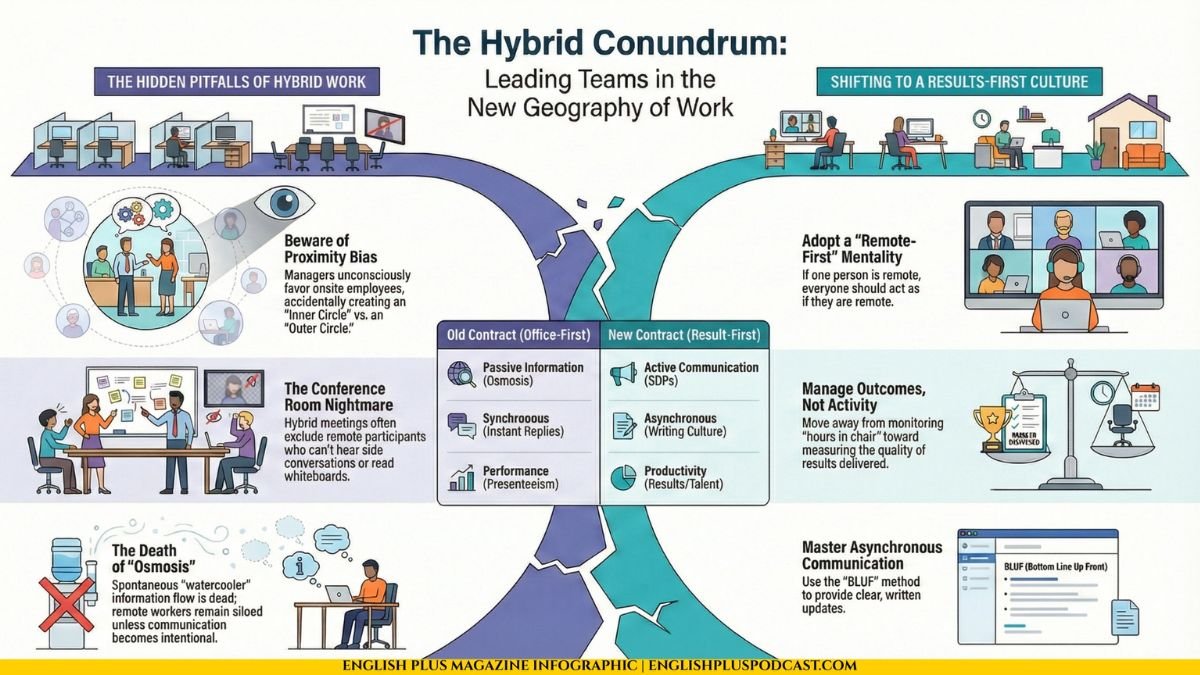
Let’s start with the elephant in the Zoom room: Proximity Bias. This is the unconscious tendency for leaders to show favoritism to the employees they see physically every day. It’s not malicious; it’s biological. We are primates. We bond through physical presence. When you see someone in the hallway, you exchange a smile, you grab a coffee, you talk about the game. These “micro-interactions” build trust capital.
Now, consider the remote employee. They are a face in a box. They only appear when a meeting is scheduled. They don’t get to laugh at the boss’s bad jokes in the elevator. Over time, a dangerous rift opens up. The in-office team becomes the “Inner Circle”—the ones who know the gossip, the ones who get the ad-hoc assignments, the ones who get promoted because they were “top of mind.” The remote team becomes the “Outer Circle”—the executioners, the task-doers, the ones who are slowly drifting away from the heartbeat of the company.
This creates a caste system. You have the “citizens” of the office and the “digital nomads” of the cloud. If managers aren’t ruthlessly intentional about counteracting this, they will inevitably create a team where the onsite people are the strategists and the remote people are the service providers. And let me tell you, nothing destroys morale faster than feeling like a second-class citizen in your own company.
The Conference Room Nightmare
We have all endured the specific hell of the “Hybrid Meeting.” You know the scene. Five people are sitting in a conference room, laughing, eating donuts, and sketching on a whiteboard. Three people are dialed in remotely.
For the people in the room, it’s great. For the people on the screen, it is a disaster. They can’t hear the side conversations. They can’t read the handwriting on the whiteboard because of the glare. If they try to speak, there’s a lag, or they end up interrupting someone, or worse, they are just ignored because the people in the room are focused on each other.
The remote participants eventually just go on mute and check their email. They have mentally checked out because the physical architecture of the meeting excluded them. This is a failure of design. If you are going to run a hybrid team, you have to adopt a “Remote-First” mentality for meetings. If one person is on Zoom, everyone should be on Zoom (or at least act like it). Otherwise, you aren’t having a meeting; you’re having a party in the office and letting the remote people watch through a window.
The Death of the Watercooler (and Why That Matters)
Engineered Serendipity
We used to rely on “osmosis” for information flow. You learned things just by being there. You overheard a conversation in the breakroom that solved a problem you were stuck on. You bumped into Steve from Accounting and found out the budget was cut. This is serendipity—happy accidents of information exchange.
In a hybrid world, osmosis is dead. You cannot overhear a conversation on Slack unless you are tagged in it. Information becomes siloed. The remote workers only know what you explicitly tell them. This means communication must shift from “passive” to “active.”
Managers have to become architects of serendipity. You can’t just hope people talk; you have to engineer it. This feels artificial at first. Scheduling “virtual coffees” or forcing people to use “random chat” channels feels like forced fun. But without these structures, the social fabric of the team dissolves. You end up with a group of efficient mercenaries who deliver work but don’t care about each other. And mercenaries leave the moment someone else offers them a slightly bigger bag of gold.
The Asynchronous Revolution
To solve this, smart companies are moving toward “Asynchronous Communication.” This is a fancy way of saying: “Stop expecting everyone to answer immediately.”
In the office, synchronization is easy. I walk to your desk, I ask a question, you answer. Done. But when half the team is remote (and maybe in different time zones), demanding instant responses is a recipe for burnout. It forces the remote people to be tethered to their notifications, terrified that if they don’t reply in 30 seconds, you’ll think they are watching Netflix.
Asynchronous work requires a culture of writing. Instead of a quick chat, you write a detailed memo. Instead of a status meeting, you update a project board. It feels slower in the moment, but it is faster in the long run because it creates a paper trail. It democratizes information. The remote person has the same access to the doc as the person sitting next to the CEO. It levels the playing field.
The Trust Deficit
Surveillance vs. Outcomes
Why do so many managers hate remote work? Let’s be honest. It’s about control. When you can see your employees typing, you assume they are working. It’s a lazy metric, but it’s comforting. When they are at home, you have to trust them. And for many micromanagers, that trust is physically painful.
This has led to the rise of “bossware”—software that tracks keystrokes, takes screenshots, and monitors mouse movement. If you are thinking about using this, stop. Just stop. It is the quickest way to tell your high-performers that you treat them like delinquent teenagers.
The Hybrid Conundrum demands a shift from managing activity (hours in chair) to managing outcomes (results delivered). If I hire a graphic designer, I shouldn’t care if they design the logo at 9 AM or 9 PM, or if they do it while wearing pajamas, as long as the logo is good and on time. This sounds simple, but it requires managers to actually define what “good” looks like. It’s harder to manage outcomes than to manage attendance. It requires clarity. And frankly, a lot of managers rely on ambiguity to hide their own lack of strategy.
The New Social Contract
We are rewriting the social contract of work. The old contract was: “I buy your time, you give me obedience.” The new contract is: “I buy your talent, you give me results.”
Hybrid work exposes the cracks in the old contract. It reveals who is actually working and who was just “performing” work by walking around the office with a serious expression and a stack of papers. The remote environment strips away the theater of productivity.
This is terrifying for the “presenteeism” crowd—the people who built careers on face time and office politics. But it is liberating for the doers. The challenge for leadership is to protect the doers from the politicians, even when the politicians are the ones buying you lunch.
Designing the Future Office
The Office as a Tool, Not a Container
So, is the office dead? No. But the purpose of the office has changed. We used to go to the office to do everything—email, deep work, meetings, lunch. Now, if I have to commute 45 minutes just to put on headphones and answer emails, I am going to be resentful. I can do that at home.
The office must become a “collaboration hub.” You go to the office for specific tasks: brainstorming, complex problem solving, difficult feedback conversations, and socializing. The office should look less like a row of cubicles (libraries for typing) and more like a mix of coffee shop, living room, and conference center.
If you demand people come back to the office, you have to give them a “why.” And “because I said so” is no longer a valid reason. The “why” has to be: “Because we need to jam on this idea,” or “Because we’re having a team lunch.” The office is no longer a container for people; it is a tool for specific modes of work.
The Fairness Trap
Finally, a word on fairness. Managers often try to solve the Hybrid Conundrum by imposing rigid rules to be “fair.” “Everyone must be in on Tuesdays and Thursdays.”
This backfires. Tuesday might be the day I need to do deep focus work (better at home). Thursday might be the day my kid has soccer. By forcing rigidity in the name of fairness, you destroy flexibility, which was the whole point.
True fairness isn’t treating everyone the same; it’s treating everyone with the same principles. The principle should be: “Work where you are most effective for the task at hand.” For some, that’s 5 days home. For others, it’s 5 days office. The chaos of managing these different schedules is the price you pay for access to the best talent pool in the world.
The Hybrid Conundrum isn’t going away. We aren’t going back to 2019. The toothpaste is out of the tube. The companies that win won’t be the ones that force everyone back to the cubicle, nor the ones that go fully remote without a plan. The winners will be the ones who master the mess. They will be the ones who realize that geography is no longer destiny, and that a team is not defined by where they sit, but by what they build together.
Focus on Language
Let’s get our hands dirty with the vocabulary I used in this piece. We’re dealing with business and sociology here, so the words are often about structures, perceptions, and dynamics. Understanding these terms gives you the power to articulate exactly why your workday feels the way it does.
First up is Liminal. I described the hybrid state as a “liminal space.” This comes from the Latin limen, meaning threshold. A liminal space is a transition point—it’s the waiting room, the hallway, the time between “no longer” and “not yet.” An airport is a liminal space; you aren’t in your home city, but you aren’t at your destination. Adolescence is a liminal stage. When you use this word, you’re describing a state of ambiguity and transition. “We are in a liminal period between the old strategy and the new launch.”
Then we have the Conundrum. It’s right there in the title. A conundrum is a confusing and difficult problem or question. It’s stronger than just a “problem.” A problem has a solution; a conundrum is a puzzle where the answer is elusive or involves a difficult trade-off. “The ethics of AI present a conundrum for regulators.” It sounds much more sophisticated than saying, “It’s a tricky situation.”
I talked about Proximity Bias. This is a specific type of cognitive bias. Proximity means nearness in space, time, or relationship. So, proximity bias is the unconscious tendency to favor people who are physically close to you. This is a huge buzzword in HR right now. You can use “proximity” in everyday life too. “I only dated him because of proximity; we lived in the same dorm.”
We used the word Osmosis. Biologically, this is how molecules pass through a membrane. In business and social contexts, it means learning or absorbing information gradually and unconsciously, just by being around. “I never studied Spanish, I just picked it up by osmosis living in Madrid.” In the article, I argued that learning by osmosis is dead in remote work because you aren’t physically surrounded by the information flow.
Let’s look at Serendipity. This is one of the most beautiful words in English. It means the occurrence of events by chance in a happy or beneficial way. Finding a $20 bill in your old coat pocket is serendipity. Meeting your future spouse because you both grabbed the same taxi is serendipity. Managers try to “engineer serendipity” by creating spaces where people bump into each other. “Our meeting was pure serendipity.”
I mentioned Siloed. In agriculture, a silo is a tall tower used to store grain. In business, if information or teams are “siloed,” it means they are isolated from others. The marketing team doesn’t talk to the sales team; they are in separate silos. This is bad. You want to “break down silos.” “The data is too siloed; we need a centralized system.”
We discussed Asynchronous. The prefix a- means “not,” and synchronous means happening at the same time. So, asynchronous means not happening at the same time. Email is asynchronous—I send it now, you read it later. A phone call is synchronous—we are both there at once. Mastering “async” communication is a superpower. “Let’s move this meeting to an asynchronous update so we don’t have to find a time that works for everyone.”
Then there’s Presenteeism. We touched on this in the last article too, but it bears repeating. It’s the practice of being present at one’s place of work for more hours than is required, especially as a manifestation of insecurity. It’s showing up just to be seen. “The culture of presenteeism means people are afraid to leave before the boss does.”
I used the term Mercenary. Historically, a mercenary is a soldier who fights for any country that pays them, not out of loyalty. In business, a “mercenary” employee is someone who is highly skilled but has no loyalty to the company culture; they are just there for the check. “He’s a bit of a mercenary; he’ll jump ship for a 5% raise.”
Finally, Ambiguity. This is the quality of being open to more than one interpretation; inexactness. I said bad managers rely on ambiguity to hide their lack of strategy. If instructions are ambiguous, you don’t know what to do. Being able to “tolerate ambiguity” is often listed as a leadership skill. “The contract was full of ambiguity, which led to a lawsuit.”
Now, for the speaking section. I want to give you a challenge regarding Conciseness and Asynchronous Communication.
We talked about how remote work requires better writing.
Your assignment: I want you to imagine you need to ask your boss for a deadline extension on a project.
First, record yourself rambling about it. “Hey, so, um, I was looking at the thing, and I know it’s due Tuesday, but like, my cat got sick, and the data was weird…”
Now, I want you to rewrite that request using the “BLUF” method (Bottom Line Up Front). State the request clearly, then the reason, then the new plan.
“I am requesting a 48-hour extension on Project X. New deadline: Thursday at 5 PM. Reason: Unexpected data discrepancies require manual review. I have the resources to complete this by Thursday.”
Record the “BLUF” version. Notice how much more formidable (remember that word?) and professional you sound. This is how you win at hybrid work.
Critical Analysis
We’ve painted a picture of the Hybrid model as a messy but necessary evolution. We’ve championed the “Remote-First” mindset and criticized the “Proximity Bias” of managers. But let’s play the devil’s advocate. Are we ignoring the darker reality of a remote-heavy workforce?
First, let’s talk about The Outsourcing Slippery Slope.
If a job can be done from a kitchen table in Ohio, it can be done from a kitchen table in Manila, Bangalore, or Warsaw—often for a fraction of the cost. By demanding fully remote roles, are Western workers inadvertently arguing for their own obsolescence?
There is a valid argument that the “office” acts as a protective barrier for local wages. Once you detach the role from the geography, you enter a global labor market. If you are a remote worker demanding a San Francisco salary while living in a low-cost area, you might soon find that your employer realizes they can hire three people in a different time zone for the price of you. The “Hybrid” model (requiring some office presence) might actually be the only thing protecting local labor markets from total globalization.
Secondly, let’s look at The Erosion of Mentorship.
We mentioned the death of osmosis, but let’s go deeper. Who suffers most in a remote world? It’s not the senior leaders; they already have their networks and skills. It’s the juniors. It’s the 22-year-old fresh out of college.
You learn the soft skills of a job—how to handle a difficult client, how to read a room, how to negotiate—by watching senior people do it. You can’t watch someone “handle a room” on Zoom. We risk creating a “Lost Generation” of workers who have high technical skills but zero political or social intelligence because they spent their formative years alone in a bedroom. Is it ethical for senior staff to stay home, effectively pulling up the ladder behind them?
Third, consider The Class Divide.
We talked about the “two-tier” workforce within a company, but what about society at large? “Hybrid work” is a luxury privilege of the “Laptop Class.” Nurses, construction workers, chefs, bus drivers—they cannot work hybrid.
By obsessing over hybrid policies, we are focusing corporate energy entirely on the elite top 30% of the workforce. This widens the cultural resentment between the “Zoomers” (in the literal sense of Zoom users) and the physical workers. The more the Laptop Class retreats into their home bubbles, the less they understand the reality of the cities and communities they live in. This disconnect can lead to profound social fracturing.
Fourth, let’s challenge the Productivity Narrative.
We often hear “I am more productive at home.” And for individual tasks (writing code, drafting reports), that is likely true. But is individual productivity the same as organizational productivity?
Innovation is often inefficient. It requires wasting time. It requires bad ideas. It requires friction. If everyone is at home maximizing their personal efficiency, the collective “spark” might die. We might be getting better at doing the tasks we already know how to do, but getting worse at inventing the tasks of the future. A company of highly efficient individuals can still be a stagnant company.
Finally, we must interrogate The Mental Health Impact of Isolation.
We praise the lack of commute, but the commute served a psychological function: it was a decompression chamber. It separated “Home You” from “Work You.”
Without that separation, and without the casual social interaction of the office, loneliness is skyrocketing. We are social animals. Is it healthy to spend 10 hours a day interacting only with screens? We might be trading the stress of traffic for the depression of isolation.
So, while Hybrid is here to stay, we need to be clear-eyed about the risks: global wage arbitrage, a skills gap for the young, increased class inequality, and a loneliness epidemic. It’s not just a logistical puzzle; it’s a societal one.
Let’s Discuss
Here are five questions to get you debating with your colleagues.
1. Is “location-based pay” fair?
If you move from New York to a rural village, should your salary be cut? Some say yes (pay is based on cost of labor). Some say no (pay is based on value of output). If you do the same work, why should you get paid less just because your rent is cheaper?
2. Should junior employees be required to be in the office more than seniors?
This seems logical for mentorship, but it creates a hierarchy where the “bosses” get the freedom and the “kids” get the commute. Does this breed resentment? Or is it a necessary part of paying your dues?
3. Is it ethical to have a “camera on” policy?
Managers argue it helps connection and proves you are there. Employees argue it is invasive and causes “Zoom dysmorphia” (anxiety about your appearance). Is requiring video a form of surveillance?
4. Will the Hybrid model kill the big city?
If people only come in 2 days a week, downtown businesses (cafes, dry cleaners) lose 60% of their revenue. Cities depend on commuter foot traffic. Do corporations have a responsibility to the cities they occupy?
5. If you are fully remote, can you ever really be promoted?
Be honest. If there is a promotion, and one candidate sits next to the CEO every day and the other lives in another state, who gets it? Is the “Proximity Bias” inevitable, and should remote workers just accept slower career growth as the trade-off for freedom?
Fantastic Guest: An Interview with Genghis Khan
Danny: Welcome back to the Fantastic Guest segment. We have been discussing the “Hybrid Conundrum”—how to manage a workforce that is scattered, half-visible, and communicating across different time zones. We’ve talked about the challenges of logistics, trust, and the “Digital Nomad” lifestyle.
So, I thought: who is the ultimate expert on managing a massive, distributed, nomadic workforce? Who built the largest contiguous land empire in history without a single Zoom call? Who created the original “asynchronous” communication network? He is the Great Khan, the Universal Ruler, the CEO of the Mongol Empire… Genghis Khan. Temüjin, welcome to the studio. Please don’t kill me.
Genghis: You sit in a box. You talk into a stick. And you drink water from plastic. Is this how the conquerors of the future live? It is… soft.
Danny: It is a bit soft, yes. We call it “comfort.” But we are very stressed! We have “burnout.”
Genghis: Burnout. I know this. When a horse is ridden too hard, it foams at the mouth and dies. You eat it, and you get a fresh horse. Do you eat your workers when they burn out?
Danny: No! No, we definitely do not eat them. We give them “Mental Health Days.”
Genghis: You give them a day to reflect on their weakness? Interesting strategy. We gave them kumis and a larger share of the plunder. It seemed to work better.
Danny: I want to talk about your management style. You managed an empire that stretched from the Pacific Ocean to the Caspian Sea. You had generals operating thousands of miles away from you. Today, managers panic if their employee is working from a coffee shop down the street. How did you handle “remote work”?
Genghis: It is simple. Trust. And consequences.
When I sent Subutai to conquer the West, I did not check on him every hour. I did not ask for a “status update.” I gave him a mission: “Go West. Break their walls. Bring me their loyalty.”
If he succeeded, he was rewarded with land and horses. If he failed… well, he knew the price of failure.
Your managers panic because they do not trust their own judgment in choosing the general. If you hire a wolf, you let him hunt. If you hire a sheep, you must watch him. You hire too many sheep, Danny.
Danny: “If you hire a wolf, let him hunt.” That’s actually a great argument for autonomy. We talked about “Bossware”—software that spies on employees to see if they are typing. Did you have spies?
Genghis: Of course I had spies. But I spied on my enemies, not my friends. Why would I spy on my own general? If he is riding for me, I know it. If he betrays me, I will know it when the tribute stops arriving.
This “Bossware”… it sounds like the tactic of a weak leader. A leader who needs to watch his men’s fingers is a leader who fears his men. And a leader who fears his men should not be Khan.
Danny: You were the original “Digital Nomad,” minus the digital part. You lived in yurts (gers). You hated walls. You hated cities. In the article, we discussed how the office is becoming a “collaboration hub” rather than a container. You viewed cities as… well, targets.
Genghis: Walls are a cage. I never understood the obsession with stone houses. You build a wall to keep people out, but you only succeed in trapping yourself in.
The Steppe is the ultimate office. You move where the grass is green. You move where the water is fresh. If the air becomes stale, you pack up the yurt and you ride.
Your “Hybrid” workers… they want the freedom of the Steppe, but they want the safety of the Wall. They want to be nomads with health insurance. It is a difficult balance. You cannot be a wolf and a house dog at the same time.
Danny: That is the “Hybrid Conundrum” in a nutshell! We want the freedom and the safety.
Let’s talk about communication. You invented the Yam system. It was a network of relay stations where riders would swap horses to carry messages across the empire at incredible speed. It was basically the 13th-century internet.
Genghis: The Yam was the veins of the empire. Without it, we were just scattered tribes. With it, we were one body.
A message could travel 200 miles in a day. We used bells to signal our arrival so the next horse would be ready. No time was wasted.
But notice this: The rider carried the message. He did not carry “chatter.” He did not ride 200 miles to say, “Hey, just checking in.” He rode 200 miles to say, “The Shah is dead. Send reinforcements.”
Your “Slack” and “Email”… you use the Yam for chatter. You clog the veins with nonsense. “Happy Birthday, Susan.” “Look at this cat.” If a rider rode 200 miles to show me a picture of a cat, I would have him whipped.
Danny: I think every modern worker wishes they could whip someone for a “reply all” email. So you were a proponent of “Asynchronous Communication”? You sent the message, and you trusted it would get there?
Genghis: I sent the message. I waited. The answer came back. I did not sit by the tent flap vibrating with anxiety.
You are addicted to the “Now.” You think if you don’t answer in one minute, the sky will fall. The sky is very heavy, Danny. It does not fall so easily. Patience is a weapon.
Danny: Let’s talk about “Proximity Bias.” The article discusses how managers favor the people they see every day. You had a massive inner circle—the Kheshig (imperial guard). But you promoted people from conquered tribes, people you barely knew, based on merit. You famously shot an arrow at a man, Jebe, who almost killed you, and then you hired him!
Genghis: Jebe. The Arrow. Yes. He shot my horse out from under me. He had courage. He had skill.
Most leaders surround themselves with flatterers. They want men who look like them, talk like them, and agree with them. This is “Proximity Bias,” yes? It is a disease. It breeds weakness.
I did not care if a man was a Mongol, a Uyghur, a Christian, or a Muslim. I did not care if he was a shepherd or a prince. I cared about one thing: Can he do the job?
Jebe almost killed me. That means he is a good shot. Why would I kill a good shot? I made him a general. He conquered lands I never saw.
If your managers only promote the people who sit in the cubicle next to them, they are promoting “sitters.” I promoted “shooters.”
Danny: “Promote shooters, not sitters.” I love that. But how do you build culture? We worry that if everyone is remote, we lose the “company culture.” The Mongols had an incredibly strong culture. How did you maintain that identity when your people were scattered across Asia?
Genghis: We shared the spoils. That is culture.
When we conquered a city, the lowest soldier got his share. The general got his share. I got my share. No one was left out.
In your companies, the CEO gets the gold. The worker gets the… what is it? The “pizza party”?
That is not culture. That is insult.
Loyalty is bought with victory and fair distribution. If a man knows that fighting for the Khan means his family will eat well, he will fight for the Khan even if he is 5,000 miles away. If he knows the Khan eats while he starves, he will defect.
You worry about “Zoom Happy Hours.” You should worry about the loot distribution.
Danny: You’re basically advocating for profit-sharing as the ultimate remote work retention tool.
Genghis: Is that radical? It seems like common sense. A wolf pack stays together because they all eat the kill.
Danny: Let’s talk about the “Watercooler Moment.” We miss the serendipity of bumping into people. Did you miss the casual interactions when you were commanding from a distance?
Genghis: The Steppe is lonely. That is why hospitality is sacred. When two travelers meet, they share everything. News, food, milk.
But we did not rely on “bumping into” each other to run the empire. That is gambling. We relied on the Kurultai.
Danny: The Kurultai? That was the big council, right?
Genghis: Yes. Once in a while, we summoned everyone. All the generals, all the chiefs. We met in one place. We drank. We wrestled. We planned the next ten years.
It was mandatory. If you didn’t come to the Kurultai, you were a rebel.
This is your “Hybrid” model, I think? Work apart for the season. Come together for the Council.
When we were together, we did not do the work we could do apart. We did not sit in the yurt and check the horses’ hooves. We looked at the map. We looked at each other’s eyes. We reaffirmed our oath.
Then, we scattered again.
You try to have a Kurultai every day on this “Zoom.” That is why you are tired. The Council is for big decisions, not for daily chatter.
Danny: That is a perfect description of the ideal company retreat. Work apart, gather to bond and strategize, then scatter.
Henry Ford was on the show recently. He talked about efficiency and machines. You seem to value… adaptability.
Genghis: Ford builds machines. Machines break if they hit a rock.
I built an organism. A swarm.
When the Mongol army attacked, we did not march in a line like the Romans or the Europeans. We flowed like water. If the enemy was strong in the center, we retreated and surrounded the flanks. We feigned defeat to draw them out.
Your modern companies are trying to be machines. They want rigid processes. “Step 1, Step 2, Step 3.”
But the world is chaotic. A pandemic happens. A market crashes.
If you are a machine, you break. If you are a swarm, you adapt. You need workers who can think, not just follow the manual.
Danny: That connects to “Outcomes over Activity.” You didn’t care how they won the battle, just that they won.
Genghis: Exactly. I did not tell Subutai, “Hold the sword with your left hand, ride at a 45-degree angle.” I said, “Destroy the Khwarazmian Empire.” How he did it was his art.
Your managers are trying to paint the picture for the artist. They should just buy the canvas and step back.
Danny: I have to ask about the brutality. You are… well, you’re Genghis Khan. You wiped out entire cities. You killed millions. Is it weird for you to be giving advice on “soft skills”?
Genghis: I was hard on my enemies. I was very good to my friends.
That is the distinction.
Your modern world is confused. You are soft on your enemies (your competitors) and you are hard on your friends (your employees).
You let your competitors take your market share because you are “polite.” And then you lay off your loyal workers to save money. This is backward.
I protected my people. I made the Silk Road safe. A maiden with a pot of gold could walk from one end of the empire to the other unharmed. That is safety. That is “Psychological Safety,” no?
But if you crossed me? If you killed my ambassadors? Yes. I burned you to the ground.
There must be a line. Inside the tent: loyalty, protection, gold. Outside the tent: fire.
Your companies have no tent. You fire your own people to please the stock market. You are eating your own pack.
Danny: “You are eating your own pack.” That is a chilling indictment of modern layoffs.
Genghis, you eventually died. The empire was split among your sons. It eventually fell apart. Was that a failure of succession planning? A failure of the “Hybrid” model losing its center?
Genghis: It was the inevitable decay of settling down.
My grandsons… they started living in the cities. Kublai Khan lived in a palace in China. The others lived in palaces in Persia.
They stopped riding. They stopped sleeping under the stars. They became soft. They became “Proximity Bias” victims—listening to the courtiers who whispered in their ears instead of the generals in the field.
When you stop moving, you die. When you build walls, you die.
That is the danger for your companies. You build a headquarters. You buy the fancy chairs. You think you have won.
But the hunger is gone.
The Hybrid model is good because it keeps you a little bit uncomfortable. It keeps you moving. Do not settle, Danny. The moment you love your office chair more than your mission, you are conquered.
Danny: Wow. “The moment you love your office chair more than your mission, you are conquered.”
One last question. We have “Digital Nomads” today—people who work from Bali, then Portugal, then Mexico. Do you view them as your spiritual descendants?
Genghis: Do they ride horses?
Danny: No. They ride Ubers.
Genghis: Do they conquer the local population?
Danny: No, they mostly just drive up rent prices.
Genghis: Then they are not conquerors. They are tourists.
But… the spirit is there. The desire to see the horizon. That is good.
But tell them this: A nomad is not just a wanderer. A nomad moves with purpose. We moved to find pasture. We moved to find water.
If they are just moving to find a better background for their “Instagram,” they are lost.
Move with purpose. And carry a bow. You never know when you will need it.
Danny: Carrying a bow might violate HR policy, but I like the sentiment.
Genghis Khan, Temüjin… thank you for sparing us today and for sharing your wisdom on distributed management.
Genghis: You are welcome. This water in the plastic bottle… can I take it? It is a marvel. Light as a feather, yet holds water.
Danny: It’s yours. A tribute to the Great Khan.
Genghis: Excellent. I will tell the horde that Danny the Host submitted without a fight. You are safe… for now.
Danny: I’ll take “safe for now.” Ladies and gentlemen, Genghis Khan!








0 Comments