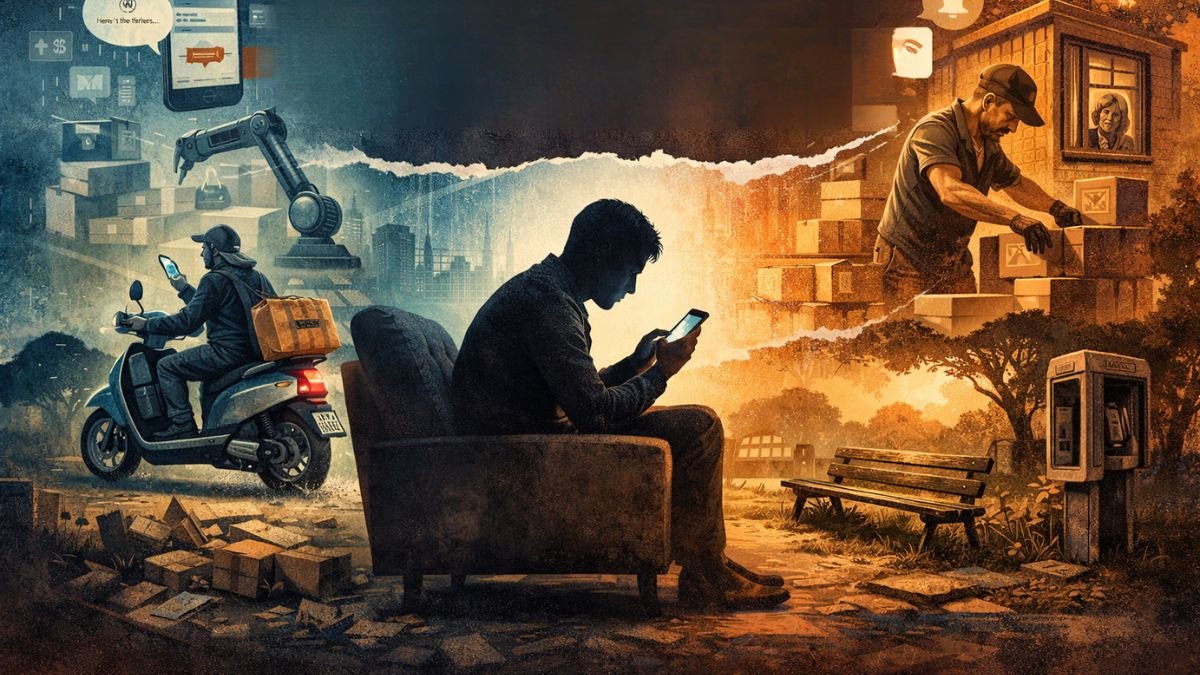
- The Friction-Free Trap
- The Erosion of Cognitive Endurance
- The Illusion of Time Saved
- The Loss of Community and Friction
- The Hidden Labor of Seamlessness
- The Atrophy of Self-Reliance and Craft
- So Where Do We Go from Here?
- LET’S GET CRITICAL
- FANTASTIC GUEST: AN INTERVIEW WITH HENRY DAVID THOREAU
- LANGUAGE FOCUS: VOCABULARY AND SPEAKING
- LANGUAGE FOCUS: GRAMMAR AND WRITING
- EDUSTORY: THE LAST MANUAL
- LET’S DISCUSS
- Question 1: Is the convenience critique itself a form of privilege?
- Question 2: If saved time is being consumed by more content and more work, is the problem really convenience, or is it the economic system that fills every gap with productivity?
- Question 3: Thoreau argued that solitude and community are complements, not opposites. Can the same be said about convenience and inconvenience?
- Question 4: The article claims that algorithms have replaced micro-interactions, but has social media created a new kind of community that the article fails to acknowledge?
- Question 5: The story of Osman’s bakery suggests that mastery and patience lead to deeper fulfillment than convenience. But is that universally true, or is it another form of the effort heuristic the critical section warned about?
- WHAT NOW?
- Your 7-Day Intentional Friction Plan
- Let’s Play & Learn
- Check Your Understanding (Learning Quiz)
The Friction-Free Trap
Let me paint a picture for you. It is a Tuesday morning. You wake up, and before your feet even touch the floor, you have already checked three notifications, asked a voice assistant for the weather, and ordered breakfast through an app that somehow knew you wanted that avocado toast before you did. By the time you leave the house, if you leave the house, you have accomplished a dozen micro-tasks without once engaging with another human being, without once being forced to think hard about anything, and without once encountering a single moment of friction.
Sounds efficient, right? Sounds like progress. Sounds like the shimmering utopia that every tech company has been promising us since the invention of the smartphone.
But here is the thing nobody in those Silicon Valley keynote speeches wants to talk about: all that friction we eliminated? It was not just inconvenience. It was the texture of being alive. It was the cognitive workout that kept our minds sharp, the social glue that held communities together, and the source of a quiet, deeply human satisfaction that came from doing difficult things. We did not just streamline our lives. We hollowed them out.
This article is about what we lost when we decided that ease was the highest virtue. It is about attention spans, invisible laborers, vanishing communities, and the strange paradox of having more time and doing less with it. And if you are already feeling a little defensive, good. That means this is working.
The Erosion of Cognitive Endurance
When Thinking Becomes Optional
There is a muscle in your brain, metaphorically speaking, that is responsible for what psychologists call cognitive endurance. It is the capacity to sit with a difficult problem, tolerate ambiguity, resist the urge for immediate answers, and push through the discomfort of not knowing. And like any muscle, if you stop using it, it atrophies.
Now consider the world we have built. Need to settle a debate at dinner? Google it in four seconds. Cannot remember a word? Autocomplete finishes the sentence for you. Writing an email and unsure how to phrase that delicate request? An AI will draft it in your voice, or at least in a voice that sounds vaguely professional and oddly cheerful. Navigation? Your GPS will reroute you around any obstacle, including the obstacle of having to actually learn the geography of the city you live in.
Each of these micro-conveniences, taken individually, seems harmless. Helpful, even. But stacked together, day after day, year after year, they amount to a systematic outsourcing of thought. We are no longer exercising our ability to wrestle with complexity. We are no longer comfortable with the feeling of not knowing something, and that discomfort, ironically, is the very thing that drives genuine learning and creative problem-solving.
Research in cognitive psychology has shown that desirable difficulties, tasks that are challenging but achievable, are among the most powerful catalysts for long-term memory formation and skill development. When you struggle to recall a fact from memory instead of looking it up, you strengthen the neural pathway to that fact. When you navigate a new city without a map, you build a richer spatial understanding. When you draft that email yourself, awkward phrasing and all, you refine your communication instincts.
We have been so seduced by the promise of frictionless living that we forgot a fundamental truth: difficulty is not a flaw in the human experience. It is a feature.
The Illusion of Time Saved
Where Does All That Reclaimed Time Actually Go?
If there is one sales pitch that the convenience economy has perfected, it is this: we are giving you your time back. Every app, every service, every gadget is marketed as a time-saving device. The food delivery app saves you from cooking. The robot vacuum saves you from cleaning. The scheduling software saves you from the nightmare of coordinating calendars.
So, by conservative estimates, the average person in a developed nation is saving somewhere between one and three hours per day thanks to modern conveniences. That is seven to twenty-one hours per week. That is an entire extra day, in some cases, of reclaimed life. So the question becomes: What are we doing with that day?
And the answer, if we are being brutally honest, is mostly nothing meaningful. The time saved by convenience is not being reinvested into deeper relationships, creative pursuits, physical fitness, or philosophical contemplation. It is being absorbed, almost entirely, by screens. More scrolling. More streaming. More consumption of content that, paradoxically, was also designed to save us time. We watch videos at double speed. We listen to podcasts at 1.5x. We skim articles instead of reading them. We are saving time in order to consume more time-saving content, and the circularity of it should make us dizzy.
The sociologist Judy Wajcman has written extensively about this phenomenon. She argues that convenience technology does not actually reduce the total amount of work we do. Instead, it raises the baseline expectation. Because you can respond to an email instantly, you are now expected to. Because you can order groceries in ten minutes, you are now expected to have a stocked fridge at all times. Because meetings can be scheduled with a click, your calendar is suddenly full of meetings that did not need to happen. Convenience has not given us leisure. It has given us a faster treadmill.
The Loss of Community and Friction
The Disappearing Third Place
Here is something that might sound old-fashioned, and I am comfortable with that: some of the most important human interactions in history have happened in lines. In queues at the post office. In waiting rooms. At the butcher counter. Over a fence while checking the mail. These were not planned social events. They were accidental collisions, the kind of micro-interactions that sociologists call weak ties, and they were the invisible connective tissue of community.
Weak ties are not your close friends or family. They are the barista who remembers your order, the neighbor you nod to on your morning walk, the fellow parent you chat with at school pickup. Research by Mark Granovetter, published in his landmark 1973 paper “The Strength of Weak Ties,” demonstrated that these casual connections are disproportionately important for social cohesion, information flow, and even job opportunities. They are the bridges between social clusters, and without them, communities fragment into isolated bubbles.
Now think about how many of those weak ties have been eliminated by convenience. You do not go to the store; your groceries appear at your door, carried by a person you will never see again and who was algorithmically dispatched. You do not ask for directions; your phone tells you where to go. You do not wait in line at the bank; you deposit checks with a camera. You do not browse a bookstore and strike up a conversation about that novel on the display table; an algorithm recommends your next read based on what people with similar purchasing patterns bought.
Each of these transactions is faster, easier, and more efficient. And each of them removes a potential moment of human connection. Multiply that by millions of people, millions of times a day, and you begin to understand why loneliness has become what the U.S. Surgeon General has called an epidemic. We did not just optimize our errands. We optimized away our neighbors.
The Hidden Labor of Seamlessness
Someone Is Always Absorbing the Friction
There is a concept in physics called the conservation of energy: energy is neither created nor destroyed, only transferred. Something eerily similar happens with inconvenience. When a service feels effortless to you, that friction did not evaporate. It was transferred to someone else, usually someone who is paid far less than you to endure it.
Consider the delivery driver who weaves through traffic to bring your lunch in under fifteen minutes, tracked by an app that penalizes them for delays they cannot control. Consider the warehouse worker who picks and packs your same-day delivery, monitored by algorithms that measure their productivity in seconds. Consider the content moderator in a developing nation who screens horrific images for pennies per hour so your social media feed feels clean and curated.
This is the part of the convenience economy that is deliberately kept out of sight. The entire business model depends on invisibility. The moment you see the human being behind the seamless experience, the spell breaks. The fifteen-minute delivery stops feeling magical and starts feeling uncomfortable. The algorithm stops feeling smart and starts feeling exploitative.
The gig economy, which powers much of modern convenience, was initially marketed as freedom. Be your own boss. Set your own hours. Work when you want. But the reality, as documented by researchers, journalists, and the workers themselves, is far grimmer. Gig workers typically lack health insurance, retirement benefits, paid leave, and even a guaranteed minimum wage. They are classified as independent contractors, which is a legal category that allows companies to extract maximum labor while assuming minimum responsibility.
And here is the uncomfortable truth that ties it all together: the convenience of the privileged is almost always subsidized by the precarity of the vulnerable. That two-dollar delivery fee does not reflect the true cost of getting a burrito to your door in twelve minutes. The difference is paid by a human being who cannot afford to say no.
The Atrophy of Self-Reliance and Craft
The Joy We Traded for Instant Gratification
Let me ask you something, and I want you to answer honestly: When was the last time you made something from scratch? Not assembled something from a kit. Not followed a three-step recipe from a fifteen-second video. Actually made something, from raw materials, with your own hands, through a process that was frustrating and time-consuming and imperfect and deeply, immensely satisfying?
There is a well-documented phenomenon in psychology called the IKEA effect, named after the Swedish furniture giant. It describes the tendency for people to place disproportionately high value on things they have partially created, even if the result is objectively mediocre. That wobbly bookshelf you assembled yourself? You love it more than the sleek one from the showroom because you sweated over it. Your effort became part of its value.
Now scale that insight up to an entire culture. When nearly everything in our lives is pre-made, pre-assembled, pre-curated, and pre-digested, we lose the opportunity to invest effort and, with it, the opportunity to feel genuine pride. We lose the quiet confidence that comes from knowing you can fix a leaky faucet, cook a meal for ten, navigate a foreign city, or write a heartfelt letter without artificial intelligence smoothing out your rough edges.
The philosopher Matthew Crawford, in his book “Shop Class as Soulcraft,” argues that manual competence, the ability to do things with your hands and solve tangible problems, is not just a practical skill. It is a form of agency. It is how human beings come to understand themselves as capable actors in the world, rather than passive consumers of it. When everything is done for us, we do not just lose skills. We lose a piece of our identity.
This is perhaps the deepest and most insidious cost of convenience: not just that it makes things easier, but that it makes us smaller. We become people who cannot tolerate difficulty, who panic when the Wi-Fi goes down, who feel genuinely helpless when an app crashes. We have traded the robust satisfaction of competence for the fragile comfort of dependency.
So Where Do We Go from Here?
None of this is an argument for abandoning modern technology and moving to a cabin in the woods. That would be its own kind of extremism, and besides, you would miss your podcasts. The point is not to reject convenience wholesale but to become conscious of its costs. To notice when you are outsourcing a decision that deserves your attention. To recognize when saved time is just being laundered into more consumption. To see the person behind the seamless experience. To occasionally, deliberately, choose the harder path, not because you have to, but because the difficulty itself is the reward.
Because here is the beautiful, frustrating, gloriously inconvenient truth about being human: we were not designed for frictionless living. We were designed for struggle, for growth, for connection, for the deep satisfaction of doing hard things in the company of others. And no algorithm, no matter how elegant, can replicate that.
LET’S GET CRITICAL
Alright, so we just spent a good chunk of time building a compelling case that convenience is quietly dismantling everything good about the human experience. And honestly, the argument holds up pretty well. But that is exactly why we need to stop and poke some holes in it, because the most dangerous ideas are the ones that feel too right to question.
Let us start with the most obvious pushback: romanticizing friction is a luxury. The entire premise of the article rests on the assumption that friction, inconvenience, and difficulty are inherently valuable. And for a middle-class professional with a stable income, a reliable car, and the leisure time to cook risotto from scratch, sure, maybe friction is enriching. But for a single parent working two jobs, a disabled person who cannot physically stand in a checkout line, or someone living in a food desert where the nearest grocery store is forty minutes away, convenience is not a trap. It is a lifeline.
The danger of framing convenience as the enemy is that it can quickly slide into a kind of moral superiority, the idea that people who use delivery apps or rely on GPS are somehow lesser, softer, or more morally compromised than those who churn their own butter. This is a cousin of the bootstraps mentality, and it is worth recognizing. Not everyone who chooses the easy option is being lazy. Sometimes they are exhausted. Sometimes they are surviving.
Now, let us talk about the nostalgia problem. The article paints a warm picture of bygone community interactions, the butcher, the post office, the neighbor over the fence. And yes, weak ties matter. Granovetter was right. But let us not pretend that those spaces were universally welcoming. For many people, particularly those from marginalized communities, those public spaces were sites of surveillance, judgment, and exclusion. The idea that the pre-digital community was a golden age of connection is, at best, a selective memory and, at worst, a whitewashed fantasy. Convenience has, for many, been a form of liberation from hostile social environments.
There is also a cognitive bias at play here that is worth naming: the effort heuristic. We tend to believe that things requiring more effort are inherently more valuable. This is the same bias that makes us distrust free advice and overvalue expensive wine. But effort and value are not always correlated. Sometimes the efficient solution is genuinely better. Sometimes the algorithm does recommend a better book than a random conversation in a bookstore would have. Sometimes the GPS route saves you from a genuinely dangerous neighborhood your instincts would not have flagged.
And what about the cognitive endurance argument? Yes, desirable difficulties enhance learning, but there is a crucial word in that phrase: desirable. Not all difficulty is productive. Spending forty minutes trying to parallel park does not make you a more enlightened human being. It just wastes forty minutes. The research on cognitive load theory actually suggests that eliminating unnecessary friction frees up mental bandwidth for the difficult tasks that actually matter. In other words, letting GPS handle your commute so you can mentally prepare for a complex presentation at work might be the smarter cognitive trade-off.
Then there is the question of who gets to define meaningful time use. The article implies that the hours reclaimed by convenience should ideally be spent on deep relationships, creative work, or personal growth, and that scrolling or streaming somehow does not count. But that is a value judgment dressed up as objective analysis. For someone recovering from trauma, mindless scrolling might be a necessary form of emotional regulation. For a factory worker after a twelve-hour shift, binge-watching a show is not a failure of character. It is rest. The idea that reclaimed time must be productive to be valid is itself a product of the same hustle culture the article claims to critique.
Finally, the gig economy critique, while valid, is incomplete if we do not acknowledge that gig work has also provided income opportunities for people who were previously excluded from traditional employment, including immigrants, people without formal education, and those who need flexible schedules for caregiving. The solution is not to eliminate gig work but to regulate and protect it, to ensure that convenience does not require exploitation.
So where does this leave us? Not in the comfortable position of knowing that convenience is bad and friction is good. Instead, it leaves us in the much more interesting and much more honest position of acknowledging that this is genuinely complicated. The costs of convenience are real, but so are the benefits. The challenge is not to pick a side but to think carefully about when friction adds value and when it is just friction, when convenience serves us and when it diminishes us, and to make those judgments with nuance rather than nostalgia.
FANTASTIC GUEST: AN INTERVIEW WITH HENRY DAVID THOREAU
Danny: Ladies and gentlemen, welcome to the Fantastic Guest segment, where we bring history’s most fascinating minds into the most confusing century imaginable and see what happens. Today, our guest is a man who famously walked away from society to live alone in the woods, wrote an entire book about it, and then walked back. He is the original off-the-grid influencer, the patron saint of deliberate living, and possibly the only person in history who could make a chapter about beans genuinely compelling. Please welcome Henry David Thoreau.
Thoreau: Thank you, Danny. Though I must say, I find the concept of a “welcome” somewhat paradoxical in a medium where I am, presumably, already here.
Danny: And we are already off to a beautifully pedantic start. Henry, can I call you Henry?
Thoreau: You may. Though I notice that in your century, people seem to ask permission for things they have already decided to do. You said “Henry” before you asked.
Danny: Guilty as charged. So, Henry, you are famous for going to Walden Pond in 1845 to, as you put it, live deliberately. You wanted to strip life down to its essentials and see what it had to teach you. Now, we have just written an entire article about how modern convenience is eroding the human experience. I imagine you have some thoughts.
Thoreau: Quite a few. Though I confess I find it amusing that it took your civilization nearly two centuries to arrive at an insight I articulated from a ten-by-fifteen-foot cabin. But I will try not to be smug about it.
Danny: Too late. But go on.
Thoreau: What strikes me most about your predicament is not the technology itself but the unconsciousness with which it is adopted. In my day, if a man bought a new tool, say a better plow, he understood the transaction. He paid money, which represented hours of his labor, in exchange for something that would save him future hours. The calculus was direct and visible. But what I observe in your era is that the true costs are hidden, sometimes deliberately so, and the user proceeds under the illusion that ease is free.
Danny: That is essentially the thesis of our article. But here is where I want to push you a little, because you are sometimes accused of being, shall we say, a bit of a hypocrite on this subject. You went to live in the woods to escape society, but Walden Pond was only about a mile and a half from town. Your mother did your laundry. You had dinner at friends’ houses. You were not exactly Bear Grylls out there.
Thoreau: And this is precisely the point that your contemporaries, and apparently you, consistently misunderstand. I did not go to Walden to become a hermit. I went to conduct an experiment in attention. The question was never whether a man could survive alone in the wilderness. The question was whether a man could learn to pay attention to his own life. And that, Danny, is exactly the faculty your convenience culture has anesthetized.
Danny: Anesthetized. That is a strong word.
Thoreau: It is the right word. Consider: your article describes people who save hours each day through technology and yet feel they have no time. This is not a failure of time management. It is a failure of attention. You are not short on hours. You are short on presence. The hours pass, but you are not in them. You are already in the next task, the next notification, the next algorithmically curated distraction.
Danny: You know, that actually connects to something I have been thinking about. You wrote in Walden that the mass of men lead lives of quiet desperation. Do you think that is still true, just louder now?
Thoreau: It is quieter, actually, and that is what makes it more dangerous. In my time, desperation was felt. A man who hated his work knew he hated it. His body ached, his spirit flagged, and the pain was a signal. In your time, the desperation is buffered by an endless procession of small comforts. You do not feel the ache because there is always another distraction to numb it. The delivery arrives. The show starts. The notification pings. You are desperate, but you are comfortable, and that combination is far more insidious than honest misery.
Danny: That is genuinely chilling. Let me shift gears a bit. The article discusses the loss of community that comes with convenience, the idea that we have optimized away the casual human interactions that held communities together. As someone who literally moved to the woods to be alone, are you really the best person to argue for community?
Thoreau: A fair question, and I appreciate you asking it with such transparent glee. But yes, I believe I am exactly the right person. Solitude and community are not opposites. They are complements. I chose solitude not because I despised society but because I wanted to encounter it on my own terms, with a mind that was fully present rather than merely habituated. When I returned to town after my time at Walden, I was a better neighbor because I was a better observer. I had re-learned how to pay attention to another person.
Danny: So your argument is that the value of community depends on the quality of attention you bring to it?
Thoreau: Precisely. And this is what I find most troubling about the dynamic your article describes. It is not merely that people have fewer casual interactions. It is that when they do interact, they are only partially present. I have observed your people sitting together in what you call coffee shops, each absorbed in a small glowing rectangle, occasionally showing each other images on these rectangles and calling it connection. That is not community. That is parallel isolation with a shared address.
Danny: Parallel isolation with a shared address. I am writing that down. Now, I want to raise the counterargument we explored in the critical thinking section. Some critics would say that romanticizing pre-digital community ignores the fact that those spaces were not welcoming for everyone. The town square was great if you were a white man of means. Less great if you were not.
Thoreau: This is a valid and necessary correction, and I will not pretend that my own era was innocent of exclusion. I was an abolitionist, as you may know, and I recognized even then that the so-called community of Concord was built on hierarchies that denied full humanity to many of its members. So yes, I concede that the friction of the past was not equally distributed. Some bore more of it, and not by choice.
Danny: That is surprisingly self-aware for a nineteenth-century transcendentalist.
Thoreau: We were not all as oblivious as Emerson.
Danny: Oh, shots fired at Ralph Waldo. He is going to hear about this in the afterlife book club. Let us talk about the gig economy, because the article makes a sharp point about the conservation of friction, the idea that when convenience feels effortless for the consumer, someone else is absorbing the difficulty. What is your take?
Thoreau: It reminds me of something I wrote about the railroad. People told me the railroad was a marvel of progress, that it connected towns and moved goods and shrank distances. And I asked: who laid the tracks? The answer, of course, was immigrants, laborers, men who were paid poorly and treated worse. The railroad ran over them, literally and figuratively. Your gig economy is the same principle with better branding. The tracks are invisible, but they are still being laid by human bodies.
Danny: You also wrote that the cost of a thing is the amount of life you exchange for it. How does that apply here?
Thoreau: It is the most relevant thing I ever said, and I say that without false modesty. When you order a meal delivered in fifteen minutes, the stated cost is a fee and a tip, if the customer bothers. But the true cost includes the driver’s time, their vehicle wear, their exposure to traffic and weather, their lack of insurance, and the portion of their life they will never recover. You are not paying ten dollars for a meal. You are paying ten dollars plus a fraction of someone else’s existence. And the system is designed so that you never have to see that equation.
Danny: That is a devastating way to put it. Let me ask you one last question, and it is the big one. If you could give one piece of advice to people living in 2026, trying to navigate this world of relentless convenience, what would it be?
Thoreau: I would say this: do not be afraid of inconvenience. Not all of it, and not all the time, but enough of it. Learn to recognize the difference between friction that wastes your life and friction that builds it. Walk somewhere you could drive. Cook something you could order. Write a letter, with a pen, to someone you could text. Sit with a question long enough to feel the discomfort of not knowing. Because it is in that discomfort that you will find something no algorithm can deliver: the experience of being genuinely, fully, uncomfortably alive.
Danny: Henry David Thoreau, transcendentalist, philosopher, and the only person who could make me feel guilty about using a GPS. Thank you for being here.
Thoreau: The pleasure was mine. Though I must say, this glowing screen you are looking at concerns me greatly.
Danny: You and me both, Henry. You and me both.
LANGUAGE FOCUS: VOCABULARY AND SPEAKING
Vocabulary in Focus
Let us roll up our sleeves and get into some of the rich vocabulary that powered this article, because these are not just fancy words for the sake of sounding smart. These are words that will genuinely level up the way you communicate, whether you are writing an essay, nailing a job interview, or just trying to win an argument at dinner without resorting to raised voices.
First up, let us talk about “atrophy.” In the article, we used it in the context of self-reliance atrophying when we stop exercising it. Atrophy literally means the gradual decline or wasting away of something, usually from disuse. Doctors use it to describe muscles that shrink when a patient is bedridden, but it works beautifully in a figurative sense too. You might say, “My patience for small talk has completely atrophied since I started working from home,” or “If you do not practice your Spanish, it will atrophy faster than you think.” The beauty of this word is that it implies something was once strong and has weakened, so it carries a built-in sense of loss.
Next, “insidious.” We described the cost of convenience as insidious, meaning it operates in a harmful way that is gradual and subtle, almost sneaky. Something insidious does not announce itself. It creeps in. Think of it as the opposite of a loud explosion; it is more like a slow leak. You could use it in everyday conversation: “The insidious thing about procrastination is that it feels like a choice until it becomes a habit.” The word has a slightly sinister connotation, which is exactly why it works so well in arguments about things that seem harmless on the surface.
Then we have “anesthetized,” which Thoreau used in our interview to describe what convenience does to our attention. To anesthetize someone is to make them numb, to remove their ability to feel. Doctors do it before surgery, but figuratively, it means rendering someone emotionally or intellectually inert. “Social media has anesthetized us to outrage” is a sentence you might hear in a university lecture, and now you know exactly what it means and how to use it. The key nuance here is that being anesthetized is not the same as being relaxed. It implies a loss of something you should be feeling.
“Precarity” is another gem from the article. It describes a state of existence that is uncertain and insecure, particularly in relation to employment or living conditions. It comes from the word precarious, but precarity is the noun form that describes the systemic condition rather than just a momentary feeling. “Gig workers live in a state of constant precarity” is a powerful sentence because it elevates the description from individual complaint to structural critique. If you want to sound like you have read a sociology textbook without being boring about it, precarity is your word.
“Desirable difficulties” is a phrase from cognitive psychology, and it appeared in the section on cognitive endurance. It refers to learning challenges that slow you down in the short term but dramatically improve retention and understanding in the long term. The classic example is testing yourself on material instead of rereading it; it feels harder, but the research shows it works far better. In conversation, you might say, “Learning to code without tutorials was a desirable difficulty; it was brutal at first, but I understand the logic so much better now.” The phrase is especially useful because it reframes struggle as investment.
“Algorithmically dispatched” appeared in our discussion of gig workers and delivery services. It paints a vivid picture: a human being whose movements and tasks are determined not by a boss or by their own judgment but by a set of mathematical instructions running on a server somewhere. The word “dispatched” already suggests being sent, like a soldier or a courier, but pairing it with “algorithmically” adds a layer of dehumanization. You could adapt it: “I feel like my workday is algorithmically dispatched, bouncing from meeting to meeting with no agency.”
“Cognitive endurance” is the capacity to sustain deep, focused thought over extended periods, especially when the task is difficult or frustrating. We used it to describe what modern convenience is eroding. Think of it as the mental equivalent of running a marathon, not a sprint, but sustained effort over time. It is useful in academic and professional settings: “The biggest challenge of writing a dissertation is not intelligence; it is cognitive endurance.”
“Seamlessness” sounds like a compliment, and in the tech world, it is. A seamless experience is one where everything flows without interruption, where you do not notice the transitions or the infrastructure. But in our article, we interrogated this ideal and found that seamlessness for one person often means invisibility for another. “The seamlessness of the app hides the chaos behind the scenes” is a sentence that could apply to everything from food delivery to social media.
“Micro-interactions” are the small, often unplanned social exchanges that happen in daily life, a smile, a brief chat, a shared laugh in a waiting room. We used this in the context of community loss. These are not deep, meaningful conversations, but they are the social fabric of a neighborhood. “Moving to a new city, I realized how much I depended on the micro-interactions of my old routine.”
Finally, “outsourcing” usually lives in the business world, meaning to contract work out to an external party. But we used it metaphorically to describe outsourcing our thinking to technology. This figurative use is powerful because it implies a conscious, even lazy, delegation of something that should be your responsibility. “I have been outsourcing my decision-making to review sites, and I am not sure I can even pick a restaurant on my own anymore.”
Speaking Focus
Now let us put these words to work in the way they were always meant to be used: out loud. Because knowing a word on paper and actually deploying it in conversation are two very different skills. One is recognition; the other is production, and production is where the real growth happens.
The speaking skill we are going to focus on today is what I call argumentative fluency, the ability to construct a clear, layered argument on the spot using sophisticated vocabulary naturally. This is not about sounding like a dictionary. It is about being able to articulate complex ideas with precision and confidence, which is exactly what you need in debates, presentations, interviews, and even passionate conversations with friends.
Here is how to practice it. Start with a simple opinion, something like “I think social media does more harm than good.” Now, instead of stopping there, build layers. Use the vocabulary we have discussed. You might say: “The insidious thing about social media is that it atrophies our capacity for genuine connection by replacing micro-interactions with curated performances. The seamlessness of the experience anesthetizes us to the precarity it creates for content creators, and the desirable difficulty of real conversation is outsourced to likes and emojis.” That is one opinion, expressed with nuance and power, using eight of our vocabulary words naturally.
Your challenge this week is this: pick any topic you care about, whether it is education, technology, food, politics, anything. Record yourself making a two-minute argument about it, and challenge yourself to use at least five of the vocabulary words from this section. Then listen back. Notice where you stumbled, where you paused, where a word felt forced versus where it flowed. Do it again. And again. Each time, the words will feel a little less like borrowed clothes and a little more like your own.
For an extra challenge, after you record your argument, record a rebuttal to yourself. Use the vocabulary to argue the opposite position. This forces you to see the words as flexible tools rather than accessories to a single viewpoint, and it is spectacular practice for the kind of critical thinking we have been promoting throughout this article.
LANGUAGE FOCUS: GRAMMAR AND WRITING
The Writing Challenge
Here is your writing challenge, and it is directly inspired by everything we have been discussing: Write a 500-word persuasive essay titled “In Defense of Inconvenience,” in which you argue that a specific form of inconvenience, one that modern technology has eliminated or reduced, should be intentionally reintroduced into daily life. You must choose one concrete example, not convenience in general, but a specific friction point, and build a compelling case for why bringing it back would improve individual lives or society.
Maybe you argue for the return of paper maps. Maybe you champion handwritten letters. Maybe you make the case for waiting in line at a bakery instead of ordering ahead. The choice is yours, but it must be specific, and your argument must be structured and persuasive.
Grammar and Writing Tips for Success
Let us talk about the grammar and writing techniques that will make this essay shine. The most important structure for a persuasive essay is the concession-rebuttal pattern. This is where you acknowledge the opposing argument before dismantling it, and it is incredibly powerful because it shows intellectual honesty and makes your rebuttal more convincing by contrast.
Here is how it works grammatically. You use concessive clauses, typically introduced by words and phrases like “although,” “while,” “even though,” “despite the fact that,” or “admittedly.” For example: “While ordering groceries online is undeniably efficient, the act of wandering through a physical market engages our senses and decision-making faculties in ways that a scrolling interface never can.” Notice the structure: the concession comes first in the subordinate clause, acknowledging the strength of the opposition, and then the main clause delivers your argument with added force. This pattern, concession followed by rebuttal, is the backbone of sophisticated persuasive writing.
Another essential structure is the conditional sentence, particularly the second conditional for hypothetical scenarios. “If we were to reintroduce the practice of asking strangers for directions, we would inevitably rediscover the small joys of unplanned human connection.” The second conditional, formed with “if” plus past simple in the condition clause and “would” plus base verb in the result clause, allows you to paint a vivid picture of an alternative reality without claiming it is already true. This is persuasion at its most elegant because you are inviting the reader to imagine rather than demanding they agree.
Pay close attention to your use of parallel structure as well. When you are listing benefits, costs, or examples, keep the grammatical form consistent. “Reintroducing this inconvenience would sharpen our attention, strengthen our patience, and restore a sense of daily adventure” is clean and rhythmic because all three items follow the same pattern: verb plus object. Compare that to a clumsy version: “It would sharpen our attention, we would be more patient, and also adventure.” The broken parallelism makes the sentence stumble, and so does the argument.
Use the subjunctive mood sparingly but effectively. In formal persuasive writing, the subjunctive appears in recommendations and hypotheticals: “It is essential that we reconsider our relationship with convenience” uses the base form “reconsider” rather than “reconsiders,” which is the subjunctive. It sounds formal and authoritative, which is exactly the tone you want when making a case.
Finally, close your essay with what I call a reframing sentence, one that takes a concept from the introduction and presents it in a new light based on the argument you have built. If you opened by describing convenience as liberation, close by reframing it as a comfortable cage. This kind of structural bookending gives your essay a sense of completeness and intellectual depth that separates good writing from great writing. Now go write it.
EDUSTORY: THE LAST MANUAL
The notification came at 6:47 AM, which was three minutes before Sana’s alarm was set to go off, and she hated it for that. Three minutes. Three stolen minutes of sleep that her phone’s predictive system had decided she did not need because her biometric data indicated she was already in a light sleep phase. She stared at the ceiling and waited for the resentment to fade, which it did, as it always did, replaced by the gentle chime of her morning briefing.
“Good morning, Sana. It is Wednesday, March 12th. Your optimal breakfast based on yesterday’s activity and current nutritional profile is a spinach and feta omelet with a side of mixed berries. Shall I place the order?”
“Yes,” she said, and she was out of bed and in the shower before the word had fully left her mouth. The water was already at her preferred temperature. She had not adjusted it manually in over a year.
Sana worked as a content strategist for a mid-size tech firm, which meant she spent most of her day deciding which words an AI should use to describe products that other AIs had helped design. She was good at it, or at least she had been told she was good at it by the performance algorithm, which sent her a weekly summary of her productivity metrics along with a suggested action plan for improvement. Last week’s suggestion had been to reduce her average email composition time by twelve seconds. She had not figured out how to do that yet, though she suspected the answer was to let the drafting assistant handle more of the phrasing.
Her commute was seventeen minutes, door to desk, because the transit app routed her through a combination of ride-share and electric scooter that optimized for both time and carbon footprint. She wore noise-canceling earbuds that played a curated podcast mix, algorithmically selected to match her current stress level and cognitive bandwidth. She never chose what to listen to. She never needed to.
It was during one of these commutes, on a Tuesday that was otherwise indistinguishable from any other Tuesday, that the scooter broke.
Not dramatically. No sparks, no crash, no cinematic moment of crisis. It simply stopped accelerating on a gentle hill about six blocks from her office, beeped twice in apology, and displayed a message on its tiny screen: SERVICE DISRUPTION. ALTERNATIVE TRANSPORT CALCULATING.
Sana stood there, one foot on the scooter, one on the pavement, and waited. The app spun. And spun. And then, with a small vibration, delivered the verdict: NO ALTERNATIVES AVAILABLE. ESTIMATED WAIT TIME: 22 MINUTES.
Twenty-two minutes. She looked at the hill ahead of her. Six blocks. She could walk it in ten.
This should not have felt like a revelation, but it did. The idea of simply walking, without a route, without a calculated ETA, without a podcast buffering in her ears, felt oddly transgressive, like sneaking a candy bar before dinner. She pulled out her earbuds, left the scooter leaning against a lamppost, and started walking.
The first thing she noticed was the bakery.
It was on the corner of a street she had passed hundreds of times on the scooter, but she had never actually looked at it. A small, somewhat battered storefront with a hand-painted sign that read “Osman’s” in faded gold script. The window was fogged from the inside, and through the condensation she could see shapes moving, shelves stacked with round, crusty loaves. The smell hit her next, warm and yeasty and so aggressively real that it seemed to exist in a different sensory register than the rest of her morning.
She went inside. She did not know why. The app had not suggested it.
The man behind the counter was in his sixties, compact and precise in his movements, with flour dusting his forearms and a pair of reading glasses pushed up on his forehead. He looked at her the way people used to look at each other, which is to say he actually looked at her.
“First time?” he asked.
“Is it that obvious?”
“You have the look. The look of someone who wandered in instead of ordered ahead.” He smiled. “It is a good look. It is becoming rare.”
“I did not even know this place was here.”
“It has been here for thirty-one years. My father opened it. I took over when he got too old to stand at the ovens.” He gestured at the display case. “Everything is made here. No mixes, no frozen dough, no shortcuts. My father used to say that bread is the last honest thing a person can make, because you cannot fake it. The flour knows.”
Sana laughed, not the performative exhale she used in meetings but an actual, involuntary laugh. “The flour knows?”
“The flour knows,” he repeated, completely serious. “You rush it, it resists. You do not give it time to rise, it stays flat. You try to automate it, and what you get is something that looks like bread and chews like bread but does not nourish like bread. Bread requires patience. It requires your hands. It requires you to fail a few times before you learn the feel of it.”
He handed her a small sourdough roll, still warm, and waved away her phone when she tried to pay. “First one is free. If you come back, I will teach you to make it yourself.”
She almost did not come back. The next morning, the scooter was fixed, the route recalculated, the podcast requeued. Her life clicked back into its frictionless groove as if the interruption had never happened. But the roll sat in her memory like a stone in a shoe, not painful exactly, but impossible to ignore.
She went back on Saturday.
Osman, which was the baker’s name, did not seem surprised. He put her to work immediately, handing her a lump of dough and a wooden board and saying, simply, “Feel it.”
“Feel what?”
“The dough. It will tell you what it needs. You cannot read it in a recipe. You have to learn it with your hands.”
She kneaded badly. The dough stuck to her fingers, tore when she pulled too hard, refused to hold its shape. Osman watched without comment, occasionally adjusting her grip or the angle of her wrists. After forty minutes, she had produced something that looked like a deflated soccer ball.
“Terrible,” Osman said cheerfully. “But you will remember this one. The first one you always remember.”
He was right. She did remember it. Not the way she remembered a fact, instantly retrievable, but the way she remembered learning to ride a bicycle, with her whole body. The stickiness of the dough. The ache in her forearms. The flour on her jeans that she did not bother to brush off on the walk home because, for reasons she could not articulate, she wanted to keep it there a little longer.
She went back the next Saturday, and the one after that, and the one after that. Each time, the bread was slightly less terrible. Each time, Osman offered some quiet observation, never a lecture, that shifted her understanding by a degree. “You are fighting the dough. Stop fighting. Let it come to you.” Or: “Too much flour. You are afraid of the mess. The mess is the point.”
Other people drifted in on these Saturday mornings. A retired engineer named Hiro who had been coming for twenty years. A college student named Jules who was writing a thesis on food cultures and had stayed for the sourdough. A woman named Priya who never explained why she came but who kneaded with a focused intensity that suggested she was working through something she could not say out loud.
They did not become friends in the way the word is used online. They became something older and less defined. People who occupied the same space regularly, who knew each other’s rhythms, who could sit in flour-dusted silence and feel no need to fill it. Osman never asked anyone to exchange contact information or connect on a platform. The bakery was the connection. The bread was the conversation.
One morning, about three months in, Sana arrived to find the bakery dark. A note on the door, handwritten, said: CLOSED FOR FAMILY MATTER. BACK WHEN THE DOUGH SAYS SO.
She stood on the sidewalk and felt something she had not felt in a long time, or perhaps had never allowed herself to feel: the discomfort of not knowing. Not knowing when Osman would return. Not knowing if the bakery would reopen. Not knowing what to do with a Saturday morning that had, without her noticing, become the most important appointment of her week.
Her phone buzzed. The algorithm, sensing a gap in her schedule, suggested three alternative activities: a virtual baking class, a guided meditation, and a new breakfast spot with a 4.7 rating. She looked at the suggestions, each one a perfectly calibrated attempt to fill the space that Osman’s absence had opened up.
She put the phone in her pocket. She walked to the small park two blocks away, sat on a bench, and did nothing. The nothing was uncomfortable. The nothing was not optimized. The nothing did not have a rating or a review. But the nothing was hers, and she held onto it the way she had learned to hold the dough: loosely, patiently, and without fighting.
Three weeks later, the sign on the door changed. OPEN. COME KNEAD.
She went in, and Osman was there, thinner but smiling, already at the counter, already covered in flour. He handed her a lump of dough without a word, and she began to knead, and for a while neither of them spoke, because the flour already knew everything it needed to know.
LET’S DISCUSS
If you have made it this far, congratulations, you have engaged with some genuinely complex ideas about convenience, community, cognition, and what it means to live a fully human life. But here is the thing: reading about these ideas is only half the equation. The other half is talking about them. Arguing about them. Hearing someone else’s perspective and realizing your own might need adjusting. That is where real understanding happens, and, not coincidentally, that is where your English takes a serious leap forward. So let us get into five questions that deserve a real conversation.
Question 1: Is the convenience critique itself a form of privilege?
The article argues that convenience costs us something real, but the Let’s Get Critical section pointed out that this argument tends to come from people who can afford to reject convenience. Think about this carefully. Is there a way to critique convenience culture without dismissing the people for whom it is genuinely necessary? Where is the line between a thoughtful critique of modern ease and an elitist nostalgia for a harder life that was only charming if you were not the one suffering through it? When you discuss this, consider specific examples from your own life or community where convenience is essential versus where it might be excessive.
Question 2: If saved time is being consumed by more content and more work, is the problem really convenience, or is it the economic system that fills every gap with productivity?
The article suggests that the time freed by convenience is immediately absorbed by screens and hustle. But ask yourself: is it fair to blame the tools, or should we be looking at the economic pressures that make people feel they cannot rest? A delivery app does not force you to fill the freed time with work emails. A cultural expectation does. Discuss whether the villain here is technology or the broader system that treats every free moment as wasted potential.
Question 3: Thoreau argued that solitude and community are complements, not opposites. Can the same be said about convenience and inconvenience?
Instead of seeing this as an either-or debate, consider whether there is a way to deliberately design a life that uses convenience strategically while preserving meaningful friction. What would that look like practically? Think about your own daily routine: which conveniences genuinely free you, and which ones have quietly removed something you valued? Share specific examples and see if others in the discussion have identified different friction points worth preserving.
Question 4: The article claims that algorithms have replaced micro-interactions, but has social media created a new kind of community that the article fails to acknowledge?
The argument about losing weak ties assumes that only face-to-face interactions count. But millions of people have found belonging in online communities, support groups, and forums that did not exist before the internet. Is it possible that the article is measuring community by an outdated standard? Discuss whether digital communities can replicate the benefits of the micro-interactions Granovetter described, or whether something essential is lost in translation.
Question 5: The story of Osman’s bakery suggests that mastery and patience lead to deeper fulfillment than convenience. But is that universally true, or is it another form of the effort heuristic the critical section warned about?
Think about something you have mastered through sustained effort and something you enjoy precisely because it is easy. Is the satisfaction of the difficult thing genuinely superior, or do we just believe it should be because our culture values struggle? Challenge the assumption that hard-earned things are always more meaningful. Share an experience where the easy path led to something surprisingly valuable, and discuss what that means for the article’s overall thesis.
WHAT NOW?
A Balanced Framework for Intentional Living
The point of everything we have discussed is not to vilify convenience or to glorify hardship. It is to develop what we might call a friction-aware mindset, the ability to distinguish between convenience that genuinely improves your quality of life and convenience that quietly degrades it. Here is a simple framework built on the arguments and counterarguments we have explored.
First, the Audit Principle. Before adopting a convenience, ask: What am I gaining, and what am I giving up? If you are gaining time but losing a skill, a relationship, or a cognitive exercise, the trade-off deserves conscious consideration rather than automatic acceptance. Second, the Redistribution Test. Ask who absorbs the friction you are eliminating. If the convenience you enjoy requires someone else to work in precarious, underpaid, or dehumanizing conditions, the ethical cost should factor into your decision. Third, the Attention Filter. Ask whether this convenience enhances or fragments your attention. If it frees you up for deeper focus, it is serving you well. If it simply creates space for more distraction, it is stealing from you while pretending to give. Fourth, the Connection Check. Ask whether this convenience increases or decreases your meaningful interactions with other people. Efficiency that isolates is efficiency that costs more than it is worth. Fifth, the Agency Test. Ask whether this convenience is building your independence or creating dependency. If losing access to it would leave you helpless, that is a signal that you have outsourced too much.
Your 7-Day Intentional Friction Plan
Day 1: The Navigation Challenge.
Turn off your GPS for one routine trip today, whether it is your commute, a trip to the store, or the route to a friend’s house. Use memory, landmarks, and, if you get lost, ask someone for directions. Students: try finding your way to a new classroom or building on campus without a phone map. Professionals: drive or walk to a meeting location from memory. Notice how your brain engages differently when it has to work for the route.
Day 2: The Cooking Experiment.
Prepare one meal entirely from scratch, no delivery, no meal kits, no pre-made sauces. Choose something slightly beyond your comfort level. Students: even if it is just a proper pasta sauce from fresh tomatoes, do it start to finish. Professionals: if you usually order lunch, bring something homemade. Pay attention to the process, not just the outcome. The mess is the point.
Day 3: The Analog Communication Day.
Write a handwritten note, letter, or card to someone you care about. Do not text it, do not email it, do not voice-note it. Use paper and a pen. Students: leave a note for a roommate or friend. Professionals: write a thank-you note to a colleague. Notice how much more deliberately you choose your words when you cannot delete them.
Day 4: The Boredom Experiment.
Find twenty minutes today where you would normally reach for your phone and do nothing instead. Sit in a waiting room, ride public transit, or take a walk without headphones. Do not fill the silence. Let your mind wander. Students: try a study break where you literally stare out a window. Professionals: eat lunch without a screen. Track what your mind does when it is not being fed content.
Day 5: The Conversation Challenge.
Strike up a conversation with a stranger or acquaintance you would normally ignore, the barista, the person at the next table, the cashier. Ask a genuine question. Students: talk to someone in class you have never spoken to. Professionals: chat with someone in a different department. Rebuild one micro-interaction that convenience has eliminated.
Day 6: The Learning Struggle.
Spend thirty minutes trying to learn or solve something without Googling the answer. A puzzle, a math problem, a new chord on an instrument, a word you cannot quite remember. Sit with the discomfort of not knowing. Students: work through a difficult problem set before looking at solutions. Professionals: tackle a work challenge using your own analysis before reaching for an AI tool.
Day 7: The Reflection.
Write a short reflection, even just a paragraph, about what this week felt like. Which experiments were easy? Which were surprisingly hard? Which conveniences did you miss, and which did you realize you could live without? This is not a productivity exercise. It is an attention exercise. The goal is not to permanently reject convenience but to become conscious of its effects so you can choose, deliberately, what kind of life you want to live.
Let’s Play & Learn
Interactive Vocabulary Building
Crossword Puzzle
Word Search
Check Your Understanding (Learning Quiz)
This quiz is not a regular test where you either get it right or wrong. There are hints for all options to help you make a better choice if you need to, and better yet, there is feedback for all options you might choose, right or wrong, to make sure you learn from every choice you make and not just head over to receive a result, which might lift you up or pull you down. You will feel good about what you learn from this quiz and you will learn a lot regardless of how many questions you get right, and that’s why I’m calling it a Learning Quiz. Enjoy!







0 Comments