- MagTalk Discussion Audio
- The Shadow in Our Midst
- Deconstructing the Terminology: What Are We Really Talking About?
- The Anatomy of a Crime: How Does This Happen?
- The Human Cost: The Devastating Aftermath
- The Global Response: Fighting a Faceless Enemy
- Our Role in the Fight: From Bystander to Advocate
- Focus on Language
- Vocabulary Quiz
- Let’s Discuss
- Learn with AI
- Let’s Play & Learn
MagTalk Discussion Audio
The MagTalk Discussion deep dive audio episode is not a mere reading of the article, but a lively discussion of it, so even if you decide to read the article, you may want to listen to this episode as well.
[ppp_patron_only level=5]
[/ppp_patron_only]
The Shadow in Our Midst
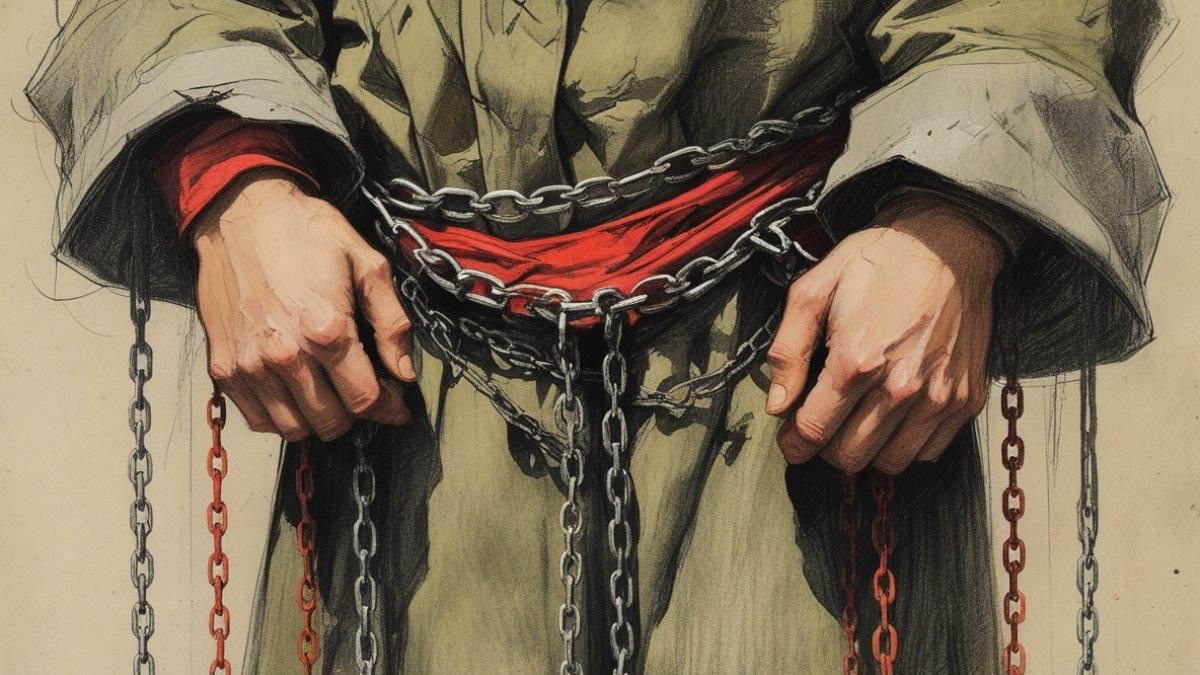
It’s a comfortable thought, isn’t it? That slavery is a relic of the past. A dark, brutal chapter in history books, studied by students, commemorated in museums, and firmly, unequivocally over. We picture Lincoln, we think of Wilberforce, and we rest on the laurels of their hard-won victories. But what if I told you that there are more people living in slavery today than at any other point in human history? It’s a jarring, dissonant thought, one that feels fundamentally wrong, like a sentence that refuses to parse. Yet, it’s the chilling reality. As of this year, an estimated 50 million people are ensnared in the insidious web of modern slavery, a sprawling criminal enterprise that generates upwards of $236 billion in illicit profits annually. This isn’t a problem confined to faraway, developing nations. It’s happening in plain sight and out of sight, in bustling city centers and quiet suburban towns, on farms, in factories, and behind the closed doors of ordinary-looking houses. It’s in the supply chains of the products we buy and the services we use. Human trafficking and modern slavery are the shadow pandemics of our time, thriving on vulnerability, fueled by greed, and sustained by our collective ignorance. This article isn’t meant to be a comfortable read. It’s a wake-up call. It’s an unflinching look into the mechanics of this monstrous trade, the profound devastation it wreaks on human lives, and the burgeoning global movement to tear it down, one broken chain at a time.
Deconstructing the Terminology: What Are We Really Talking About?
When we talk about “human trafficking” and “modern slavery,” we’re not using metaphorical language. These are precise terms for a spectrum of exploitation. Let’s break down the architecture of this crime to understand its many faces.
Human Trafficking: The Process of Enslavement
At its core, human trafficking is the process. Think of it as the verb, the action of bringing a person into a state of exploitation. The United Nations defines it through a three-part model: the Act, the Means, and the Purpose.
- The Act: This is the recruitment, transportation, transfer, harboring, or receipt of persons. It’s the physical movement or holding of an individual.
- The Means: This is how the trafficker gains control. It’s not always the violent kidnapping we see in movies. More often, it’s through insidious methods like the threat or use of force, coercion, abduction, fraud, deception, or the abuse of power or a position of vulnerability. A key element here is that the initial consent of the victim is irrelevant if any of these means were used. A person might agree to travel for a job opportunity, but if that opportunity was a lie designed to entrap them, they are a victim of trafficking.
- The Purpose: The end goal is always exploitation. This includes, at a minimum, the exploitation of the prostitution of others or other forms of sexual exploitation, forced labor or services, slavery or practices similar to slavery, servitude, or the removal of organs.
Modern Slavery: The State of Being Enslaved
If trafficking is the process, modern slavery is the destination. It’s the condition of being exploited that a person cannot leave due to threats, violence, coercion, deception, or abuse of power. It’s a vast umbrella term that covers a multitude of horrific practices.
- Forced Labor: This is the most common form of modern slavery. Victims are forced to work against their will, often under the threat of violence or other penalties, in industries as diverse as agriculture, construction, manufacturing, and hospitality. They might have their passports confiscated, be told they have an insurmountable “debt” to their employer, or have their families threatened. They are workers in name only; in reality, they are assets to be bled dry.
- Sexual Exploitation: This is the form of trafficking that often gets the most media attention. It involves forcing an individual to engage in commercial sex acts. Victims are frequently controlled through violence, drugs, and psychological manipulation. It is a brutal, dehumanizing industry built on the complete violation of a person’s autonomy.
- Debt Bondage (Bonded Labor): This is perhaps the most widespread and subtle method of enslavement. A person incurs a debt—sometimes a small loan for medicine or travel—and is then forced to work to pay it off. The trafficker, however, manipulates the terms, adding exorbitant interest and fees, ensuring the debt can never truly be repaid. The victim is trapped in a perpetual cycle of labor for which they receive little or no pay, with the debt passing from one generation to the next.
- Domestic Servitude: Behind the closed doors of private homes, individuals are forced to work as domestic help. They are isolated, their movements restricted, and they often work around the clock for no pay. They become invisible prisoners in a family home, their abuse hidden from the outside world.
- Forced Marriage: This occurs when an individual is forced to marry against their will. They may be subjected to servitude, sexual exploitation, and other forms of abuse within the marriage. While it can affect anyone, women and girls are disproportionately victimized.
- Child Slavery: Children are uniquely vulnerable. Child slavery includes the forced recruitment of child soldiers, any form of child sexual exploitation, and forced labor. Crucially, under international law, any child involved in commercial sex is considered a victim of trafficking, regardless of whether force, fraud, or coercion was used.
The Anatomy of a Crime: How Does This Happen?
Traffickers are not mythical monsters lurking in the shadows. They are often calculating opportunists, and sometimes they are people the victim knows and trusts. Understanding their methodology is key to recognizing and preventing this crime.
The Profile of a Predator
Traffickers come from all walks of life. They can be members of large, sophisticated transnational criminal organizations or opportunistic individuals. They can be family members, intimate partners, community leaders, or seemingly legitimate labor recruiters. What they share is a predatory instinct for vulnerability. They are adept at identifying and exploiting weakness, desperation, and hope. A trafficker might present as a charming suitor, a benevolent benefactor offering a way out of poverty, or a stern but fair boss. This chameleon-like ability to adapt their persona to the victim’s needs is one of their most dangerous tools.
The Bait: Recruitment Tactics
The recruitment process is rarely a dramatic, violent abduction. It’s often a slow, methodical grooming process built on deception.
- The False Promise: The most common lure is the promise of a better life. This can be a well-paying job in another city or country, an educational opportunity, or a chance at love and marriage. Traffickers create a compelling narrative that taps directly into the victim’s deepest desires and most pressing needs. They advertise on social media, in newspapers, and through word-of-mouth networks.
- The “Loverboy” Method: Particularly common in sex trafficking, a trafficker will initiate a romantic relationship with the victim. They shower them with attention, gifts, and affection, building a powerful emotional bond and a deep sense of trust. Once the victim is emotionally dependent, the trafficker begins to make requests, slowly coercing them into exploitation, often framing it as a way for them to “help” their partner.
- Isolation and Control: Once a victim is recruited, the next step is to isolate them. This can be physical isolation by moving them to a new location where they don’t know anyone and don’t speak the language. It’s also psychological isolation. Traffickers will confiscate phones, identification documents like passports and driver’s licenses, and control all communication with the outside world. They systematically break down the victim’s support network, making the trafficker the sole provider of information and “safety.”
- Coercion and Fear: Control is maintained through a relentless campaign of fear. This includes physical and sexual violence, threats against the victim’s family back home, and psychological manipulation. Victims are often told that they or their loved ones will be harmed or killed if they try to escape, or that they will be arrested and deported because of their illegal status, which the trafficker themselves has orchestrated. This creates a state of learned helplessness, where the victim believes that escape is impossible or would lead to an even worse fate.
The Human Cost: The Devastating Aftermath
The physical scars of modern slavery can be horrific, but the psychological wounds are often deeper and more enduring. The experience of being trafficked is a profound and multifaceted trauma that shatters a person’s sense of self, safety, and humanity.
A Shattered Psyche
Survivors of human trafficking exhibit incredibly high rates of severe psychological distress. The constant state of fear, powerlessness, and degradation leaves an indelible mark.
- Post-Traumatic Stress Disorder (PTSD): The vast majority of survivors experience symptoms of PTSD. This can include debilitating flashbacks, where they are forced to relive their trauma; severe anxiety; hypervigilance (a state of being constantly “on guard”); and an inability to feel safe in the world.
- Depression and Anxiety Disorders: The experience of being completely stripped of one’s autonomy and subjected to abuse often leads to profound depression, feelings of worthlessness, and debilitating anxiety. Many survivors struggle with suicidal ideation.
- Complex Trauma (C-PTSD): Unlike single-incident trauma, trafficking involves prolonged, repeated exposure to traumatic events, often within a relationship of control (the trafficker). This leads to what is known as complex trauma, which affects a person’s core identity, their ability to form healthy relationships, and their capacity to regulate their emotions.
- Stockholm Syndrome and Trauma Bonding: In a desperate psychological attempt to survive, some victims develop a twisted sense of attachment or loyalty to their trafficker. This “trauma bond” is a survival mechanism, not a rational choice. The trafficker may be the only person providing food or shelter, creating a deeply confusing and toxic dependency that can make it incredibly difficult for a victim to leave, even when an opportunity arises.
The Long Road to Recovery
Escaping or being rescued is not the end of the ordeal; it is the beginning of a long and arduous journey of recovery. Survivors need comprehensive, long-term, trauma-informed care. This includes safe housing, medical attention, legal assistance to navigate the justice system, and intensive psychological support. They must relearn how to make their own choices, how to trust other people, and how to live in a world that once treated them as a commodity. The journey is often fraught with setbacks, but the resilience of the human spirit is a powerful force. With the right support, survivors can and do rebuild their lives, becoming powerful advocates in the fight against the very evil that once consumed them.
The Global Response: Fighting a Faceless Enemy
Combating a multi-billion dollar global criminal enterprise is a monumental task, but it is a fight that is being waged on multiple fronts by a dedicated coalition of governments, NGOs, and individuals.
The Role of Law and Government
International agreements, like the UN’s “Palermo Protocol,” provide a framework for nations to criminalize trafficking, protect victims, and promote cooperation. National laws, such as the Trafficking Victims Protection Act (TVPA) in the United States, create legal tools to prosecute traffickers and provide services for survivors. Law enforcement task forces at the federal, state, and local levels are becoming more adept at identifying and investigating these complex cases. However, challenges abound. Prosecutions are difficult; victims are often too traumatized or intimidated to testify, and the transnational nature of the crime creates jurisdictional nightmares.
The Power of Non-Governmental Organizations (NGOs)
On the front lines of this fight are countless NGOs doing the vital, boots-on-the-ground work. Organizations like Polaris, International Justice Mission (IJM), and the Coalition to Abolish Slavery and Trafficking (CAST) are indispensable. They operate hotlines (like the National Human Trafficking Hotline: 1-888-373-7888), run rescue operations, provide shelter and long-term restorative care for survivors, and advocate for stronger anti-trafficking policies. They are often the first point of contact for a victim seeking help and the primary providers of the specialized care survivors need to heal.
The Tech Revolution: A Double-Edged Sword
Technology has fundamentally reshaped the landscape of human trafficking. Traffickers use social media and encrypted messaging apps to recruit and control victims and online marketplaces to sell them. However, that same technology is being turned against them.
- Data Analytics and AI: Anti-trafficking organizations and law enforcement are now using artificial intelligence and machine learning to analyze vast amounts of online data. Algorithms can scan escort ads and job postings for keywords, images, and patterns indicative of trafficking, flagging them for investigation. Financial institutions use AI to detect suspicious transaction patterns that could be linked to money laundering from trafficking operations.
- Digital Forensics: When a trafficker is arrested, digital forensics experts can recover a treasure trove of evidence from phones and computers—text messages, location data, financial records—that can be used to build a rock-solid case for prosecution.
Our Role in the Fight: From Bystander to Advocate
The sheer scale of this problem can feel overwhelming, leading to a sense of helplessness. But that is a luxury we cannot afford. The fight against modern slavery requires the participation of society at every level. It requires us to open our eyes and accept that this is happening in our communities.
Cultivating Awareness
The first and most crucial step is to learn the red flags. Is a worker avoiding eye contact, seeming fearful or anxious, and letting someone else speak for them? Do they show signs of physical abuse? Are they living in unsuitable conditions? Do they seem to have their freedom of movement restricted? Recognizing these signs is not about being a vigilante; it’s about being an informed and responsible member of the community. If you see something that doesn’t feel right, report it to the National Human Trafficking Hotline. You don’t need to be sure; you just need to be concerned.
Conscious Consumerism
Our purchasing power is a potent tool. The demand for cheap goods and services fuels the demand for forced labor. While navigating complex global supply chains is difficult, we can start making more informed choices. Support companies that are transparent about their supply chains and are committed to ethical sourcing. Look for certifications like Fair Trade. Ask questions. Demand accountability. By signaling to the market that we will not tolerate slave labor in our products, we can create powerful economic pressure for change.
Amplifying the Message
Use your voice. Talk about this issue with your friends, family, and colleagues. Share resources and articles from reputable anti-trafficking organizations on your social media. Advocate for stronger anti-trafficking legislation and better support for survivors in your community. The silence and ignorance surrounding modern slavery are the walls behind which it hides. Every conversation, every share, every act of advocacy helps to tear those walls down, exposing this crime to the light and creating a world where every single person is, and remains, free.
Focus on Language
[ppp_patron_only level=5]
Vocabulary and Speaking
Alright, let’s take a deep breath. That was a heavy, intense article, and it’s supposed to be. But now, we’re going to shift gears a little. We’re going to put on our language-learner hats and look back at some of the powerful words and phrases we used. The goal here isn’t just to understand the topic better, but to grab some of this advanced vocabulary and make it our own. These are words you can use in essays, in presentations, in serious conversations, and even just to sound a little smarter at your next dinner party. We’ll break down ten key terms, look at how they were used, and figure out how you can slot them into your everyday English.
Let’s start with a word from the very first paragraph: insidious. I wrote that human trafficking is an “insidious web.” When something is insidious, it proceeds in a gradual, subtle way, but with very harmful effects. It’s not a big, loud, obvious danger. It’s the kind of danger that creeps up on you. Think of a disease that has no symptoms in its early stages but becomes very serious later on. That’s insidious. Or think about a bad habit, like procrastinating. It doesn’t seem like a big deal at first—you just put one small thing off. But gradually, subtly, it grows until it’s causing major problems in your life. That’s the insidious nature of procrastination. In our article, calling the web of trafficking “insidious” highlights how traffickers don’t usually announce their evil intentions. They use subtle deception and manipulation to trap people. You could use this in your own life. For example, you might say, “The spread of misinformation online is insidious; it slowly erodes public trust without anyone noticing until it’s too late.” Or, “I had to quit my job because of the insidious office politics that were making everyone miserable.” It’s a fantastic word for describing a hidden, creeping evil.
Next up is dissonant. I mentioned that the idea of modern slavery is a “djarring, dissonant thought.” Dissonant comes from music theory. A dissonant chord is one where the notes clash; it sounds unstable or unpleasant and creates a feeling of tension. It’s the opposite of a harmonious chord. When we use it outside of music, we’re talking about something that is inconsistent, out of place, or lacks agreement. It creates a sense of mental or emotional clashing. The idea that slavery exists now clashes with our belief in progress and human rights. It just doesn’t fit. It’s dissonant. You can use this to describe any situation where things just don’t add up or feel wrong. For instance: “There was a dissonant quality to his apology; his words were sorry, but his tone was arrogant.” Or, “The company’s new eco-friendly ad campaign felt dissonant, given their history of polluting.” It’s a great way to say that something feels off or contradictory on a deep level.
Let’s look at the word unequivocally. I said that we see slavery as “firmly, unequivocally over.” If something is unequivocal, it leaves no doubt. It is completely clear, absolute, and unambiguous. There are no “ifs,” “ands,” or “buts.” It’s a very strong and formal way of saying “totally” or “absolutely.” The adverb “unequivocally” gives your statement a lot of power and certainty. You could say, “The evidence shows, unequivocally, that the suspect was at the scene of the crime.” Or on a more personal level, “After her amazing presentation, I am unequivocally in support of her proposal.” Be careful not to overuse it, as it is a very strong word. Save it for when you want to express complete and total certainty about something important.
Now for a phrase: rest on the laurels. The article states, “…and we rest on the laurels of their hard-won victories.” This is a fantastic idiom. To “rest on your laurels” means to be so satisfied with your past achievements that you stop trying to achieve anything new. The “laurels” refer to the laurel wreath, a symbol of victory and honor in ancient Greece and Rome. So if you’re resting on them, you’re basically coasting, relying on your past successes instead of putting in the effort now. For example, a company that was once a market leader but failed to innovate could be accused of resting on its laurels. You could warn a friend, “You got the highest score on the midterm, but don’t rest on your laurels; the final exam is going to be much harder.” It’s a perfect phrase for cautioning against complacency.
Let’s move on to insurmountable. We talked about how traffickers can make a victim feel they have an “insurmountable ‘debt’.” If a problem or obstacle is insurmountable, it is too great to be overcome. It’s impossible to get past. The image is of a mountain so high you cannot surmount, or climb, it. This word is perfect for describing challenges that seem absolutely overwhelming. You might hear someone say, “For the small startup, the competition from the tech giant seemed insurmountable.” Or, “Despite facing what felt like insurmountable odds, she managed to graduate with top honors.” In the context of the article, this word captures the psychological trap of debt bondage perfectly—the feeling of being crushed by a burden you can never escape.
Another great word is chameleon-like. I described traffickers as having a “chameleon-like ability to adapt.” A chameleon, as you know, is a lizard that can change its skin color to blend in with its surroundings. So, to describe someone or something as chameleon-like is to say they are very adaptable and can change their behavior or appearance to fit in or to deceive others. It often carries a slightly negative connotation, suggesting a lack of a stable, authentic self. You could say, “The politician had a chameleon-like ability to change his stance on issues depending on his audience.” Or, more positively, “As an undercover agent, her chameleon-like talent for adopting new personas was her greatest asset.” It’s a very descriptive and vivid way to talk about adaptability, for good or ill.
Next is systematically. The article says traffickers “systematically break down the victim’s support network.” When you do something systematically, you do it according to a fixed plan or system; it’s methodical, deliberate, and thorough. It’s not random or haphazard. It implies a cold, calculated efficiency. For example, “The army systematically dismantled the enemy’s defenses.” Or, “To prepare for the marathon, she systematically increased her mileage each week.” In the article’s context, it emphasizes the cruel and calculated nature of the trafficker’s strategy—it’s a planned attack on the victim’s psyche.
Let’s talk about indelible. I wrote that trafficking leaves an “indelible mark.” Something that is indelible cannot be removed or forgotten. The word comes from the Latin indelebilis, meaning “indestructible.” It’s often used to talk about memories, influences, or effects that are permanent. Think of indelible ink—it can’t be washed away. You could say, “My first trip to Paris left an indelible impression on me.” Or, “The failures of his early career taught him an indelible lesson about humility.” Using “indelible mark” to describe the psychological wounds of trafficking powerfully conveys their permanence and severity.
Here’s another useful adjective: arduous. The path to recovery for a survivor is described as a “long and arduous journey.” Arduous means involving or requiring strenuous effort; it’s difficult and tiring. It’s a step above just “hard.” It suggests a long, tough slog. Climbing Mount Everest is an arduous task. Writing a Ph.D. dissertation is an arduous process. You could say, “After an arduous a hike, we finally reached the summit.” It’s the perfect word to describe tasks that require immense and sustained effort, and it perfectly captures the difficulty of a survivor’s healing process.
Finally, let’s look at the word monumental. I said that combating this crime is a “monumental task.” Like insurmountable, this word describes something of great size, but it focuses more on scale and importance than on being impossible. A monumental task is one that is massive, imposing, and of great significance, like building a monument. It suggests a huge undertaking that requires a massive, coordinated effort. For example, “Cleaning up the oil spill was a monumental undertaking for the coastal communities.” Or, “The discovery of penicillin was a monumental achievement in the history of medicine.” It conveys a sense of awe-inspiring size and importance, which is exactly the feeling one gets when facing the global problem of human trafficking.
So there you have it: insidious, dissonant, unequivocally, rest on the laurels, insurmountable, chameleon-like, systematically, indelible, arduous, and monumental. These are powerful, descriptive words that can add precision and sophistication to your English.
Now for our speaking lesson. Today, we’re going to focus on something called “tonal modulation for emotional impact.” That sounds complicated, but it’s really not. It’s about how you change your tone of voice to match the emotional weight of what you’re saying. When discussing a serious topic like human trafficking, you can’t speak in a flat, monotonous voice. It would sound disrespectful and apathetic. Conversely, you don’t want to sound overly dramatic or theatrical, as that can seem insincere. The key is to find the right balance.
Let’s practice with some of our new vocabulary. Take the word insidious. I want you to say this sentence out loud: “The trafficker’s plan was insidious.” Now, say it again, but this time, lower your pitch slightly on the word “insidious” and say it a little more slowly, almost stretching it out. “The trafficker’s plan was in-sid-i-ous.” Hear the difference? The second way has more gravity. It makes the word sound as creepy and dangerous as its meaning.
Let’s try another one with the word arduous. Say this sentence: “Her recovery was an arduous journey.” Now, try it again. This time, put a little bit of stress and a slight sigh or breathiness into the word “arduous.” “Her recovery was an arduous journey.” It makes it sound difficult and tiring, just like the word means.
One more. Let’s use monumental. “The fight against slavery is a monumental task.” Now say it with a sense of scale. Your voice should get a little louder and more open on “monumental,” as if you’re describing something vast. “The fight against slavery is a MONUMENTAL task.”
This is tonal modulation. It’s about using the music of your voice—your pitch, pace, and volume—to convey the emotion behind your words. It makes you a much more engaging and persuasive speaker.
Here’s your challenge. I want you to find a short paragraph from the main article—any paragraph you like. Your assignment is to read it out loud three times.
- The first time, read it in your normal, everyday voice.
- The second time, I want you to consciously try to use tonal modulation. Slow down on the serious words (like insidious, brutal, shattered). Raise your volume slightly on words that convey scale or importance (monumental, global). Lower your pitch to create a sense of gravity.
- The third time, record yourself on your phone and listen back. Does it sound authentic? Are you conveying the seriousness of the topic?
This exercise will make you more aware of the power of your own voice. It’s a skill that will serve you well, whether you’re giving a presentation at work, participating in a debate, or simply having a deep and meaningful conversation with a friend. Give it a try.
Grammar and Writing
Welcome to the grammar and writing workout. We’ve explored the dark world of human trafficking, and now we’re going to use that challenging topic to sharpen our writing skills. Great writing isn’t just about having something to say; it’s about knowing how to say it with power, clarity, and impact.
Your Writing Challenge:
Imagine you work for a non-profit organization that fights human trafficking. Your organization is trying to secure a significant grant from a major philanthropic foundation. Your task is to write a 500-word letter to the foundation’s board of directors. The purpose of this letter is to persuade them that your organization is the most effective and deserving recipient of their funding.
This isn’t just any letter. It needs to be professional, compelling, and emotionally resonant without being manipulative. It must clearly articulate the problem, propose a concrete solution (your organization’s work), and demonstrate a track record of success.
This challenge will test your ability to use persuasive language, structure a formal argument, and employ specific grammatical structures to maximize your impact.
Now, let’s break down how to succeed in this challenge. This is your writing lesson.
Tip 1: Master the Art of the Persuasive Opening (The Hook)
You have about ten seconds to grab your reader’s attention. A dry, boring opening like “I am writing to apply for the Human Rights Grant” is a death sentence. You need a powerful hook. We can use a specific grammatical structure here: The Inverted Sentence.
A standard sentence might be: “Modern slavery is a devastating problem that affects 50 million people.”
An inverted sentence flips the structure for emphasis: “Affecting over 50 million people, modern slavery remains one of the most devastating, and hidden, crimes of our time.”
See the difference? Starting with the participial phrase “Affecting over 50 million people” immediately establishes the scale and gravity of the issue before you even name it. It creates a sense of drama and importance.
Another technique is using a rhetorical question.
Instead of: “We must consider the human cost.”
Try: “What is the true cost of a single life stolen by traffickers?”
This directly engages the reader and forces them to contemplate the issue on a personal, emotional level. Your opening paragraph should state the problem in a way that feels urgent and profound.
Tip 2: The Power of the Active Voice (Owning Your Actions)
This is one of the most important grammar rules for persuasive writing. The active voice is strong, direct, and clear. The passive voice is often weak, indirect, and evasive.
Passive Voice: “Survivors have been provided with shelter and counseling by our organization.” (The action is being done to the survivors by an unnamed agent until the end of the sentence).
Active Voice: “Our organization provides survivors with critical shelter and trauma-informed counseling.” (Your organization is the subject, performing the action directly).
The active voice makes your organization sound dynamic, capable, and in control. To write in the active voice, always try to make the person or group doing the action the subject of the sentence.
Let’s practice:
- Passive: “A new awareness campaign was launched.” -> Active: “We launched a new awareness campaign that reached over two million people.”
- Passive: “Legal aid is offered to victims.” -> Active: “Our legal team offers pro bono aid to every victim we serve.”
For your letter, you should almost exclusively use the active voice when describing your organization’s achievements. You are not a passive bystander; you are an active agent of change.
Tip 3: Using Modal Verbs for Strategic Persuasion
Modal verbs (will, can, could, may, might, should, must) are your secret weapons for shaping your message. They allow you to express certainty, possibility, and obligation. Use them strategically.
- To show capability (use can): “With this grant, our investigative team can expand its operations by 30%, allowing us to reach more victims.” This shows ability.
- To show certainty and promise (use will): “Your investment will directly translate into lives saved. We will report our progress quarterly.” This sounds like a firm commitment.
- To show potential and vision (use could): “Imagine a world where every child could grow up free from the threat of exploitation. Your support could help us build that world.” “Could” is softer than “will” and is excellent for painting a picture of a possible future.
- To express moral obligation (use must or should): Use this when talking about the problem itself, not your organization. “We as a society must do more to protect the vulnerable.” This creates a shared sense of responsibility with the reader.
By carefully choosing your modal verbs, you can guide the foundation’s board from seeing what is possible to feeling what is necessary.
Tip 4: The Rule of Three (Tricolon)
The Rule of Three is a classic rhetorical device. The human brain loves patterns, and listing things in threes makes them more memorable, satisfying, and persuasive.
Instead of: “We provide help to survivors.”
Try: “We provide survivors with safety, healing, and a path to justice.”
Instead of: “Our approach is good.”
Try: “Our approach is strategic, compassionate, and evidence-based.”
Look for opportunities to structure your points in threes. It adds rhythm and power to your prose. It makes your statements sound complete and authoritative.
Tip 5: Concrete Nouns and Vivid Verbs (Show, Don’t Just Tell)
Generalities are the enemy of persuasion. Don’t just tell the board you do good work; show them. Replace vague language with specific details.
Vague: “We help people with our programs.”
Specific and Vivid: “We operate three safe houses that shelter over 100 survivors annually. Our legal team prosecutes traffickers and has secured 25 convictions in the last two years. Our outreach program distributes vital information and hygiene kits to at-risk youth on the streets.”
Use strong verbs (operate, shelter, prosecute, distributes) instead of weak ones (help, do, give). Use concrete nouns (safe houses, convictions, hygiene kits) instead of abstract ones (programs, support). This paints a clear picture of your impact and proves that you are not just talking; you are doing.
Putting It All Together: A Sample Structure for Your Letter
- Paragraph 1: The Hook. Start with your inverted sentence or rhetorical question. State the vastness and urgency of the human trafficking problem. Make the reader feel the weight of the issue.
- Paragraph 2: The Introduction of the Hero. Introduce your organization. Use the active voice. “For the past ten years, [Your Organization’s Name has stood on the front lines of this fight.” Briefly state your mission. Use the Rule of Three to describe your core values or approach (e.g., “Our work is built on three pillars: Rescue, Restoration, and Reform.”)
- Paragraph 3: The Proof. This is where you get specific. Use your concrete nouns and vivid verbs. Give them the numbers. “Last year alone, our hotline received 5,000 calls, leading directly to 50 active rescue operations. We provided 10,000 nights of safe shelter…” This is your evidence.
- Paragraph 4: The Vision (The Ask). This is where you use your modal verbs. Explain exactly what you will do with their money. “A grant of $500,000 will allow us to open a new dedicated legal clinic. This clinic can double our capacity to represent survivors in court. We could finally meet the overwhelming demand for our services.” Connect their money directly to a tangible, powerful outcome.
- Paragraph 5: The Closing. Reiterate your commitment. End with a powerful, forward-looking statement. Thank them for their time and consideration. “Together, we can turn the tide against this injustice. We look forward to the possibility of partnering with you to create a world free from slavery.”
Now, take these tools and get to work on that letter. Remember, you’re not just asking for money. You are advocating for human freedom. Your words have the power to change lives. Write with passion, precision, and purpose.
Vocabulary Quiz
Let’s Discuss
This is a topic that can feel distant, but it’s deeply woven into the fabric of our global society. It’s crucial to talk about it, to ask hard questions, and to challenge our own assumptions. Here are a few questions to get a meaningful conversation started in the comments or with people you know.
- The Psychology of the Bystander: Why do you think a crime as widespread as modern slavery remains so “invisible” to so many people?
- Diving Deeper: Think about your own community. Before reading this, how much did you think about where your food comes from or who cleans the local hotel rooms? Is it a lack of information, a feeling of helplessness, or something else that allows us to look away? Discuss the psychological barriers that prevent us from confronting uncomfortable truths that are right in front of us.
- Technology: A Tool for an enslaver or a Liberator? The article mentions technology is a “double-edged sword.” Which edge do you think is sharper right now?
- Diving Deeper: Consider the power of social media to both recruit victims and to run awareness campaigns. Think about how encrypted apps can hide traffickers, while AI can be used to find them. Do you think technology is, on balance, making the problem worse or providing us with the tools to finally solve it? What future tech innovations could change the game, for better or for worse?
- Consumer Responsibility: How much responsibility do individual consumers have to fight forced labor in supply chains? Is it our job, or the government’s and corporations’?
- Diving Deeper: Let’s be honest, it’s hard to know if a smartphone or a t-shirt was made with slave labor. Is it realistic to expect the average person to research every purchase? Or should we focus on pressuring governments to enact and enforce stricter laws on corporations? Where does the most effective power for change lie: with our wallets or our votes?
- The “Loverboy” Tactic and Victim Blaming: The article discusses how traffickers often pose as romantic partners. How does this tactic challenge our preconceived notions of what a trafficking victim “looks like”?
- Diving Deeper: When people think of trafficking, they often picture a violent kidnapping. The reality is often much more subtle and psychological. Why might it be harder for people—and even law enforcement—to see the victim as a “real” victim when they initially seemed to “go willingly” with a boyfriend? Discuss how societal views on relationships, consent, and manipulation can lead to victim-blaming.
- Recovery and Justice: What does true “justice” look like for a survivor of human trafficking?
- Diving Deeper: Is justice simply seeing their trafficker imprisoned? Or is it more complex? Discuss the different components of justice for a survivor. Consider the importance of financial restitution, long-term psychological care, safe housing, educational and job opportunities, and having their story heard and believed. If you were designing a “justice system” for survivors, what would be its most important pillars?
Learn with AI
Disclaimer:
Because we believe in the importance of using AI and all other technological advances in our learning journey, we have decided to add a section called Learn with AI to add yet another perspective to our learning and see if we can learn a thing or two from AI. We mainly use Open AI, but sometimes we try other models as well. We asked AI to read what we said so far about this topic and tell us, as an expert, about other things or perspectives we might have missed and this is what we got in response.
Hello there. It’s great to have this chance to elaborate on the main article. While the piece you’ve just read provides a comprehensive overview, as an AI focused on synthesizing vast amounts of data on this topic, I can shed some light on a few nuanced areas that often get missed in the broader conversation.
First, let’s talk about the intersection of climate change and human trafficking. This is a threat multiplier that is only just beginning to get the attention it deserves. The article mentioned vulnerability as the key ingredient traffickers exploit. Well, climate change is a massive, global engine of vulnerability. When a typhoon, a drought, or rising sea levels destroy a family’s farm and livelihood, it creates mass displacement and desperation. Millions of people are forced to migrate, often with no resources, no support network, and no legal status in their new location. This is a perfect storm for traffickers. They swoop into these disaster-stricken or displaced communities offering fraudulent promises of work and safety, preying on people who have just lost everything. So, when we think about fighting human trafficking, we must also think about climate resilience and providing safe, legal migration pathways for climate refugees. The two issues are becoming inextricably linked.
Second, I want to delve deeper into the role of small-to-medium-sized enterprises (SMEs) in the problem. We often focus on large, multinational corporations and their complex supply chains, and that’s important. However, a huge amount of forced labor happens in smaller, less regulated businesses. Think about local construction subcontractors, independent farming operations, nail salons, or family-owned restaurants. These businesses often fly under the radar of major audits and government oversight. The exploitation here can be more direct and personal, with the business owner being the trafficker. This makes it a much more fragmented and difficult problem to tackle through policy alone. It requires a community-level response: local business associations promoting ethical practices, and an aware public who can spot the signs in their own neighborhoods.
Finally, let’s touch upon the neurological impact of trauma and why it’s so critical for recovery. The article mentioned C-PTSD and trauma bonding, which is excellent. But let’s get even more specific. Prolonged, severe trauma, like that experienced during trafficking, can literally change the brain’s architecture. The amygdala, the brain’s fear center, can become overactive, leading to the hypervigilance we discussed. The prefrontal cortex, which governs decision-making and impulse control, can be impaired. This is not a matter of a survivor being “weak” or “making bad choices.” It is a brain injury. This is why “trauma-informed care” is not just a buzzword; it’s a non-negotiable requirement for helping survivors. It means that every single person who interacts with a survivor—from police officers to doctors to therapists—needs to understand that they are interacting with someone whose brain is wired for survival, not for calm, linear storytelling or immediate trust. Recovery isn’t just about healing the spirit; it’s about giving the brain the time and the right environment to physically heal and form new, healthy neural pathways. Understanding this biological reality is essential for empathy and for designing effective, long-term support systems.
So, as you continue to think about this topic, I encourage you to consider these deeper, interconnected layers: the growing shadow of climate change, the hidden role of smaller businesses, and the real, physical impact of trauma on the human brain. They add crucial depth to our understanding of this devastating crime.
Let’s Play & Learn
Interactive Vocabulary Building
Crossword Puzzle
Word Search
[/ppp_patron_only]









0 Comments