
MagTalk Video
MagTalk Audio
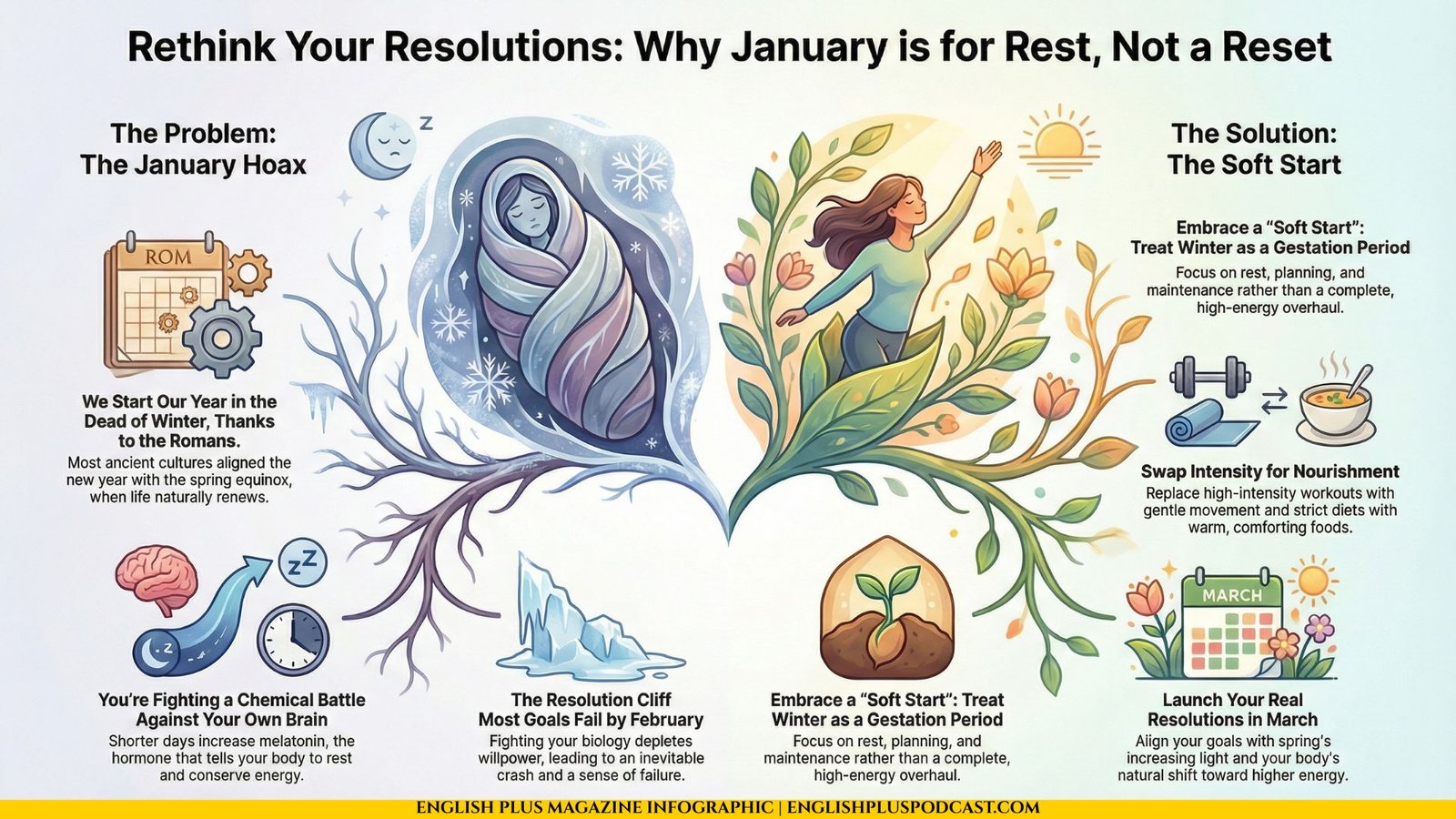
The January Paradox
There is a distinct, almost palpably tragic scent in the air during the first week of January. If you walk into a gym, it smells like fresh rubber, desperation, and the sweat of people who would rather be literally anywhere else. If you look at social media, it reeks of toxic positivity and the grinding gears of the “new year, new me” industrial complex. We are collectively hallucinating that because a calendar page flipped from December 31 to January 1, we are suddenly different people. We convince ourselves that the lethargy we feel is a character flaw, a lack of discipline, or a moral failing.
But here is the cold—quite literally freezing—truth: You are not lazy. You are just a mammal trying to survive winter, and society is gaslighting you into thinking you should be blooming when you are biologically programmed to be dormant.
The Janus Deception and the Arbitrary Calendar
How Romans Ruined Our Rhythm
It is fascinating how much of our modern anxiety can be traced back to men in togas who died two millennia ago. The month of January is named after Janus, the Roman god of beginnings, gates, transitions, time, duality, doorways, passages, and endings. He is usually depicted as having two faces, since he looks to the future and to the past. It sounds poetic, but purely from an agricultural and biological standpoint, starting the “new” year in the dead of winter is lunacy.
For the vast majority of human history, the new year didn’t start when the ball dropped in Times Square. It started when the earth woke up. Ancient cultures, who were far more in tune with the planet than we are with our Wi-Fi signals, typically celebrated the new year around the Vernal Equinox in March. This makes sense. March is when life returns. January is when life holds its breath.
The Disconnect from Reality
We have constructed a linear, industrial concept of time that demands consistent output regardless of the season. We expect the same productivity in the dark, freezing days of January as we do in the high energy, sun-drenched days of July. This is a fundamental denial of our physiology. We are not machines; we are biological entities governed by circadian rhythms and seasonal shifts. When you force a high-octane “grindset” mentality in January, you are swimming upstream against a river of melatonin.
The Biology of Winter Dormancy
The Melatonin Mandate
Let’s talk about the chemistry coursing through your veins right now. In winter, days are shorter. Less sunlight hits your retina, which signals your pineal gland to produce more melatonin—the hormone that regulates sleep and signals to the body that it is time to wind down. In the summer, the suppression of melatonin by sunlight gives us energy. In winter, the lack of light increases melatonin, naturally inducing a state of lower energy, introspection, and conservation.
When you try to wake up at 5:00 AM in January to crush a high-intensity interval training workout, you are fighting a chemical battle against your own brain. Your body is screaming for rest, for warmth, and for calorie conservation. This isn’t weakness; it is a survival mechanism. Our ancestors who tried to run marathons in the snow didn’t pass on their genes; the ones who huddled by the fire and saved their energy did.
The Fallow Field
If we look at nature, nothing blooms all year round. The soil requires a period of lying fallow—resting—to regenerate nutrients. If a farmer tried to force crops to grow in frozen soil, they wouldn’t just fail; they would destroy the potential for the next harvest. Yet, this is exactly what we do to our minds. We treat our creativity and ambition like a factory line that never stops, rather than a field that needs seasons. January should be our fallow period. It is a time for root work, not fruit work. It is for planning, dreaming, resting, and reading, not for launching and sprinting.
The Burnout Trap
The Resolution Cliff
Statistics tell us that the vast majority of New Year’s resolutions fail by the second week of February. Why? Because willpower is a finite resource, and when you use all of it fighting your biology, you run out. We start January with a sprint, running on the fumes of holiday stress and champagne, and by the time we hit the bleakness of February, we crash. This cycle of enthusiastic start followed by inevitable crash creates a psychological feedback loop of failure. We start to believe we are incapable of change, when really, we just have terrible timing.
The Cost of Ignoring the Rhythms
Fighting the winter blues with forced productivity is like trying to cure a broken leg by walking it off. It just causes more damage. This constant friction between what our bodies need (rest) and what society demands (hustle) leads to a specific kind of winter burnout. It manifests as irritability, deep fatigue, and a cynicism toward our own goals. We burn out because we are trying to harvest in the middle of winter.
A Proposal: The Soft Start
Embracing the Hibernation Mode
So, what is the alternative? Do we just lie on the couch eating potato chips until spring? Not exactly, though that does sound appealing. The alternative is a “Soft Start.” Treat January and February as the gestation period of the year.
Instead of hitting the gym five days a week, focus on gentle movement like yoga or walking. Instead of launching a new business, spend the time researching and outlining. Instead of forcing a strict diet, focus on nourishing, warm foods that comfort you. Reframe January as the month of “maintenance” rather than “overhaul.”
The Hard Launch: March Equinox
The Natural New Year
If you want to set resolutions that actually stick, wait until the Vernal Equinox in late March. The days are getting longer, the light is returning, and your biology is naturally shifting toward higher energy. You will feel a natural urge to move, to go outside, to start things. This is the wind at your back.
When you align your goals with the season, you aren’t fighting yourself. You are riding the wave of your own biology. Use the winter to sharpen the axe, so that when spring comes, you can chop down the tree with one swing, rather than hacking away at it dully for three months in the freezing cold.
Be More Bear
There is a reason bears hibernate. They are majestic, terrifyingly powerful creatures, and they know that the smartest thing to do in winter is to sleep. We would do well to learn from them. Stop beating yourself up for not operating at peak efficiency in the darkest month of the year. Pour a hot drink, grab a blanket, and let yourself rest. The spring will come, and when it does, you’ll actually have the energy to meet it.
Reading Comprehension Quiz
Focus on Language
Part 1: Vocabulary and Speaking
Let’s dive right into the language used in our article because, frankly, if we want to articulate complex ideas about biology and society, we need words that carry some weight. We’re not just talking about being “tired”; we’re talking about something deeper.
The first word we really need to get comfortable with is circadian. You see this everywhere in health literature now, usually paired with “rhythm.” In the article, we mentioned fighting our circadian rhythms. This refers to the physical, mental, and behavioral changes that follow a 24-hour cycle, primarily responding to light and darkness. If you tell your boss, “I’m not lazy, I’m just respecting my circadian rhythm,” you sound a lot smarter than if you just say you want to sleep in, even if the result is the same. It’s about that internal clock.
Then we have lethargy. This isn’t just being sleepy. It’s a state of weariness that involves a lack of energy or enthusiasm. It feels heavy. In the winter, that lethargy isn’t necessarily a bad thing; it’s the body’s way of saying “slow down.” But we often mistake this natural lethargy for laziness.
We also discussed the concept of dormancy. This is a great word borrowed from botany and biology. When a plant is dormant, it’s alive, but its normal physical functions are suspended or slowed down for a period of time. It’s deep sleep. In a metaphorical sense, we can say our creativity is in a state of dormancy during January. It’s not dead; it’s just waiting for the right conditions to wake up.
That brings us to fallow. This is an agricultural term. A fallow field is one that is left unplanted for a period to restore its fertility. If you use this in everyday life, it’s incredibly sophisticated. You might say, “I’m letting my social life lie fallow for a month.” It implies a purpose behind the inactivity. You aren’t just doing nothing; you are regenerating.
We talked about the inevitable crash. Inevitable means certain to happen; unavoidable. When you fight nature, burnout is inevitable. It’s a strong word to use when you want to emphasize cause and effect.
Then there is gestation. Biologically, this is the process of carrying or being carried in the womb between conception and birth. But we used it metaphorically: “Treat January as the gestation period of the year.” It means the development of a plan or idea over a period of time. You are building the baby, not delivering it yet.
We also have reframe. This is a psychological darling. It means to look at a situation, thought, or feeling from a different angle to change its meaning. Instead of seeing January as a failure of productivity, we reframe it as a success in resting. It’s a powerful tool for mental health and a great verb for your vocabulary.
We mentioned toxic positivity. This is a phrase that has exploded in popularity. It refers to the belief that no matter how dire or difficult a situation is, people should maintain a positive mindset. It’s the “good vibes only” culture that ignores real pain or biological reality. Calling out toxic positivity shows you have a nuanced understanding of emotional intelligence.
Let’s look at recalibrate. To calibrate means to adjust a machine so it works precisely. To recalibrate is to adjust it again or differently. We need to recalibrate our expectations for the winter. It sounds precise and technical, which gives your argument authority.
Finally, hustle. We usually use this as a noun or verb related to working hard, but in the article, we contrasted it with rest. The “hustle culture” is the societal pressure to constantly be working. Being able to critique the hustle is a very modern, very relevant conversation topic.
Now, speaking of conversation, how do we use these to sound better when we talk? It’s about upgrading your descriptors. Instead of saying “I’m so tired of everyone pretending to be happy,” you say, “I’m exhausted by this toxic positivity.” Instead of saying “I’m taking a break,” you say, “I’m lying fallow for a bit to recalibrate.”
Here is a little speaking challenge for you. I want you to look at your calendar for next week. Find one thing you feel obligated to do but don’t have the energy for. I want you to record a short voice note—just for yourself or a friend—explaining why you are cancelling or postponing it, but use the “biological argument.” Use words like circadian, dormancy, or reframe. Practice justifying your rest with science rather than apologies. It changes how you sound, but more importantly, it changes how you feel about the decision.
Vocabulary and Speaking Quiz
Part 2: Grammar and Writing
For this section, we are going to tackle a writing challenge that directly applies the “Soft Start” philosophy, but we are going to use it to master some specific grammar structures that deal with the future and conditionality.
The Writing Challenge: The March Manifesto
Forget the New Year’s Resolution. I want you to write a “March Manifesto.” This is a short text (maybe 200-300 words) outlining what you will do when spring arrives, but crucially, it must explain what you are doing now to prepare for it. The structure is: “Because I am resting now, I will be ready to…”
This brings us to our grammar focus: The Future Continuous vs. The Future Simple and Conditionals.
When we make standard resolutions, we usually use the Future Simple: “I will go to the gym.” “I will write a book.” It’s decisive, but it feels like a one-time action or a distant promise.
For your Manifesto, I want you to experiment with the Future Continuous: Subject + will + be + verb-ing.
Example: “Come March, I will be launching my new project.”
The Future Continuous implies that the action will be in progress at a specific time in the future. It paints a picture of you in the middle of the action, which makes the visualization much stronger. It sounds more inevitable and planned than a simple “I will launch.”
Next, let’s look at First Conditionals for cause and effect. The structure is: If + Present Simple, … will + Verb.
In the context of our article, we are making a bargain with ourselves.
“If I rest (Present Simple) in January, I will have (Future Simple) the energy to run in March.”
This structure is crucial for persuasive writing. You are justifying the current inaction by promising a future result.
However, to make your writing really advanced (C1/C2 level), we need to look at Cohesive Devices for Contrast. The article is built on the contrast between Society’s expectations and Biological reality. You need to master these transitions:
- Conversely / On the contrary: Use these to show a direct opposite.
- “Society tells us to sprint in January. Conversely, biology tells us to sleep.”
- While / Whereas: Use these to contrast two things in the same sentence.
- “While the modern calendar demands consistency, nature demands seasonality.”
- Nevertheless / Nonetheless: These are great for acknowledging a point but pivoting back to your argument.
- “We know we should rest. Nevertheless, we feel guilty when we aren’t productive.”
Tips for the Writing Challenge:
Don’t just list goals. Create a narrative. Start with the current state (The Dormancy), use a transition word to pivot to the future (The Awakening), and use the Future Continuous to describe that future state.
Example snippet:
“Currently, I am in a state of deep dormancy, allowing my creative soil to lie fallow. However, this is not laziness; it is preparation. If I respect my need for sleep now, I know that by the Vernal Equinox, I will be writing with a fervor that I simply cannot access right now. I am sharpening the axe so that I will be ready to swing.”
See how that works? It sounds intentional, powerful, and grammatically complex. Try to write your own paragraph using one Future Continuous verb, one Conditional sentence, and one contrast word.
Grammar And Writing Quiz
Critical Analysis
Okay, let’s take a step back and look at this article with a critical eye. I’ve been playing the role of the anti-January advocate, but as an expert observer, we have to poke some holes in this theory for the sake of intellectual honesty.
First, the article relies heavily on the Naturalistic Fallacy. This is the philosophical argument that just because something is “natural” (like hibernating), it is automatically “good” or “better.” Nature also gives us diseases and hurricanes; we don’t embrace those. Just because our ancestors slowed down doesn’t mean we must. Our ability to override our base instincts is exactly what makes us human. High-level athletes and CEOs often perform despite how they feel, not because of it.
Secondly, let’s talk about Seasonal Affective Disorder (SAD). The article suggests leaning into the lethargy. However, for people suffering from clinical SAD, “leaning in” to the darkness and inactivity can actually be dangerous. The clinical treatment for winter depression is often behavioral activation—forcing oneself to move, to get light exposure, and to maintain a routine even when you don’t want to. Telling someone with depression to just “be dormant” might actually exacerbate their symptoms.
Thirdly, the economic reality. The world economy is global. If you decide to “soft launch” in January while your competitors in a different time zone or with a different mindset are sprinting, you lose market share. The “Agricultural Metaphor” is beautiful, but we are in an Information Economy. Ideas don’t need frost to germinate.
So, while the “Soft Start” is a compelling concept for mental health and preventing burnout, we have to be careful not to use it as a crutch that prevents us from building resilience. The goal shouldn’t be to be a slave to the calendar or a slave to our biology, but to find a synthesis where we can be productive without being destructive.
The Debate
Let’s Discuss
Here are five questions to help us dig a little deeper into this topic. These aren’t just for comprehension; they are designed to make you question the premise of the article and your own life.
1. Is “Biological Rhythm” just a convenient excuse for lack of discipline?
It is easy to say “I’m hibernating,” but where is the line between self-care and self-indulgence? If we only worked when we “felt” like it or when the sun was shining, would human civilization have achieved anything? Discuss the balance between honoring biology and the necessity of grit.
2. Does the invention of electricity render the “Seasonal” argument moot?
The article argues we are wired for the rhythms of light and dark. But we have conquered darkness. We have LEDs, heating, and Vitamin D supplements. Since we have technologically overcome winter, shouldn’t our behavior evolve to match our technology? Are we holding onto a biological past that is no longer relevant?
3. How does the “Janus Deception” impact those in the Southern Hemisphere?
In Australia or Brazil, January 1st lands in the middle of summer. Yet, the “New Year Resolution” pressure is global and often Western-centric. Do people in the Southern Hemisphere feel the same “New Year” burnout, or is it actually easier for them to start fresh because the weather supports it? This challenges the cultural universality of the article.
4. The Privilege of Hibernation: Who can actually afford to “Soft Launch”?
The advice to “take it easy” in January is lovely if you have a flexible job or control over your schedule. But what about shift workers, emergency responders, or parents? Is the concept of “seasonal living” an elitist luxury? How can the average person apply these principles without getting fired?
5. The Psychology of the “Clean Slate.”
Even if January is biologically wrong, psychologically, humans love a “fresh start.” There is power in the symbol of the number “1.” If we move the “New Year” to March, do we lose the collective psychological momentum of the entire world trying to change at once? Is there value in the shared struggle of January, even if it’s doomed?








0 Comments