- Podcast Episode
- The Call That Echoed Through Centuries
- The First Crusade: Against All Odds
- The Empire Strikes Back: Zengi, Nur ad-Din, and Saladin
- The Third Crusade: A Clash of Titans
- The Fourth Crusade: A Venetian Betrayal
- The Slow Burn and the End of an Era
- The Cultural Exchange: More Than Just War
- The Shadow of the Cross
- Focus on Language
- Critical Analysis
- Let’s Discuss
- Let’s Play & Learn
Podcast Episode
The Call That Echoed Through Centuries
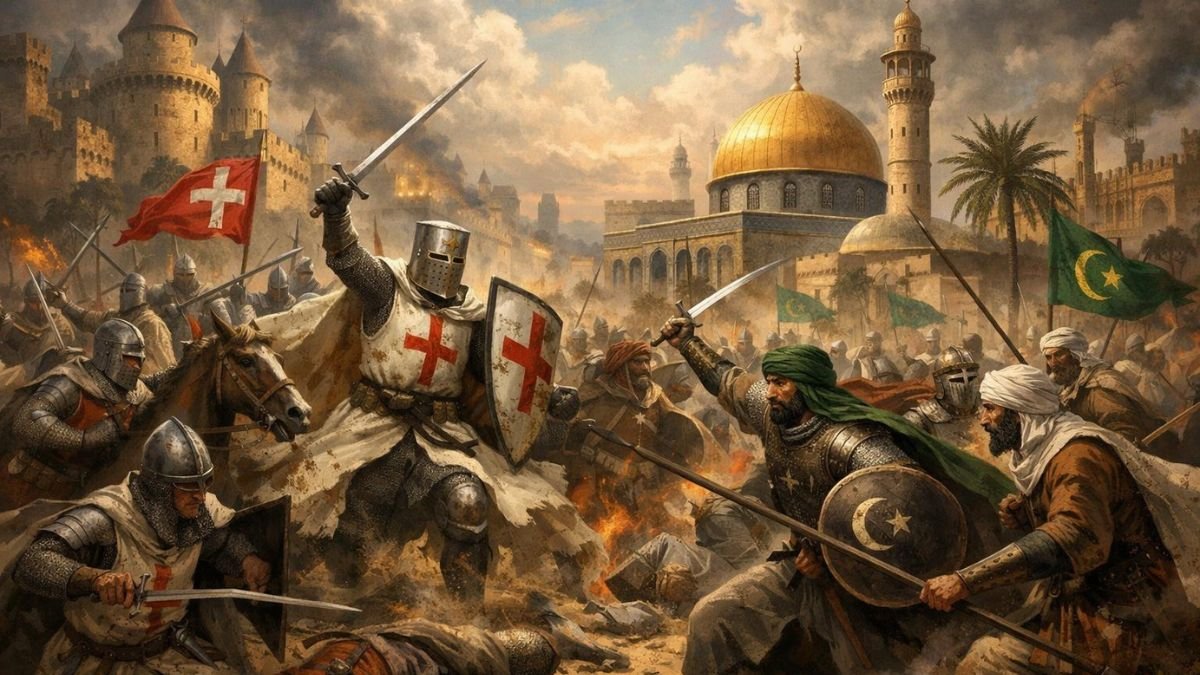
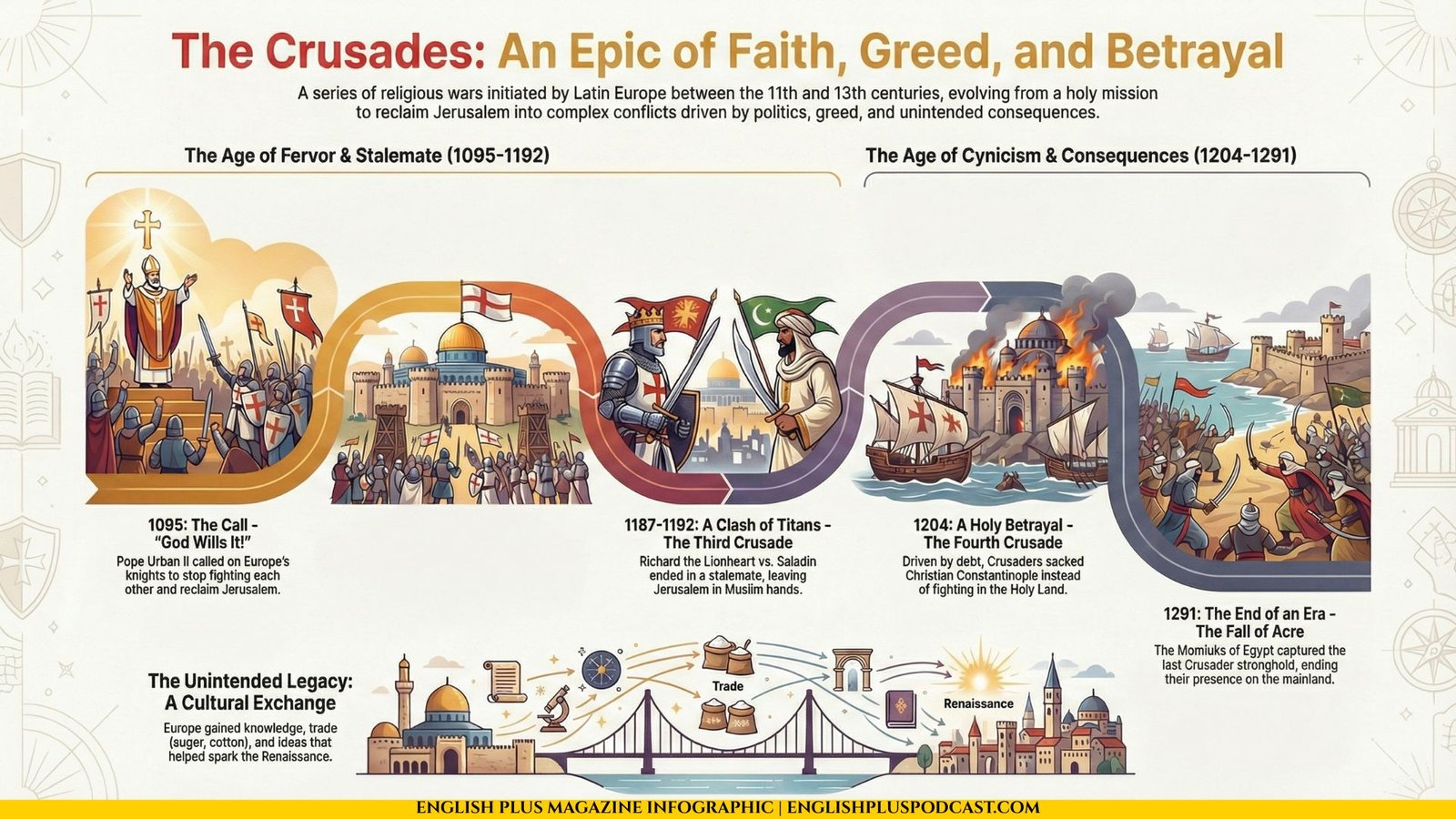
It starts not with a clash of swords, but with a speech. Picture the year 1095. Europe is a muddy, violent, fragmented collection of fiefdoms where the primary pastime of the nobility seems to be raiding their neighbors’ cattle and burning down peasants’ huts. Enter Pope Urban II at the Council of Clermont. He looks out at a crowd of French nobility—men who are bored, violent, and worried about their immortal souls—and he offers them a solution that solves all his problems and theirs in one fell swoop. He tells them to stop killing each other and go kill the “infidels” in the East. He promises them absolution for their sins and hints at the riches that flow like milk and honey in the Holy Land.
It was a masterclass in political spin. In one moment, Urban II invented the concept of armed pilgrimage. The crowd erupted with cries of “Deus Vult”—God wills it. And just like that, the medieval world was set on a collision course that would last for centuries. But let’s not be naive and think this was purely about piety. Sure, there were true believers who walked barefoot across continents, fueled only by the fire of their faith. But there were also younger sons of lords who had no inheritance, looking for land. There were merchants from Venice and Genoa eyeing the trade routes of the Mediterranean. It was a cocktail of genuine religious zeal, cold political calculation, and naked greed.
The First Crusade: Against All Odds
The First Crusade is one of those historical anomalies that simply shouldn’t have worked. You had a disjointed army led by squabbling princes, marching thousands of miles through hostile territory, with no supply lines and no clear chain of command. They arrived in the Levant starving and decimated by disease. By all logic, they should have been wiped out by the local Seljuk forces.
But the Islamic world was arguably even more divided than the Christians were. The Sunni and Shia split, combined with petty rivalries between city-state emirs, meant that the Crusaders were fighting a series of isolated enemies rather than a unified front. Through a mix of sheer desperation, fanaticism, and luck, the Crusaders managed to capture Antioch and then, in 1099, Jerusalem itself.
The Bloodbath in the Holy City
We need to address the elephant in the room regarding the capture of Jerusalem. When the Crusaders breached the walls, they didn’t just occupy the city; they butchered its inhabitants. Historical chronicles describe horses wading in blood up to their knees. It was a massacre that shocked even the violent standards of the 11th century. This wasn’t just warfare; it was an atrocity that left a psychic scar on the region, one that would serve as a rallying cry for Muslim unification later on. They established the Crusader States—Outremer—transplanting European feudalism into the Middle East. For a brief window, it looked like they were there to stay.
The Empire Strikes Back: Zengi, Nur ad-Din, and Saladin
Success breeds complacency. The Latin Kingdom of Jerusalem spent the next few decades embroiled in its own internal politics, often forgetting they were a tiny island in a very large sea. The Islamic counter-crusade didn’t happen overnight. It started with Zengi, who took back Edessa in 1144, sparking the Second Crusade.
Now, if the First Crusade was a miraculous success, the Second Crusade was a tragic comedy. Led by the heavy hitters of Europe, Louis VII of France and Conrad III of Germany, it was a disaster of mismanagement. They managed to accomplish nothing other than alienating their allies and failing to take Damascus. This failure shattered the myth of Crusader invincibility.
The Rise of Saladin
Then came Salah ad-Din Yusuf ibn Ayyub, known to the West as Saladin. He is perhaps the most fascinating figure in this entire drama. He wasn’t just a warlord; he was a statesman who understood that you can’t defeat the invaders until you unify the home team. He united Egypt and Syria, effectively surrounding the Crusader states. At the Battle of Hattin in 1187, he didn’t just defeat the Crusader army; he obliterated it by cutting off their water supply and letting the desert heat do the work. When he retook Jerusalem, unlike the Crusaders a century earlier, he largely spared the population. That act of chivalry cemented his legend in both East and West.
The Third Crusade: A Clash of Titans
The fall of Jerusalem panic-induced the Third Crusade. This is the one Hollywood loves, featuring Richard the Lionheart and Philip II of France. It’s often framed as a duel between Richard and Saladin. And in many ways, it was. Richard was a military genius, a man who lived for war. He captured Acre and defeated Saladin at Arsuf, proving that the Crusaders could still bite.
However, the Third Crusade ended in a stalemate. Richard realized he could take Jerusalem, but he couldn’t hold it. He eventually signed a treaty with Saladin that allowed unarmed Christian pilgrims access to the city, but left it in Muslim hands. It was a pragmatic end to a conflict fueled by idealism. Richard went home, got kidnapped for ransom—because medieval politics never sleep—and died from a stray arrow shortly after. Saladin died soon after the treaty, penniless because he had given away his personal wealth to his subjects.
The Fourth Crusade: A Venetian Betrayal
If you want to understand how cynical these wars eventually became, look no further than the Fourth Crusade. The goal was, once again, Jerusalem. The plan was to sail to Egypt and strike at the heart of Ayyubid power. But the Crusaders couldn’t pay the Venetians for the fleet they had commissioned. The Doge of Venice, Enrico Dandolo—a blind man in his nineties and sharp as a tack—made them an offer: help us sack the Christian city of Zara to pay off your debt, and then we’ll see.
Things spiraled from there. Through a series of political manipulations and promises of money from an exiled Byzantine prince, the Crusaders ended up not in Jerusalem, but in Constantinople. In 1204, the Crusaders sacked the greatest Christian city in the world. They looted, burned, and desecrated Hagia Sophia. It was the final nail in the coffin for relations between the Catholic West and the Orthodox East. They never made it to the Holy Land. They destroyed the very shield that protected Europe from the East, weakening Byzantium so much that it would eventually fall to the Ottomans. Talk about shooting yourself in the foot.
The Slow Burn and the End of an Era
There were other Crusades—the Fifth, the Sixth (where Frederick II actually regained Jerusalem through diplomacy, much to the Pope’s annoyance), the Seventh, and the Eighth led by Saint Louis, who died of dysentery in Tunis. But the fire was dying out. The fervor of 1095 was replaced by cynicism and exhaustion. The Mamluks of Egypt eventually rose up, a warrior caste that didn’t mess around with treaties. By 1291, with the fall of Acre, the Crusader presence on the mainland was extinguished.
The Cultural Exchange: More Than Just War
Here is where we find the irony of history. While the wars were brutal, the periods of peace were porous. The Crusaders who lived in the East for generations, the Poulains, adopted local dress, ate local food, and learned the languages. They realized that soap, spices, and bathing were actually quite nice ideas.
Europe gained immensely from this contact. They brought back sugar, lemons, cotton, and muslin. They brought back knowledge—advancements in medicine, optics, and castle fortifications. The concentric castles of Wales built by Edward I? Direct copies of Byzantine and Arab fortifications. The intellectual darkness of Europe was pierced by light filtering in from the Islamic Golden Age. We recovered lost Greek texts that had been translated into Arabic. In a way, the Renaissance has its roots in the muddy, bloody soil of the Crusades.
The Shadow of the Cross
So, what are we left with? The Crusades were a watershed moment. They defined the identity of Europe and defined the relationship between the Western and Islamic worlds in ways we are still untangling today. They were a testament to the power of belief to mobilize nations, and a testament to the power of greed to corrupt that belief. They remind us that history is rarely a straight line of progress; it is a messy, circular, and often contradictory struggle for meaning, power, and survival.
Reading Comprehension Quiz
Focus on Language
Vocabulary and Speaking
Let’s dive right into the language we used to construct this narrative, because history isn’t just about dates; it’s about the words we use to frame those dates. We used some heavy hitters in the text, and I want to unpack them so you can slip them into your daily conversations or your next presentation to sound just a little more sophisticated.
We started by talking about zeal. You saw this when we described the “genuine religious zeal” of the early Crusaders. Zeal is more than just enthusiasm; it is a fervent, tireless devotion to a cause. It borders on obsession. In your own life, you might not have religious zeal, but you might attack a new fitness regime with zeal, or perhaps you have a colleague who approaches filing tax reports with a disturbing amount of zeal. It implies an energy that burns hot. If you say someone is “zealous,” you are suggesting they are pushing hard, perhaps too hard.
Then we looked at the word foment. We didn’t use it explicitly in the text, but the context of Pope Urban II was all about fomenting action. To foment is to instigate or stir up, usually something undesirable like trouble or rebellion. Urban fomented a holy war. In a modern context, you might see a manager who foments discord among their team to keep everyone off balance, or a politician fomenting unrest. It’s a word that carries the weight of starting a fire that might get out of control.
We described the First Crusade as a watershed moment. This is a beautiful geographic metaphor that has bled into general usage. Literally, a watershed is an area of land that separates waters flowing to different rivers. Figuratively, it is a turning point, a moment after which nothing is the same. The invention of the internet was a watershed moment for communication. Meeting your partner might be a watershed moment in your personal life. It implies a “before” and an “after” that are distinctly different.
We also talked about the cosmopolitan nature of the exchange. When the Crusaders settled, they became more cosmopolitan. This word comes from “cosmos” (world) and “polites” (citizen). A cosmopolitan person or city is comfortable with many different countries and cultures. New York is cosmopolitan. A person who has traveled, eaten weird food, and knows how to say “cheers” in five languages has a cosmopolitan outlook. It is the opposite of being provincial or narrow-minded.
Let’s look at attrition. We mentioned the Crusaders were decimated by disease and the journey; this is a war of attrition. Attrition is the process of reducing something’s strength or effectiveness through sustained attack or pressure. It’s wearing someone down. If you are in a negotiation that has been going on for ten hours, you are winning by attrition. You aren’t knocking them out; you are just waiting for them to get too tired to say no.
We used the word pretext. The Fourth Crusade used the debt to Venice as a pretext to attack Christian cities. A pretext is a false reason given to justify a course of action that is not the real reason. It’s an excuse. You might use a headache as a pretext to leave a boring party early. Governments often use border disputes as a pretext for invasion. It’s a handy word when you want to call out someone’s insincerity without calling them a liar directly.
We touched upon galvanize. Pope Urban II galvanized the nobility. To galvanize is to shock or excite someone into taking action. It comes from Luigi Galvani, who made frog legs twitch with electricity. When you galvanize a team, you are jolting them awake. A crisis often galvanizes a community to help one another. It implies a sudden unification of purpose through shock or inspiration.
We discussed clout. Saladin had immense political clout. Clout is influence or power, especially in politics or business. It’s the weight you throw around. If you know the CEO personally, you have clout in the company. In the Crusades, the Pope had spiritual clout that translated into military power. It’s a punchy, heavy word.
We saw the word decimated. Historically, this meant killing one in every ten mutinous soldiers (from the Latin decem). In modern usage, and how we used it, it means to kill, destroy, or remove a large percentage or part of. The Crusader armies were decimated by the march. You can use this when a project fails spectacularly, or a sports team loses badly. “Our sales were decimated by the economic downturn.”
Finally, let’s look at inadvertently. The Crusaders inadvertently paved the way for the Renaissance. Inadvertently means without intention; accidentally. You might inadvertently insult someone by forgetting their name. It’s a softer way of saying “I messed up” or “it happened by accident.” It removes the malice from the action but acknowledges the result.
Now, let’s move into the speaking aspect. Knowing these words is one thing, but the real magic happens when you can weave them into a narrative. The Crusades article was essentially a story—a complex, multi-generational story. To speak effectively about history or any complex topic, you need to master the art of the Thematic Bridge.
Notice how we didn’t just list dates? We moved from the theme of faith to the theme of betrayal. When you are speaking, avoid the trap of “and then this happened, and then this happened.” Instead, use your vocabulary to bridge ideas. Don’t say “They fought a long time.” Say, “It became a war of attrition.” Don’t say “It changed everything.” Say, “It was a watershed moment.”
Here is your speaking challenge. I want you to take a personal event from your past—a job change, a move to a new city, or a difficult project. I want you to record yourself telling that story in under two minutes. But here is the catch: you must frame it as a historical narrative using at least three of the words we discussed. Was the project a war of attrition? Was the decision to move a watershed moment? Did you use a pretext to quit your job? By elevating the language, you elevate the perceived importance of the story. You turn an anecdote into an epic. Try it. Listen to the recording. Do you sound like a casual observer, or do you sound like a historian of your own life?
Vocabulary and Speaking Quiz
Grammar and Writing
For this section, we are going to pivot to the written word. We’ve consumed a lot of history, but now I want you to produce some. The challenge with writing about grand historical events is that we often get stuck in the “bird’s-eye view.” We see the maps, the arrows moving, and the kings signing treaties. But good writing—writing that resonates—happens in the mud. It happens at the human level.
The Writing Challenge
I want you to write a diary entry or a letter. It should be roughly 300 to 400 words. I want you to adopt the persona of a minor, insignificant character during the Siege of Jerusalem (either the First Crusade in 1099 or Saladin’s reconquest in 1187). You could be a squire who is terrified of the noise, a merchant watching his stock run out, or a water carrier.
The goal isn’t to describe the political situation. I don’t want to hear about what the King thinks. I want to hear about the hunger, the heat, the fear, and the specific, sensory details of your immediate surroundings.
Grammar Focus: The Past Perfect vs. The Past Simple
To pull this off effectively, you are going to need to master the timeline, and that brings us to the battle between the Past Simple and the Past Perfect. This is often where non-native (and many native) writers get messy.
The Past Simple is for the main events of your story that are happening right now in the timeline of the diary.
- “I looked over the wall.”
- “The captain shouted orders.”
The Past Perfect (had + past participle) is for things that happened before the timeline of your diary entry. This is crucial for backstory and context.
- “I looked over the wall where the stones had fallen yesterday.”
- “I was hungry because the rats had eaten our last sack of grain.”
If you mix these up, the reader gets lost in time. If you write, “I was hungry because the rats ate the grain,” it implies the rats ate the grain at the exact moment you were hungry. The Past Perfect (had eaten) pushes that action back, creating depth in your timeline. In your diary entry, use the Past Perfect to reference the life you left behind. “I remembered the fields I had plowed back in France.” This contrast creates a poignant sense of loss.
Writing Technique: Sensory Filtering
In the article, we described “horses wading in blood.” That is a visual and tactile image. For your challenge, I want you to use Sensory Filtering. This means describing the world strictly through the senses of your character.
Don’t say: “The siege was loud and scary.” That is abstract.
Say: “The constant thud of the battering ram rattled the teeth in my skull. The air tasted of copper and old smoke.”
Notice the difference? The second example filters the experience through the body. When you write your entry, force yourself to include at least one detail for sound, smell, and touch. The Crusades were a very smelly, loud, and tactile experience. If your writing is sterile, it fails.
Grammar Focus: The Subjunctive of Regret
Since this is a diary from a person in a desperate situation, you will likely need the structure of regret or hypothetical wishes.
- “I wish I were back home.” (Note: ‘Were’ not ‘was’—this is the subjunctive mood for contrary-to-fact statements).
- “If only I had listened to my father.” (This is the Third Conditional—imagining a different past).
Using these structures adds emotional weight. A soldier doesn’t just say, “I made a mistake coming here.” He says, “If I had known the heat would be like this, I never would have taken the cross.” It implies a heaviness and a longing that simple sentences can’t convey.
Tips for Success
- Avoid Anachronisms: Don’t have your character checking their watch or talking about “kilometers.” Keep the language grounded in their reality. They measure time by the sun or church bells. They measure distance in leagues or days’ marches.
- Limit the Scope: Don’t try to explain the whole war. Your character doesn’t know the whole war. They only know that their boots have holes in them and they are thirsty. The smaller the focus, the more realistic it feels.
- The “Show, Don’t Tell” Rule: I know, you hear this all the time, but it’s vital here. Don’t tell me the character is religious. Show him clutching a wooden cross until his knuckles turn white. Don’t tell me he is tired. Show him sleeping through the alarm bell.
This writing challenge is an exercise in empathy. You are using grammar (Past Perfect, Subjunctive) and vocabulary to inhabit the skin of someone dead for 900 years. If you can make a reader feel the heat of the Jerusalem sun in 400 words, you have mastered the art of creative non-fiction. Give it a shot.
Grammar and Writing Quiz
Critical Analysis
Now, I’m going to put on my expert hat—perhaps a slightly cynical, tweed-jacket-wearing historian hat—and look at what we just went through. We painted a broad, sweeping picture of the Crusades, but history is rarely that clean, and there are massive chunks of context that usually get glossed over in Western narratives, including ours.
First, we need to challenge the very idea of the “Islamic World” vs. the “Christian World.” The article mentions the Sunni-Shia split, but it really underplays just how much the Muslims of the region disliked each other. At times, Syrian emirs were actually happy the Crusaders arrived because it gave them a buffer against their rivals in Egypt or Baghdad. There were alliances between Crusader lords and Muslim emirs against other Crusader lords and Muslim emirs. It wasn’t a solid block of Green vs. Red. It was a kaleidoscope of local warlords using religion as a flag of convenience.
Secondly, we need to talk about the Byzantine Empire. We mentioned the Fourth Crusade sacked Constantinople, but we didn’t emphasize enough that the Crusades were, from the very beginning, a massive headache for the Byzantines. Emperor Alexios I Komnenos asked the Pope for a few mercenaries to help get back some territory. Instead, he got a massive, uncontrollable mob of religious fanatics showing up on his doorstep. From the Byzantine perspective, the Crusaders were just as much “barbarians” as anyone else. The friction between the Orthodox East and Catholic West is the real tragic undercurrent here, arguably more so than the Christian-Muslim conflict.
Also, let’s critique the economic driver. We touched on Venice, but the economic explosion the Crusades caused is often treated as a side effect. Some historians argue it was the primary driver. The Italian maritime republics (Venice, Genoa, Pisa) essentially used the Crusades to destroy the Byzantine trade monopoly and establish the first European colonial trade networks. Was it a Holy War, or was it the violent opening of new markets? If you follow the money, the cross looks a lot like a dollar sign (or a ducat sign).
Finally, we have to look at the terminology. The word “Crusade” wasn’t even used by the people at the time. They called themselves “pilgrims” or “cross-bearers.” The term “Crusade” is a later invention. By labeling it “The Crusades,” we retroactively group distinct, separate conflicts into one ideological bucket, which simplifies the messy reality of what actually happened. We must be careful not to view 11th-century actions through 21st-century ideological lenses.
Let’s Discuss
Here are some questions to get the gears turning. These aren’t simple yes/no questions; they are designed to make you question the narrative.
Was the First Crusade an act of defense or aggression?
Consider the Islamic expansion prior to 1095 that took territory from Byzantium. Was Urban II reacting to a threat, or using a distant threat to grab power in Europe? Where do you draw the line between a preemptive strike and an unprovoked invasion?
Does the “End Justify the Means” in the context of the Fourth Crusade?
The Venetians destroyed a Christian city to ensure their own economic survival and dominance. Can a state be “moral,” or is survival the only metric that matters in geopolitics? How does this compare to modern proxy wars?
How would history be different if Richard the Lionheart had recaptured Jerusalem?
Think critically. Would the Crusaders have been able to hold it? Or would it have led to an even more massive unification of the Islamic world and a bloodier reprisal? Sometimes, does “winning” a battle lead to losing the war?
Is “Religious Zeal” actually just “Political Tribalism” in disguise?
The article mentions the mix of piety and greed. Is it possible for a mass movement to be purely idealistic, or is there always a political manipulator pulling the strings? Can you think of modern movements that mirror this dynamic?
Why do we romanticize Saladin and Richard more than the peace-makers?
Emperor Frederick II regained Jerusalem through diplomacy and speaking Arabic, yet he is often forgotten or vilified. Richard killed thousands and is a hero. What does this say about human nature and the stories we prefer? Do we prefer glorious violence over boring peace?
Did the Crusades ultimately benefit Europe more than the Middle East?
Europe got science, spices, and the Renaissance. The Middle East got invasion and political fragmentation. Discuss the concept of “Cultural Exchange” happening at the point of a sword. Is progress worth the human cost?






0 Comments