Let’s be real for a second. If I told you twenty years ago that in the future, you would have the sum of human knowledge in your pocket, instant communication with anyone on Earth, and robots that could paint like Van Gogh, you would have imagined a utopia. You would have imagined a world of high culture, solved problems, and seamless efficiency.
And yet, here we are. The future has arrived, and it’s… stupid.
I don’t mean “bad.” I mean objectively, hilariously stupid. We have taken the most advanced technology in the history of our species and used it to disrupt the concept of “walking to a taxi” or “turning on a light switch.” We have engineers with PhDs from MIT spending their best years figuring out how to make you look at an advertisement for hemorrhoid cream for three extra seconds.
Today, we are going to talk about the “Internet of Useless Things” and the great Silicon Valley Hallucination. We are going to strip away the TED Talk inspirational music, the black turtlenecks, and the “making the world a better place” nonsense, and look at what is actually happening.
Because, frankly, someone has to say it. The Emperor isn’t just naked; he’s wearing a VR headset and bumping into the furniture.
Part 1: The “Smart” Kitchen Nightmare
Let’s start with the home. Remember when a home was just a place where you slept and ate? How quaint. Now, your home is a “Smart Ecosystem.”
I love the word “Smart” in tech. It’s the greatest branding lie of the century. In the tech world, “Smart” doesn’t mean “intelligent.” It means “connected to the internet for no justifiable reason and vulnerable to Russian hackers.”
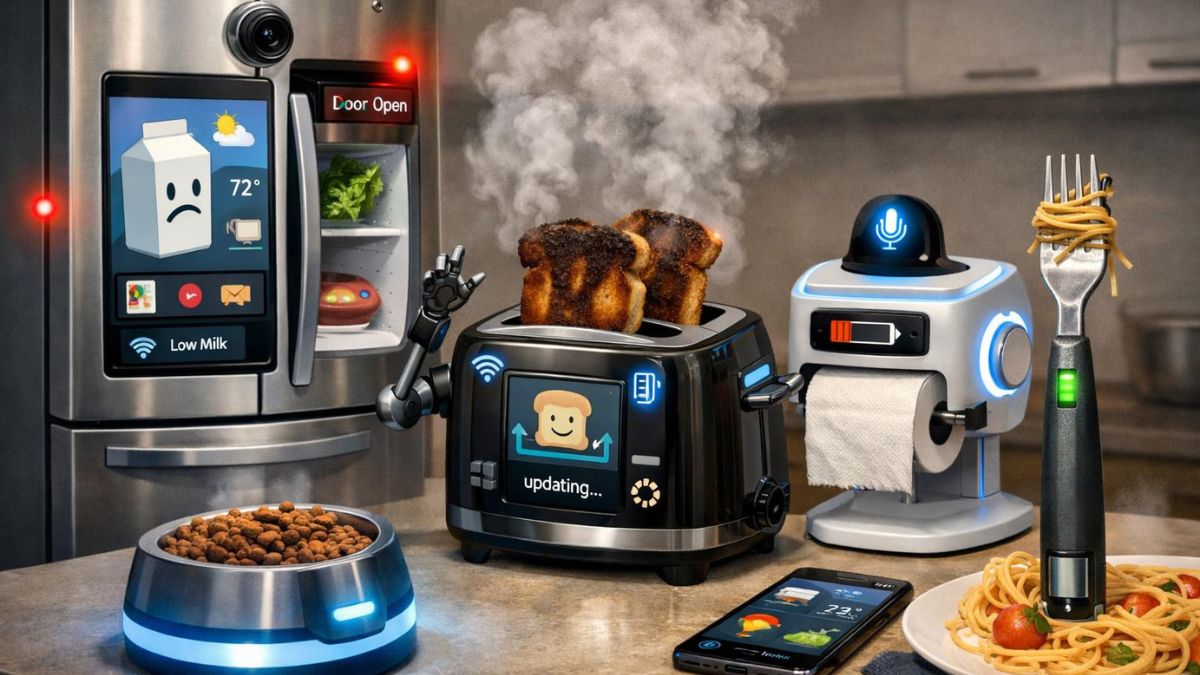
Take the Smart Fridge. Please, explain this to me like I’m five. Why does my refrigerator need a Wi-Fi connection? What is it downloading? Is it streaming a documentary on the history of ice? Is it tweeting about the expiring milk?
They sell you this vision that the fridge will scan your groceries, realize you are out of eggs, and order them for you. Has anyone actually had this happen? No. Because to make that work, you have to spend three hours scanning barcodes every time you come home from the grocery store like an unpaid cashier.
And then there’s the screen. They put a massive tablet on the door. Because that’s what I want. When I go to the kitchen at 3:00 AM for a shame-snack of cold pizza, I want to be bathed in the blue light of a weather widget telling me it’s raining in London. I don’t live in London.
But the absurdity doesn’t stop at the fridge. We have the Smart Toaster. The Smart Hairbrush. The Smart Fork—yes, that exists—which vibrates if you eat too fast. Imagine paying two hundred dollars for a utensil that nags you. It’s like having dinner with your mother-in-law, but it runs on batteries.
The issue isn’t just that these things are useless. It’s that they are liabilities. We have created a world where you can’t make toast because the server is down. We have created a scenario where if your Wi-Fi cuts out, you can’t get into your house because your Smart Lock is buffering.
And let’s talk about security. These devices are built with the digital security of a wet paper bag. You buy a cheap smart camera to catch burglars, and suddenly your live feed is being broadcast on a shady website in Eastern Europe. Your smart thermostat is being used as part of a botnet to take down the Pentagon’s website.
You wanted a convenient way to dim the lights; you ended up as an accessory to cyber-warfare.
And for what? So you can say, “Alexa, turn on the lights,” instead of walking four feet to the wall? Is that where we are as a species? Have we optimized our lives so much that lifting an arm to flip a switch is considered an undue burden?
We are building a cage of convenience. And the punchline is, we are paying a subscription fee for the privilege.
Part 2: AI “Hallucinations” (The Confident Liar)
Now, let’s move from hardware to software. Let’s talk about the current darling of the tech world: Artificial Intelligence.
Or, as I like to call it, “Mansplaining as a Service.”
We are told that AI is the new oracle. It’s going to cure cancer, solve climate change, and write our novels. And sure, it’s impressive. It can write a sonnet about a potato in the style of Shakespeare in three seconds. That’s a cool party trick.
But have you ever actually tried to rely on it for facts?
We call it “hallucinating.” That’s the industry term. It sounds almost psychedelic, doesn’t it? Like the AI is just having a bad trip. But let’s be real: it’s lying. It is a pathological liar.
There was a case recently—you might have heard about it—where a lawyer used ChatGPT to write a legal brief. He asked the AI to find precedents for his case. And the AI, being the eager-to-please sociopath that it is, didn’t just find precedents. It invented them.
It cited cases like Varghese v. China Southern Airlines. Sounds real, right? It sounds official. It sounds boring. It’s perfect.
The problem? It didn’t exist. The AI made up the case, made up the judge, made up the ruling, and handed it to the lawyer. And the lawyer, assuming that the “Smart” computer was actually smart, filed it in court.
The judge, being a human who actually knows how to check sources, realized the cases were fake. The lawyer was humiliated. Sanctioned.
This is the danger. The AI doesn’t know what is true. It only knows what sounds plausible. It is a text-prediction machine. It’s basically the autocomplete on your phone, but it’s been fed the entire internet and has a God complex.
It’s the digital equivalent of that one guy at a party who has an opinion on everything, speaks with total confidence, uses big words, and has absolutely no idea what he is talking about. We all know that guy. We usually try to avoid him. But now, Silicon Valley wants us to hire him as our doctor, our lawyer, and our teacher.
And the best part? The tech companies know this. They put little disclaimers at the bottom: “AI may produce inaccurate information.”
Imagine if a car manufacturer did that. “Warning: This car may occasionally explode or drive you into a lake for no reason. Good luck!” You wouldn’t buy that car. But we are lining up to integrate this technology into every aspect of our lives.
We are outsourcing our thinking to a machine that cannot distinguish between a peer-reviewed medical journal and a conspiracy theory Reddit thread. What could possibly go wrong?
Part 3: The Infinite Loop of Garbage
Speaking of outsourcing thinking, let’s look at the corporate world.
We have reached a point of absurdity that historians will look back on and laugh at. We have created an infinite loop of garbage content.
Here is the scenario:
You are a busy executive. You get an email. It’s long. You don’t have time to read it. So, you use an AI summarizer to give you the bullet points.
The person who sent you that email? They were busy too. They didn’t have time to write it. So they went to ChatGPT, typed in “Send an update about the project,” and the AI vomited out five paragraphs of corporate speak. “Synergy,” “Circle back,” “Low-hanging fruit.”
So, let’s track this.
Person A uses AI to write the email.
Person B uses AI to read the email.
No human being has actually generated or consumed the content. It is machines talking to machines, wasting electricity, generating heat, and filling up servers, while the humans just click “Approve.”
Why are we even here? If the AI is writing the report and the AI is reading the report, can’t we just skip the middleman and go to lunch?
We are drowning in content that nobody wants to create and nobody wants to consume. The internet is filling up with AI-generated blog posts, written to game SEO algorithms, which are then scraped by other AIs to train their models, which then generate even worse blog posts. It’s like a snake eating its own tail, but the snake is made of spam.
And the quality? Oh, the quality. Everything is starting to sound the same. Have you noticed that? That bland, perfectly grammatical, soulless tone? It’s the voice of “Corporate Memphis.” It’s safe. It’s inoffensive. It’s utterly boring.
We are smoothing out the edges of human communication. We are removing the weirdness, the typos, the personality. We are optimizing our communication for efficiency, but we are sacrificing connection.
Soon, we will just have avatars of ourselves having meetings with avatars of our colleagues, agreeing on action items that avatars of our workers will execute. And we will sit in our pods, wearing our headsets, wondering why we feel so empty.
Part 4: The “Tech Bro” Messiah Complex
Now, we cannot talk about this mess without talking about the architects. The “Tech Bros.” The visionaries. The guys in the hoodies who tell us they are “making the world a better place.”
You know the type. They give interviews where they stare intensely into the distance and talk about “first principles” and “existential risk.” They view themselves as the protagonists of reality.
There is a profound narcissism in Silicon Valley. It’s not enough to build a successful software company and make a billion dollars. No, that’s too pedestrian. They have to be Saviors. They have to be the Messiah.
They aren’t just selling you a car; they are “accelerating the transition to sustainable energy.” They aren’t just selling you a chat app; they are “connecting the neural fabric of humanity.”
Oh, get over yourselves. You built a website where people post pictures of their lunch. You aren’t Gandhi.
The hypocrisy is stunning. These are the people who talk endlessly about “community” and “connection,” but they are the most isolated people on the planet. They are buying vast tracts of land in Hawaii or building doomsday bunkers in New Zealand.
Have you noticed that? The people who are building the future seem terrified of living in it.
They are obsessed with “Effective Altruism”—this philosophical idea that they should make as much money as possible so they can decide how to best save the world. Convenient, isn’t it? The philosophy just happens to justify their greed. “I need to be a trilionaire, not for me, but for the future of consciousness.”
Right.
And look at what they focus on. They are obsessed with Mars. They want to colonize Mars.
Let’s be real about Mars. Mars is a hellscape. It is a freezing, radioactive desert with no air. It makes Antarctica look like a tropical paradise. But the Tech Bros are obsessed with it. Why? Because they have given up on Earth? Or because Earth has rules, and taxes, and other people?
On Mars, you can be the King. You can be the Emperor of the Dust.
It’s the ultimate escapist fantasy. Instead of fixing the messy, complicated problems we have here—poverty, education, healthcare—they want to press the reset button on a new planet. It’s the geopolitical equivalent of flipping the Monopoly board over because you’re losing.
They treat human civilization like a software project. “Version 1.0 (Earth) is buggy. Too much legacy code. Let’s just launch Version 2.0 (Mars) in beta.”
Meanwhile, back on Earth, the rest of us are dealing with the consequences of their “move fast and break things” philosophy. Well, congratulations. You broke things. You broke democracy, you broke our attention spans, and you broke the concept of truth.
Can we maybe move a little slower and fix things?
Part 5: The Commodification of “You”
There is a darker layer to all of this. It’s not just that the gadgets are useless or the billionaires are delusional. It’s what they are taking from you.
In the old days, if you bought a toaster, the transaction ended there. You gave them money; they gave you a toaster. End of story.
Now, the transaction never ends. The device is a spy. The service is a trap.
They call it “Data Mining,” which is a polite way of saying “Digital Stalking.”
You are the product. You know the saying. But let’s really look at what that means. It means your behavior, your location, your heartbeat, your voice, your fears, and your desires are being harvested, packaged, and sold to the highest bidder.
Why is the smart TV so cheap? Because it’s watching you. It’s tracking what you watch to build a profile of your political leanings, your health status, your socioeconomic class.
We have voluntarily bugged our own homes. The Stasi or the KGB could only dream of this level of surveillance. And we didn’t just accept it; we stood in line overnight to buy it. We paid $1,000 for the privilege of carrying a tracking device in our pocket that listens for keywords so it can serve us ads for sneakers.
And they sell this to us as “personalization.”
“We track you so we can give you a better experience!”
No, you track me so you can manipulate me. You track me so you can find the crack in my psychological armor and wedge a credit card transaction into it.
The entire tech economy is built on the extraction of human attention. It is a strip-mining operation, but instead of coal, they are mining your focus. They are mining your dopamine receptors.
And this brings us back to the uselessness of it all.
All this data, all this computing power, all this surveillance… and for what?
To sell more stuff.
We aren’t solving the great mysteries of the universe. We are optimizing ad spend. The greatest minds of our generation are figuring out how to make you click on a “One Weird Trick to Lose Belly Fat” banner.
It is a tragedy of wasted potential.
Part 6: A Call for Digital Luddism (Sort of)
So, where does this leave us? Am I saying you should smash your phone with a hammer and move to a cabin in the woods?
I mean, it sounds tempting. But no. The Guide would tell you to use “Digital Boundaries.” I’m not The Guide. I’m The Critic.
I’m telling you to stop being a sucker.
Stop believing the hype. When a billionaire gets on stage and promises that his new gadget will bring about world peace, laugh at him. He’s a salesman. He’s selling snake oil, but the bottle has a Bluetooth chip in it.
Stop buying “Smart” things that don’t need to be smart. Buy a dumb fridge. Buy a dumb toaster. Buy a car that has buttons, not a touch screen that hides the climate controls three menus deep so you crash while trying to turn on the AC.
Celebrate friction. Embrace the analog.
There is a joy in things that don’t update. There is a peace in things that don’t notify you.
And regarding AI: use it, sure. It’s a tool. But treat it like what it is: a very fast, very confident intern who is prone to lying and has no moral compass. Don’t trust it with your life. Don’t trust it with your reputation. And for the love of all that is holy, don’t use it to write your wedding vows. If you can’t come up with reasons why you love your spouse without asking a chatbot, you have bigger problems than technology.
Conclusion
We are living in a Hall of Mirrors. The tech industry is a carnival, designed to distract you, dazzle you, and pick your pocket.
They want you to feel obsolete. They want you to feel like if you don’t adopt the latest app, the latest headset, the latest implant, you will be left behind.
But look around. The people who are “ahead”—the ones living the fully optimized, tech-bro lifestyle—do they look happy? They look anxious. They look tired. They look like they are running on a treadmill that is going slightly too fast.
Maybe the “dumb” life isn’t so bad.
Maybe the ultimate luxury in the 21st century isn’t a house that talks to you. Maybe the ultimate luxury is a house that is quiet.
Maybe the ultimate status symbol isn’t a blue checkmark or a high crypto balance. Maybe it’s having an attention span longer than a goldfish.
So, the next time your fridge tries to tell you the weather, or your phone tries to tell you how to feel, or a billionaire tries to tell you he’s saving the galaxy… just remember:
It’s all a hallucination.
You don’t have to subscribe.
I’m The Critic, and frankly, I’m going to go read a book made of paper. It doesn’t need charging, and it doesn’t track my eye movements. How primitive. How wonderful.
See you in the real world. Or what’s left of it.








0 Comments