We have all been there. It is 3:00 PM on a Thursday. You have been staring at a spreadsheet for six hours, your lower back feels like it is being compressed by a hydraulic press, and your inbox has that terrifying little number next to it that keeps climbing like a high-altitude mountaineer who doesn’t know when to quit. You are tired. Not the “I need a nap” kind of tired, but the “I need to dissolve into the ether and become a cloud” kind of tired.
And then, ping. An email from HR lands in your inbox. The subject line is something cheerful, maybe accompanied by an exclamation point that feels aggressive in the current climate. “Wellness Wednesday!” it chirps. “Join us for a 15-minute guided meditation on Zoom! And don’t forget, we have a subscription to the Calm app available for all employees!”
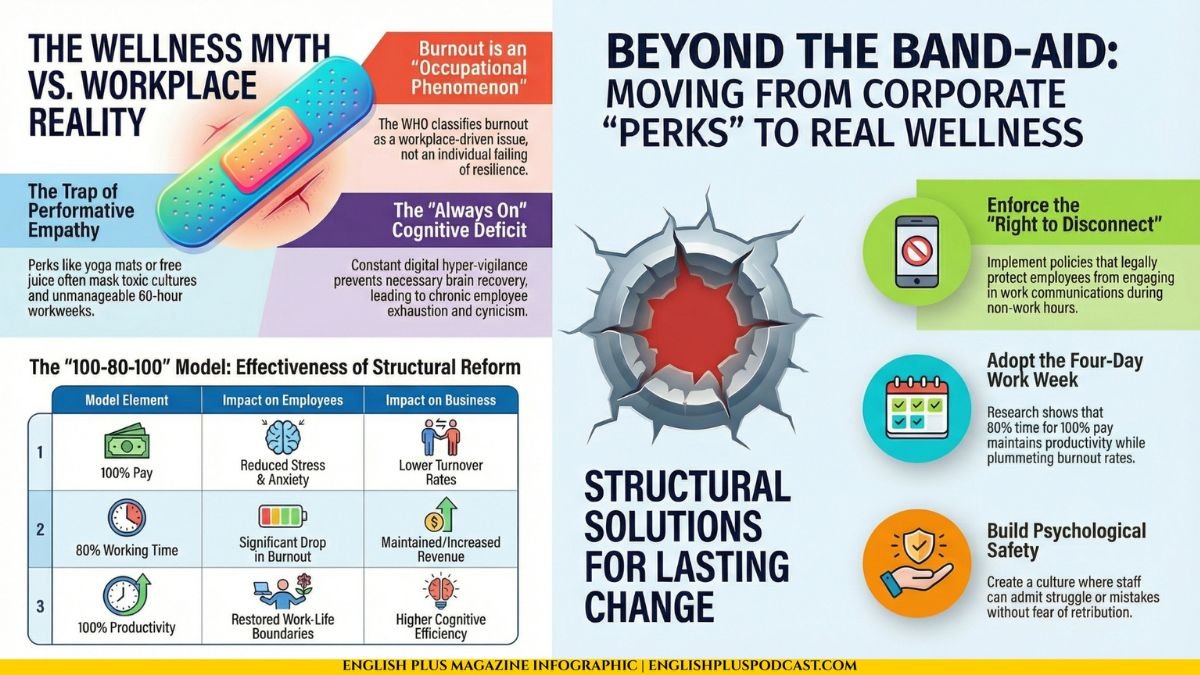
You look at the email. You look at your workload, which requires roughly 12 hours of labor to complete in the next four. You look back at the email. And you feel a very specific emotion. It is a mix of rage, exhaustion, and the dark absurdity of modern life. It is the feeling of being handed a Band-Aid for a bullet wound.
This is the current state of corporate mental health. We are living in the golden age of “Wellness.” Companies are tripping over themselves to offer perks: nap pods, yoga classes, mindfulness seminars, and the coveted “Mental Health Day.” On the surface, it looks like progress. Finally, the corporate machine is acknowledging that we are human beings with nervous systems, not just productivity units with pulse rates. But if we scratch the surface of this shiny new empathy, we often find a rotting infrastructure underneath. We have to ask the uncomfortable question: Is this actually progress, or is it just excellent Public Relations?
The Great Disconnect: Mindfulness vs. The Grind
The Band-Aid on the Bullet Wound
There is a term in psychology called “cognitive dissonance.” It is the mental discomfort experienced by a person who holds two or more contradictory beliefs, ideas, or values. The modern workplace is a factory for cognitive dissonance.
On one hand, the company values list “Work-Life Balance” and “Employee Well-being” in bold, sans-serif font on the website. On the other hand, the unwritten rules of the culture demand that you answer emails at 9:00 PM, work through lunch, and view taking a vacation as a sign of weak commitment. This creates a psychological fracture.
When a company offers a “mindfulness app” subscription to an employee who is working 80 hours a week, they aren’t solving the problem; they are gaslighting the employee. They are essentially saying, “The problem isn’t that we are working you to the bone; the problem is that you aren’t breathing correctly while we do it.” It shifts the responsibility for well-being from the institution to the individual. If you burn out, it’s not because the workload was unmanageable; it’s because you didn’t meditate enough. You failed at self-care.
This is the corporate equivalent of telling someone whose house is on fire to just “center themselves.” The intention might be benign, but the impact is insulting. A yoga mat in the breakroom does not compensate for a toxic manager. A webinar on “resilience” does not make up for stagnant wages and job insecurity. We are treating the symptoms with lavender-scented distractions while ignoring the disease, which is the structural design of modern work itself.
Performative Empathy
We have entered the era of “Performative Empathy.” This is when an organization creates the appearance of caring without doing the structural work of actually caring. It’s cheap, it’s visible, and it looks great on a LinkedIn post.
Allocating a “Mental Health Day” once a year is the definition of performative empathy. It acknowledges the issue for exactly 24 hours. But what happens on the day after? You return to the same crushing inbox, the same unreasonable deadlines, and the same anxiety. In fact, you might be even more stressed because now you are a day behind.
True empathy costs money. True empathy looks like hiring enough staff so that one person isn’t doing the jobs of three people. It looks like paying a living wage so employees aren’t stressed about rent. It looks like creating a culture where saying “no” to a project doesn’t put a target on your back. But those things don’t make for cute Instagram graphics. “We hired three new support staff to reduce your workload” isn’t as sexy as “Free Green Juice Friday!” But it is infinitely more effective.
Burnout: The WHO’s New Diagnosis
The Anatomy of Exhaustion
For years, “burnout” was treated as a colloquialism. It was something you said when you were just a bit tired of your job. It was viewed with a mix of pity and suspicion, often interpreted as a lack of resilience or “grit.”
But in 2019, the World Health Organization (WHO) changed the game. They officially classified burnout not as a medical condition, but as an “occupational phenomenon.” This distinction is crucial. It places the cause of burnout squarely in the workplace, not in the worker.
According to the WHO, burnout is characterized by three dimensions: feelings of energy depletion or exhaustion; increased mental distance from one’s job, or feelings of negativism or cynicism related to one’s job; and reduced professional efficacy.
Notice the second one: cynicism. That is the hallmark of the modern worker. We have become cynical because we have realized that the contract is broken. We gave our best years, our energy, and our creativity to organizations that treat us as disposable. Burnout isn’t just about being tired; it’s about being hollowed out. It’s a spiritual erosion. It’s the feeling that your labor has no meaning, or worse, that your labor is actively harming you.
The “Always On” Culture
The primary driver of this burnout is the dissolution of boundaries. Technology promised to liberate us; instead, it tethered us. The smartphone in your pocket is a portal through which your boss can reach you at any moment.
We live in an “Always On” culture. The expectation of immediate response has permeated every industry. If you don’t reply to a Slack message within five minutes, you are seen as “checking out.” This state of hyper-vigilance is biologically unsustainable. Our brains are not designed to be in a state of low-level alert 24/7. We need downtime—true downtime, where the brain is offline—to recover.
But in the modern corporate ethos, downtime is viewed as “wasted time.” We have fetishized “busyness.” We wear our sleep deprivation like a badge of honor. “I’m so busy,” we say, with a mix of complaint and pride. We are competing to see who can care the least about their own biological needs. And the result is a workforce that is chronically inflamed, anxious, and operating at a cognitive deficit.
Structural Solutions vs. Perks
The Right to Disconnect
If yoga mats aren’t the answer, what is? The answer lies in policy, not perks. We need structural guardrails to protect us from the voracious appetite of capitalism.
One of the most promising developments is the “Right to Disconnect.” This legal principle asserts that an employee has the right to not engage in work-related electronic communications during non-work hours. France pioneered this law in 2017 for companies with more than 50 employees. Other countries, including Portugal and parts of Canada, are following suit.
Imagine that. Imagine a law that says your boss literally cannot email you at 8:00 PM, or if they do, you are legally protected from ignoring it until 9:00 AM the next day. It sounds radical, but it shouldn’t be. It is simply a reinstatement of the boundaries that existed naturally before the Blackberry was invented. It forces companies to respect the distinction between “work time” and “life time.”
Critics argue this kills flexibility. “What if I want to work at night so I can pick up my kids in the afternoon?” But the Right to Disconnect doesn’t ban flexibility; it bans expectation. You can work whenever you want, but you cannot demand that others do the same.
The Four-Day Work Week
Then there is the holy grail of structural reform: The four-day work week.
We are still operating on a schedule designed for factory workers in the 1920s. Henry Ford popularized the five-day, 40-hour week. A century later, despite massive leaps in technology and productivity, we are working more hours, not fewer.
Trials of the four-day work week (100% pay, 80% time, 100% productivity) in the UK, Iceland, and New Zealand have shown stunning results. Employee stress goes down. Burnout plummets. Sick days decrease. And here is the kicker: revenue often goes up.
Why? Because a rested brain is a productive brain. Parkinson’s Law states that “work expands to fill the time available for its completion.” If you give someone five days to write a report, they will take five days. If you give them four, they will cut out the doom-scrolling, the pointless meetings, and the water cooler gossip, and they will get it done. The four-day week respects the worker’s time and forces the company to be efficient. It is the ultimate mental health intervention because it gives people back the one resource they can never replenish: time.
Redefining Professionalism
Psychological Safety
Beyond laws and schedules, we need a cultural shift in how we define “professionalism.” For too long, being professional meant leaving your humanity at the door. It meant being a stoic, emotionless robot who never admitted to struggle.
Google conducted a massive study called “Project Aristotle” to figure out what made their best teams effective. They looked at everything—IQ, personality types, backgrounds. But the number one factor for high-performing teams was “Psychological Safety.”
Psychological safety is the belief that you won’t be punished or humiliated for speaking up with ideas, questions, concerns, or mistakes. It is the ability to say, “I am overwhelmed,” or “I made an error,” without fear of retribution.
A mentally healthy workplace is one where psychological safety is the bedrock. It’s a place where vulnerability isn’t punished. If a manager admits, “I’m having a hard week, so I’m logging off early,” it gives permission for the team to do the same. This dismantles the “Strongman” archetype we discussed in previous articles. It humanizes the hierarchy.
The Call to Action
So, to the CEOs reading this (and I know you’re out there, probably skimming this on your phone while ignoring a family dinner): cancel the subscription to the meditation app. Stop buying the cheap pizza.
If you want to support mental health, look at your payroll. Look at your staffing levels. Look at your email culture. Ask yourself: “Am I designing a job that a human being can actually do?”
And to the employees: Stop accepting the Band-Aid. Stop apologizing for having limits. Your burnout is not a personal failure; it is a structural feature of a broken system. The “Mental Health Day” is a nice gesture, sure. Take it. Sleep in. Watch bad TV. But don’t let them convince you that one day off fixes a year of exploitation. We don’t need a day; we need a paradigm shift. We need work that sustains life, rather than consuming it.
Focus on Language
Let’s dive into the linguistic machinery of this topic because the words we use to describe our work reality are powerful tools. If we can name the beast, we can tame it—or at least complain about it more accurately.
I want to start with the phrase Cognitive Dissonance. I used this early on. It sounds academic, like something you’d hear in a lecture hall with bad lighting, but it is incredibly useful in everyday life. It describes the mental stress of holding two conflicting beliefs. You know that feeling when you love animals but you’re eating a burger? That twinge? That’s cognitive dissonance. In the workplace, it’s believing “I am a valued employee” while seeing “My boss ignores my emails.” You can use this whenever reality clashes with your expectations. “I’m having some serious cognitive dissonance about this eco-friendly company using so much plastic packaging.”
Then we have Performative. This word has exploded in usage recently. It means doing something for show, rather than for the intrinsic value or meaning of the action. It implies a lack of authenticity. We talked about “performative empathy”—HR acting like they care just for the optics. You can use this for anything that feels fake. “His apology felt very performative; he just didn’t want to get cancelled.” It’s a great way to call out hypocrisy without screaming “You liar!”
Let’s look at Ubiquitous. This is a fancy five-dollar word that means “found everywhere.” I didn’t use it explicitly in the text, but the “Always On” culture is ubiquitous. Smartphones are ubiquitous. Anxiety is ubiquitous. It’s a great word to replace “everywhere” when you want to sound sophisticated. “The ubiquitous presence of advertising makes it hard to focus.”
We touched on Paradigm Shift. This was popularized by the philosopher Thomas Kuhn. A paradigm is a model or pattern—a way of looking at the world. A paradigm shift is a fundamental change in the basic concepts and experimental practices of a scientific discipline, but we use it socially to mean a massive change in how we think. Moving from a 5-day week to a 4-day week is a paradigm shift. It’s not just a tweak; it’s a whole new game. Use this when a small change isn’t enough. “We don’t need a new policy; we need a paradigm shift.”
Let’s talk about Commodity. A commodity is a raw material or primary agricultural product that can be bought and sold, like copper or coffee. But in this context, we often talk about time or labor being treated as a commodity. When a company treats you like a commodity, they treat you like a replaceable part. You are just a unit of production. It’s dehumanizing. You can say, “In the dating app world, romance has become a commodity.”
I used the word Gaslighting. This is a heavy one. It comes from a 1938 play called Gas Light. It means manipulating someone into questioning their own sanity. When a company tells you “we support work-life balance” while emailing you at midnight, they are gaslighting you. They are denying your reality. Use this carefully, but use it when someone is trying to overwrite your truth. “Stop gaslighting me; I know I sent that report on time.”
Then there is Presenteeism. This is the opposite of absenteeism. Absenteeism is staying home when you shouldn’t. Presenteeism is showing up when you shouldn’t—when you are sick, burned out, or just zoning out. It’s being physically present but mentally gone. It’s a huge problem in corporate culture. “The culture of presenteeism means everyone sits at their desks until 6 PM just to be seen.”
We discussed Colloquialism. A colloquialism is a word or phrase that is not formal or literary, typically one used in ordinary or familiar conversation. I mentioned that “burnout” used to be a colloquialism before the WHO made it official. “Y’all” is a colloquialism. “Gonna” is a colloquialism. It’s a useful word when discussing language registers.
Let’s look at Systemic. This means relating to a system, especially as opposed to a particular part. We talked about “systemic issues” in the workplace. If one person is burned out, it’s personal. If everyone is burned out, it’s systemic. It means the flaw is in the design of the machine, not the operator. “Racism is a systemic issue, not just a matter of individual prejudice.”
Finally, Autonomy. This is the right or condition of self-government. In the workplace, autonomy is having control over how you do your work. Lack of autonomy is a huge driver of burnout. If you are micromanaged, you have low autonomy. Adults crave autonomy. “I love my new job because I have the autonomy to set my own schedule.”
Now, for the speaking section. I want to challenge you on the concept of “The Humble Brag.” This is related to the “busyness” culture we discussed. A humble brag is when you complain about something that is actually a boast. “I’m so exhausted because I have so many clients wanting to hire me!”
Your assignment: I want you to listen to your colleagues or friends this week. Catch them (or yourself) doing a “Busy Humble Brag.”
“I’m so busy, I haven’t eaten all day.”
“I worked until 2 AM last night, I’m a zombie.”
When you hear it, I want you to mentally reframe it using the vocabulary we learned. Is that Presenteeism? Is it Performative? And then, try to express your own workload without bragging. Instead of “I’m swamped,” try “My workload is currently exceeding my capacity, so I need to prioritize.” It sounds professional, it sets a boundary, and it isn’t a humble brag. Record yourself saying three different versions of “I have too much work” that sound authoritative, not exhausted.
Critical Analysis
We have spent a lot of time bashing the corporate “Mental Health Day” and calling it a PR stunt. And frankly, it is fun to do that. It feels righteous. But let’s put on our devil’s advocate hat for a moment. Is it possible we are being too cynical?
First, let’s consider the argument: “Don’t let the perfect be the enemy of the good.”
Is a mental health day a structural fix? No. But is it nothing? Also no. For a single parent, or someone on the verge of a breakdown, one day off paid by the company is a tangible benefit. By dismissing it as “performative,” do we risk discouraging companies from doing anything at all? If we scream that “Yoga isn’t enough!” companies might just say, “Fine, no yoga then.” And then we have no structural change and no yoga. Maybe we should view these perks not as the solution, but as the entry point—a trojan horse that brings the conversation of mental health into the boardroom.
Secondly, we need to talk about The Economic Reality of Small Business.
It is easy to demand a four-day work week from Google or Microsoft. They have billions in cash reserves. But what about the small bakery? The startup? The family-owned mechanic shop? Can they afford to pay 100% salary for 80% time? Structural reforms like the Right to Disconnect or the 4-Day Week might inadvertently crush small businesses that operate on thin margins. If we mandate these changes without government support, we might hand even more market dominance to the corporate giants who can afford to be “ethical.” We need to critically analyze who pays for the “wellness revolution.”
Thirdly, let’s look at Individual Responsibility.
We placed the blame squarely on “The System.” But are we, the workers, entirely innocent? We talked about the “addiction to the grind.” To what extent do we perpetuate this culture? We answer emails at night not always because we have to, but because it makes us feel important. It soothes our anxiety. We get a dopamine hit from being “needed.” If the company announced a strict 9-to-5 policy tomorrow, many of us would struggle with the withdrawal. We need to critique our own internal relationship with work, identity, and validation. We are not just victims of the system; we are also enablers of it.
Fourth, there is the danger of “Therapy Speak” in the Office.
As we push for “psychological safety” and “empathy,” are we blurring the lines too much? Your boss is not your therapist. HR is not your counselor. There is a risk that by bringing our entire emotional selves to work, we create a messy, unprofessional environment where trauma-dumping becomes the norm. Do we really want our colleagues to know our deepest struggles? Or is there value in the “professional mask”? The Victorian separation of public and private life had its downsides, but it also offered a layer of protection. We need to be critical of the push to make the workplace a site of emotional processing. Maybe work should just be… work.
Finally, let’s interrogate “Quiet Quitting.”
This term has become a lightning rod. Is it really “quitting”? Or is it just doing the job you were paid for? The term itself is a corporate framing designed to shame people for setting boundaries. A critical analysis would suggest we stop using the term “Quiet Quitting” entirely and start calling it “Acting Your Wage.” The fact that doing the bare minimum of the contract is framed as a rebellion shows just how skewed our baseline has become.
So, while the “Mental Health Day” might be a PR stunt, the alternative—a complete erasure of the boundary between work and life—might be even more dangerous. We need to find the middle ground between “Corporate Robot” and “Oversharing Trauma Victim.”
Let’s Discuss
Here are five questions to get you fighting in the comments section. I want to see nuance. I want to see debate.
1. Is “Quiet Quitting” an act of rebellion or a lack of ambition?
Is it ethical to do the bare minimum if you want a promotion? Does “acting your wage” hurt your team members who have to pick up the slack? Where is the line between setting boundaries and being lazy?
2. Would you take a 20% pay cut for a 4-day work week?
The “ideal” model is 100% pay for 80% time. But let’s be real. If your boss said, “You can have Fridays off forever, but I cut your salary by 20%,” would you take it? What does your answer say about how you value time vs. money?
3. Should your boss care about your feelings?
We talk about empathy, but is it actually your boss’s job to manage your emotional state? Or is their job just to ensure you produce work? Is the demand for “emotional intelligence” at work unfair to managers who aren’t trained psychologists?
4. Is the “Right to Disconnect” actually restrictive?
Some people love working at 10 PM so they can go to the gym at 10 AM. If we ban after-hours emails, do we destroy the flexibility that remote work gave us? How do we protect boundaries without enforcing a rigid 9-to-5 that doesn’t work for parents?
5. Are “perks” (free food, nap pods) actually a trap?
Companies like Google made the office a playground. But was that to be nice, or was it to make sure you never went home? Is a “cool” office just a golden cage? Would you prefer a boring office and more time at home?
Fantastic Guest: An Interview with Henry Ford
Danny: Welcome back to the show. We’ve been talking about the corporate “Mental Health Day,” the burnout epidemic, and the absolute absurdity of the modern workplace. We’ve complained about the 40-hour work week, the grind, and the feeling that we are just cogs in a machine.
So, I decided: if we’re going to talk about being cogs in a machine, let’s talk to the man who built the machine. He is the father of the modern assembly line, the inventor of the Model T, and—surprisingly to some—the man who actually popularized the 5-day, 40-hour work week (down from the 6-day, 60-hour norm of his time). He is a Titan of Industry, a controversial figure, and a man who believed that “History is more or less bunk.” Please welcome the founder of the Ford Motor Company, Henry Ford. Henry, welcome to the future.
Ford: It’s loud. And everyone is looking at small glass squares in their hands. Is that work?
Danny: That’s the iPhone. And yes, unfortunately, that is work. We call it “checking email.”
Ford: It looks like idling. I hate idling. An idling motor is a waste of fuel. An idling man is a waste of life.
Danny: Well, that’s exactly why I brought you here. We are currently in a crisis of “idling” combined with exhaustion. You are famous for revolutionizing the workplace. You introduced the moving assembly line, which turned manufacturing into a miracle of efficiency. But you also turned humans into robots. Do you accept responsibility for the fact that most of us feel like appliances today?
Ford: I accept responsibility for taking the burden off flesh and bone and putting it on steel and motor. Before me, a man broke his back carrying parts. After me, the belt brought the part to him. That is not turning a man into a robot; that is turning a man into a master of the machine. The machine does the heavy lifting. The man provides the intelligence. Or at least, he’s supposed to.
Danny: In theory, yes. But the criticism of your system—Fordism—was always that it was dehumanizing. The repetition. Screw the nut, turn the bolt, repeat 10,000 times a day. Charlie Chaplin made a whole movie about it, Modern Times.
Ford: Chaplin was a comedian. I was an industrialist. He made people laugh; I made people mobile. You tell me which is more important. Before the Model T, the average man lived and died within 20 miles of where he was born. I gave him the world. If the cost of that freedom was that a few men had to tighten a bolt 10,000 times a day for high wages, it was a fair trade.
Danny: Let’s talk about those wages and hours. In 1914, you shocked the world. You doubled the daily wage to $5 a day and you reduced the work day from 9 hours to 8. Later, in 1926, you instituted the 5-day work week. Saturday and Sunday off. The Wall Street Journal called you a traitor to your class. They said you were crazy. Why did you do it? Was it out of the kindness of your heart?
Ford: Kindness? No. I am not a philanthropist. I am a businessman. I did it because it was necessary.
First, turnover. Men were quitting faster than I could hire them. The work was hard. It was monotonous. To keep a man at the line, I had to pay him enough that he wouldn’t want to leave.
Second, efficiency. A man who works 10 hours slows down in the last two. He makes mistakes. He hurts himself. A man who works 8 hours works hard for 8 hours. I wanted 8 hours of work, not 10 hours of shuffling.
And third… who do you think buys the cars, Danny?
Danny: The customers?
Ford: The workers! If I pay my men $2 a day, they can’t afford a Ford. They can only afford shoes. If I pay them $5 a day, they can buy the car they are building. You cannot have mass production without mass consumption. I created the middle class not because I loved them, but because I needed someone to sell to.
Danny: That logic—”I need rested, wealthy workers to buy my product”—seems to have completely vanished. Today, companies pay as little as possible and work people as long as possible. We have the “Gig Economy” now. No benefits, no security, just hustle.
Ford: Then your economy will collapse. It is simple mechanics. If you starve the engine, the car stops. If you starve the worker—either of money or of time—consumption stops. If consumption stops, the factories close. Your modern CEOs… they look at the quarterly report, not the ten-year horizon. They are stripping the gears to make the car go faster for one mile, and ignoring that the transmission is melting. It is stupid.
Danny: “Stripping the gears to make the car go faster.” That is the perfect metaphor for Burnout.
Ford: Burnout is a mechanical failure. If a machine overheats, you turn it off. You let it cool down. You oil it. You don’t scream at the machine to “be more mindful.” You don’t give the machine a yoga mat. You fix the operating conditions.
I hear you have these “Wellness” programs now. “Mindfulness.” What is this?
Danny: It’s… well, companies give us apps to help us breathe. They give us seminars on resilience. They tell us to meditate so we can handle the stress of the job.
Ford: This is nonsense. If the job is stressing the man, change the job. Simplify the motion. Raise the conveyor belt so he doesn’t have to stoop. Reduce the hours.
When I saw that men were getting tired lifting the flywheel magneto, I didn’t hire a clown to cheer them up. I redesigned the line so the magneto slid into place.
You are trying to fix the psychology of the worker because you are too lazy to fix the engineering of the work.
Danny: “You are too lazy to fix the engineering of the work.” Henry, that is devastatingly accurate. We treat the worker as the bug, not the system.
Ford: The worker is never the bug. The worker is the power source. If the power source is flickering, check the wiring.
Danny: I want to talk about the “Sociological Department.” This is a part of your history that gets glossed over. You paid the $5 day, but there was a catch. You had a team of inspectors who literally went to workers’ houses. They checked if the house was clean. They checked if they drank alcohol. They checked their marital status. If they failed the inspection, they didn’t get the raise.
That sounds a lot like the modern “Wellness Program” tracking our steps, or insurance companies monitoring our health. It’s intrusive. Why did you feel you had the right to police their private lives?
Ford: Because I was investing in them. If I give a man $5 a day—a fortune at the time—and he spends it on whiskey and gambling, he is not a better worker. He is just a richer drunk. He will come to work hungover. He will wreck my machinery.
I wanted to build a life, not just a bank account. I wanted them to learn American values. Thrift. Hygiene. Sobriety. A clean home produces a clear mind. A clear mind produces a good car.
You call it intrusive. I called it quality control. You inspect the steel to make sure it isn’t brittle. Why not inspect the man to make sure he isn’t broken?
Danny: But Henry, that’s Paternalism. It’s treating the worker like a child. “I’ll give you your allowance if you clean your room.” Modern workers resent that. We want the money, and we want you to stay out of our business.
Ford: And look at you now. You have your “freedom,” and you are burnt out, anxious, and sleep-deprived. Maybe you needed a father figure. Maybe you needed someone to tell you, “Go to bed, stop drinking, clean your house.”
You traded my Sociological Department for your… what is it? Twitter? You let strangers on the internet police your thoughts instead of your employer policing your habits. I’m not sure you traded up.
Danny: Ouch. Okay, point taken. But let’s look at the “Right to Disconnect.” In your day, when the whistle blew, work stopped. You couldn’t take the assembly line home. Today, we carry the assembly line in our pockets. The email. The Slack message. We never stop.
Ford: That is a design flaw.
Danny: A design flaw in the technology?
Ford: A design flaw in the management. A man who works 24 hours is a useless man. He has no perspective. He has no fresh air.
I believed in leisure. “Leisure is the cold storage of labor.” You put the labor on ice so it stays fresh. If you leave the meat out on the counter all night, it rots. Your work is rotting because you never put it in the fridge.
If I were running a company today, I would cut the wire. At 5:00 PM, the server shuts down. No emails. No calls. If you can’t get your work done in 8 hours, you are incompetent, or the system is broken. Either way, working until midnight is not the answer. It is a sign of failure.
Danny: It’s amazing to hear the architect of industrial capitalism say that working late is a sign of failure. We view it as a badge of honor.
Ford: That is because you have confused “busyness” with “business.” They sound the same, but they are opposites. A busy man is swatting flies. A business man is making honey.
I saw men in my shop running around, sweating, shouting. I fired them.
I saw a man sitting calmly, watching the line, tapping a gauge once an hour. I promoted him. He knew how to run the system. The sweaters were just fighting it.
Danny: Let’s talk about the 4-Day Work Week. We discussed it in the article. Studies show it increases productivity. Given that you moved us from 6 days to 5, would you support moving from 5 to 4?
Ford: Only if the productivity matches. It is a math equation.
In 1926, I gave them Saturday off because I realized that with the new machinery, we could produce as much in 5 days as we used to in 6. So, why keep them there? It costs money to light the factory. It costs money to heat it. If the output is the same, shut it down.
If your modern computers make you so fast—if this “AI” I hear about is so smart—then why are you working more? The machine should liberate the man. If the machine is making you work harder, you are using the machine wrong. Or…
Danny: Or?
Ford: Or the machine is using you.
Danny: That’s the fear. The algorithm is the new assembly line, but it moves at the speed of light, and we can’t keep up.
Ford: Then you must govern the speed. I controlled the speed of the belt. If I set it too fast, the men couldn’t keep up, parts dropped, quality suffered. I slowed it down to the optimum pace.
You have set your digital belt to “Infinite.” No human can work at “Infinite.” You need a governor on the engine.
Danny: I want to pivot to the “Mental Health” aspect. You famously said, “History is more or less bunk.” You were focused entirely on the now and the future. Do you think looking back—analyzing our feelings, our trauma, our past—is counter-productive?
Ford: It is bunk. We want to live in the present and the only history that is worth a tinker’s dam is the history we make today.
You people are obsessed with your feelings. “I feel sad today.” “I feel anxious.” So what? Go do something. Action cures fear.
I had failures. I went bankrupt twice before Ford Motor Company. I didn’t sit in a room and analyze my “trauma” from the bankruptcy. I built a better car.
You treat your emotions like they are fragile china dolls. You polish them, you look at them. I treated my emotions like fuel. If I was angry, I worked harder. If I was sad, I worked harder. Work is the best therapy.
Danny: That is the “Strongman” argument we talked about earlier. But Henry, that approach leads to repression. It leads to men who drop dead of heart attacks at 50.
Ford: And your approach leads to men who are 30 and still living in their parents’ basements because they are too “anxious” to get a job.
I am not saying ignore pain. I am saying do not wallow in it. The wheel must turn. If you stop the wheel to examine every crack in the pavement, you never get anywhere.
Danny: You were known as a pacifist. You hated World War I. You even rented a ship, the Oscar II (the “Peace Ship”), and sailed to Europe to try to stop the war yourself. It failed spectacularly, and you were mocked.
Was that a moment where you felt burnout? Where the world was too big to fix?
Ford: It was a moment where I realized that logic does not govern the world. Greed governs the world.
I thought, “War is inefficient. It destroys men, it destroys machines, it disrupts trade. If I explain this to them, they will stop.”
I was naive. They wanted the destruction.
Did I burn out? No. I went home and I focused on what I could control. My factory. My workers. My tractors.
That is the cure for the anxiety of the world. Shrink your circle. You cannot fix Europe. You can fix your fender. So fix the fender.
Danny: “Shrink your circle.” That’s actually very stoic advice.
Let’s talk about “Quiet Quitting.” The idea of doing the bare minimum. You dealt with unions. You dealt with strikes. How would you handle a generation that just… opts out?
Ford: I would ask: What is the incentive?
A man works for three reasons: Fear, Money, or Pride.
Fear is a bad motivator. It wears off.
Money is good. That was my $5 day.
Pride is the best.
If your workers are “Quiet Quitting,” it means you have given them no pride in their work. You have made the job so small, so meaningless, that they cannot see themselves in it.
When a man drove a Ford Model T down the street, the worker who put on the wheels could say, “I did that. That is mine.”
What does your modern worker point to? A spreadsheet? A PowerPoint? Who takes pride in a PowerPoint?
Give them something real to build, and they will not quit.
Danny: That connects to the “Alienation of Labor” that Marx talked about. Not that I’m calling you a Marxist.
Ford: Don’t you dare. Marx wanted to redistribute wealth. I wanted to create it. There is a difference. But yes, a man must see the fruit of his labor. If he only sees the seed, he loses interest.
Danny: Henry, you were an innovator, but you were also stubborn. You refused to update the Model T for nearly 20 years. You famously said, “Any customer can have a car painted any color that he wants so long as it is black.” GM came along with different colors and options, and they started beating you.
Is there a lesson there for modern corporate culture? About flexibility?
Ford: The lesson is: Don’t fall in love with your own success.
I thought I had solved the car. I thought the Model T was the perfect machine. I stopped listening.
When you stop listening, you start dying.
Your modern corporations… they are stuck on the “Growth” model. “We must grow 10% every year!” Why? Sometimes you have reached the limit of the Model T. Sometimes you need to shut down the factory and invent the Model A.
But they are afraid to shut down. They are afraid to stop the line. So they just keep painting the Model T black and wondering why people are buying Chevrolets.
Burnout is often the result of pushing an obsolete model too hard. If your business model requires burning out your employees to make a profit, your business model is obsolete.
Danny: “If your business model requires burning out your employees to make a profit, your business model is obsolete.” That needs to be on a billboard on Wall Street.
Henry, I have to ask about the future. You were a futurist. You built “Fordlandia” in the Amazon (which failed). You believed in soy plastics. Looking at us now—the internet, AI, the remote work—what is the next revolution?
Ford: The decentralization of the city.
I hated the city. I hated Detroit, eventually. Too crowded. Too dirty.
I believed that with the car, and with electricity, we could move industry back to the farm. We could have small factories in the countryside. A man could work in the factory for 8 hours, and farm his land for 4 hours. He would be self-sufficient.
You have the internet now. You can work from anywhere. Why are you still crowding into these concrete canyons? Why are you paying $3,000 a month for a shoebox apartment?
Move out! Go to the land. Grow your own soybeans. Work on your computer from the porch.
The future is not the skyscraper. The future is the homestead with high-speed wifi.
Danny: That sounds remarkably like the “Cottagecore” movement or the “Digital Nomad” life. You were the original Digital Nomad, just without the digital part.
Ford: I was a nomad of the mind. I never stayed still.
Danny: Before we wrap up, I want to give you a chance to roast modern cars. What do you think when you see a Tesla?
Ford: It’s electric. I liked electric cars. My wife, Clara, drove an electric car. I worked with Edison on a battery car.
But why is it so complicated? Why does it need a screen the size of a television? Why does it need to drive itself?
Driving is a joy. Controlling the machine is the point. If the car drives you, you are just cargo.
And the door handles… why do they hide? Just give me a handle! I want to open the door, not solve a puzzle!
Danny: (Laughs) I agree. The handles are annoying.
Henry, thank you. You are a complex man. You gave us the weekend, but you also gave us the assembly line. You paid high wages, but you invaded our privacy. You are a paradox.
Ford: A motor is a paradox, Danny. Fire and steel working together. Explosion and containment. Without the paradox, there is no motion.
Enjoy your weekend. I invented it.
Danny: I will. And I won’t check my email.
Ford: Good. Now, is there any way to get a decent cup of coffee in this century, or should I go back to 1920?
Danny: I think there’s a hipster place down the street that grinds the beans by hand. 60 beans exactly.
Ford: Excellent. Lead the way.









0 Comments