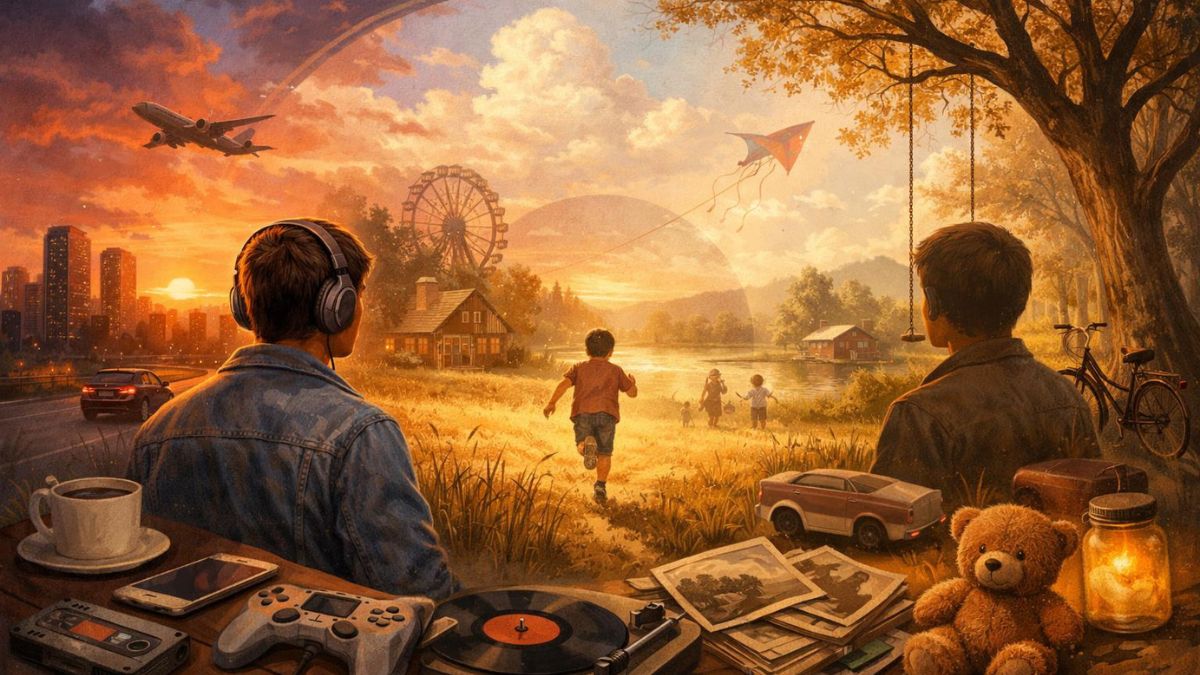
Hello and welcome to another episode of Word Power. I’m so glad you’ve decided to join me today because we are going to talk about something that I guarantee every single person listening has felt. It’s that sudden, sharp pang in your chest when you smell a specific type of coffee, or that warm, fuzzy feeling when a song from twenty years ago comes on the radio. It’s nostalgia. But have you ever stopped to wonder why we feel it? Is it just our brains playing tricks on us, making the past look better than it actually was? Or is there a deeper, maybe even survival-based reason why we cling to our memories?
Today, we aren’t just going to get sentimental; we are going to dissect the psychology behind this phenomenon. And, of course, since this is Word Power, I’ve woven in some essential, high-level vocabulary words that you can use to articulate these complex feelings. We’re going to look at the difference between remembering the past and reshaping it, and by the end of this, you’ll have the words to describe not just what you remember, but how you feel about it. So, let’s settle in and turn back the clock.
The Psychology of Nostalgia: A Trip Down Memory Lane
There is a strange and powerful paradox in the human experience. We live our lives moving forward, second by second, ticking toward the future, yet our minds seem constantly pulled backward, anchored by an invisible gravity to days that are long gone. This is the realm of nostalgia. For centuries, physicians actually considered nostalgia a disease—a “cerebral disease of demoniac cause,” or a form of intense homesickness that could physically cripple soldiers fighting far from home. Today, however, we view it differently. We see it as a bittersweet emotion, a complex blend of joy and sadness that arises when we think about the past.
But why do we do it? Why do we spend so much mental energy revisiting a time that no longer exists?
Psychologically speaking, nostalgia often acts as a sanctuary. When the present moment feels chaotic, uncertain, or overwhelming, our minds retreat to the safety of the known. The past is safe because it has already happened; there are no surprises there. We know the ending of that story. In this sense, nostalgia is a defense mechanism. It allows us to retreat into a wistful state of mind where we can self-soothe. It’s not just about missing a place or a person; it’s about yearning for a feeling of security and continuity.
However, we have to be careful. The memory is not a video recorder. It does not play back events exactly as they occurred. Instead, our brains are like editors making a movie. We tend to cut out the boring parts, the painful arguments, and the mundane struggles, leaving only the highlight reel. We view our history through rose-colored glasses. This optical illusion of the mind can lead us to glorify eras that, in reality, were fraught with their own difficulties. How often have you heard someone say, “Life was so much simpler back then”? Was it really simpler, or were we just younger and shielded from the complexities of the world?
This creates a fascinating tension between reality and reminiscence. We aren’t necessarily missing the actual past; we are missing the version of ourselves that existed in that past. We miss the innocence, the lack of responsibility, or the feeling of infinite potential.
There are specific triggers that launch us into this state. It’s rarely a conscious decision. Usually, it is something evocative—a sensory input that bypasses our logic and hits us straight in the emotional center of the brain. The sense of smell, for instance, is famously linked to memory. The scent of rain on hot asphalt might instantly transport you back to your childhood summer vacations. This is often called the “Proustian moment,” named after the author Marcel Proust, who wrote pages and pages about the flood of memories triggered simply by the taste of a madeleine cake dipped in tea.
But nostalgia isn’t always just a passive, sentimental loop. Psychologists distinguish between “restorative nostalgia” and “reflective nostalgia.” Restorative nostalgia attempts to reconstruct the lost home or the lost era. It’s the dangerous kind that thinks the past was perfect and tries to recreate it in the present, often aggressively. It refuses to accept that time is irreversible. Reflective nostalgia, on the other hand, is more accepting. It dwells on the longing and the loss, acknowledging that the past is gone. It is a form of mourning that ultimately helps us accept the passage of time. It allows us to visit the past without trying to live there.
In our modern, fast-paced digital world, this pull is stronger than ever. We are constantly bombarded with “throwback” photos and “on this day” reminders from social media. We are living in an era of manufactured nostalgia, where pop culture constantly reboots old movies and samples old music to capitalize on our collective yearning. It validates our memories, making us feel that our generation’s experience was significant.
Ultimately, though, the function of these recollections is to provide a sense of identity. By threading together the beads of our past experiences, we create the necklace of our self. Without these memories, without looking back at the bygone days—even if we distort them slightly—we would have no context for who we are today. It grounds us. It reminds us that we have survived, that we have loved, and that we have a history. So, while it is important not to get stuck in the past, dipping our toes into that river of memory is essential for our emotional well-being. It reminds us that life is fleeting, or ephemeral, and that makes the present moment all the more precious.
Unlocking the Vocabulary of the Past
Now, I want to take a step back—pun intended—and look at the language I used to describe this journey into the past. Talking about memories requires nuance because memories aren’t just “good” or “bad.” They are complex.
Do you remember when I used the word wistful? I mentioned retreating into a “wistful state of mind.” This is a beautiful word to have in your arsenal. It doesn’t just mean sad. It describes a feeling of vague or regretful longing. If you are looking out the window at the rain, thinking about a friend you haven’t seen in ten years, you are being wistful. It’s quiet, it’s pensive, and it usually involves a little bit of sadness about something that you can’t have back. You can use this in everyday conversation easily. You might say, “He had a wistful smile on his face when he talked about his college days.” It suggests he was happy to talk about it, but sad that those days are over.
That brings us to the word yearning. I said we aren’t just missing a place, but “yearning for a feeling of security.” Yearning is much stronger than just “wanting.” To yearn is to have an intense feeling of loss or lack and a deep desire for something. It comes from the gut. You don’t yearn for a sandwich—unless you haven’t eaten in three days—but you do yearn for freedom, or you yearn for your homeland. It implies a deep, soulful hunger. If you are writing a story or just describing a deep ambition, use “yearning” to show how powerful that desire is.
I also mentioned that we view history through rose-colored glasses. This is an idiom, but it’s treated almost like a vocabulary unit in English because it’s so common. If you view something through rose-colored glasses—or rose-tinted glasses—you are looking at it with an overly optimistic attitude, ignoring all the flaws. It’s a distortion. We do this with relationships all the time. After a breakup, you might only remember the romantic dates and forget the terrible arguments. You’d say, “Stop looking at your ex through rose-colored glasses; remember why you broke up!” It’s a very practical phrase to use when you think someone is being unrealistic about how good something was.
Connected to that idea, I used the word glorify. I said we “glorify eras” that were actually difficult. To glorify means to represent something as being admirable or perfect, usually more than it actually is. It’s about putting something on a pedestal. You see this in history books or movies that make war look heroic and exciting, ignoring the tragedy. That is glorifying war. In your daily life, you might hear people glorify “hustle culture” or working 18 hours a day, making it sound cool when it’s actually unhealthy. It’s a great word for critical thinking.
Moving on to the triggers of these memories, I used the word evocative. I mentioned that triggers are usually something evocative. This comes from the verb “evoke,” which means to bring a feeling, a memory, or an image into the conscious mind. If something is evocative, it is powerful enough to pull those emotions out of you. The smell of pine trees might be evocative of Christmas. A spooky song might be evocative of a horror movie. You can use this to describe art, music, or atmosphere. Instead of saying, “The music was emotional,” you could say, “The music was deeply evocative,” which sounds much more sophisticated.
I also used the word bygone. I referred to “bygone days.” This is a somewhat literary word, but it adds a nice flavor of age and finality. Bygone simply means belonging to an earlier time. We often use it in the phrase “let bygones be bygones,” which means to forget past offenses and move on. But as an adjective, it describes things that are gone forever. You might talk about the “elegance of a bygone era” when looking at old fashion. It feels more poetic than just saying “old” or “past.”
And speaking of feelings that don’t last, I used the word ephemeral near the end. I said life is ephemeral. This is a favorite word of poets and philosophers. It means lasting for a very short time. Bubbles are ephemeral. A sunset is ephemeral. It emphasizes how temporary and fragile something is. If you want to sound deep and reflective, this is the word to use. You might say, “Social media fame is often ephemeral,” meaning it’s here today and gone tomorrow.
I also used the word sentimental. We often hear this word, but let’s clarify it. I said nostalgia isn’t always just a “sentimental loop.” Being sentimental means being prompted by feelings of tenderness, sadness, or nostalgia. It’s an emotional word, sometimes implying that the emotion is a bit excessive. If you keep every single birthday card you’ve ever received, you are a sentimental person. If you cry at commercial breaks on TV, you’re being sentimental. It’s not necessarily bad, but it can imply that your heart is ruling your head.
Finally, let’s look at reminiscence. I talked about the tension between reality and reminiscence. A reminiscence is a story told about a past event remembered by the narrator. It’s the act of remembering. You might sit around a campfire having reminiscences about your school days. It’s a formal noun for the stories we tell about our past.
So, when you combine all these—when you have a wistful moment, sparked by an evocative song, leading to a reminiscence about a bygone era—you are painting a complete picture of your internal emotional world.
So, the next time you find yourself getting lost in a memory, take a moment to analyze it. Are you wearing rose-colored glasses? Are you yearning for something real, or just a feeling of safety? Nostalgia is a beautiful, human experience, and now you have the tools to talk about it with the depth it deserves.
Thank you for listening to this episode of Word Power. I hope you found it evocative and helpful. I’ll see you in the next episode.
Keywords and Definitions
- Nostalgia A sentimental longing or wistful affection for the past, typically for a period or place with happy personal associations.
- Wistful Having or showing a feeling of vague or regretful longing.
- Yearning An intense feeling of loss or lack and longing for something.
- Rose-colored glasses An optimistic perception of something; a perspective that ignores flaws and sees only the good.
- Glorify To describe or represent something as admirable, especially unjustifiably or more than it is in reality.
- Evocative Bringing strong images, memories, or feelings to mind.
- Bygone Belonging to an earlier time.
- Ephemeral Lasting for a very short time.
- Sentimental Of or prompted by feelings of tenderness, sadness, or nostalgia, sometimes to an excessive degree.
- Reminiscence A story told about a past event remembered by the narrator; the act of remembering things from the past.






0 Comments