
- The Empty Chair at the Head of the Table
- Management by Code and the Kafkaesque Nightmare
- The Panopticon Effect: Always Watching, Never Seen
- The Gamification of Labor: Press Button, Receive Treat
- The New Unionism: Glitching the System
- Conclusion: Who Is Responsible?
- Focus on Language: Vocabulary and Speaking
- Critical Analysis
- Let’s Discuss
- Let’s Play & Learn
- Check Your Understanding
The Empty Chair at the Head of the Table
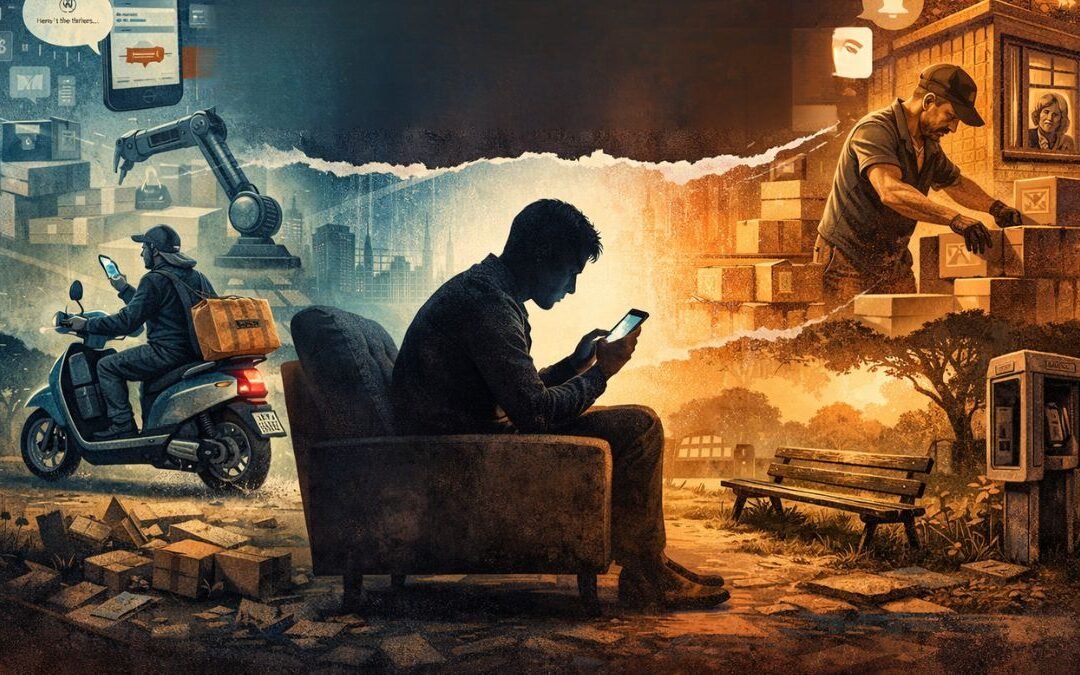
We spend an inordinate amount of time worrying about the robot that will steal our job. It is the classic science fiction nightmare: you walk into your office, and a chrome-plated droid is sitting at your desk, typing faster than you ever could. But while we were all staring at the front door waiting for the Terminator to arrive, the real revolution slipped in through the back server room. The robots didn’t come to take our jobs; they came to be our bosses.
This is not a future projection. It is the lived reality for millions of people right now. If you have ever hailed a ride, ordered a burrito to your couch, or clicked “buy” on a package that arrived the next day, you have interacted with the “Gig Economy.” But let’s strip away the marketing buzzwords. “Gig Economy” sounds fun, like we are all rock stars playing a weekend set. The reality is far more clinical. It is a labor market managed almost entirely by software.
There is no manager to shout at, no HR department to complain to, and no office holiday party. There is just an app, a black box of code that decides who works, who gets paid, and who gets fired. We have replaced the fallible, biased, coffee-drinking human supervisor with an infallible, opaque, data-hungry algorithm. And as it turns out, the only thing worse than a boss who plays favorites is a boss who doesn’t even know you exist as a human being.
Management by Code and the Kafkaesque Nightmare
The defining feature of traditional employment was the relationship. It might have been a bad relationship—your boss might have been a tyrant or an incompetent fool—but it was human. If you were five minutes late because your car broke down, you could explain that. You could appeal to empathy.
In the world of algorithmic management, empathy is a variable that hasn’t been coded yet. Consider the concept of “deactivation.” In the gig economy, you rarely get fired. Firing implies a formal process, a severance package, maybe a stern talk. Instead, you are deactivated. One day, you open the app to start your shift, and the screen is locked. A message pops up: “Your account has been suspended due to a violation of community standards.”
Which standard? The app won’t tell you. Who complained? Privacy policy prevents disclosure. How do you appeal? You fill out a form that disappears into the digital ether, likely reviewed by another algorithm or a support worker in a different hemisphere who has thirty seconds to decide your fate.
This is a Kafkaesque bureaucracy for the modern age. Drivers for ride-share platforms have shared stories of being deactivated because their completion rate dropped by a percentage point, or because a passenger filed a false report to get a free ride. In a traditional job, you face your accuser. Here, you face a math equation. The psychological toll of this is profound. Workers live in a state of constant, low-grade anxiety, knowing that their livelihood hangs by a digital thread that can be cut at any moment, without explanation and often without recourse. It creates a workforce that is compliant not out of loyalty, but out of a terrified confusion.
The Panopticon Effect: Always Watching, Never Seen
Jeremy Bentham, an 18th-century philosopher, designed a theoretical prison called the Panopticon. The design allowed a single watchman to observe all inmates without them being able to tell whether they were being watched. The result? The prisoners behaved perfectly at all times, effectively policing themselves because the surveillance might be happening.
The modern warehouse is the Panopticon realized, but with better Wi-Fi.
In the massive fulfillment centers that power our two-day shipping addiction, the algorithm is omniscient. Workers carry handheld scanners that track not just inventory, but them. Every second is accounted for. The scanner counts down the seconds you have to walk to the next aisle, pick an item, and scan it. If you are too slow, it logs “Time Off Task.”
“Time Off Task” is the weaponization of efficiency. It doesn’t care if you stopped to tie your shoe, or if you had to move a heavy pallet to get to the item, or if you just needed to breathe for ten seconds. It sees a pause in data, and it flags you. Accumulate enough flags, and the system automatically generates a warning. Accumulate enough warnings, and the system fires you.
This creates a hyper-surveilled working class. We used to complain about the boss hovering over our shoulder. Now, the boss is in your pocket, on your wrist, and in the scanner in your hand. This level of granular tracking strips away autonomy. You are not a worker making decisions; you are a biological component in a mechanical system, being optimized for maximum throughput. The tragedy is that while the algorithm maximizes efficiency, it minimizes humanity. It treats the need to use the restroom or the need to stretch a cramping muscle as “inefficiencies” to be routed around.
The Gamification of Labor: Press Button, Receive Treat
If the stick is the threat of deactivation, the carrot is “gamification.” This is where the sociology of the algorithmic boss gets truly manipulative. Tech companies have borrowed heavily from the video game industry to keep workers engaged and logging longer hours.
Have you ever noticed how ride-share apps or delivery platforms use bright colors, progress bars, and badges? That isn’t just aesthetic design; it is psychological engineering. When a driver tries to log off for the night, the app might pop up a message: “You are only $15 away from your daily goal! Keep driving?”
It triggers the same dopamine loop as a slot machine or a mobile game. They use “streaks”—bonuses for accepting ten rides in a row. They use “surge pricing” zones that light up the map in bright red, beckoning drivers like moths to a flame.
This is insidious because it creates the illusion of choice. The platform says, “You are your own boss! Work when you want!” But then it uses subtle psychological triggers to manipulate when you want to work. It bypasses your rational decision-making—”I am tired, I should go home”—and hacks your brain’s reward center—”Just one more level, just one more ride.”
It masks the reality of low wages. Instead of a guaranteed hourly rate, you get the thrill of the chase. You aren’t working for a paycheck; you are grinding for high scores. By turning labor into a game, these platforms obscure the fact that the house always wins. The badges and platinum status levels don’t pay the rent, but they keep the wheels turning.
The New Unionism: Glitching the System
However, humans are remarkably adaptable. If you put people in a maze, they will eventually figure out how to climb the walls. As the algorithmic boss becomes more controlling, the workers are finding novel ways to fight back. We are witnessing the birth of a new kind of labor movement—one that is as decentralized and digital as the management it opposes.
Traditional unions rely on physical gathering—meeting in the breakroom, standing on the picket line. But gig workers are isolated. They never meet their colleagues. So, they have moved the picket line to WhatsApp groups, Reddit forums, and Discord servers.
In these digital spaces, workers reverse-engineer the boss. They share data on how the algorithm works. They coordinate mass “log-offs” to trigger surge pricing artificially. If the algorithm lowers pay rates in a certain area, a coordinated group of drivers might all decline rides simultaneously, forcing the system to panic and raise the offer.
This is “algorithmic collective action.” It is a game of cat and mouse. The platform updates the code to plug the loophole; the workers find a new exploit. It is an adversarial relationship where the workers are treated like bugs in the software, and the workers treat the software like a puzzle to be solved.
The Human Element in a Digital World
There is something deeply inspiring about this resistance. It proves that you can strip away the office, the manager, and the HR department, but you cannot strip away the fundamental human need for solidarity. We are social animals. We will find each other. Even if we are just dots on a map, we will find a way to signal to one another.
Conclusion: Who Is Responsible?
As we look to the future, the question isn’t whether algorithmic management will stay—it definitely will. It is too profitable and too efficient to go away. The question is how we civilize it.
Right now, the algorithmic boss operates in a moral vacuum. If an algorithm discriminates against a certain demographic because of a biased dataset, who is to blame? The engineer who wrote the code? The executive who signed off on it? Or the code itself?
The “Gig Economy” has allowed corporations to offload risk onto the worker. They provide the car, the gas, the insurance, and the labor, while the company provides the software. But we are reaching a breaking point. We have to decide if efficiency is the ultimate virtue of our society.
The algorithm is a mirror. It reflects our desire for cheap, instant gratification. We want the pizza in 30 minutes, and we don’t want to think about the digital whip cracking over the driver’s head to get it there. But we must look. We must see the invisible manager. Because eventually, that manager won’t just be overseeing drivers and warehouse workers. It will come for the lawyers, the writers, the middle managers, and the coders too. The algorithm is learning. And it is a very strict boss.
Focus on Language: Vocabulary and Speaking
Let’s unpack the machinery of the language we just used. To discuss modern labor and technology effectively, you need a vocabulary that bridges the gap between sociology and computer science. We are dealing with concepts that are invisible but heavy, so our words need to carry that weight.
1. Panopticon
This is a powerhouse word. Originally a prison design where guards could see everyone but prisoners couldn’t see the guards, we use it now to describe any system of total surveillance. In the article, we talked about the warehouse as a Panopticon. In real life, you can use this to describe any situation where you feel watched but can’t see the watcher.
Context: “The open-plan office feels like a panopticon; I feel like my screen is always visible to everyone.”
2. Recourse
Recourse is the legal or formal ability to get help or a decision changed. We mentioned that deactivated drivers have no recourse. It means they have no one to turn to, no way to fix the problem.
Context: “If the airline loses your luggage and their hotline is broken, you have no recourse but to wait.”
3. Infallible
To be infallible is to be incapable of making mistakes. We often think computers are infallible, but they aren’t. We used it to contrast human bosses (fallible) with the perceived perfection of algorithms.
Context: “My GPS is usually good, but it’s not infallible; it once drove me into a lake.”
4. Opaque
If something is opaque, you can’t see through it. In business and tech, we use it to describe processes that are hidden or secretive. The “black box” algorithm is opaque. Transparency is the opposite.
Context: ” The company’s hiring process is completely opaque; I have no idea why they rejected me.”
5. Precarity / Precarious
This word defines the gig economy. It refers to a state of being uncertain, unstable, or insecure. “Gig work” sounds cool; “labor precarity” sounds dangerous. It means you are one bad day away from ruin.
Context: “Freelancing offers freedom, but the financial precarity can be very stressful.”
6. Gamification
This is turning non-game activities (like work or exercise) into a game with points, badges, and levels. We discussed how apps use gamification to manipulate workers.
Context: “My fitness app uses gamification to make me run, giving me a digital trophy if I don’t stop.”
7. Atomized
In sociology, when a group is broken down into isolated individuals, they are atomized. Gig workers are atomized because they don’t share a physical workspace. It makes organizing unions hard.
Context: “Modern society feels atomized; we live in apartments next to people we never speak to.”
8. Arbitrary
Based on random choice or personal whim, rather than any reason or system. When an algorithm bans a user for a rule that isn’t clear, it feels arbitrary.
Context: ” The dress code rules at this school seem completely arbitrary.”
9. Surveillance Capitalism
A term coined by Shoshana Zuboff. It refers to an economic system centered around the commodification of personal data. The “Algorithmic Boss” thrives on surveillance capitalism.
Context: “Social media is free because the real business model is surveillance capitalism.”
10. Autonomy
The right or condition of self-government. Freedom. Gig apps promise autonomy (“Be your own boss!”), but the article argues they actually remove it through subtle control.
Context: “I love this job because my manager gives me a lot of autonomy to choose my projects.”
Speaking Lesson: The “Devil’s Advocate” Challenge
Now that we have these heavy-hitting words, let’s put them in your mouth. The goal of sophisticated speaking isn’t just knowing the definition; it’s about flow and collocation (knowing which words live happily next to each other).
Here is a technique: The Pivot.
In advanced conversation, you often have to acknowledge a point and then turn it in a new direction.
Structure: “While [Concession, the reality is often more [Vocabulary Word.”
Example:
“While the app claims to offer freedom, the reality is often more opaque and filled with precarity.”
Your Challenge:
I want you to imagine you are a PR representative for a Gig App. You are defending the algorithm. Then, I want you to switch roles and be the labor activist attacking it.
- PR Rep: Use the words Autonomy and Gamification (in a positive way).
- Draft: “We offer total autonomy. Our gamification features are just fun ways to motivate people!”
- Activist: Use the words Panopticon and Arbitrary.
- Draft: “Your system is a digital panopticon where firings are completely arbitrary.”
Try to speak these sentences out loud. Feel the difference in tone. The PR rep sounds light and open. The Activist sounds sharp and urgent. Mastering this tonal shift is key to C1/C2 level English.
Critical Analysis
Let’s take a step back. I wrote the article from a very specific perspective: the pro-labor, skeptical sociologist view. But if we want to be true experts, we have to look at the blind spots. What did I miss?
1. The Consumer’s Complicity
The article paints the “Company” as the villain. But who is driving the algorithm? We are. The consumer. The algorithm is just optimized to give us what we want: cheap prices and instant speed. If Uber raised prices to give drivers a full salary and benefits, would you still use it? Or would you switch to the cheaper competitor? The “Invisible Boss” is actually doing our bidding. We are the silent managers.
2. The Global South Perspective
I focused heavily on a Western perspective (US/Europe). But in many developing nations, “algorithmic management” is actually an improvement over local labor conditions. In places with high corruption or nepotism, an algorithm can be seen as “fairer.” It doesn’t care who your father is; it only cares if you did the job. For millions in the Global South, gig work is a lifeline to the global economy, not a trap. We must be careful not to project Western labor anxieties onto the entire world.
3. The “Bias” Counter-Argument
We assume human bosses are better. Are they? Human bosses are sexist, racist, and moody. They play favorites. In theory, a well-designed algorithm could be the most fair boss in history. It doesn’t care about your gender or your race, only your output. The problem isn’t that it’s an algorithm; the problem is that it is currently designed for profit, not fairness. But is the solution to go back to humans, or to build better algorithms?
These nuances matter. It is easy to say “AI Boss Bad.” It is much harder to say, “How do we build an AI Boss that is ethical?”
Let’s Discuss
Here are five questions to spark a debate. Don’t just answer “yes” or “no.” Dig in.
If an algorithm fires you, should you have the legal right to explain your side to a human?
This sounds obvious, but it is expensive. If companies are forced to hire humans to review every firing, the cost of the service goes up. Are you willing to pay $5 more for your delivery to ensure the driver has “due process”?
Is “Gamification” essentially lying?
If an app uses psychological tricks to make you work when you are tired, is that coercion? Or is it just smart marketing? Where is the line between motivation and manipulation?
Should we tax “Data” as labor?
If these apps are training their AI on the movements and decisions of the workers, aren’t the workers technically “teaching” the computer? Should they be paid for the data they generate, not just the delivery they make?
Would you feel more comfortable with an AI boss or a Human boss who you know dislikes you?
The AI is cold, but predictable. The human is warm, but potentially vindictive. Which is the lesser of two evils?
Can a union exist without a factory floor?
Can digital solidarity ever match the power of physical presence? Can you truly trust a “coworker” you know only as a username on a Reddit forum?





0 Comments