
Vocabulary Preview
- Inexorable: Impossible to stop, prevent, or avoid; inevitable.
- Ubiquity: The state of being very common or appearing everywhere.
- Hedonistic: Engaged in the pursuit of pleasure; self-indulgently devoted to happiness.
- Mitigate: To make something less severe, harmful, or painful.
- Salutary: Producing good effects; beneficial, especially after something unpleasant.
- Crucible: A situation of severe trial, or a place where different elements interact to produce something new.
- Transmute: To change in form, nature, or substance, often into a higher or better form.
- Equanimity: Mental calmness, composure, and evenness of temper, especially in difficult situations.
- Intrinsic: Belonging naturally; essential.
- Fortitude: Courage in pain or adversity.
Listen
Or Read
The Value of Suffering: Can Pain Lead to Growth and Wisdom?
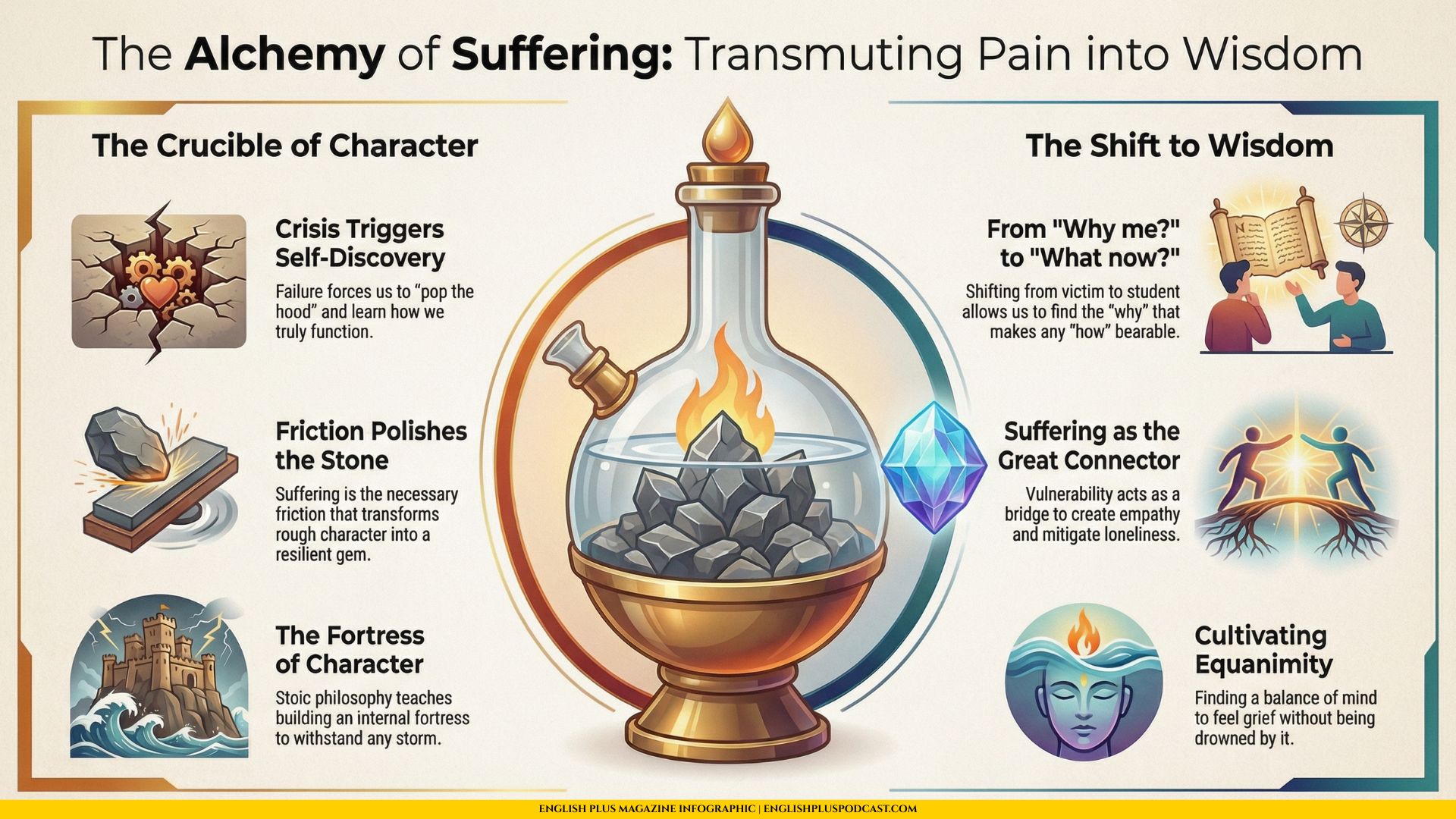
It is a seductive thought, isn’t it? To edit out the heartbreak, the grief, the physical aches, and the crushing disappointments. We live in a culture that is obsessed with comfort. We have apps to deliver our food so we don’t have to walk in the rain, pills to dull every ache, and endless entertainment to distract us from the quiet hum of anxiety in our chests. We treat suffering like a virus, something to be eradicated or, at the very least, numbly ignored. But here is the provocative thought I want to plant in your mind today: what if by avoiding pain, we are also avoiding the very thing that makes us human? What if the inexorable nature of suffering isn’t a curse, but a necessary friction that polishes the rough stone of our character into a gem?
Now, don’t get me wrong; I am not suggesting we should go out looking for misery. That would be masochistic. But given the ubiquity of pain in the human experience—since none of us gets out of here without a few scars—it seems wasteful to just endure it without asking what it might be teaching us. The ancient Stoics, those toga-wearing philosophers of Greece and Rome, understood this well. They didn’t preach a hedonistic avoidance of pain; instead, they believed that while we cannot control what happens to us, we have absolute power over how we respond. They argued that the goal of life wasn’t to collect pleasures like seashells, but to build a fortress of character that could withstand any storm.
Think about the last time you learned a truly valuable lesson. I’m willing to bet it wasn’t while you were lounging on a beach sipping a piña colada. It was probably during a breakup, a career failure, or a health scare. When things are going well, we tend to coast. We are on autopilot. It is only when the engine fails that we actually pop the hood and learn how the machine works. In this way, pain acts as a crucible. It burns away the superficial layers of our ego and forces us to confront who we really are. It is in these dark moments that we often find a salutary clarity that was impossible to see when the sun was shining too brightly.
There is a concept in alchemy—the medieval forerunner to chemistry—about turning lead into gold. Psychologically, we have the capacity to do the same thing. We can transmute our suffering into wisdom. This is what the psychiatrist Viktor Frankl meant when he wrote about finding meaning in the most horrific circumstances imaginable. He observed that those who could find a “why” for their existence could bear almost any “how.” When we cease to view our pain as a random act of malice from the universe and start viewing it as a challenge to be met, we shift from being victims to being students of life. We stop asking “Why me?” and start asking “What now?”
This shift requires a tremendous amount of fortitude. It asks us to look at our scars not as disfigurements, but as maps of the territory we have survived. It asks us to cultivate equanimity, a balance of mind that allows us to feel the grief or the anger without being drowned by it. It is about acknowledging that the darkness is just as intrinsic to the world as the light. You cannot have shadows without a light source, and you cannot have genuine joy without understanding the depth of sorrow.
Furthermore, suffering is the great connector. It is the bridge between islands. When you are perfect, happy, and successful, you are often isolated in your tower of success. But when you are vulnerable, when you are hurting, you connect with the rest of humanity. Your pain allows you to mitigate the loneliness of others because you can say, “I know how this feels. I have been there too.” It creates empathy, which is perhaps the highest form of human intelligence. Without our own struggles, we would be emotional sociopaths, unable to understand the plight of our neighbor.
So, we find ourselves in a paradox. We spend our lives trying to run from the very thing that helps us grow. We try to insulate ourselves from risk, from loss, from the messiness of being alive, only to find that a life without these things feels shallow and brittle. Perhaps the goal shouldn’t be to eliminate suffering, but to deepen our capacity to hold it. To let it carve out spaces in our hearts that can then be filled with more love, more gratitude, and more resilience.
As you move through your week, I want you to look at the difficulties you are facing—the traffic jam, the difficult boss, the heartache—and try to flip the script. Instead of just gritting your teeth, ask yourself what this moment is demanding of you. Is it patience? Is it courage? Is it forgiveness? Because if you can find the lesson in the pain, you haven’t just survived it; you have defeated it. And that brings me to a question I would love to hear your thoughts on: Can you think of a specific difficult time in your life that, looking back, you are actually grateful for because of who it forced you to become? Share your story in the comments below!
Word Power
Let’s take a moment to unpack the heavy-hitting vocabulary we used to explore this topic. These words are like precision tools; they help us articulate complex feelings and situations that simple words just can’t capture.
First, we talked about the inexorable nature of suffering. This is a powerful word that means “unstoppable” or “unyielding.” Think of a glacier moving down a mountain—slow, but inexorable. You can’t talk it out of moving. In life, the passage of time is inexorable. You might use it to describe a deadline that is approaching no matter how much you procrastinate.
We mentioned the ubiquity of pain. If something is ubiquitous, it is everywhere. Smartphones are ubiquitous in modern society. We used it to remind ourselves that pain isn’t a rare glitch; it’s a common feature. You could say, “The ubiquity of coffee shops in Seattle is amazing.”
We contrasted the Stoics with a hedonistic lifestyle. Hedonistic comes from “hedonism,” the philosophy that pleasure is the most important thing in life. A hedonistic weekend might involve eating too much, sleeping in, and binge-watching TV. It’s often used to describe someone who lacks self-discipline.
We discussed how we try to mitigate suffering. To mitigate means to make something less severe or painful. You take aspirin to mitigate a headache. You might plant trees to mitigate climate change. It’s a very common professional word, especially in risk management.
I used the word salutary to describe the clarity we get from tough times. Salutary means beneficial, but usually in a way that comes from something unpleasant. A “salutary lesson” is a hard lesson that does you good in the long run. Getting fired might be a salutary experience if it pushes you to find a job you actually love.
We called pain a crucible. A crucible is literally a pot used to melt metals at high heat, but metaphorically, it’s a severe test or trial. Basic training in the military is a crucible. It’s where the pressure is so high that you are changed by it.
We talked about the ability to transmute suffering into wisdom. This is a magical word. It means to transform something completely, usually into something better. You might transmute your nervous energy into excitement before a speech.
We emphasized the need for equanimity. This is one of my favorite words. It’s that calm, cool, collected state of mind, especially when things are going wrong. If everyone is panicking during a fire drill and you are calmly walking to the exit, you are showing equanimity.
We said darkness is intrinsic to the world. Intrinsic means essential or belonging naturally. The sweetness is intrinsic to the apple. You can’t take it out without destroying the apple. You might say, “Trust is intrinsic to a good relationship.”
Finally, we used fortitude. This is an old-school word for courage, but specifically courage in pain or adversity. It’s not just bravery in a fight; it’s the strength to endure a long illness or a difficult winter. It implies stamina and mental strength.
Speaking Tips & Challenge
Now, how do you actually use these words without sounding like a philosophy professor?
- Context matters: Use hedonistic when joking about your weekend plans (“I’m planning a purely hedonistic Saturday”). Use mitigate in business or formal situations (“We need to mitigate these risks”).
- Pair them up: Inexorable goes great with “time” or “progress.” Ubiquity pairs well with technology or trends.
- Don’t overthink it: Fortitude is just a stronger word for guts. Crucible is just a stronger word for a test.
Your Speaking Challenge:
I want you to think about a minor annoyance you faced today—maybe a traffic jam or a rude email.
Retell the story of that annoyance to yourself (or a friend), but frame it as a philosophical challenge using at least three of the new words.
Example: “The traffic was inexorable, and I had to summon all my equanimity not to scream. I tried to view the delay as a crucible for my patience.”
Give it a try! You might find that using these words actually helps you handle the stress better.









0 Comments