- Rentier Capitalism: The Death of Ownership
- The Privatization of Law: The Terms of Service Tyranny
- Gig Economy vs. Serfdom: The Algorithm as Overseer
- Breaking the Digital Manor
- Focus on Language
- Critical Analysis: Is “Feudalism” Just a Scary Word for Progress?
- Let’s Discuss
- Fantastic Guest: Danny vs. The Most Dangerous Woman in America
- Let’s Play & Learn
- Check Your Understanding (Quiz)
History has a funny way of recycling itself. We like to think of time as an arrow moving forward—progress, democracy, flying cars, Star Trek. But sometimes, time is a flat circle. Sometimes, we invent incredibly futuristic technology only to use it to rebuild incredibly ancient social structures.
If you look past the sleek glass of your smartphone and the convenience of one-day delivery, you might notice something unsettling. We aren’t moving toward a futuristic democracy of equals. We are moving back to the Middle Ages, just with much better Wi-Fi.
Welcome to the era of Techno-Feudalism.
In the 19th century, coal barons built “company towns.” They owned the mines, sure, but they also owned the houses the workers lived in, the grocery stores where they bought food, and the police force that kept them in line. Workers were paid in “scrip”—fake money that could only be spent at the company store. It was a closed loop of control.
Today, Big Tech has built digital versions of these company towns. Amazon, Apple, Google, and Meta aren’t just businesses; they are fiefdoms. They control the marketplace (the App Store), the public square (social media), and the infrastructure (cloud servers). And us? We aren’t really citizens of the internet anymore. We are serfs working the land for a digital lord, paying rent in data and attention, existing only at the pleasure of the algorithm.
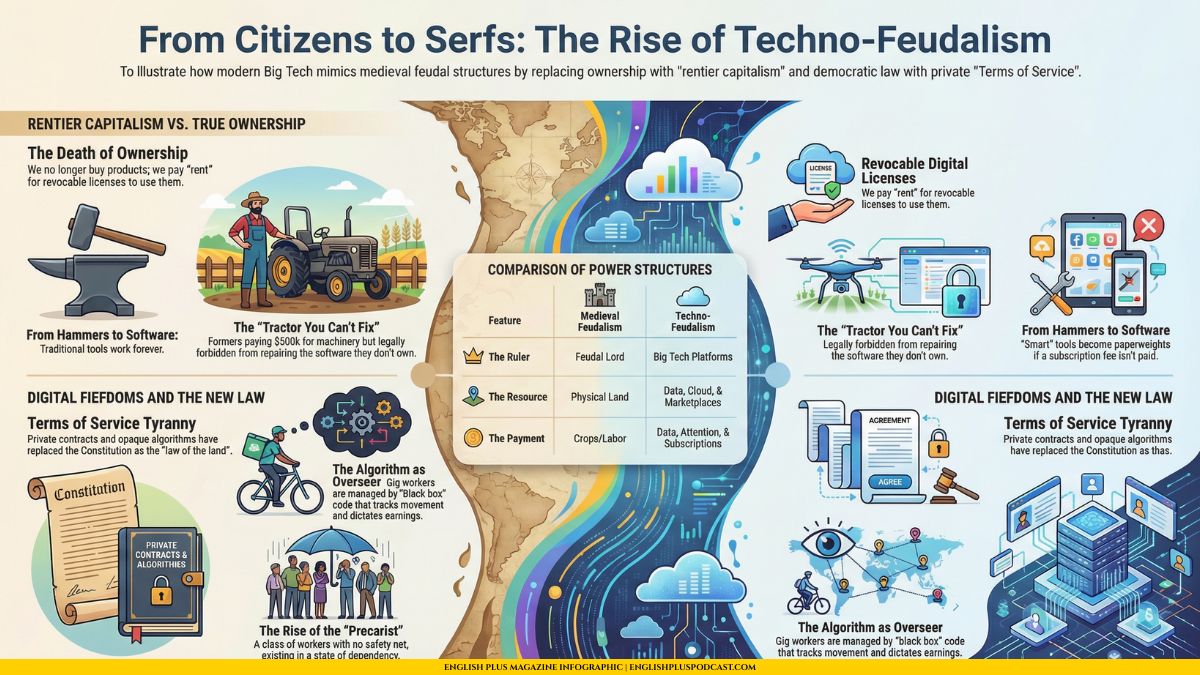
Rentier Capitalism: The Death of Ownership
The defining characteristic of feudalism was that the serf owned nothing. The lord owned the land; the serf just had the “privilege” of working on it in exchange for protection.
Fast forward to today. Look at your digital life. Do you own the movies in your iTunes library? No, you purchased a “license” to view them, which can be revoked at any time. Do you own the software on your computer? No, you pay a monthly subscription for access.
This is the shift from capitalism to “Rentier Capitalism.” In traditional capitalism, you buy a hammer, and it’s yours. If the hammer company goes bankrupt, you still have a hammer. In Techno-Feudalism, you buy a smart hammer that requires a software update to hit nails, and if you stop paying the monthly fee, it turns into a paperweight.
The Tractor You Can’t Fix
The most egregious example isn’t even in Silicon Valley; it’s on the farm. John Deere, the tractor company, has pioneered the concept that farmers don’t actually own their tractors. Sure, they paid half a million dollars for the machine, but the software that runs it belongs to John Deere.
If the tractor breaks down, the farmer isn’t allowed to fix it with a wrench. That would violate the “Terms of Service.” They have to wait for an authorized John Deere technician to come out and unlock the software. This is the digital equivalent of a feudal lord telling a peasant he isn’t allowed to sharpen his own plow without permission. It creates a dependency that extracts wealth from the user long after the initial purchase. We are slowly turning into tenants in our own lives, renting the tools we need to survive from a handful of tech overlords.
The Privatization of Law: The Terms of Service Tyranny
In a democracy, if you are accused of a crime, you have rights. You have the presumption of innocence, the right to a trial, and the right to appeal. The government cannot just exile you because the Mayor is in a bad mood.
But in a digital fiefdom, there is no Constitution. There is only the “Terms of Service.”
When you are banned from a platform like YouTube, Twitter, or Facebook, you are effectively exiled from the public square. For many people—journalists, creators, small business owners—this is the digital equivalent of the death penalty. It destroys their livelihood and their social standing.
The Black Box Courtroom
And how is this verdict reached? Is there a jury of your peers? No. There is an opaque algorithm or an underpaid moderator in a call center halfway across the world who makes a split-second decision. There is rarely a clear appeal process. You are simply… gone.
We have allowed private corporations to privatize the concept of “Law.” They define what is “speech” and what is “harassment.” They define what is “misinformation” and what is “news.” And because these platforms are monopolies (or near-monopolies), you can’t just “go to another town.” If you get kicked off the internet’s main infrastructure, you are a digital ghost. The tech CEOs are the new Kings, and their whims are the law of the land.
Gig Economy vs. Serfdom: The Algorithm as Overseer
Perhaps the clearest parallel to feudalism is the so-called “Gig Economy.” Companies like Uber, DoorDash, and TaskRabbit pitched us a vision of ultimate freedom. “Be your own boss!” they said. “Work whenever you want!”
But look closer. A medieval serf had “freedom” in the sense that he wasn’t a slave; he worked on his own schedule, as long as he produced enough crops for the lord. Today’s gig worker is in a similar state of precarious dependency.
The Precariat
Sociologists call this new class the “Precariat” (precarious proletariat). These workers have no safety net. They have no health insurance, no paid time off, and no guarantee of wages. They are not “employees” with rights; they are “independent contractors.”
But are they independent? An Uber driver cannot set their own prices. They cannot build their own customer base. They cannot even see the destination of the passenger before they accept the ride. They are managed by an algorithm that acts as a ruthless overseer. If their rating drops below 4.6 stars, they are “deactivated” (fired) by a computer code.
This is 21st-century serfdom. The platform owns the “land” (the customer base and the software), and the driver takes all the risk. If the car breaks down, that’s the driver’s problem. If demand drops, that’s the driver’s problem. The platform extracts a “rent” (20-30% of the fare) simply for allowing the serf to work.
Breaking the Digital Manor
It is easy to be seduced by the convenience of Techno-Feudalism. It is nice to have food delivered in twenty minutes. It is nice to have all our photos backed up in the Cloud. But we need to ask ourselves what we are trading for this convenience.
We are trading ownership for access. We are trading rights for permissions. We are trading the rule of law for the rule of code.
We aren’t citizens of the internet anymore; we are users. And “user” is just a modern word for a subject who has no say in how the kingdom is run. If we want to reclaim the promise of the digital age—the promise of democratization and empowerment—we need to start tearing down the castle walls. We need the “Right to Repair.” We need “Data Portability” (the ability to take your data and leave). And we need to recognize that a Terms of Service agreement should not overrule the Bill of Rights.
The Middle Ages ended because the serfs realized that the lords needed them more than they needed the lords. It might be time for a similar realization today.
Focus on Language
Let’s unpack the vocabulary of Techno-Feudalism. The language we use to describe the economy often shapes how we understand it. If we use words like “sharing economy,” it sounds nice and communal. If we use words like “rentier capitalism,” it sounds extractive and parasitic. Learning these distinctions gives you the power to analyze the world more critically.
Here are ten key terms from the article that will sharpen your political and economic English.
First, let’s look at “Rentier.” A rentier is a person or entity that earns income from capital (like land, patents, or software) rather than from labor or producing new things. In the article, we talked about “Rentier Capitalism.” This implies an economy based on charging fees for access rather than selling goods. You can use this in real life to describe business models. “That software company is acting like a rentier; they stopped innovating and just keep raising the subscription price.”
Next is “Fiefdom.” Historically, a fiefdom was the estate of a feudal lord. Metaphorically, we use it to describe an organization or department controlled by a dominant person or group. “The marketing department became the Vice President’s personal fiefdom; no one else could make a decision.” It implies control, exclusion, and a lack of democracy.
Then we have “Precarious.” We mentioned the “precariat.” Precarious means not securely held or in position; dangerously likely to fall or collapse. It describes a state of uncertainty. “His financial situation is precarious right now.” It’s a sophisticated way to say “shaky” or “unstable.”
Let’s talk about “Sovereign.” A sovereign is a supreme ruler, especially a monarch. We argued that tech platforms act like sovereign states. In conversation, you can use this to describe supreme power. “My cat thinks she is the sovereign of this house.” It adds a regal, authoritative tone.
A crucial concept is “Opaque.” Literally, it means not transparent; you can’t see through it. We described algorithms as opaque. In business or politics, this is a negative word. “The hiring process was completely opaque; we have no idea why they chose him.” It suggests something is being hidden.
We used the term “Egregious.” This means outstandingly bad; shocking. We called the John Deere example egregious. This is a power word for complaints. “That was an egregious error.” It sounds much more serious than just saying “very bad.”
Let’s look at “Overseer.” Historically, an overseer was a person who supervised others, often slaves or workers. We called the algorithm an overseer. Using this word invokes a sense of strict, perhaps cruel, supervision. “My manager acts less like a leader and more like an overseer.”
Another key phrase is “Closed Loop.” This refers to a system where everything is contained within itself. The company town was a closed loop. We often use this in systems thinking. “We need to create a closed loop recycling system.”
We talked about “Revoked.” To revoke means to put an end to the validity or operation of a decree, decision, or promise. “Your license can be revoked.” You can use this for permissions. “I revoked his access to the shared drive.”
Finally, “Dependency.” This is the state of relying on something or someone. We said the system creates dependency. “We need to reduce our dependency on fossil fuels.” It implies a weakness or a lack of freedom.
Speaking Section: The Power of Metaphor
Now, let’s move to speaking. The article relied heavily on Metaphor and Analogy. We compared Big Tech to Feudal Lords. We compared Gig Workers to Serfs.
Using analogies is one of the best ways to explain complex ideas in English. It creates a bridge between what the listener knows (Kings/Castles) and what you want to teach them (Algorithms/Data).
The Challenge:
I want you to practice making analogies. I want you to take a modern problem and compare it to something historical or physical.
- Example: “Social Media is like…”
- Analogy: “…is like a town square where everyone is shouting.”
- Analogy: “…is like a gladiator arena.”
- Example: “My smartphone is like…”
- Analogy: “…is like a leash.”
- Analogy: “…is like a swiss army knife.”
Your Assignment:
Take the concept of “Subscription Services” (Netflix, Spotify, etc.).
Complete this sentence: “Paying for everything by subscription is like…”
Try to use the vocabulary words we learned. For example: “It is like living in a precarious hotel where the landlord can revoke your key at any time.”
Speaking in pictures (analogies) makes you memorable. Try it out in your next conversation!
Critical Analysis: Is “Feudalism” Just a Scary Word for Progress?
We have painted a very dark picture of the digital world. We used heavy, emotionally charged words like “Serfdom,” “Tyranny,” and “Overseer.” But as critical thinkers, we need to pause and ask: Is this analogy actually fair? Or are we just using scary medieval words to complain about modern capitalism?
Let’s play Devil’s Advocate.
1. The “Voluntary” Counter-Argument
The biggest flaw in the “Feudalism” analogy is the concept of force. Medieval serfs were legally bound to the land. They couldn’t leave. If they tried, they were hunted down.
In contrast, no one forces you to use Facebook. No one forces you to drive for Uber. You can delete the app. You can quit. You can buy a dumbphone.
Is it really “serfdom” if you can opt out? The article argues that these platforms are “infrastructure,” implying they are necessary for life. But are they? People lived happily without Amazon Prime twenty years ago. Perhaps we aren’t “serfs”—perhaps we are just addicted consumers who refuse to make the hard choice of disconnecting. We are trading our data for convenience willingly. That looks less like feudalism and more like a transaction.
2. The Barrier to Entry Argument
The article critiques the Gig Economy as precarious. And it is. But what is the alternative? Before Uber, to become a taxi driver, you had to buy a “medallion” that cost hundreds of thousands of dollars. It was a closed cartel.
Uber lowered the barrier to entry to zero. Anyone with a car could start earning money immediately. For millions of people—immigrants, students, single parents—this flexibility is not “oppression”; it is a lifeline. It allows people who were locked out of the traditional economy to enter it. By focusing only on the lack of benefits, do we ignore the massive benefit of access?
3. The “Benevolent Lord” Defense
We attacked the “Company Town,” but let’s look at what the Tech Giants actually provide. Google gives you the world’s information, email, and maps for free. YouTube allows anyone to become a broadcaster for free.
In a feudal system, the lord takes and gives almost nothing back. In the digital ecosystem, the “Lords” provide immense value. We pay with data, yes, but many would argue that is a fair trade for the magical services we receive. Is it “Rentier Capitalism,” or is it the most democratic distribution of tools in history? A kid in a village in India has the same access to Wikipedia as a professor at Harvard. That doesn’t sound like the Middle Ages.
4. The Innovation Necessity
Finally, consider the John Deere tractor. Why lock the software? They argue it is for safety and environmental compliance. If farmers hacked the software to make the engine more powerful, it might bypass emissions standards or make the machine dangerous.
Furthermore, the “subscription” model funds continuous updates. If we only bought software once (like a hammer), companies would have no money to fix bugs or add security patches three years later. Maybe “renting” software is the only way to keep it secure in a world of constant cyber-attacks.
So, while the “Techno-Feudalism” analogy is powerful and highlights real dangers about ownership and power, it might obscure the fact that this system also provides unprecedented freedom and utility. The truth, as always, is probably somewhere in the messy middle.
Let’s Discuss
Here are five questions to dig deeper into the topic. Use these to spark a debate in the comments or at your next dinner party.
If you buy a digital movie and the platform shuts down, should you get a refund?
This touches on the definition of “ownership.” If you bought a DVD, it’s yours forever. If you bought a digital file, you really just bought a “right to watch.” Should the law force companies to give us downloadable files we can keep offline?
Is social media a “Private Space” or a “Public Square”?
If it’s a private space (like a mall), the owner can kick out anyone they want. If it’s a public square (like a park), free speech rules apply. Since Facebook is where political debate happens, has it become the public square, and should the government regulate it like one?
Should “Gig Work” be a third category of employment?
Right now, we have “Employee” (benefits) and “Contractor” (freedom). Gig work tries to be both but often fails. Should we invent a new legal category that offers some benefits (like a portable health fund) without destroying the flexibility?
Is the “Right to Repair” dangerous?
Tech companies say that if they let us fix our own phones, we might break the battery or compromise security. Are they protecting us, or just protecting their profits? Would you trust a refurbished iPhone fixed by your neighbor?
Would you pay $10 a month for Facebook if it meant they stopped tracking your data?
We complain about surveillance, but we love “free.” If the Feudal model is “pay with data,” would you prefer the Capitalist model of “pay with cash”? Or do we feel entitled to have everything for free and have privacy?
Fantastic Guest: Danny vs. The Most Dangerous Woman in America
Danny: Welcome back. We’ve been talking about Techno-Feudalism—the idea that Big Tech is turning us all into digital serfs living in “Company Towns.” To understand this, I figured we needed someone who didn’t just study company towns in a textbook, but someone who was actually arrested in them. Repeatedly. She was called “The Grandmother of All Agitators” and “The Most Dangerous Woman in America.” Please welcome the spirit of Mother Jones. Mother, thank you for putting down your picket sign to join us.
Mother Jones: I never put down the sign, sonny. I just lean it against the wall while I talk. And looking at this contraption you’re speaking into… looks like you’ve got quite a bit of agitating to do yourself.
Danny: You mean the microphone? Or the computer?
Mother Jones: I mean the whole setup. You call this progress? I walked through your city to get here. I saw men riding bicycles with square boxes on their backs, delivering food. They looked tired. They looked scared. They looked like they were running from a whip. In my day, we called that piece-work. You call it the “Gig Economy.” A fancy word for starvation.
Danny: You’re hitting the nail on the head already. That’s exactly what we’re discussing. The shift from “employment” to this precarious “gig work.” The companies say it’s freedom. They say, “Be your own boss.”
Mother Jones: “Be your own boss.” I’ve heard that lie before. The coal operators used to tell the miners, “You’re independent contractors! You get paid by the ton! If you work harder, you make more!” But who weighed the ton? The company weighman. And he always had his thumb on the scale. Who sets the price for your Uber driver? The machine. The algorithm. If you can’t set your price, and you can’t set your hours without being punished, you ain’t a boss. You’re a mule.
Danny: But the technology is different, surely. The Uber driver has a GPS. They have safety features. It’s not a coal mine.
Mother Jones: No, it’s worse. In the coal mine, at least the darkness hid you from the boss for a few minutes. You could take a breath. You could curse the foreman’s name. This… this digital mine you’ve built? The eye of the boss is in your pocket. It watches you every second. It tracks your speed, your braking, your route. It’s a Panopticon. If a miner stopped to tie his boot, he didn’t get “deactivated” by a ghost in a machine. You’ve built a prison and convinced the prisoners to pay for the locks.
Danny: That brings me to the “Company Town” comparison. In your day, the company paid in “scrip”—fake money only good at the company store. Today, we have Amazon credits, V-Bucks, ecosystem lock-ins. Do you see the parallel?
Mother Jones: I see the same greed wearing a new suit. In West Virginia, if you tried to buy bread from an independent baker, the mine guard would kick in your door and throw you out of your company house. Today, you tell me that if you buy a “kindle” book, you can’t read it on another machine? That if you buy a tractor, you can’t use a wrench to fix it?
Danny: Exactly. That’s the John Deere situation. Farmers pay half a million dollars for a tractor but only “license” the software. They can’t repair it.
Mother Jones: Then they don’t own it! Listen to me, boy. Ownership is freedom. If a man owns his tools, he can look the boss in the eye and say, “Go to hell.” If the boss owns the tools, the man has to look at his shoes and say, “Yes, sir.” You have created a generation of people who own nothing. You lease your music. You lease your movies. You lease your house. You lease your car ride. You are sharecroppers. That’s all you are. Digital sharecroppers farming data for Mr. Zuckerberg.
Danny: “Digital Sharecroppers.” That hurts, but it feels accurate. But Mother, the argument is that this system is efficient. It’s convenient. We get next-day delivery. We get instant entertainment. Isn’t that worth something?
Mother Jones: Convenience is the bribe they pay you to stop fighting. The Romans called it “Bread and Circuses.” You call it “Amazon Prime and TikTok.” It’s the same thing. You get your little trinket delivered to your door, so you don’t notice that the man delivering it is peeing in a bottle because he’s afraid to stop the truck. You get your funny cat videos, so you don’t notice that the platform is selling your private thoughts to advertisers. You are trading your dignity for a cheaper toaster. It’s a bad trade.
Danny: Let’s talk about the “Terms of Service.” In the article, we argued that these contracts have replaced the Constitution. When you get banned from Twitter, there is no trial. You’re just gone.
Mother Jones: We called those “Yellow Dog Contracts.” You had to sign them to get a job. They said, “I promise never to join a union, never to complain, never to sue.” If you broke the contract, you were blacklisted. Not just fired—blacklisted. Your name went on a list, and no mine in the state would hire you. That’s what your “ban” is. It’s a global blacklist. And you let these corporate kings decide who speaks? You let a billionaire in Silicon Valley decide what is “truth”?
Danny: Well, they are private companies. They say they have the right to refuse service.
Mother Jones: A company town is a private company too! But when the company owns the streets, the water, and the lights, it stops being a private business and starts being a public tyrant! When a platform becomes the only way to speak to your neighbors, it ain’t a store anymore. It’s the Town Square. And the Town Square belongs to the people. You let them privatize your voice. Shame on you.
Danny: So, what would you do? If you were alive today, how would you fight an algorithm? You can’t strike against a server. You can’t picket a cloud.
Mother Jones: Can’t you? You think those servers run on magic? They run on electricity. They run on workers. The engineers, the coders, the delivery drivers, the warehouse packers. They are flesh and blood. You organize them.
Danny: It’s hard to organize gig workers. They never meet each other. They’re isolated in their cars.
Mother Jones: Then you organize the customers! You organize the “users.” Imagine if, for one day, nobody logged in. Imagine if, for one week, nobody bought a Prime package. You hit them in the only place they feel pain: the wallet. But you won’t do it.
Danny: Why not?
Mother Jones: Because you’re addicted. The miner wasn’t addicted to the coal. He hated it. He wanted out. You… you love your little glowing screens. You love the dopamine. The coal barons had to use guns to keep us in line. The tech barons just use “likes” and “notifications.” It’s much cheaper than bullets, and it works twice as well.
Danny: That is incredibly depressing. You’re saying we are complicit in our own serfdom.
Mother Jones: I’m saying you are sleepwalking into slavery. You are worried about “Techno-Feudalism”? You should be. But don’t blame the technology. A hammer can build a house or crack a skull; it depends on whose hand holds the handle. Right now, the handle is in the hand of the rentier. The man who charges you rent to breathe his air.
Danny: We talked about “Rentier Capitalism.” The idea that they extract value without producing anything.
Mother Jones: Parasites! That’s what they are. Look at this “App Store” tax. A developer makes a tool. A user wants the tool. Apple stands in the middle and takes 30 percent? For what? For opening the gate? That is a toll booth on the highway of human creativity. In the Middle Ages, the Robber Barons put chains across the river and charged boats to pass. This is just a digital chain.
Danny: You have a way with metaphors, Mother.
Mother Jones: I have a way with the truth. And the truth is, you are letting them dismantle the very concept of private property. They tell you, “You will own nothing and be happy.” Well, the first part is true. You own nothing. Are you happy?
Danny: I think we are anxious. We feel… precarious.
Mother Jones: Precarious. Good word. We lived precariously too. We didn’t know if we’d eat the next day. But we had something you don’t have.
Danny: What’s that?
Mother Jones: Solidarity. When the mine boss cut the wages, we didn’t just tweet about it. We marched. We brought our pots and pans and beat them until the governor had to send in the National Guard. We knew who the enemy was. You? You think the enemy is your neighbor who voted for the wrong guy. You think the enemy is the other driver taking your fare. You don’t look up. You don’t look at the algorithm.
Danny: How do we “look up”? The algorithm is opaque. It’s a black box.
Mother Jones: Then you smash the box! You demand transparency. You demand that the “code” be public law. If the code determines your wage, the code is a labor law. If the code determines your speech, the code is a civil law. And laws must be written by the people, not by a boy genius in a hoodie.
Danny: I want to ask you about the “Right to Repair.” It seems like such a small thing, fixing your own phone. But you see it as revolutionary?
Mother Jones: It is the most revolutionary thing! To fix something is to understand it. To understand it is to master it. If you can’t fix it, it is magic. And if it is magic, you are a peasant watching a wizard. When a farmer fixes his own tractor, he is asserting his humanity. He is saying, “I am the master of this machine, not its servant.” The moment you legally forbid a man from fixing his own tools, you have declared him a child. You have declared him a dependent. It is an insult to human dignity.
Danny: You mentioned “Dignity.” That seems to be the core of this. The Feudal system was an assault on dignity.
Mother Jones: Exactly. It wasn’t just the poverty. It was the humiliation. Having to ask the Lord for permission to marry. Having to ask the Lord for permission to travel. Now, you have to ask the App for permission to work. You have to ask the Cloud for permission to listen to a song you paid for. It makes you small. And I spent ninety-three years trying to make people feel big.
Danny: You were famously fearless. You walked into machine gun fire. What are you afraid of today?
Mother Jones: I’m afraid of your silence. I’m afraid that you have become so comfortable in your digital cages that you don’t even rattle the bars anymore. I’m afraid that you confuse “access” with “freedom.” Just because you can access the whole world on that screen doesn’t mean you are free. A prisoner can see the sky through the window; that don’t mean he can fly.
Danny: That’s… heavy. But let’s try to end on a slightly lighter note. If you could say one thing to Jeff Bezos or Elon Musk, what would it be?
Mother Jones: I wouldn’t say a word to them. I’d talk to their warehouse workers. I’d tell them, “Boys and girls, look at that rocket ship he’s building. He paid for that with your sweat. He paid for that with your bathroom breaks that you didn’t take. That rocket belongs to you. Maybe you should take it for a joyride.”
Danny: I think that would be considered grand theft spacecraft.
Mother Jones: I call it “asset forfeiture.”
Danny: Mother Jones, you are an absolute force of nature. Thank you for scaring the hell out of us, and hopefully, waking us up.
Mother Jones: Don’t thank me. Organize. And put down that damn phone.
Danny: I will. Right after I tweet this interview.
Mother Jones: Hopeless.
Danny: And there you have it. The view from the coal mines applied to the data mines. Mother Jones thinks we are sharecroppers in a digital field, paying rent to lords we can’t see. She thinks the “Right to Repair” is a fight for the soul of humanity. And frankly, after hearing her, I’m ready to grab a wrench and dismantle something.




0 Comments