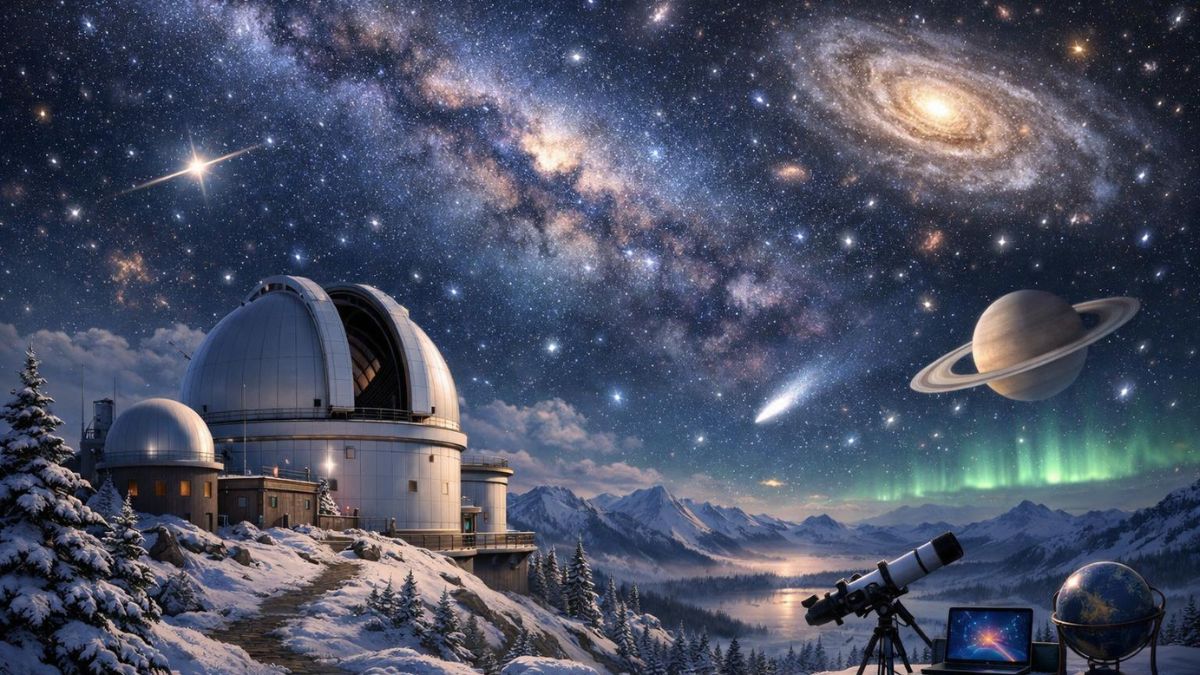
It is one of the great ironies of the calendar that the season we associate with the most frantic terrestrial activity—the shopping, the traffic, the aggressive competitive decorating—is also the season that offers us the most profound portal to the infinite. While we are busy fighting over the last parking spot at the mall, the universe is putting on its most spectacular show right above our heads. And usually, we are too busy looking at our phones to notice.
Winter, particularly in the Northern Hemisphere, is the VIP season for stargazing. Yes, it is cold. Yes, you will lose feeling in your extremities. But there is a scientific trade-off for your shivering. Cold air holds less moisture than warm air. Humidity is the enemy of the astronomer; it creates a haze that scatters light and muddies the view. In winter, the atmosphere is crisp, dry, and stable, turning the sky into a high-definition screen. Furthermore, during the winter months, the Earth is facing away from the center of our own galaxy. We are looking out into the quieter, darker suburbs of the Milky Way, rather than into the bright, cluttered downtown. This means the background is darker, making the stars that are visible pop with an intensity you just don’t get in July.
So, this is an invitation. An invitation to step away from the eggnog, put on a coat that makes you look like a marshmallow, and step outside to engage in a little cosmic time travel. Because that is what stargazing is. It is not just looking up; it is looking back.
The Speed of Light and the Ghost of the Past
When you look at your spouse across the dinner table, you are seeing them as they are in the present—or at least, a few nanoseconds in the past. Light travels fast. But space is big. By the time the light from the stars reaches your retina, it has been traveling for years, centuries, or millennia.
Take Sirius, the brightest star in the winter sky. You can’t miss it; it’s the glittering diamond hanging off the belt of Orion. When you look at Sirius, you are seeing light that left that star eight years ago. You are looking at the past. But that is a mere stone’s throw in cosmic terms. Look at the belt of Orion itself. Those stars are over 1,000 light-years away. You are seeing light that started its journey before the Norman Conquest, before the invention of the printing press, before the discovery of electricity.
There is a profound humility in this. We obsess over our current news cycle, our current anxieties, our current holiday to-do lists. But the sky is a history book. It reminds us that our “now” is just a tiny, fleeting moment in a narrative that is unimaginably vast. When you stand under the winter sky, you are interfacing with the ancient. You are receiving postcards that were mailed before your great-great-grandparents were born. It forces a perspective shift. It is hard to stay angry about a passive-aggressive comment from a relative when you are staring at a photon that has been traveling through the void for a thousand years just to die on the back of your eye.
The Navigation of the Ancients
We often forget that for 99% of human history, the night sky was not just scenery; it was a tool. It was the original GPS, the original calendar, and the original Netflix. Our ancestors sat around fires—much like we sit around radiators—and looked up to make sense of their world.
The winter sky is dominated by Orion, the Hunter. He is perhaps the most recognizable constellation globally. The ancient Egyptians saw him as Osiris, the god of the afterlife. The Greeks saw a hunter chasing the Pleiades. The Ojibwe people of North America saw the Wintermaker, whose presence signaled the coming of the cold.
When we look up at these same patterns, we are sharing a direct visual experience with every human who has ever lived. Julius Caesar looked at that same Orion. Shakespeare looked at that same Orion. A prehistoric nomad crossing the land bridge looked at that same Orion. In a world that is constantly changing, where landscapes are paved over and skylines are rewritten by skyscrapers, the stars are the only permanent landscape we have. They are the common heritage of humanity. Connecting with them is a way of shaking hands with our ancestors across the chasm of time.
The Psychology of Awe
But why does this matter? Why should we care about balls of gas burning billions of miles away? Because looking at them triggers a specific psychological state known as “awe.”
Psychologists define awe as the feeling we get when we are confronted with something so vast that it transcends our current understanding of the world. It is that feeling of being small, of being overwhelmed. And interestingly, research shows that awe makes us better people.
When we experience awe, our self-focus diminishes. The “I” becomes less important, and the “we” becomes more important. Studies have shown that people who have recently experienced awe are more generous, more cooperative, and feel more connected to the people around them. It turns out that feeling insignificant is actually good for us.
We live in a culture of extreme narcissism. Social media algorithms are designed to make us feel like the main character in the movie of the universe. We curate our lives, we obsess over our image, we live in a hall of mirrors. The night sky shatters that mirror. It tells us, brutally and beautifully, that we are not the center of anything. We are tiny biological specks on a wet rock orbiting a mediocre star in the outskirts of a spiral galaxy.
This sounds depressing, but it is actually liberating. If we are small, then our problems are small. If the universe is vast, then there is room for possibility. The winter sky offers a “cosmic perspective” that dissolves the ego. It is a form of spiritual recalibration. It is hard to be a narcissist when you are looking at the Andromeda Galaxy, a swirling island of a trillion stars that is rushing toward us at 250,000 miles per hour.
The Science of Stardust
Let’s dig a little deeper into the physics. The connection we feel to the stars is not just poetic; it is literal. The iron in your blood, the calcium in your bones, the carbon in your brain—all of these heavy elements were forged in the nuclear furnaces of dying stars.
The early universe was boring. It was mostly hydrogen and helium. You can’t make a human out of hydrogen and helium. You need the heavy stuff. And the only place the heavy stuff is created is inside a high-mass star. When those stars explode as supernovae, they scatter those elements across the cosmos. These elements eventually clump together to form planets, and asteroids, and eventually, us.
So, when the holiday season talks about “giving,” remember the ultimate gift. The stars gave their lives to create the building blocks of you. As the astrophysicist Carl Sagan famously said, “We are made of starstuff.” This isn’t a metaphor. It is a biological fact. We are the universe experiencing itself. We are a way for the cosmos to know itself.
This perspective reframes the holiday season. It moves it away from the commercial exchange of plastic goods and toward a celebration of existence itself. We are here, against all odds, conscious and capable of looking up. That is a miracle that no Black Friday sale can compete with.
The Tragedy of the Vanishing Dark
However, there is a melancholic note to this symphony. We are losing the stars. Light pollution is erasing the night sky at a terrifying rate. For many people living in urban centers, the “milky way” is just a candy bar. They have never seen the spine of our galaxy arching across the sky.
We have declared war on the dark. We are afraid of it, so we banish it with LEDs and streetlights and neon signs. But in doing so, we are severing our connection to the cosmos. We are trapping ourselves in a bubble of our own making, cutting off the view of the infinite.
This winter, try to find the dark. Drive out of the city. Turn off the porch lights. Reclaim the night. There is a specific kind of silence that comes with the dark, a visual silence that allows the mind to expand. The stars are still there, waiting for us to turn down the noise so they can speak.
The Pale Blue Dot
In 1990, the Voyager 1 spacecraft, as it was leaving our solar system, turned its camera around and took a picture of Earth from 3.7 billion miles away. In that photo, Earth is a tiny pixel, a “pale blue dot” suspended in a sunbeam.
Carl Sagan wrote a beautiful reflection on that image, noting that everyone you have ever loved, every superstar, every dictator, every saint and sinner in the history of our species lived there—on a mote of dust suspended in a sunbeam.
The winter holidays are a time when we try to manufacture peace on Earth. We buy gifts, we sing songs, we send cards. But perhaps the most effective way to foster peace is to remember the Pale Blue Dot. To remember that we are all crew members on a fragile spaceship floating through a hostile void.
When you look up at the winter sky, you are seeing the context of our existence. You are seeing the cold, indifferent vastness that surrounds our tiny oasis of warmth. It makes the warmth of our homes, and the warmth of our relationships, feel all the more precious. We are huddled together around a planetary fire, drifting through the dark. The least we can do is be kind to one another.
So, this season, by all means, enjoy the festive lights. Enjoy the glitter and the glow. But do not forget the original lights. Do not forget the ancient, nuclear fires burning in the deep dark. Step outside. Look up. Let the cold air bite your cheeks and let the vastness sting your ego. Feel the awe. And then, bring that perspective back inside with you. It is the best gift you can give to the world.
Focus on Language
Let’s take a tour of the linguistic landscape we just traversed. When we talk about space and science, the vocabulary often feels sterile or overly academic. My goal here was to take those “cold” scientific words and warm them up, to make them conversational and relatable. We want to sound smart, but not like a textbook that no one wants to read.
Let’s start with Celestial. We used this right at the beginning: “The Celestial Canvas.” Celestial simply means relating to the sky or outer space. But it carries a connotation of something divine, heavenly, or supremely good. You can use it to describe a planet, but in real life, you can use it to describe something incredibly beautiful. “That chocolate cake was a celestial experience.” It elevates the subject.
Then we have Magnitude. In astronomy, magnitude refers to the brightness of a star. But in conversation, magnitude refers to the great size or extent of something. We often use it when we realize how big a problem or an event is. “I don’t think you understand the magnitude of this mistake.” It adds weight. It’s not just big; it has gravity.
We talked about Primordial. This is a fantastic word. It means existing at or from the beginning of time; primeval. We talked about “primordial” elements. You can use this to describe something that feels ancient or instinctual. “There was a primordial fear in his eyes.” It suggests something deep in our DNA, something that predates civilization.
We used the word Ephemeral. We described our “now” as a fleeting, ephemeral moment. Ephemeral means lasting for a very short time. It comes from the Greek word for a mayfly, an insect that lives for only one day. Trends are ephemeral. Youth is ephemeral. Use this word when you want to sound a bit poetic about how short life is.
Let’s look at Paradox. We mentioned the “irony” or paradox of the winter sky—cold ground, clear view. A paradox is a seemingly absurd or self-contradictory statement or proposition that when investigated or explained may prove to be well founded. “It is a paradox that the more you learn, the less you feel you know.”
We used the term Anthropocentrism. This is a mouthful, but it’s useful. It means regarding humankind as the central or most important element of existence. We talked about how the stars cure us of this. If someone thinks everything is about humans or about them specifically, they are being anthropocentric. It’s the opposite of the “cosmic perspective.”
We talked about Zenith. While not explicitly in every paragraph, the concept of looking up implies looking toward the zenith. The zenith is the point in the sky or celestial sphere directly above an observer. Metaphorically, it means the time at which something is most powerful or successful. “The band was at the zenith of their fame in the 90s.”
We discussed the Void. We talked about light traveling through the void. The void is a completely empty space. It sounds much more dramatic than “empty space.” You can use it to describe emotional emptiness too. “He felt a void in his life after he retired.”
We used Recalibration. We said stargazing is a “spiritual recalibration.” To calibrate is to adjust a machine so it works accurately. To recalibrate is to adjust it again. When you are stressed or lost, you need to recalibrate your mindset. It’s a mechanical word applied to psychology.
And finally, Insignificant. We said feeling insignificant is good for us. This usually means too small or unimportant to be worth consideration. But in our context, we flipped it. We made insignificance a positive trait—a relief from the pressure of being important.
Now, let’s move to the speaking aspect.
When you use words like these—words that deal with vastness and time—the delivery is everything. You cannot rush through a sentence about a billion light-years. You have to give the listener time to process the scale.
We are going to practice The Pause of Magnitude.
When you are describing something huge, or ancient, or profound, you need to slow down and pause before and after the key concept.
Instead of saying: “Thestarissodistantthatthelighttookmillionsofyearstogethere.”
Say: “The star is so distant… [pause]… that the light took millions of years… [pause]… to get here.”
The pause acts like a highlighter pen. It tells the listener, “Hey, this part is heavy. Let it sink in.”
Here is your challenge:
I want you to try the “Vastness Pitch.” Find an object in your room—a cup, a chair, a window. I want you to describe it as if it were a celestial object using our vocabulary. Make it sound important and ancient.
For example, don’t say “It’s an old coffee mug.”
Say: “This vessel is… [pause]… primordial. It has survived the magnitude of the dishwasher. It holds the celestial liquid of the morning.”
It’s silly, yes. But it trains your brain to access these “big” words and get comfortable with the rhythm of sophisticated speech. Record yourself doing it. Listen to the pauses. Do you sound like a philosopher or a panicked auctioneer? Aim for the philosopher.
Let’s Discuss
Here are five questions to spark some deep thinking. I want you to take these not just as questions to answer, but as starting points for a debate with yourself or others in the comments.
1. Is the universe beautiful or is it just hostile?
We often romanticize the stars as beautiful, but space is actually a vacuum filled with deadly radiation and freezing temperatures. It is indifferent to life. Is our perception of “beauty” just a survival mechanism, or is there an objective beauty in the cosmos even if no one is there to see it?
2. Does the “Cosmic Perspective” lead to nihilism or altruism?
The article argues that feeling small makes us generous (altruism). But for some, realizing we are “tiny specks” makes them feel like nothing matters (nihilism). If we are just dust, why bother recycling or being kind? Where is the line between “nothing matters, so I give up” and “nothing matters, so I’m free”?
3. Is light pollution a necessary evil?
We miss the stars, yes. But streetlights reduce crime and accidents. We traded the Milky Way for safety and 24-hour productivity. Was it a fair trade? Can we have both, or is the loss of the night sky the inevitable price of civilization?
4. Why do we value ancient myths over modern science?
We still talk about Orion and Osiris. We love the stories. But the scientific reality (balls of burning gas) is arguably more impressive. Why do we emotionally connect more with a made-up hunter than with the physics of nuclear fusion? Is the human brain just wired for story over fact?
5. Is the “Overview Effect” accessible to everyone?
Astronauts report a life-changing shift when seeing Earth from space. We tried to simulate that with stargazing. But can you really get that perspective from the ground? Or is that level of enlightenment reserved for the few billionaires and scientists who get to leave the atmosphere?
Critical Analysis
Okay, let’s take the telescope away for a second and look at this article with a skeptical eye. I’ve painted a very romantic picture of stargazing, claiming it makes us better, kinder, and more connected. But is that actually true, or is it just nice-sounding sentimentality?
First, let’s look at the “Ancients.” The article claims our ancestors looked up and felt awe and connection. And sure, they probably did. But they also felt terror. They looked up and saw comets as omens of plague. They saw eclipses as monsters eating the sun. They didn’t just use the stars for navigation; they used them for astrology and superstition, which often led to fear-based decisions. The article sanitizes history to make it feel cozy. The stars weren’t always friends; often, they were terrifying gods.
Secondly, let’s address the privilege of the “Cosmic Perspective.” It is very easy to stand in your backyard in a warm coat and feel “philosophical awe” about your insignificance. It is much harder to feel that when you are insignificant because of poverty or oppression. Telling someone who is struggling to put food on the table that “we are just stardust” is not comforting; it’s dismissive. The “Pale Blue Dot” philosophy is a luxury of those who have their basic needs met.
Also, the science. The article focuses heavily on the visible universe. But science tells us that visible matter—stars, you, me, the dog—makes up less than 5% of the universe. The rest is Dark Energy and Dark Matter. We literally cannot see 95% of reality. So when we look up and feel like we are “seeing the universe,” we are actually suffering from a massive selection bias. We are looking at the foam on the ocean and thinking we understand the deep sea.
Finally, the psychological claim that awe makes us “generous.” While studies suggest this, human history is full of people who were obsessed with the stars and yet were terrible humans. Astronomy has been funded by tyrants and warmongers for centuries (usually to improve navigation for warships). Knowing where the stars are doesn’t automatically grant you a moral compass.
So, gaze up, yes. But don’t expect the stars to do the heavy lifting of making you a good person. That work still has to happen down here in the mud.










0 Comments