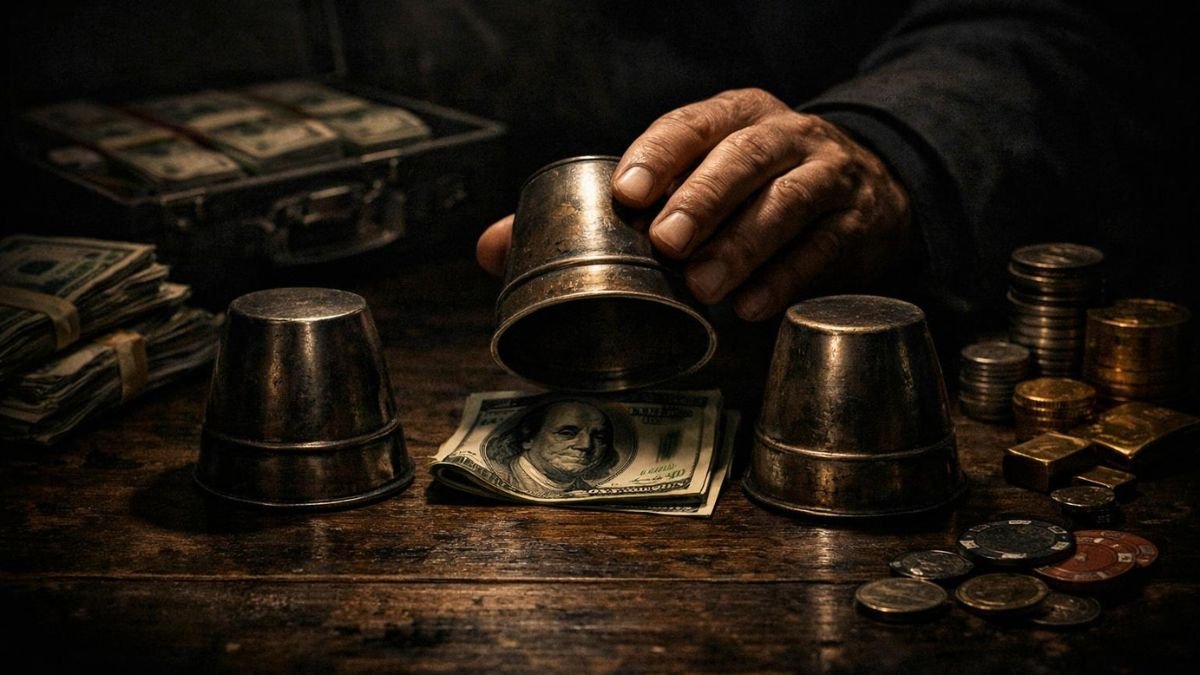
The Shadow Games Series
Shadow Games Series: Episode 1 | The Fine Line: Lobbying vs. Bribery
Shadow Games Series: Episode 2 | The Shell Game: How Money Hides
Shadow Games Series: Episode 3 | The Oligarch’s Playbook: Consolidating Power
Shadow Games Series: Episode 4 | The Cost of Corruption: The Human Toll
Shadow Games Series: Episode 5 | Cleaning House: Can It Be Fixed?
Shadow Games Series: Episode 2 | The Shell Game: How Money Hides
The Art of Invisible Architecture
If you were to walk down a certain sun-drenched street in George Town, Grand Cayman, or perhaps a quiet, wind-swept lane in Delaware, you might encounter a building that defies the laws of physics. To the naked eye, it is a modest structure—a beige, two-story office block with a palm tree out front or a generic glass façade reflecting the passing traffic. It looks remarkably ordinary. Yet, if you were to look at the paperwork filed within its walls, this single building is the corporate headquarters for twenty thousand companies.
It is a metaphysical feat. Inside this building, there are no assembly lines, no cubicles buzzing with telemarketers, no warehouses stacked with inventory. There is only a server rack, a few filing cabinets, and perhaps a receptionist who has the unenviable task of answering the phone for thousands of different entities.
Welcome to the Shell Game. In the previous episode, we explored how influence is bought and sold through the very public mechanisms of lobbying. Today, we step into the shadows. We are going to explore how money learns to walk through walls. We are going to dissect the mechanisms of financial opacity—the shell company, the offshore account, and the labyrinthine trust—to understand how wealth disconnects itself from its owner.
This is not merely a story about tax evasion or criminal masterminds, though both play a starring role. It is a story about the fundamental fluidity of capital in the modern world. While you and I are tethered to geography—we live in a house, we work in an office, we pay taxes where we buy our coffee—money has achieved a state of quantum superposition. It is everywhere and nowhere at once.
The Anatomy of a Ghost
To understand the shell company, we must first strip away our traditional understanding of what a “company” is. When we hear the word, we imagine a brand, a product, a workforce. We imagine Ford building cars or Google writing code. But in the legal realm, a company is simply a “juridical person.” It is a piece of paper that says, “I exist, I can own property, and I can sue or be sued.”
A shell company is a juridical person with no body. It produces nothing. It employs no one. It serves only one function: to hold assets.
Imagine you have a pile of gold coins. If you keep them in your house, everyone knows they are yours. If you are sued, the court takes them. If you die, the taxman takes a share. If you want to buy a politician, everyone sees you handing over the gold.
Now, imagine you create a company called “Blue Horizon Holdings.” You transfer the gold to Blue Horizon. You are no longer the owner of the gold; the company is. But who owns the company? Well, Blue Horizon is owned by another company called “Red Sunset LLC,” registered in the British Virgin Islands. And who owns Red Sunset? A trust based in the Cook Islands, whose beneficiary is… well, that is a secret.
Suddenly, the gold has vanished from your ledger. You still control it—you hold the keys to the companies—but legally, you are a stranger to your own wealth. The shell company acts as a firewall, a barrier of legal abstraction that separates the asset from the liability of being human.
This structure is the basic building block of the offshore world. It is the “Russian Nesting Doll” of finance. You open one doll only to find another, and another, and another, until you are left with a tiny, indivisible piece of wood that reveals nothing about who bought the dolls in the first place.
The Twin Engines: Anonymity and Avoidance
Why go to such elaborate lengths? The motivation usually bifurcates into two distinct but often overlapping desires: privacy and profit.
Let us begin with profit, or more accurately, the preservation of it. The global tax system is a patchwork of incompatible jurisdictions. Some countries have high taxes and robust public services; others have zero taxes and charge only a small annual registration fee for companies. The game, for the ultra-wealthy and multinational corporations, is to ensure that profits are realized in the latter, while costs are incurred in the former.
This is known as “profit shifting.” A tech giant might develop a patent in California (high tax) but sell the rights to that patent to its own subsidiary in Bermuda (no tax). The California company then pays massive “licensing fees” to the Bermuda company for the right to use the patent. These fees are counted as business expenses, which lowers the taxable income in the US. Meanwhile, the Bermuda company collects pure profit, tax-free. The money hasn’t actually moved—it just walked through a paper wall.
But for many, the allure is not just saving money; it is becoming invisible. This brings us to anonymity. In an era of digital surveillance, where every swipe of a credit card is tracked, the shell company offers the last bastion of true privacy.
For the kleptocrat looting their national treasury, the drug cartel laundering cash, or the arms dealer circumventing sanctions, the shell company is not a luxury; it is a necessity. It breaks the chain of custody. It allows dirty money to enter the clean banking system. Once the money is inside a shell company, it can be wired to buy luxury real estate in London, a yacht in the Mediterranean, or high-art in New York. The transaction record shows “Blue Horizon Holdings” bought the penthouse, not the General who stole the aid money. The money is “laundered”—scrubbed of its sordid origins and pressed into a crisp, legitimate asset.
Dark Money: The Silent Vote
If this financial wizardry stayed in the realm of luxury condos and tax bills, it would be a matter of economics. But money, as we established in Episode 1, is the currency of political access. When shell companies enter the political arena, the implications for democracy are profound.
In many democracies, there are strict limits on how much an individual can donate to a political campaign, and strict requirements to disclose their identity. We, the public, have a right to know who is funding whom. This transparency is the check on corruption.
Enter “Dark Money.”
In the United States, specifically following the Citizens United Supreme Court ruling, the floodgates opened for corporations and unions to spend unlimited amounts on political advocacy, provided they do not coordinate directly with the candidate. This led to the rise of Super PACs (Political Action Committees) and “social welfare” organizations (501(c)(4)s).
Here is the trick: while a Super PAC must disclose its donors, a 501(c)(4) does not. So, a group of wealthy donors can pool their money into a shell company or a non-profit “social welfare” organization. This organization then donates the money to the Super PAC.
When you look at the Super PAC’s filings, you don’t see the names of the billionaires. You see a donation from “Americans for a Better Tomorrow.” The trail goes cold. The voters are bombarded with attack ads and slick marketing campaigns funded by entities that effectively do not exist.
This transforms the public square into a masquerade ball. We see the masks—the patriotic names of these organizations—but we never see the faces beneath. Policy is shaped, elections are swayed, and legislation is written, all under the influence of capital that has been meticulously scrubbed of fingerprints.
The Erosion of Accountability
The danger of the Shell Game is not just that it allows the rich to get richer or the corrupt to stay out of jail. It is that it erodes the fundamental social contract. Societies are built on the premise of shared responsibility. We all pitch in (taxes) to build the infrastructure we all use, and we all abide by the same laws.
The offshore world creates a parallel universe where these rules do not apply. It creates a secession of the elites. When the wealthiest individuals and the most powerful corporations can opt out of the national tax base, the burden shifts to the middle and working classes. When political speech can be purchased anonymously, the voice of the citizen is drowned out by the whisper of the ghost.
This system is not an accident; it is a product of deliberate design. It requires lawyers to draft the articles of incorporation, accountants to audit the books, and bankers to facilitate the transfers. It is an industry employing some of the brightest minds in the world, all dedicated to the singular task of hiding the ball.
As we peel back the layers of the shell company, we find that the “Shadow Game” is not played in a back alley. It is played in skyscrapers and courthouses, hidden in plain sight by a fortress of paperwork. And until we understand the architecture of this secrecy, we will remain spectators to a game we do not even realize is being played.
Critical Analysis: The Devil’s Advocate
The Paradox of Privacy
We have just traversed the landscape of financial secrecy, painting it as a tool for tax dodgers, kleptocrats, and subverters of democracy. The narrative is tidy, moralistic, and largely condemns the very concept of anonymity. But as we sharpen our critical faculties, we must ask: Is secrecy inherently evil? Or is privacy a neutral tool that takes on the moral character of its user?
Let us play the devil’s advocate. Let us dismantle the idea that transparency is the ultimate virtue and consider why a legitimate, ethical actor might need to hide their money—or their identity.
The Case for Safety
Imagine you are a wealthy business owner in a nation plagued by kidnapping and extortion. If your net worth is publicly available—if every property you own is listed in a searchable government database with your home address attached—you are a target. Your children are targets.
In this context, a shell company is not a mechanism of tax evasion; it is a mechanism of physical survival. Holding your home through an anonymous LLC (Limited Liability Company) ensures that a criminal scanning public records cannot easily locate where you sleep. The “mailbox in the Caymans” becomes a shield against violence.
We often critique these structures from the safety of stable democracies, forgetting that for a significant portion of the world, financial opacity is the only barrier against predatory governments or criminal gangs. If we abolish the ability to hold assets anonymously, do we inadvertently expose the vulnerable to the wolves?
Intellectual Property and Competitive Advantage
Let us move from physical safety to corporate strategy. Consider a company like Apple or Disney. If Disney wants to buy land in Florida to build a new theme park, they cannot simply walk in as “The Walt Disney Company.” If they did, land prices would skyrocket 500% overnight. The sellers would hold the project hostage, knowing Disney has deep pockets.
Instead, Disney uses shell companies with nondescript names to quietly purchase the land at fair market value. Once the assembly is complete, they reveal their identity. Is this deception? Yes. Is it nefarious? Arguably not. It is a standard business tactic to prevent price gouging.
Similarly, if a tech company is acquiring startups to build a new revolutionary product, revealing those acquisitions publicly might tip off competitors to their strategy. Anonymity allows for innovation to gestate without being strangled by the market before it is ready.
The Myth of “Dark Money” as Pure Corruption
The term “Dark Money” is loaded with negative connotation. It implies something sinister. But let us look at the legal history of anonymous political speech.
The landmark case in the United States protecting donor anonymity is NAACP v. Alabama (1958). During the Civil Rights movement, the state of Alabama tried to force the NAACP to reveal its list of members and donors. The Supreme Court ruled that they did not have to, because revealing those names would expose the donors to violence, harassment, and economic retaliation from segregationists.
This established a vital principle: anonymity protects the dissenter. If every donation to every cause must be public, then people will only donate to “safe,” mainstream causes. They will be terrified to support controversial movements—be it LGBTQ+ rights in a conservative area, or religious freedom in a secular one—for fear of being fired or ostracized.
While we rightly worry about billionaires buying elections, we must also worry about a surveillance state where every political affiliation is public record. If we ban “Dark Money” entirely, do we also crush the ability of unpopular minorities to organize and advocate for their rights?
The Futility of Whack-a-Mole
From a pragmatic perspective, we must also question the effectiveness of cracking down on shell companies. Capital is fluid. It behaves like water. If you build a dam in the Cayman Islands, the water flows to Dubai. If you block Dubai, it flows to South Dakota (which, ironically, is now a major global tax haven).
Furthermore, the rise of cryptocurrency has created a new, decentralized form of shell company—the DAO (Decentralized Autonomous Organization) and the anonymous wallet. These exist entirely outside the traditional banking system.
By imposing draconian regulations on shell companies, we often hurt the small players—the small business owner who drowns in compliance paperwork—while the true criminals simply move to more sophisticated, unregulated platforms. The “compliance cost” is a regressive tax on honesty. The cartels have the resources to hire lawyers to navigate any maze we build; the average entrepreneur does not.
The Illusion of “Offshore”
Finally, we must challenge the very geography of the problem. We talk about “offshore” as if it is a tropical island problem. But the biggest enablers of financial secrecy are not the Caymans or Panama. They are the United States and the United Kingdom.
States like Delaware, Nevada, and Wyoming offer anonymity protections that rival any Caribbean nation. The City of London is the nerve center of the global offshore network. When we wag our finger at “banana republics” for facilitating money laundering, we are often engaging in a form of geopolitical hypocrisy. The call is coming from inside the house.
So, as we analyze the Shell Game, we must be careful not to throw the baby out with the bathwater. We must distinguish between the tool (the shell company) and the intent (fraud). A hammer can be used to build a hospital or crack a skull; the problem is rarely the hammer itself, but the hand that wields it.
Let’s Discuss
To truly understand the implications of the Shell Game, we need to move the conversation from the abstract to the ethical. Here are five questions to spark debate in the comments.
1. Is privacy a right, even for your money?
We generally agree that the government shouldn’t read your diary or watch you in the shower. Does that right to privacy extend to your bank account? If you earn your money legally, do you have a moral obligation to let the world know how much you have and where you keep it?
2. Is tax avoidance “smart” or “immoral”?
There is a famous quote that says, “Anyone may arrange his affairs so that his taxes shall be as low as possible.” If the law allows a loophole, is it wrong to use it? Or is there a “spirit of the law” that we violate when we use shell companies to pay zero tax? Where is the line between good business and bad citizenship?
3. Should all political donations be public, regardless of the consequences?
Recall the NAACP v. Alabama case. If we force total transparency to stop corruption, we might endanger activists supporting unpopular causes. How do we balance the public’s “right to know” with the individual’s “right to safety”? Is there a middle ground?
4. Can we actually stop financial secrecy in a globalized world?
If one country bans shell companies, money moves to another. Is it possible to have a global agreement when countries benefit from being tax havens? Is financial secrecy an inevitable part of the global economy, or is it a policy failure we can fix?
5. Who is more to blame: the person hiding the money or the system that allows it?
We often blame the billionaires. But what about the governments (like the US and UK) that write the laws allowing these loopholes? Should we be angry at the player, or should we be angry at the game?







0 Comments