The Shadow Games Series
Shadow Games Series: Episode 1 | The Fine Line: Lobbying vs. Bribery
Shadow Games Series: Episode 2 | The Shell Game: How Money Hides
Shadow Games Series: Episode 3 | The Oligarch’s Playbook: Consolidating Power
Shadow Games Series: Episode 4 | The Cost of Corruption: The Human Toll
Shadow Games Series: Episode 5 | Cleaning House: Can It Be Fixed?
Shadow Games Series: Episode 1 | The Fine Line: Lobbying vs. BriberyThe Architecture of Influence
The Architecture of Influence
Imagine, if you will, the engine room of a massive, antiquated steamship. It is loud, it is hot, and it is greasy. To the passengers on the upper deck—the general public sipping their iced teas—the ship simply moves. They vote on where the ship should go, perhaps choosing between a tropical destination or a glacial expedition. But down in the belly of the beast, mechanics are turning valves, greasing gears, and rerouting steam pressure. These mechanics do not care about the destination as much as they care about the pipes. They know that if you turn this specific valve, the ship goes faster; if you block that pipe, the engine stalls.
In the grand theater of modern governance, these mechanics are the lobbyists. And the grease they use? That is where things get complicated.
We tend to view political corruption through the lens of a Hollywood thriller: a briefcase full of non-sequential bills exchanged in a dimly lit parking garage, a hushed conversation on a burner phone, a sudden change in policy. While this makes for excellent cinema, it makes for poor political science. The reality of how power operates is far more mundane, far more legal, and infinitely more effective. It is not about breaking the law; it is about bending the very arc of legislation until it aligns perfectly with private interest.
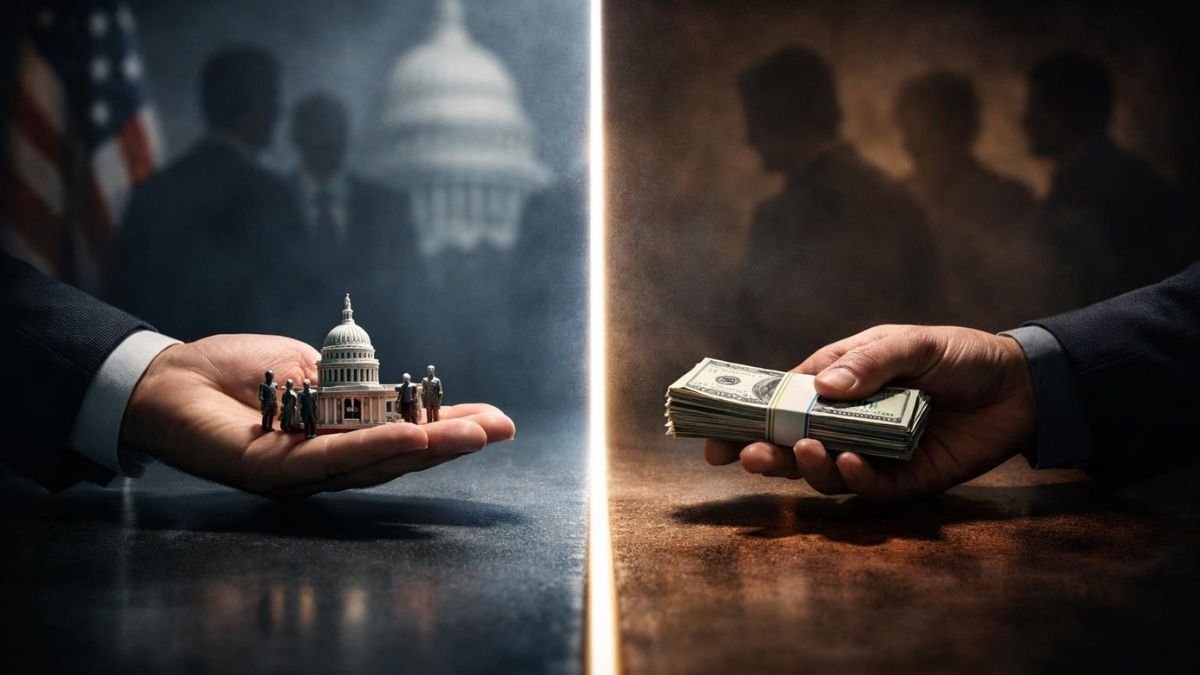
Welcome to the shadow game. In this first episode, we are going to dissect the anatomy of influence. We are going to walk the razor-thin wire between the constitutional right to petition the government and the corrosive practice of buying it. We are going to ask the uncomfortable question: at what precise dollar amount does a conversation become a crime?
The Right to Be Heard
To understand the distortion, we must first appreciate the design. Lobbying is not an aberration of democracy; it is, in many ways, its lifeblood. The term itself is often traced back to the lobby of the Willard Hotel in Washington D.C., where Ulysses S. Grant would enjoy his brandy and cigars while being pestered by petitioners seeking favors. However, the concept is enshrined much earlier, in the First Amendment of the United States Constitution, which guarantees the right “to petition the Government for a redress of grievances.”
In a vacuum, this is beautiful. If the government decides to build a highway through your living room, you have the right to march up to the Capitol and explain why that is a terrible idea. If you are a farmer and a new regulation threatens your crop yield, you have the right to educate the lawmakers—who likely have never held a shovel in their lives—about the agricultural realities of the situation.
This is the “pure” definition of lobbying: the transfer of expert knowledge to the powerful. We live in a world of staggering complexity. We cannot expect a Senator to be an expert on nuclear fusion, pharmaceutical patents, deep-sea drilling, and AI algorithms all before lunch. They rely on advocates to explain the stakes. In this light, lobbyists are merely tutors for the overworked student.
But here is the catch. Your access to the teacher depends entirely on your ability to pay the tuition. While you, the homeowner with the highway problem, have the right to petition, you likely lack the capacity to do so effectively. You cannot hire a former Congressman to make the call for you. You cannot fly the committee chairman to a golf retreat to discuss your living room. The legal framework assumes an equality of voice that simply does not exist in an economy of staggering inequality. The right to speak is universal; the ability to be heard is a luxury good.
The Currency of Access
This brings us to the “Pay-to-Play” reality. If bribery is the explicit exchange of money for a specific official act—a quid pro quo—then lobbying is the exchange of money for the opportunity to persuade.
The distinction is subtle but critical. In a bribery scenario, I give you ten thousand dollars, and you vote “yes” on Bill 101. That is illegal. You go to jail. In a lobbying scenario, I donate ten thousand dollars to your reelection campaign. I host a fundraiser for you. I ensure your Super PAC is well-fed. In return, you do not promise me a vote. You promise me something far more valuable: your time.
You promise that when I call, you will answer. You promise that when my team drafts a white paper on why Bill 101 is disastrous for the economy, you will read it. You promise that I will have a seat at the table when the legislation is being written.
This is where the water gets murky. Is it corruption? Legally, no. The Supreme Court has equated campaign spending with free speech. But functionally, it creates a tiered system of citizenship. The donor class buys access, and access buys influence. It is not that politicians are purely transactional villains twirling their mustaches. It is that they are human. If someone helps you keep your job (and reelection is the only job security they have), you are naturally inclined to listen to their grievances with a sympathetic ear.
It is a gift economy. I give you a gift (a donation), and while there is no contract stating you must reciprocate, social and political pressure dictates that you eventually will. It is a slow-motion bribe, laundered through the machinery of campaign finance laws, sanitized by bureaucracy, and accepted as “business as usual.”
The Revolving Door
If campaign donations are the fuel, the “Revolving Door” is the engine. This term describes the seamless movement of individuals between roles as legislators and regulators on one side, and members of the industries affected by the legislation and regulation on the other.
Picture a prominent staffer for a key Senator. This staffer spends ten years writing tax law. They know every loophole, every clause, and every exemption because they wrote them. They know which Senator is hesitant, which one is pliable, and what arguments work on whom. They are a master of the internal machinery.
One day, they decide to leave public service. Maybe they are tired of the low government salary; maybe they want to pay for their child’s university tuition. They are immediately hired by a major lobbying firm representing the very banks they used to regulate. Their salary quadruples overnight.
Why are they worth so much? Not because they are brilliant managers, but because they have the Rolodex. They can text the Senator. They can walk into the office of their former colleagues and say, “Hey, remember me? Let’s grab lunch.”
This creates a perverse incentive structure. If you are a regulator knowing that your future multi-million dollar salary depends on being hired by the industry you are currently policing, how hard are you going to crack down on them? Are you going to be the “tough cop” who burns bridges, or are you going to be “reasonable” and “cooperative,” signaling to your future employers that you are a team player?
The Revolving Door ensures that the culture of Washington (and London, and Brussels) remains insular. It creates a hive mind where the regulators and the regulated share the same social circles, the same values, and eventually, the same bank accounts. It blurs the line between public service and private profit until the line effectively vanishes.
The Illusion of Separation
So, where does advocacy end and corruption begin? The legal system draws a bright red line at the explicit trade of cash for votes. But the shadow game is played in the vast gray area leading up to that line.
It is played in the charity galas, the “fact-finding” trips to tropical resorts, the promise of future employment, and the unspoken understanding that money equates to speech. It is a system where the public interest is often outgunned by private capital, not because of a grand conspiracy, but because of the mundane, day-to-day mechanics of access.
We must understand that this is not a malfunction of the system; for those inside the engine room, the system is working exactly as intended. It is efficient, it is profitable, and it is stable. The only problem is that the ship is being steered by the mechanics, and the passengers on the upper deck are starting to wonder why they are heading toward an iceberg.
Understanding these mechanics is the first step in reclaiming the helm. We must look past the scandal of the week and focus on the plumbing. We must recognize that as long as access is for sale, the “fine line” between lobbying and bribery will remain nothing more than a semantic comfort for those holding the checkbook.
Critical Analysis: The Devil’s Advocate
Challenging the Narrative
We have just painted a rather grim picture of the political machine. We described a system rigged by money, oiled by cronyism, and divorced from the public good. It is a compelling narrative, one that resonates with our cynical instincts and confirms our suspicions that the “elites” are out to get us.
But before we light the torches and storm the castle, we need to pause. We need to engage in the uncomfortable practice of intellectual honesty. Is the story really that simple? Is lobbying purely a mechanism of corruption, or have we missed a vital piece of the puzzle? To truly understand power, we must strip away the moral outrage and look at the functional reality. Let us play the devil’s advocate and interrogate our own premises.
The Necessity of Expertise
The primary critique of lobbying is that it gives special interests undue influence. But let us consider the alternative. Imagine a Congress or a Parliament completely stripped of lobbyists. No corporate representatives, no union reps, no environmental advocacy groups. Just 500 or so elected officials and their young, inexperienced staff trying to regulate the entire modern world.
As mentioned in the main article, the complexity of modern governance is staggering. When Congress writes a bill to regulate cryptocurrency, or gene editing, or carbon capture technology, who explains the technical nuances? The politicians? Most of them are lawyers by trade, not cryptographers or geneticists.
Without the input of industry experts—yes, lobbyists—legislation would be written in a vacuum of ignorance. We would have laws that are technically impossible to implement or that accidentally crash entire sectors of the economy because the lawmaker didn’t understand the supply chain.
Lobbying, in this view, is an information subsidy. Corporations and interest groups spend millions of dollars doing the research that the government is too underfunded to do itself. They provide the data, the impact studies, and the technical language. Yes, that data is biased in their favor. But is biased data better than no data at all? A critical thinker might argue that a robust lobbying ecosystem, where competing interests (e.g., oil companies vs. renewable energy groups) both lobby aggressively, actually results in a more informed government. The clash of lobbyists forces the debate into the open.
The Myth of the “Public Interest”
We often speak of “Special Interests” as the villains and the “Public Interest” as the hero. But does the “Public Interest” actually exist? Or is it just a collection of millions of competing “Special Interests”?
When a teachers’ union lobbies for higher wages, that is lobbying. When a group of retirees lobbies for protecting Social Security, that is lobbying. When a civil rights group lobbies for police reform, that is lobbying.
If we demonize the mechanism of lobbying itself, we risk silencing the very tools that marginalized groups use to be heard. The same First Amendment that protects ExxonMobil protects the ACLU. You cannot sever the connection for one without severing it for the other.
Furthermore, the “Revolving Door,” which we critiqued as a source of corruption, can also be viewed as a pipeline of competence. If you want to regulate Wall Street effectively, you need people who understand how Wall Street cheats. You need poachers turned gamekeepers. If you ban anyone who has ever worked for a bank from working at the Securities and Exchange Commission, you end up with regulators who don’t understand the products they are regulating. They will be outsmarted at every turn. Is it better to have a conflicted expert or a pure novice? It is a trade-off, and trade-offs are rarely black and white.
The Limits of Money
There is a prevailing belief that the candidate with the most money always wins, and the lobbyist with the biggest checkbook always gets the law passed. While money is undoubtedly a massive advantage, the data suggests it is not a magic wand.
If money were the only factor, Jeb Bush or Michael Bloomberg would have been President of the United States. We have seen colossal failures of well-funded campaigns and legislative pushes. Why? Because ideology and voter sentiment still matter.
Lobbying is most effective on boring, technical issues that no one is watching. It is very easy to buy a tax break for a specific type of ball-bearing manufacturer because the public does not care about ball bearings. But on high-salience issues—like abortion, gun control, or healthcare—money hits a wall. A politician will not vote against the intense beliefs of their constituents just for a donation, because a donation is useless if you lose the election.
Therefore, the “Pay-to-Play” model has limits. It works in the shadows, yes, but it withers under the spotlight. This suggests that the antidote to the corruption of lobbying isn’t necessarily banning money (which drives it underground), but increasing transparency and public engagement.
The Virtue of Friction
Finally, let us consider that the “gridlock” caused by competing lobbyists might be a feature, not a bug. The American system, in particular, was designed to be slow. It was designed to prevent rapid, radical changes that could destabilize the nation.
When powerful lobbies clash—big tech vs. privacy advocates, insurers vs. doctors—they create friction. They stall legislation. While this is frustrating, it also prevents the government from careening wildly from one policy to another. It forces compromise. It forces a watering down of extreme ideas.
From this perspective, the “Shadow Game” is actually a stabilizing force. It ensures that before any major change happens, every powerful stakeholder has had a chance to scream, bargain, and negotiate. It is ugly, it is expensive, and it feels unfair. But it might just be the thing that keeps the ship from capsizing in a storm of populism or reactionary policy.
So, as we look at the fine line between advocacy and bribery, we must remain skeptical not just of the lobbyists, but of the simple solutions proposed to get rid of them. If we tear down the engine room because it is greasy, we might find that the ship stops moving altogether.
Let’s Discuss
To truly get a handle on how power works, we need to move beyond reading and start debating. Here are five questions designed to spark a deep conversation. When you answer these in the comments or with your peers, try to look past your initial gut reaction.
1. Is “access” a commodity that should be sold?
We accept that first-class tickets get you on the plane faster. We accept that expensive lawyers get you better justice. Why do we draw the line at political access? Is it possible to have a capitalist economy but a completely egalitarian political system, or will money always find a way to buy influence?
2. If you were a regulator, could you ignore your future job prospects?
Put yourself in the shoes of a government employee earning $80,000 a year, with a family to feed. You know that if you are “reasonable” with a tech company, they might hire you for $400,000 next year. Be honest—would this affect your decision-making? Is the “Revolving Door” a failure of morals, or a failure of incentive structures?
3. Should we ban the “Revolving Door” entirely?
Consider the consequences. If we say “No one who works in industry can work in government regulation,” do we lose all the experts? Would you trust a surgeon who has never been in an operating room to regulate hospitals? How do we balance expertise with impartiality?
4. At what point does a “gift” become a “bribe”?
The law says a direct trade (cash for vote) is a bribe. But what about a job for your son? What about a donation to your favorite charity? What about just being a really, really good friend who buys dinner? Try to define a strict rule that couldn’t be easily bypassed. It’s harder than it looks.
5. Is a “Special Interest” just a group of people you disagree with?
We love to hate special interests. But are you part of one? Do you own a home? Have student loans? Like national parks? If you advocate for any of these, you are a special interest. Discuss whether “lobbying” is inherently bad, or if it’s only bad when the “other side” does it.








0 Comments