Is it possible to look at something so closely that you stop being able to see it at all?
I think it is. I think it happens to us constantly, and I think there's a phrase that catches it perfectly — one of those phrases we usually say backwards, in the negative, as a warning. We say someone can't see the forest for the trees. And it's such an ordinary expression that we rarely stop to feel how strange and true the image actually is. So let's stop. Let's walk into the woods for a minute.
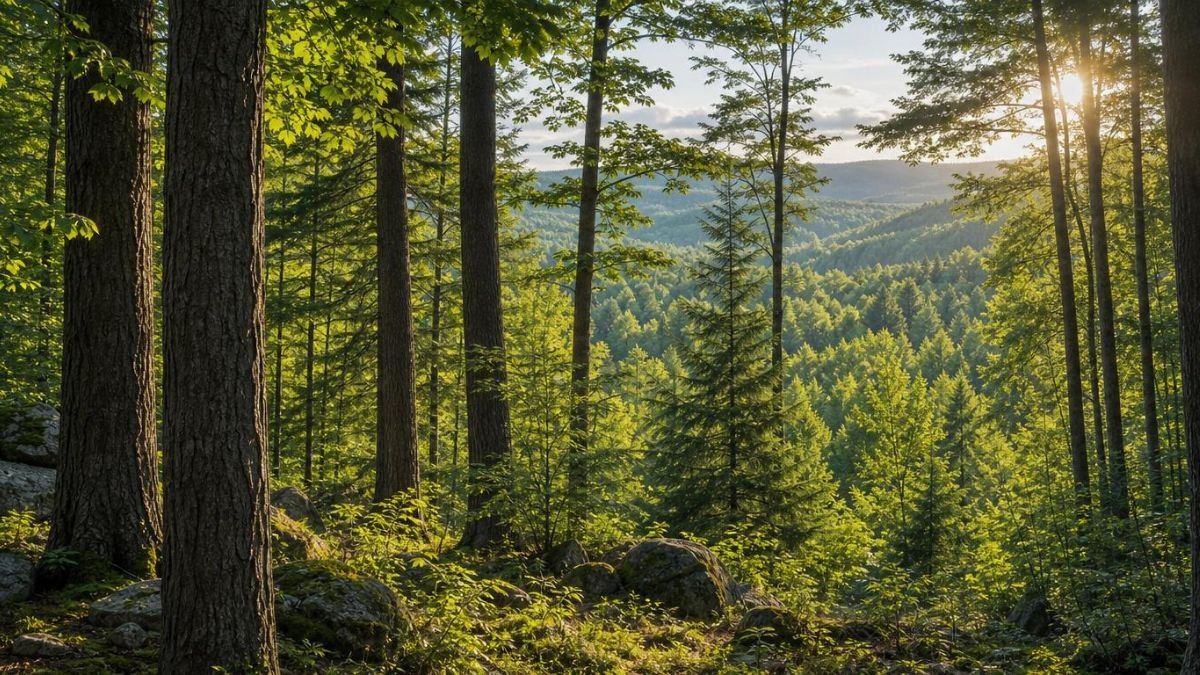
Picture it. You're standing in a forest, surrounded by trees. And you're looking at them closely — really closely. You can see the texture of the bark on this one, the exact pattern of moss, the way this branch forks, the veins in this particular leaf. You know these trees. You could describe each one in detail. And yet — because you're so close, because your face is practically against the bark — you have completely lost track of the fact that you're standing inside a forest. The individual trees are so vivid, so absorbing, so demanding of your attention, that the larger thing they add up to has become invisible to you. You can see every tree. You cannot see the forest. And the forest is the whole point.
That's the paradox at the heart of this phrase, and it's a genuinely strange one when you sit with it. It says that too much detail can blind you. That knowing the parts can stop you from seeing the whole. That there's a kind of attention so narrow, so zoomed-in, that it defeats itself — you become an expert on every leaf and lose all sense of the wood. And it happens precisely because you're paying attention, not because you're careless. The trees aren't a distraction from the forest. The trees are what the forest is made of. That's what makes it so easy to get lost in them.
And once you feel the image, you start to notice how much of life works this way. Think about a problem you've been chasing — really chasing, in the weeds of it, obsessing over each detail. And how often the answer only comes when you finally step back, when you go for a walk, when you stop staring at the individual trees long enough for the shape of the forest to reappear. The distance isn't laziness. The distance is what lets you see. You couldn't see the pattern up close because up close there is no pattern — there are only trees. Pattern is a thing that only appears from far away.
Or think about your own life. It's so easy to spend your days deep among the trees — this task, this worry, this errand, this small urgent thing and then the next small urgent thing — and to lose, for months or years, any sense of the forest. Where is all of this going? What shape is my life actually making? Am I even walking toward the place I meant to walk toward? You can be so busy, so absorbed in the vivid detail of each day, that you never once step back far enough to see the whole. And you can know your life intimately — every tree of it — and still have no idea what forest you're standing in.
That's the quiet warning inside this phrase. Detail is seductive. The individual tree is right there, in high resolution, demanding your focus, and it feels productive to attend to it. Zooming out feels like abstraction, like leaving the real work. But the forest is real too. The whole is real. And it can only be seen from a distance you have to deliberately choose to take, because nothing in the daily press of trees will ever offer it to you. You have to step back on purpose. You have to lift your face from the bark.
But — and here's where I want to be fair, because I love this word and I don't want to make it a simple lesson — the trees matter. This isn't a phrase against detail. A forest is nothing but trees; there's no forest hiding behind them, no separate thing you could go and look at instead. The whole is genuinely made of the parts. And the person who only ever sees forests — who floats at forty thousand feet and never touches a single leaf — misses everything real, too. They have the shape and none of the substance. So the phrase isn't telling you the trees don't matter. It's telling you that seeing requires both — the close and the far, the leaf and the landscape — and that we humans, by our nature, tend to get stuck in the close and forget the far.
That's the skill, then, and it's a rare one: the ability to move between the two. To lean in close enough to know the bark, and then to step back far enough to see the wood. To honor the detail and hold the whole. Most of us can only do one at a time, and most of us default to the trees, because the trees are loud and near and now. The forest waits, patient and silent, for the moment we remember to look up.
So maybe the invitation in this old phrase is simpler than it sounds. Every so often — in your work, in your worry, in your one wild and detailed life — take a step back. Not forever. Just for a moment. Lift your face from the tree you've been pressed against, and let your eyes go soft, and see what larger thing all these trees have been quietly making all along.
Here's what I'll leave you standing among. If it's possible to know every tree and still miss the forest — then what forest have you been standing inside for so long, so busy with the trees, that you've forgotten to step back and see what your life is actually becoming?



0 Comments