- The Shattering: Why We Break
- Kintsugi: The Art of Golden Repair
- The Five Pillars of Growth
- The Mechanism: From Rumination to Reconstruction
- The Danger of Toxic Positivity
- The Scar is a Map
- Focus on Language
- Critical Analysis
- Let’s Discuss
- Fantastic Guest: An Interview with Ludwig van Beethoven
- Let’s Play & Learn
- Check Your Understanding (Quiz)
We have a script for trauma. It is written in the ink of damage. It tells us that when the earthquake hits—when the diagnosis comes, when the car crashes, when the marriage implodes—we are broken. We look at the pieces of our lives scattered on the floor and we assume that, at best, we can glue them back together and look somewhat like we used to, but with visible, ugly cracks. We assume that the best-case scenario is “recovery,” which is just a fancy word for getting back to zero.
But what if zero isn’t the ceiling? What if it’s the floor?
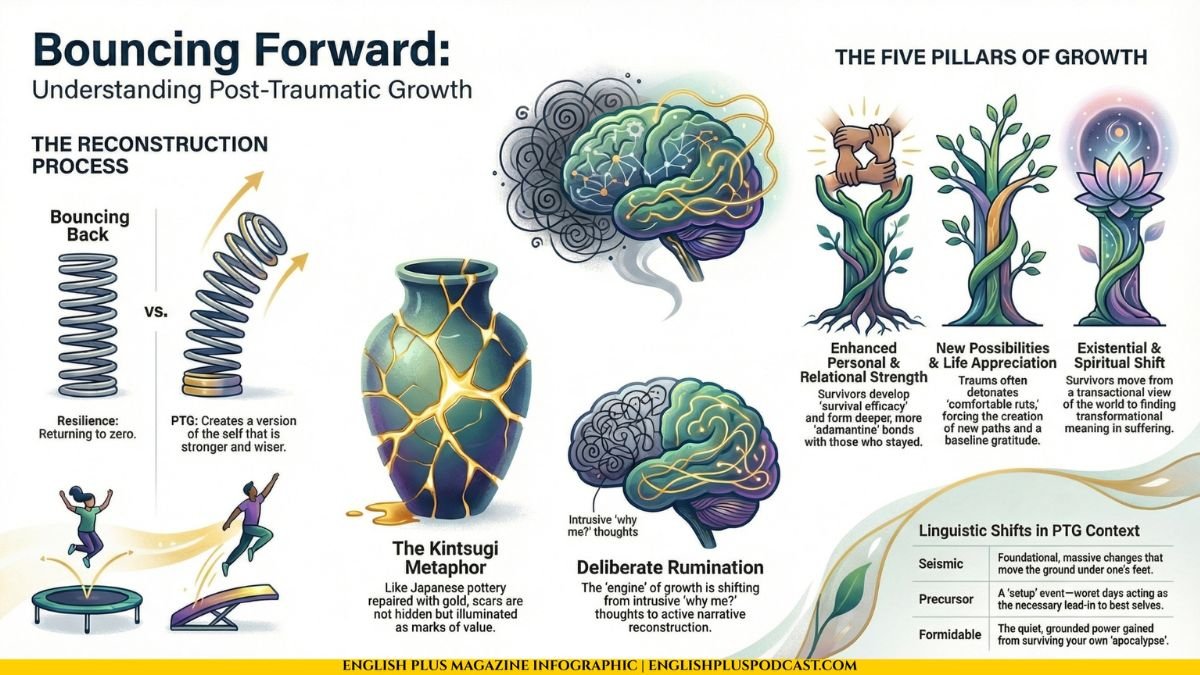
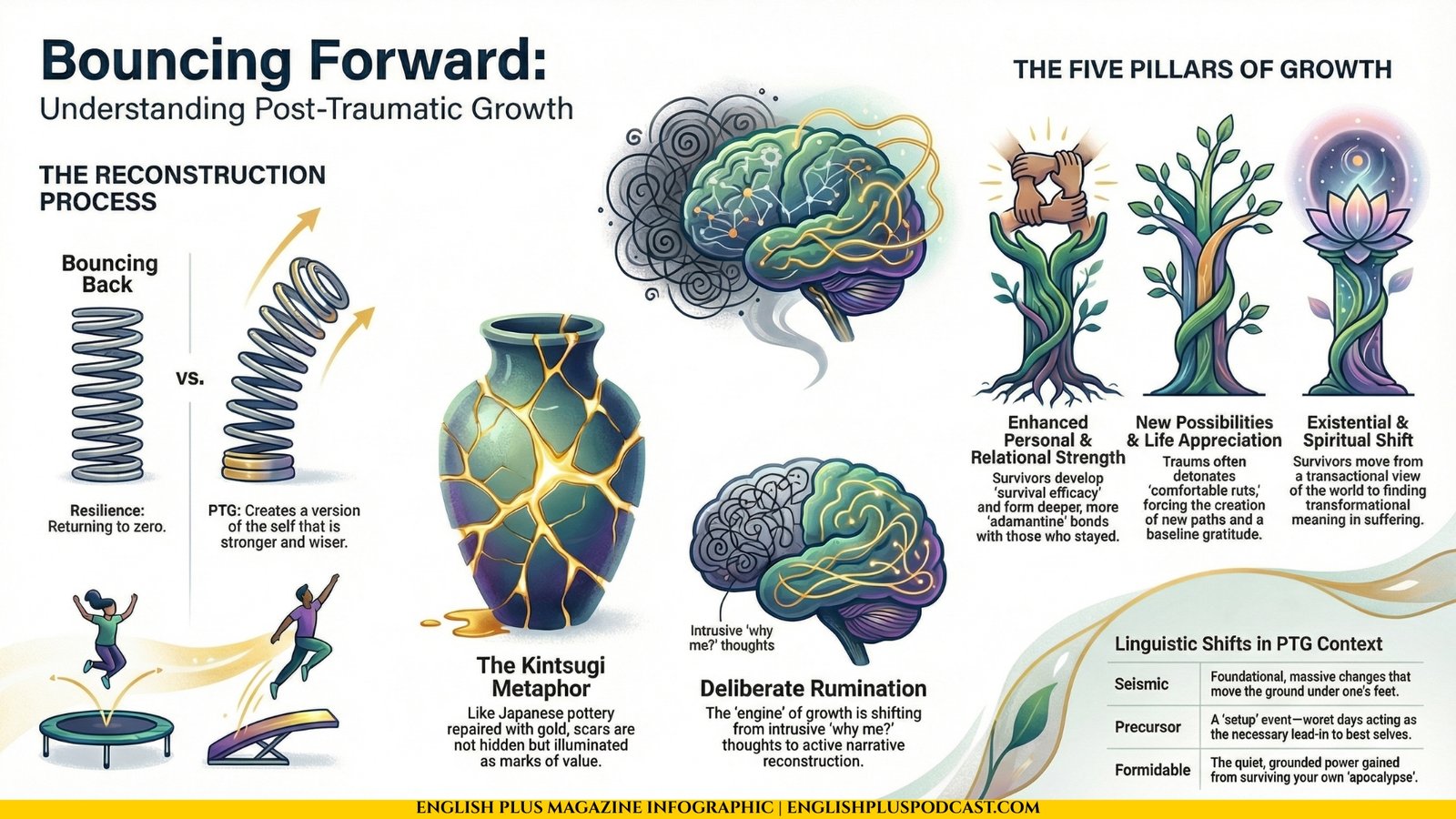
There is a concept in psychology that doesn’t get the headlines because it doesn’t bleed, and as the newsroom saying goes, “if it bleeds, it leads.” It’s called Post-Traumatic Growth (PTG). It suggests that while trauma is undeniably terrible, it is not purely destructive. For a significant number of people, the seismic event that destroys their world also clears the ground for a new, stronger, and more complex structure to be built. This isn’t about looking on the bright side or pretending that suffering is good. It is about the paradox that our worst days can be the necessary precursors to our best selves.
The Shattering: Why We Break
To understand growth, we first have to respect the shattering. We cannot skip the pain. Trauma works because it destroys our “assumptive world.” We all walk around with a set of unconscious beliefs: “The world is generally safe,” “Good things happen to good people,” “I am in control of my life.” These beliefs are the invisible floorboards we walk on.
When trauma strikes, it doesn’t just hurt us; it rips up the floorboards. Suddenly, the world is unsafe. Control is an illusion. The narrative arc of our life has been snapped in half. This is the crisis of meaning. The depression and anxiety that follow are often the brain’s frantic attempt to process a reality that no longer fits the old map. We are lost in the woods, and our compass is broken.
The “Damaged Goods” narrative tells us that this is the end of the story. You are the victim. You are the survivor. You are the one with the scar. And while those identities are real, they are static. They describe what happened to you, not what you can become. The theory of Post-Traumatic Growth argues that the very act of trying to put the map back together is what expands our cognitive and emotional territory.
Kintsugi: The Art of Golden Repair
Not Bouncing Back, But Bouncing Forward
You might have heard the term “resilience.” We usually define resilience as “bouncing back.” Imagine a rubber ball. You throw it at the floor, it distorts for a millisecond, and then returns to its original shape. That is resilience. But humans are not rubber balls. When we hit the floor, we don’t return to our original shape. We are changed indelibly.
Post-Traumatic Growth is different. It is more like the Japanese art of Kintsugi. When a valuable ceramic bowl breaks, the artisan doesn’t throw it away, nor do they try to hide the cracks with invisible glue. Instead, they rejoin the pieces with a lacquer mixed with powdered gold. The result is a bowl that is technically “broken” but is now more beautiful, more valuable, and stronger than the original intact bowl. The history of the break is not hidden; it is illuminated.
This is “bouncing forward.” It is the realization that the pre-trauma version of you—as innocent and happy as they might have been—was perhaps a bit fragile, a bit naive, or a bit asleep at the wheel. The post-trauma version is awake. The post-trauma version knows the value of a Tuesday afternoon because they know what it’s like to almost lose all future Tuesdays.
The Five Pillars of Growth
Researchers Richard Tedeschi and Lawrence Calhoun, who coined the term PTG in the 90s, identified five specific areas where this growth tends to manifest. It’s rarely a lightning bolt of enlightenment; it’s usually a slow, grinding shift in perspective.
Personal Strength
There is a specific kind of confidence that comes from surviving your own apocalypse. It is the quiet realization: “I am still standing.” Before the event, you might have worried about traffic, or social awkwardness, or a bad hair day. After you survive the divorce, the cancer, or the loss, those small anxieties evaporate. You develop a “survival efficacy.” You know, in your gut, that you can handle pain. The monster came out from under the bed, and it didn’t eat you. That knowledge makes you formidable. You walk through the world with a heavier step, not from burden, but from grounding.
Closer Relationships
Trauma is a powerful filter. It separates the wheat from the chaff in your social circle. When you are in the hospital, or in deep grief, you quickly learn who your real friends are. The drinking buddies vanish. The fair-weather friends stop calling because your sadness is “too heavy” for them. But the people who stay? The bonds with them become adamantine.
Furthermore, suffering creates a bridge of empathy. When you have suffered, you recognize the suffering in others. You stop judging and start connecting. The superficial chatter about the weather or celebrity gossip becomes intolerable, and you find yourself craving—and creating—deep, substantive conversations. You become a person who can sit in the dark with others, and that is a magnetic quality.
Appreciation for Life
This is the cliché that turns out to be profoundly true. When you almost lose your life, or the life of someone you love, the “background noise” of existence becomes a symphony. The taste of coffee, the feeling of wind on your face, the sound of your child laughing—these things stop being routine and start being miraculous.
This isn’t a constant state of euphoria. You still get annoyed when the internet is slow. But underneath the annoyance, there is a baseline of gratitude that wasn’t there before. You stop postponing joy. You eat the cake. You take the trip. You say “I love you” before hanging up the phone, every single time, because you know that “later” is not guaranteed.
New Possibilities
When the old life burns down, the plot is forced to change. Many people find that trauma pushes them off a path they didn’t even realize they hated. The high-powered executive who has a heart attack might finally quit the job to open a bakery. The widow might start a foundation. The survivor might write a book. The “closed door” metaphor is tired, but accurate. Trauma often detonates the comfortable rut we were stuck in. It forces us to ask, “If I’m not that person anymore, who do I want to be?” It clears the calendar of obligations and fills it with choices.
Spiritual and Existential Change
This doesn’t necessarily mean finding religion, though for some it does. It means engaging with the Big Questions. Why are we here? What does it mean to live a good life? When you stare into the abyss, the abyss stares back, and you are forced to formulate a philosophy that can withstand the darkness. You move from a transactional view of the universe (“If I am good, good things happen”) to a transformational view (“Bad things happen, and I must find meaning in them”).
The Mechanism: From Rumination to Reconstruction
How does this happen? Why do some people collapse while others grow? It’s not about being “stronger” or “better.” It often comes down to how we think.
The Cognitive Engine
The engine of PTG is, surprisingly, worry. Or rather, a specific kind of thinking called rumination. Immediately after trauma, we experience “intrusive rumination.” Thoughts of the event invade us. It’s unwanted and painful. But over time, for those who experience growth, this shifts into “deliberate rumination.”
This is the hard work of story-editing. It’s sitting down with the wreckage and asking, “How do I integrate this into my life story?” It is the difference between asking “Why did this happen to me?” (which usually leads to despair) and asking “Now that this has happened, what do I do?” (which leads to growth). It is the narrative reconstruction of the self.
The Danger of Toxic Positivity
We must be incredibly careful here. Discussing Post-Traumatic Growth is dangerous because it can easily slide into “Toxic Positivity.” We have all met that person who, upon hearing about a tragedy, immediately says, “Well, everything happens for a reason!” or “What doesn’t kill you makes you stronger!”
I want to be clear: Those people are annoying, and that sentiment is harmful.
Growth is not a requirement. It is not a moral duty. If you go through trauma and you just survive, that is enough. You don’t owe the world an inspirational story. We should never pressure a victim to “find the silver lining” while they are still bleeding. Growth is a byproduct of processing pain; it is not a replacement for the pain. You can be grieving and growing at the same time. You can be furious at what happened to you, and yet appreciative of who you have become. The two realities can coexist.
The Scar is a Map
We need to rewrite the cultural script. We need to stop viewing the traumatized person solely as a victim to be pitied, and start viewing them as an initiate who has survived a trial by fire. They have knowledge the rest of us don’t have. They have touched the electric fence of existence and lived to tell the tale.
If you are in the thick of it right now, if you are looking at the shards of your life and thinking there is no way to fix this, you are right. You can’t fix it. You can’t go back to who you were. That person is gone. But the person who comes next? The one who is forged in this fire? They might just surprise you. They might possess a depth, a gratitude, and a strength that the old you couldn’t even imagine. The earthquake destroys the house, yes. But it also reveals the foundation. And upon that foundation, you can build something unbreakable.
Focus on Language
Let’s get into the machinery of the words we just used, because if we want to change our thinking, we usually have to upgrade our vocabulary. The words we use to describe our experiences actually shape those experiences—it’s a linguistic feedback loop.
First off, let’s talk about Seismic. I used this to describe the event that causes trauma. Literally, this refers to earthquakes—seismic waves. But in conversation, we use it to describe any change that is foundational and massive. You wouldn’t call a bad haircut a seismic shift (unless you really, really loved that hair). But a change in government, a divorce, or a technological breakthrough like AI? Those are seismic. It implies the very ground under your feet has moved. You can say, “The company went through a seismic reorganization last month.”
Then there’s the word Precursor. I said our worst days can be precursors to our best selves. A precursor is something that comes before another thing and influences its development. It’s not just “before”; it’s a setup. Thunder is a precursor to a storm. In chemistry, a precursor is a substance from which another is formed. In real life, you might say, “Lack of sleep is often a precursor to a bad mood,” or “This internship is a precursor to a full-time job.” It links the past to the future causally.
I love the word Indelibly. I mentioned that we are changed indelibly. This comes from “indelible ink”—ink that cannot be erased. If something marks you indelibly, it marks you forever. It’s permanent. A memory can be etched indelibly in your mind. A scandal can indelibly stain a reputation. It’s a serious word. You don’t use it for something fleeting. It carries the weight of “forever.”
We talked about the Assumptive world. This is a bit of a psychological term, but it’s useful. Your assumptions are the things you believe without checking. An “assumptive world” is the bubble of safety we live in. We assume the sun will rise. We assume the brakes will work. When that breaks, we feel trauma. You can use “assumptive” to describe someone who takes things for granted. “He has an assumptive attitude, acting like he’s already got the job.”
Let’s look at Manifest. I said growth tends to manifest in five areas. To manifest means to show itself, to become visible or obvious. A disease manifests symptoms. A ghost manifests in a haunted house. In modern slang, people talk about “manifesting” their dreams (thinking them into reality), but in the classic sense, it just means “appearing.” You can say, “His stress manifested as a severe headache.”
I used the word Formidable. This is a great compliment, but it has an edge to it. A formidable person is someone who inspires respect, and maybe a little bit of fear, because they are powerful or capable. An opponent in a game can be formidable. A task can be formidable (meaning difficult). If you survive trauma, you become formidable. You aren’t just “nice”; you are strong in a way that demands respect. “She is a formidable negotiator.”
Then we have Adamantine. I used this to describe bonds between friends. This is a poetic word meaning unbreakable or extremely hard, like a diamond. In fact, “diamond” and “adamant” come from the same root. If you are “adamant” about something, you are refusing to change your mind. If a friendship is adamantine, nothing can crack it. It’s a very rich, heavy word to use when “strong” just isn’t enough.
We touched on Existential. This relates to existence. But usually, it refers to the deep, heavy questions about meaning, life, and death. An “existential crisis” is when you panic about the meaning of life. You can use this whenever things get deep. “I’m having an existential dread about turning 40.” It sounds smart and covers a lot of philosophical ground.
Let’s discuss Rumination. This is the act of chewing the cud, like a cow. But mentally, it means thinking about the same thing over and over again. It’s usually negative—looping on a worry. “Stop ruminating on that awkward comment you made.” But as we learned, there is “deliberate rumination,” which is problem-solving. It’s a key word for mental health.
Finally, Paradox. A paradox is a statement that seems contradictory but is actually true. “The only constant is change” is a paradox. Post-Traumatic Growth is a paradox because bad things produce good results. Life is full of them. “You have to spend money to make money.” Use this word when you want to highlight the complexity of a situation. “It’s a paradox: he’s the most famous person in the room, yet the loneliest.”
Now, for the speaking section. I want to give you a challenge involving the word Reframing. This isn’t just a vocab word; it’s a skill. Reframing is taking a set of facts and looking at them through a different narrative lens.
Here is your assignment: I want you to take one minor negative event from this week. Maybe you burned dinner. Maybe you got stuck in traffic.
First, say it as a tragedy. “I burned dinner and I am a failure and now I’m hungry.”
Now, I want you to reframe it using the concept of a precursor.
“Burning dinner was a precursor to us ordering pizza and having a fun, spontaneous picnic on the living room floor.”
Do you see that? The facts didn’t change (the dinner is still burnt), but the meaning changed. Practice this out loud. Record yourself telling the story of a “bad” thing that turned into a “good” thing. This is how we practice the grammar of resilience.
Critical Analysis
Now, I want to pivot. We have been painting a picture of trauma as a potential chrysalis for growth. It’s a beautiful narrative. It’s hopeful. And because it is so seductive, we need to be extremely skeptical of it. As a critical thinker, your alarm bells should be ringing whenever a story wraps up pain in a neat little bow. Let’s play the devil’s advocate and look at the dark side of the “Growth” narrative.
First, we must interrogate the “Tyranny of Positive Thinking.” By popularizing the idea that “trauma leads to growth,” do we inadvertently create a new standard of performance for victims? Imagine a woman who has lost her child. She is paralyzed by grief. Then she turns on the TV and sees a segment about a mother who started a non-profit after losing her son. She reads articles about “Post-Traumatic Growth.” Suddenly, she feels a double burden: she is grieving her child, and she feels guilty for not “growing” enough. She feels like she is failing at trauma. This concept can become a weapon used against those who are simply trying to survive. We risk pathologizing normal, messy, non-productive grief. Sometimes, a tragedy is just a tragedy, and there is no lesson to be learned.
Secondly, we need to examine “The Justification of Suffering.” There is a philosophical danger here. If we argue that trauma makes us better, stronger, and deeper people, do we risk justifying the trauma itself? You hear this in phrases like, “I wouldn’t change a thing because it made me who I am.” While that is a valid personal sentiment, on a societal level, it can lead to complacency. If poverty builds character, why fix poverty? If systemic abuse builds resilience, why dismantle the system? We must be very careful not to let the concept of PTG become a PR campaign for suffering. We can acknowledge that someone grew despite the trauma, without implying they grew because of it—or that the trauma was “necessary” for their development.
Third, let’s look at “Survivorship Bias.” The studies on Post-Traumatic Growth often rely on self-reporting. Who is most likely to volunteer for a study about growth? People who feel they have grown. Who is writing the memoirs? The survivors who found a new purpose. We rarely hear from the people who were simply crushed. There are people for whom trauma was not a catalyst, but a cage. By focusing so heavily on the growth stories, we erase the reality of those who are permanently diminished by their experiences. We risk creating a binary: the “Good Survivor” who writes a book and runs a marathon, and the “Bad Survivor” who never quite gets back on their feet. This is a cruel distortion of reality.
Furthermore, is PTG actually “growth,” or is it a “Positive Illusion”? Some psychologists argue that reporting “growth” is actually a coping mechanism. It’s a way for the brain to reduce dissonance. “This terrible thing happened, and if it was for nothing, I will go crazy. Therefore, I must decide it made me stronger.” Is that true growth, or is it a comforting lie we tell ourselves to keep going? And does it matter? If the illusion keeps you alive, is it valid?
Finally, we have to consider the “Pre-Traumatic Wisdom” alternative. Why is the narrative always that we need to be broken to be fixed? This suggests that human beings are incapable of learning depth, empathy, and gratitude through joy, education, or quiet contemplation. Why do we fetishize the “school of hard knocks”? We should critically examine why our culture respects the wisdom of the sufferer more than the wisdom of the joyful. Is it because we don’t believe happiness can be profound?
The theory of Post-Traumatic Growth is a vital tool for hope, but it must be handled with gloves. It is a possibility, not a promise. And it certainly isn’t a requirement.
Let’s Discuss
Here are five questions to get you thinking, debating, and maybe even arguing in the comments. I don’t want the easy answers; I want the messy ones.
1. Is “What doesn’t kill you makes you stronger” a lie?
Friedrich Nietzsche said it, and Kelly Clarkson sang it. But is it true? Does trauma really strengthen us, or does it just toughen us—which is different? Can you be stronger in some ways and weaker in others (e.g., more empathetic but more anxious)?
2. Is a scar a badge of honor, or just a scar?
We often romanticize scars (physical or emotional) as proof of survival. But is there value in simply wanting to be healed and whole? Do we have to define ourselves by what hurt us? Is it okay to just want the scar to fade?
3. Can you force growth, or does it have to happen naturally?
If you are in the middle of a crisis, can you “decide” to grow? Or is that like pulling on a plant to make it grow faster? Discuss the balance between active effort (therapy, journaling) and passive time.
4. How do we support a friend without demanding they “look on the bright side”?
We’ve all been the friend who doesn’t know what to say. How do we validate their pain without wallowing in it? How do we hold space for their potential growth without pressuring them to get there before they are ready?
5. Is it possible to gain this wisdom without the trauma?
Can we learn the lessons of “Post-Traumatic Growth” through literature, meditation, or empathy? Or is there a specific type of knowledge that is only accessible through direct suffering? If so, is that fair?\
Fantastic Guest: An Interview with Ludwig van Beethoven
Danny: Ladies and gentlemen, welcome to the Fantastic Guest segment. We have been talking about “Post-Traumatic Growth”—the idea that when life shatters you, you don’t just put the pieces back together; you build something entirely new. You build a cathedral out of the rubble.
When I thought about who embodies this, I didn’t want a psychologist. I didn’t want a motivational speaker. I wanted someone who stared into the absolute abyss of his own worst nightmare and screamed back at it until it turned into music. He is the Titan of the Romantic era. He lost the one sense he needed most—his hearing—and yet, in that silence, he wrote the loudest, most triumphant sounds in human history. Please welcome the Maestro, the rebel, the man who definitely needed a hug but probably would have punched you if you gave him one… Ludwig van Beethoven. Ludwig, welcome.
Beethoven: You speak very fast. Even for a ghost, you are exhausting. And your coffee is weak. It tastes like dishwater from a tavern in Bonn.
Danny: I’m sorry, Ludwig. It’s a Keurig. It’s convenience over quality. A very modern problem.
Beethoven: Convenience is the enemy of art. You want good coffee? You grind the beans. You count them. Sixty beans per cup. No more, no less. That is discipline. That is how you start a symphony.
Danny: Sixty beans exactly? That sounds a bit… obsessive.
Beethoven: It is precise. The universe is mathematical, Danny. Music is math with a soul. Coffee should be the same. But I am not here to critique your bean water. You summoned me. You want to talk about my misery.
Danny: Well, not just your misery. Your growth. We’re discussing a theory called “Post-Traumatic Growth.” The idea is that trauma can be a catalyst for becoming a more profound person. You went deaf at the height of your career as a virtuoso pianist. For a musician, that isn’t just a tragedy; it’s a cosmic joke. It’s an irony so cruel it feels biblical.
Beethoven: It was not a joke. A joke has a punchline. This had only silence. Imagine, Danny, that you are a painter, and day by day, the world turns grey. First the blue goes. Then the red. Then the yellow. Until you are painting in the dark. That was my life. I heard the humming in my ears. The buzzing. Like a hive of bees inside my skull. I tried everything. Almond oil. Galvanism. Tieing wet bark to my arms until they blistered. Doctors are fools. They told me to “avoid loud noises.” I am a composer! Loud noises are my profession!
Danny: In 1802, you went to a small town called Heiligenstadt. You wrote a letter to your brothers—the famous “Heiligenstadt Testament.” You basically admitted you were contemplating suicide. You wrote, “I would have ended my life—it was only my art that held me back.”
Beethoven: I remember. It was October. The leaves were turning. It was beautiful, and I could hear none of it. I saw a shepherd playing a flute in the distance. I saw his fingers moving. I strained my ears until they hurt. And… nothing. Just the wind in my mind. That was the moment I realized I was broken. The “Strongman”—as you called him in your other article—was dead. I was humiliated. How could I say to people, “Speak louder, shout, for I am deaf”? I, who should have had more perfect hearing than anyone else! It was shameful.
Danny: But you didn’t kill yourself. You came back from Heiligenstadt and you entered what music historians call your “Heroic Period.” You wrote the Eroica Symphony. You changed music forever. Was that the “growth”? Did the trauma force you to change your style?
Beethoven: It forced me to change my instrument. Before the silence, I was a pianist. I was a performer. I needed the applause. I needed the audience to love me. When the silence came, I could no longer perform. I could not hear their clapping. I could not hear the delicate high notes on the keyboard. So, I had to retreat. I had to go inside.
Danny: Into the “interiority” we talked about?
Beethoven: Into the cave. When the outside world goes quiet, the inside world gets very loud. I stopped writing music to please the Viennese aristocracy. I stopped writing pretty tunes for ladies to play in their parlors. I started writing the sounds of my own struggle. The Eroica is not a pretty song, Danny. It is a war. It is a man fighting Fate. Bam! Bam! Those chords! That is me punching the wall. If I could not hear the gentle notes, I would write notes so big, so heavy, that even God would have to hear them.
Danny: So, the aggression in your music—the sudden loud crashes, the intensity—that was a direct result of the deafness?
Beethoven: It was a result of the rage. You talk about “growth” as if it is a gentle flower blooming. “Oh, look, I have trauma, now I am a better person, tra-la-la.” No. Growth is violent. Growth is a forest fire. It burns everything down, and then, from the ash, something new grows. But the fire hurts. I was angry. I was furious at God. I grabbed Fate by the throat. I told Him, “You will not crush me.” My music became the weapon I used to fight back.
Danny: That connects to the concept of “Survival Efficacy” we discussed. The feeling of “I am still standing.” You realized that if the deafness didn’t kill you, nothing could.
Beethoven: Precisely. Once you have lost the most important thing, you are free. What else could they take from me? My money? I never had much. My love? I never could keep a woman anyway. My reputation? Let them say Beethoven is mad. Let them say he is a misanthrope. I am writing for the future. I am writing for the people who will understand that suffering is not the end of the story.
Danny: Let’s talk about the Kintsugi concept—repairing the broken bowl with gold. In your later years, when you were completely stone deaf, you wrote the Late String Quartets. They are… weird. They are jagged, dissonant, beautiful, and terrifying. Stravinsky called the Grosse Fuge “an absolutely contemporary piece of music that will be contemporary forever.” Do you think those pieces were the gold lacquer? Were you highlighting the cracks?
Beethoven: I was no longer interested in “continuity.” Life is not continuous. Life is interrupted. You are walking down the street, happy, and then—tragedy. You are in love, and then—betrayal. The Late Quartets are like that. They start, they stop. They scream, they whisper. They are fractured. I stopped trying to smooth over the edges. I let the music be broken. And in that brokenness, there is a truth that a perfect Mozart symphony can never touch.
Danny: Wow. Shots fired at Mozart.
Beethoven: Mozart is a garden. Beautiful, manicured. I am a mountain range. Dangerous, jagged. You go to a garden to relax. You go to the mountains to find God.
Danny: That is the most “Beethoven” thing you have ever said. But let’s play devil’s advocate, like I do in the article. One of the pillars of Post-Traumatic Growth is “Closer Relationships.” Ludwig… you were not known for your people skills. You threw eggs at your housekeeper. You got into fistfights with your brothers. You were evicted from dozens of apartments. Did trauma really make you better at relationships?
Beethoven: It made me terrible at relationships with individuals, but it made me fall in love with Humanity.
Danny: Explain that distinction.
Beethoven: When you are deaf, Danny, individual conversation is a torture. It is humiliating. People shout. They make faces. They write in those cursed conversation books. It is exhausting. So I withdrew. I became a “hostile” man because I was a frightened man. I pushed people away before they could reject me for my infirmity.
But… in my isolation, I began to think about what binds us all together. The suffering. The longing for joy. The desire for freedom. I couldn’t connect with Hans or Franz or Marie in the drawing room. But I could connect with the Soul of Mankind. The Ninth Symphony… the “Ode to Joy”… that is not a song for a friend. That is a song for the species. “All men become brothers.” I couldn’t be a brother to my own brothers, so I tried to be a brother to the world.
Danny: That’s a paradox. You were the loneliest man in Vienna, writing the ultimate anthem of connection.
Beethoven: Paradox is the only truth. Only a man in the dark knows the value of light. Only a man in silence knows the value of sound. And only a man who is utterly alone can understand the desperate, burning need for togetherness. If I had been happy, social, married, with five children… I would have written happy little dances. I would not have written the Ninth. You have to be starving to write about the feast.
Danny: “You have to be starving to write about the feast.” That is haunting. It reminds me of the “Appreciation for Life” pillar. Did you appreciate life? Or did you just endure it?
Beethoven: I appreciated the struggle of life. I appreciated nature. I took long walks in the Vienna Woods, every day, rain or shine. I loved a tree more than a man. A tree doesn’t judge you. A tree doesn’t ask why you haven’t published a new sonata lately. In nature, I felt the vibrations of the divine. That was my appreciation. I didn’t appreciate “parties” or “small talk.” I appreciated the raw force of existence.
Danny: We talked about “Toxic Positivity” in the article. The idea that people try to force a silver lining on tragedy. If someone had come up to you in 1802 and said, “Hey Ludwig, don’t worry, everything happens for a reason! This deafness is actually a blessing in disguise!”… what would you have done?
Beethoven: I would have thrown a chair at them.
Danny: I believe you.
Beethoven: It is an insult. It insults the pain. Suffering is not a “strategy” for self-improvement. Suffering is suffering. It creates a hole. You have to build a bridge over the hole, yes. But do not tell me the hole is a “gift.” The hole is a hole. I built the bridge because I had to get to the other side, not because I liked the view of the abyss.
People who say “what doesn’t kill you makes you stronger” usually haven’t been almost killed. Sometimes, what doesn’t kill you just leaves you with a limp. And you have to learn to dance with the limp. That is the triumph. Not the “strength,” but the dance.
Danny: “Dancing with the limp.” I like that. It’s more realistic. You mentioned the “Ode to Joy” earlier. I want to talk about that moment. The premiere of the Ninth Symphony. You were on stage, conducting, but you couldn’t hear the orchestra. You were waving your arms, but the music had already stopped. The alto soloist, Caroline Unger, had to turn you around so you could see the audience clapping.
Beethoven: I remember her hand on my shoulder. Gentle. I turned. I saw the handkerchiefs waving. I saw the mouths open in a roar. I saw the tears on their faces. It looked like a silent movie.
Danny: What did you feel in that moment? Was it joy? Or was it grief?
Beethoven: It was… vindication. It was the proof that I had won. The silence had tried to bury me, and I had dug my way out with notes I couldn’t even hear. It wasn’t “happiness,” Danny. Happiness is for children. It was Victory. That is the “Post-Traumatic” part. The trauma happened. The trauma stayed. But the Victory stood on top of it.
Danny: You often signed your letters, “Ever thine, Ever mine, Ever ours.” You had this intense longing. But you also wrote, “Power is the morality of men who stand out from the rest.” You seem to oscillate between needing love and needing power. Do you think trauma makes us more selfish, or more selfless?
Beethoven: It makes us more focused. When you are in pain, your world shrinks to the size of the pain. It is very hard to be selfless when you are in agony. That is the lie of the saints. Pain makes you selfish. It makes you obsessed with your own relief.
But… art. Art is the escape hatch. When I wrote, I wasn’t Beethoven the deaf guy. I was the vessel. I was pouring the pain out of my body and into the ink. Once it is on the page, it is no longer mine. It belongs to you. So, the process is selfish, but the result is selfless. I gave my pain to the world, so the world could use it to heal their own.
Danny: That’s a beautiful way to put it. You metabolized the pain for us.
Beethoven: “Metabolized.” A biological word. I like it. Yes. I ate the poison and sweat out the antidote.
Danny: I have to ask you about the modern world. You’re a ghost, so I assume you’ve seen what’s happened to music. We have electric guitars, synthesizers, sub-bass. As a man who was obsessed with vibration—you cut the legs off your piano so you could feel the floor shake—what do you think of modern music?
Beethoven: I like the heavy metal.
Danny: You do?
Beethoven: Of course. It is loud. It is angry. It is complex. This band… Metallica? They understand the Eroica. They understand the punch. And the techno music. The bass that rattles your ribcage? That is what I was trying to do! I was trying to make the orchestra rattle the ribcage! But I only had violins and cellos. If I had a subwoofer… Mein Gott. I would have cracked the foundations of the concert hall.
Danny: Beethoven dropping the bass. I would pay good money to see that DJ set.
Beethoven: “DJ Ludwig.” No. It sounds undignified. But the principle is the same. Music must be felt. If you only hear it with your ears, you are missing half of it. You must hear it with your bones. Trauma is the same, Danny. You don’t understand life until you feel it in your bones. Until it breaks a bone.
Danny: I want to go back to the “Narrative Reconstruction” we talked about. The idea of editing your life story. You had a terrible childhood. An alcoholic father who beat you, who forced you to practice until you cried. You could have been just another broken kid from a broken home. How did you rewrite that story?
Beethoven: I didn’t rewrite it. I accepted it. My father was a brute. He wanted me to be Mozart. He wanted a performing monkey. I hated him. But… he taught me discipline. He taught me that music is work.
I decided that I was not “Johann’s son.” I was “Beethoven.” I created myself. That is the ultimate rebellion against trauma. You refuse to be the product of your parents. You become the product of your own will. I told the Prince Lichnowsky once: “Prince, what you are, you are by accident of birth; what I am, I am by myself. There are and will be a thousand princes; there is only one Beethoven.”
Danny: That is the ultimate mic drop. “There is only one Beethoven.” It’s arrogant, but it’s also a survival mechanism, isn’t it? You had to believe you were special, or the suffering would have been meaningless.
Beethoven: Arrogance is the shield of the sensitive. If I did not believe I was a Titan, I would have curled up in the corner and died. You call it arrogance. I call it armor. When the world is throwing stones at you, you better wear a helmet. My ego was my helmet.
Danny: So, for the listeners out there who are going through it right now. Maybe they aren’t deaf, but they’ve lost a job, a spouse, a dream. They feel like they are in Heiligenstadt. What is the advice from the man who walked out of Heiligenstadt?
Beethoven: Do not wait for the joy to return. It might not. Do not wait for the silence to end. It won’t. You must compose in the silence.
You must find the thing that is yours—your art, your work, your love—and you must pour your despair into it until it transforms. Do not ignore the pain. Use it. It is fuel. It is dirty fuel, it smokes, it smells, but it burns hot. And it will take you somewhere new.
And eat soup. Hot soup. It is good for the soul. And count your coffee beans. Control what you can control. The rest… the rest is in the hands of Fate. And Fate is deaf, so you must shout at her.
Danny: “Fate is deaf, so you must shout at her.” Ludwig, that is profound.
Beethoven: I have my moments.
Danny: Before you go, I have to ask. The “Immortal Beloved.” The mysterious woman you wrote those famous love letters to. We still don’t know who she was. Any chance you want to give us an exclusive scoop?
Beethoven: Danny, a man must have some secrets. If I told you, the scholars would have nothing to argue about. I must give them employment. It is my contribution to the economy.
Danny: Fair enough. Keep the mystery alive. Ludwig van Beethoven, thank you for being our Fantastic Guest. Thank you for the music, and thank you for showing us that even a broken piano can play a masterpiece.
Beethoven: You are welcome. Now, I am going to find this “Metallica.” And I am going to show them how to write a proper bridge. Their transitions are sloppy.
Danny: I’d love to be a fly on the wall for that session. Ladies and gentlemen, Ludwig van Beethoven!










0 Comments