INTRODUCTION
For most of human history, tool use was the thing. It was the dividing line. The criterion that separated us from every other creature on the planet and justified our sense of ourselves as categorically different from the animals. "Man the toolmaker," as Benjamin Franklin defined it. We build, we invent, we fashion the world to our purposes. The other animals are just there, doing whatever it is they do without the benefit of shaped flint or a particularly useful stick.
And then scientists started watching animals more carefully.
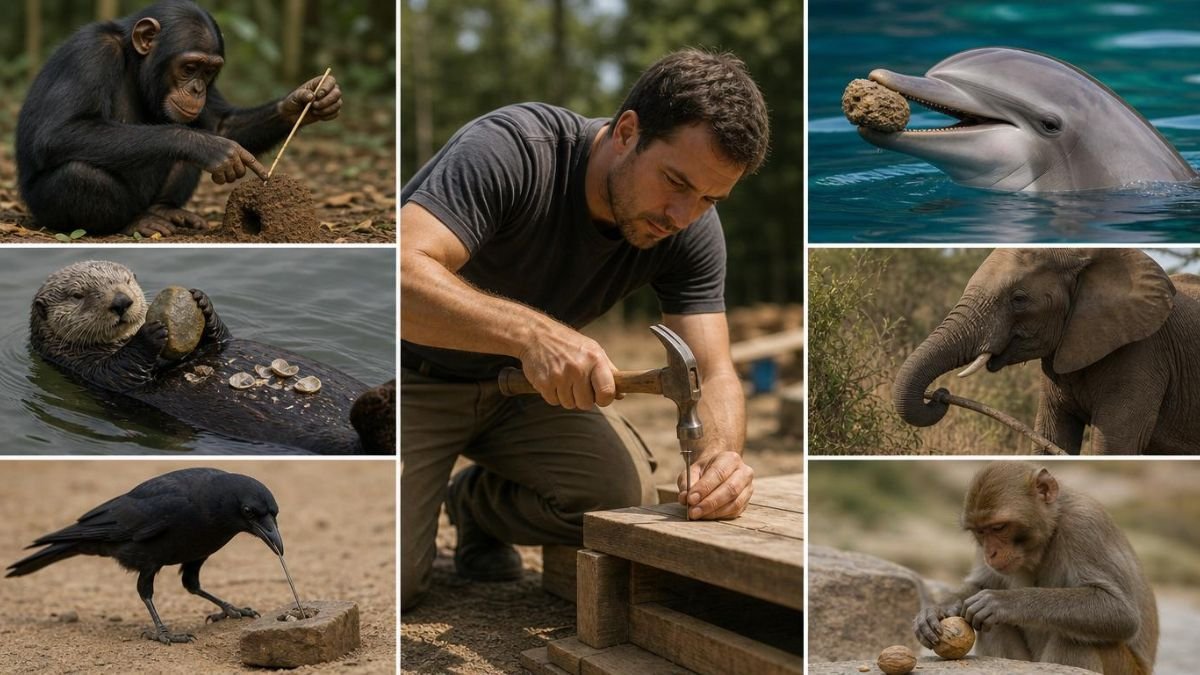
What they found, and continue to find, is humbling in the best possible way. Chimpanzees strip leaves from twigs and use them to fish termites from mounds. Crows bend wire into hooks to retrieve food from containers. Octopuses carry coconut shell halves across the seafloor and shelter inside them. Bottlenose dolphins in Shark Bay, Australia, carry sea sponges in their beaks while foraging along the seafloor to protect their sensitive skin from abrasions — a behavior that appears to be taught from mother to calf. Macaques use stones to crack nuts and pry open oysters. Sea otters lie on their backs and use rocks as anvils to break open shellfish. The list is not short.
The humans-are-the-only-animals-that-use-tools myth is not just wrong — it is spectacularly, entertainingly, and philosophically productively wrong. Because the more we understand about animal tool use, the harder it becomes to identify what, if anything, is actually unique about human cognitive and technological capabilities, and the more interesting the questions become. Today we are going to enjoy the debunking, meet some remarkable animal engineers, and ask what their abilities really reveal — about them, about us, and about the nature of intelligence itself.
Why do we read this carefully? Because good mythbusting is a practice in epistemological rigor — in asking what we actually know, how we know it, and what the evidence actually supports. Close reading of the article that follows will teach you to track an argument's evidence, to recognize when a claim is qualified and when it is not, and to identify the genuine insight buried inside a comfortable misconception. Those skills are the backbone of advanced analytical English.
The Article
What would you have to discover about another animal's behavior before you revised your fundamental assumptions about what makes humans special? That question has been getting progressively more uncomfortable to answer since 1960, when the primatologist Jane Goodall observed chimpanzees at Gombe stripping leaves from twigs and using the stripped twigs to probe termite mounds. Her mentor, Louis Leakey, famously responded: "Now we must redefine tool, redefine man, or accept chimpanzees as humans." The humans are the only animals that use tools myth did not simply become false in that moment — it became interesting, and its failure has been generating productive scientific and philosophical inquiry ever since.
The definition of "tool use" in animal behavior research is carefully specified: it is the use of an external object to achieve a goal, where the object itself is not part of the animal's body. By this definition, the evidence for tool use across the animal kingdom is now extensive. Chimpanzees use twigs to fish for termites and ants, use stones as hammers and anvils to crack nuts, use leaves as sponges to absorb drinking water, and use sticks as weapons. In some chimpanzee communities, these tool behaviors are culturally transmitted — younger animals learn them by observing older ones, and different communities have developed different tool traditions. The cultural transmission of tool behavior is significant: it is not simply genetic inheritance or individual discovery, but the social passing of learned technique from generation to generation, which is the foundation of technological culture.
The cognitive achievements of corvids — the family of birds that includes crows, ravens, rooks, and jays — have produced some of the most striking results in animal cognition research. A New Caledonian crow named Betty, studied at Oxford University, spontaneously bent a straight wire into a hook to retrieve food from a tube when no pre-bent hook was available — demonstrating not just tool use but the flexible, on-the-spot manufacture of a new tool to solve a novel problem. Subsequent research on New Caledonian crows found that they manufacture hooked tools from pandanus leaves in the wild with a standardized design that shows regional variation — different populations make slightly different hooks, again suggesting cultural transmission and something like a technological tradition. Crows also cache food and retrieve it strategically, use traffic to crack nuts (placing walnuts on pedestrian crossings and waiting for cars to crack them, then retrieving the nuts during the red light), and solve multi-step problems that require anticipating future states rather than just responding to current conditions.
The octopus case is philosophically striking in a different way. Unlike chimpanzees and corvids, whose evolutionary lineage shares a common ancestor with humans within the last five hundred million years, octopuses split from the vertebrate line approximately 750 million years ago. Their intelligence evolved entirely independently, without any shared architectural inheritance from common ancestors. When a mimic octopus in Indonesia is observed carrying coconut shell halves across the seafloor — an awkward, energy-expensive activity that produces no immediate benefit but creates shelter that can be used later — the tool-using behavior is a product of a completely separate evolutionary history. This is called convergent evolution of cognitive capability: the same functional outcome (flexible, anticipatory problem-solving using external objects) evolving independently in lineages that have had no contact for three-quarters of a billion years. The convergence suggests that tool use is not a peculiar accident of human or primate evolution but a solution that intelligence tends to discover when it reaches sufficient complexity.
What, then, is actually unique about human tool use? The honest answer is: the scale, the cumulative complexity, and the degree to which tool-making is cognitively mediated by language and abstract representation. Human technology is cumulative in a way and at a speed that no other animal's is — each generation builds on the tools and techniques of previous generations, with language as the transmission medium, producing the accelerating technological development that has gone from stone tools to smartphones in what is, evolutionarily speaking, an eyeblink. No other animal is currently building jet engines or sequencing genomes. But the difference between human technology and chimpanzee or crow technology appears to be one of degree rather than kind — a matter of more complexity, more language, more accumulation — not a categorical difference of the type that the "only animals that use tools" claim requires.
The myth's persistence, despite decades of evidence against it, reveals something interesting about human psychology. We are strongly motivated to identify categories that place us in a special, separate position from the rest of the animal kingdom — categories that feel like they justify our moral status, our sense of uniqueness, our right to use and consume the natural world on the terms we have chosen. When a category like "tool use" is dismantled, the response is often not to revise the underlying belief in human uniqueness but to find a new category: language, then theory of mind, then cumulative culture, then moral reasoning. Each category gets dismantled in turn by increasingly sophisticated animal behavior research. The search for the defining human exception continues. Perhaps what this search reveals is less about what is unique about humans and more about our need to believe that we are unique — and what that need costs us in terms of our relationship with the living world we share.
The next time you watch a crow solve a problem or a chimpanzee craft a tool, what do you feel? Admiration? Unease? A quiet threat to something you thought you owned? And is that feeling itself something worth investigating?
Close Reading Analysis
Paragraph 1: "What would you have to discover about another animal's behavior before you revised your fundamental assumptions about what makes humans special?"
Question: the opening question asks about the conditions for revising "fundamental assumptions." Why is starting with a meta-question about assumption-revision more effective for a mythbusting article than starting with the debunking evidence itself?
Starting with the meta-question places the cognitive and psychological act of revision at the center from the beginning. The article is not simply going to present evidence that the myth is false — it is going to ask the harder question about why we hold the assumption and what it would take to change it. This framing is important because it turns the mythbusting exercise into a self-examination: the reader is being asked, before any evidence is presented, to reflect on their own epistemic flexibility — on how much evidence they would need before revising a belief about human uniqueness. This is a more honest and more interesting framing than simply announcing "the myth is false," because it engages the reader as a thinking agent rather than a passive recipient of corrections. The meta-question is the article's real argument in miniature: the issue is not just the false belief but the psychological conditions that sustain it.
Paragraph 2: the definition of tool use:
Question: the paragraph provides a technical definition of tool use: "the use of an external object to achieve a goal, where the object itself is not part of the animal's body." Why is establishing a definition early in a mythbusting argument particularly important, and what would happen to the argument if the definition were omitted?
Establishing a definition is a foundational move in analytical argument because it determines the scope and criteria of the claim being evaluated. If you claim that "only humans use tools" without defining what you mean by "tool," the claim is effectively unfalsifiable — every time a counterexample is produced, the speaker can redefine "tool" to exclude it. By establishing the scientific definition early — the use of an external object to achieve a goal — the article creates clear, stable criteria that both the evidence and the counterarguments can be evaluated against. This prevents the definitional retreat that is a common defense of myths against evidence. In your own argumentative writing, always define your key terms before presenting evidence, because doing so prevents both your own thinking and your readers' evaluations from sliding around on unstable definitional ground.
Paragraph 3: Betty the crow:
Question: the paragraph introduces Betty the New Caledonian crow and describes her spontaneous wire-bending as demonstrating "not just tool use but the flexible, on-the-spot manufacture of a new tool to solve a novel problem." Why is this distinction — between using a pre-existing tool and manufacturing a new one for a novel situation — particularly significant for the human uniqueness argument?
The distinction between using a pre-existing tool and manufacturing a novel tool is significant because it addresses the most common deflection of simple tool-use examples: "the animal is just using a found object, not inventing." Manufacturing implies design — the animal has a goal, assesses available materials, and modifies them to produce a tool that did not exist before and serves a specific purpose. Betty's wire-bending is not reflexive or instinctive; it is flexible problem-solving: faced with a novel situation (no pre-bent hook available), she manufactures what she needs using materials at hand. This requires mental representation of the goal, assessment of means, and creative modification. These are the same cognitive processes involved in human tool invention, at a simpler level. The significance is not that crows are as cognitively sophisticated as humans — they are not. The significance is that the cognitive capacities involved are continuous with rather than categorically different from human tool-making cognition.
Paragraph 4: the octopus case:
Question: the paragraph introduces "convergent evolution of cognitive capability." Why is convergent evolution — the independent development of similar features in unrelated lineages — particularly strong evidence against the human uniqueness claim?
Convergent evolution is especially powerful evidence because it eliminates the explanation that a feature is a shared ancestral inheritance. If only primates and birds used tools, one could argue that this reflects something in the common ancestor of warm-blooded vertebrates. But when octopuses — which diverged from our evolutionary line 750 million years ago — display anticipatory, flexible tool use, the shared ancestry explanation is unavailable. The same functional outcome arising independently in a completely separate evolutionary history suggests that tool use is a solution that sufficiently complex intelligence tends to discover, regardless of the specific biology involved. This convergence undermines the claim that human tool use is a unique, accidental product of human evolution — it suggests instead that it is a recurring discovery made by intelligence wherever and whenever it reaches sufficient complexity.
Paragraph 5: "What, then, is actually unique about human tool use?"
Question: the paragraph answers its own question: the difference between human and animal technology is "one of degree rather than kind." What is the philosophical significance of the degree/kind distinction, and why does moving from "kind" to "degree" require a fundamental revision in thinking about human uniqueness?
The distinction between differences of kind and differences of degree is philosophically foundational. A difference of kind means a categorical difference: the two things belong to different categories, and no amount of more or less brings them into the same category. A difference of degree means that the two things exist on a continuous spectrum, and that one has more or less of something the other also has. If human tool use and chimpanzee tool use differ in kind, then human technology is categorically different, belonging to a separate class that no other animal enters. If they differ in degree, then all the animals on the spectrum — from the octopus with its coconut shells to the crow with its hook to the human with her smartphone — are doing something that belongs to the same category, with humans at the more complex end. Moving from kind to degree is a fundamental philosophical revision because it integrates human cognition into nature rather than elevating it above nature. It requires that we find our uniqueness not in categorical difference but in the specific character of our position on a shared spectrum.
Closing question:
"The next time you watch a crow solve a problem or a chimpanzee craft a tool, what do you feel? Admiration? Unease? A quiet threat to something you thought you owned?"
The phrase "a quiet threat to something you thought you owned" is precise and challenging. "Something you thought you owned" refers to the belief in human uniqueness — the cognitive territory that the myth of exclusive tool use marked as human property. Watching other animals invade that territory does feel, for many people, like a quiet threat — not a loud, alarming one, but an unsettling one. The question asks the reader to be honest about this emotional experience rather than simply accepting the intellectual argument. This is important because the persistence of the myth despite the evidence suggests that the belief is not held on purely intellectual grounds — it is held partly because of what it does for our sense of self and our relationship with the natural world. Changing the intellectual belief without examining the emotional stake will produce superficial revision. The closing question goes for the emotional stake directly.
Speaking & Writing Challenges
Writing Challenge
Choose any claim about what makes humans uniquely different from other animals — language, consciousness, art, laughter, mourning the dead, self-recognition in mirrors, or any other proposed criterion — and write a 400–500 word analytical paragraph that: (1) states the original claim and why it seems plausible, (2) presents specific animal behavior evidence that complicates it, (3) uses the degree/kind distinction to characterize the revised understanding, and (4) reflects honestly on what the revision requires us to give up and what it invites us to gain. Provide at least one specific scientific definition, at least one named example from animal behavior research, and at least one moment of honest epistemological admission.
Speaking Challenge
Prepare a two-minute spoken argument responding to the following claim: "The fact that other animals use tools does not diminish human uniqueness — it simply means we were wrong about which criterion to use." Make the strongest case for this position that you can — identifying what you believe is the best candidate for a genuine categorical difference between human and animal cognition — while acknowledging the difficulty of sustaining any categorical claim given the history of these claims being dismantled. The goal is to practice arguing a nuanced position with precision and intellectual honesty.









0 Comments