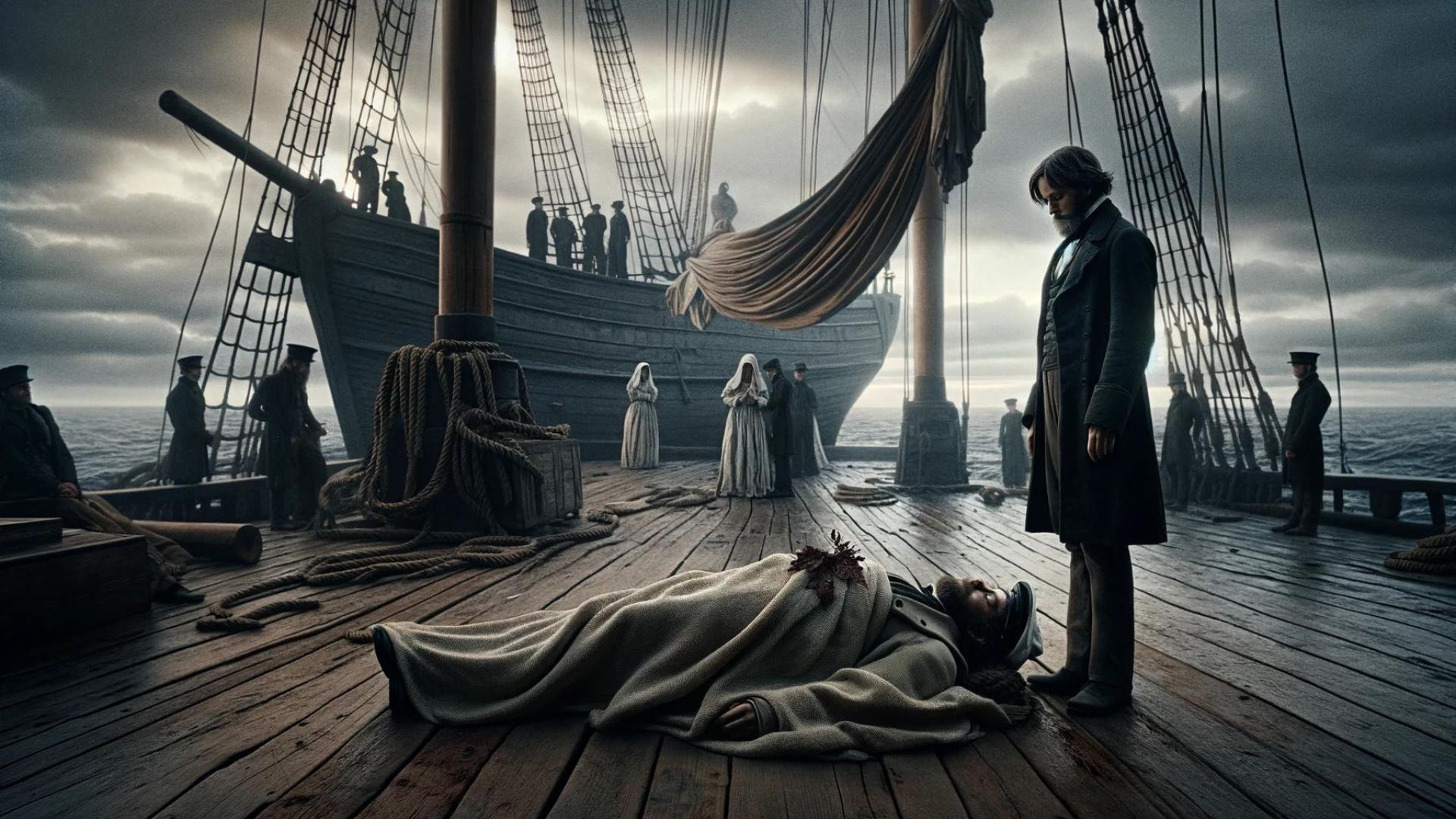
O Captain! My Captain! By Walt Whitman
O Captain! my Captain! our fearful trip is done,
The ship has weather’d every rack, the prize we sought is won,
The port is near, the bells I hear, the people all exulting,
While follow eyes the steady keel, the vessel grim and daring;
                         But O heart! heart! heart!
                            O the bleeding drops of red,
                               Where on the deck my Captain lies,
                                  Fallen cold and dead.

O Captain! my Captain! rise up and hear the bells;
Rise up—for you the flag is flung—for you the bugle trills,
For you bouquets and ribbon’d wreaths—for you the shores a-crowding,
For you they call, the swaying mass, their eager faces turning;
                         Here Captain! dear father!
                            This arm beneath your head!
                               It is some dream that on the deck,
                                 You’ve fallen cold and dead.

My Captain does not answer, his lips are pale and still,
My father does not feel my arm, he has no pulse nor will,
The ship is anchor’d safe and sound, its voyage closed and done,
From fearful trip the victor ship comes in with object won;
                         Exult O shores, and ring O bells!
                            But I with mournful tread,
                               Walk the deck my Captain lies,
                                  Fallen cold and dead.
Behind the Triumph: Whitman’s Bittersweet Elegy for Lincoln
Written in the immediate aftermath of President Abraham Lincoln’s assassination, Walt Whitman’s “O Captain! My Captain!” is a poem of both national triumph and profound loss. Its simple yet powerful imagery has made it one of Whitman’s most famous works, but beneath its surface lies a complexity that rewards a deeper look.
The Poem’s Structure
The poem uses an extended metaphor:
- The Captain: Represents Lincoln
- The Ship: Symbolizes the United States
- The Fearful Trip: The Civil War
- The Won Prize: Victory and preservation of the Union
The poem’s structure mirrors the emotional journey of the nation: initial jubilation at the Civil War’s end, swiftly undercut by the devastating realization of Lincoln’s death.
The Contradictions
“O Captain! My Captain!” is marked by internal tensions:
- Joy and Grief: The shouting crowds and ringing bells clash with the speaker’s private lament for the fallen captain. This mirrors America’s struggle to reconcile hard-won victory with a staggering loss.
- Formal vs. Personal: The poem’s traditional rhyme and meter contrast with Whitman’s usual free verse style, as though the speaker is trying to contain overwhelming emotion within a familiar structure.
- The Captain and the Crew: While the focus is on the Captain, it hints at the unacknowledged sacrifices of the countless ‘common’ soldiers and civilians who also made victory possible.
Whitman’s Own Ambivalence
Whitman deeply admired Lincoln, yet “O Captain! My Captain!” is strikingly different from his other Civil War poems. Its more conventional style and focus on a heroic leader seem at odds with Whitman’s usual celebration of democracy and the common man. This suggests Whitman’s own inner conflict: while mourning Lincoln, he might also sense that the nation’s grief could overshadow those who would carry on the hard work of building a more just Union.
The Poem’s Legacy and Our Own
“O Captain! My Captain!” was a popular phenomenon, but later critics dismissed it as sentimental. Yet, the poem endures because it touches on universal themes: the joy of overcoming adversity tempered by loss, and the uneasy transition from wartime leadership to peace.
It prompts us to ask:
- How do we truly honor our leaders and heroes, both past and present?
- How can we balance celebration with introspection?
- Can a shared moment of national grief lead to a more profound understanding of our shared purpose?
Beyond the Poem
“O Captain! My Captain!” is more than a historical artifact. It invites us to reflect on our own moments of national triumph and tragedy, and how they shape our understanding of who we are as a nation.






0 Comments