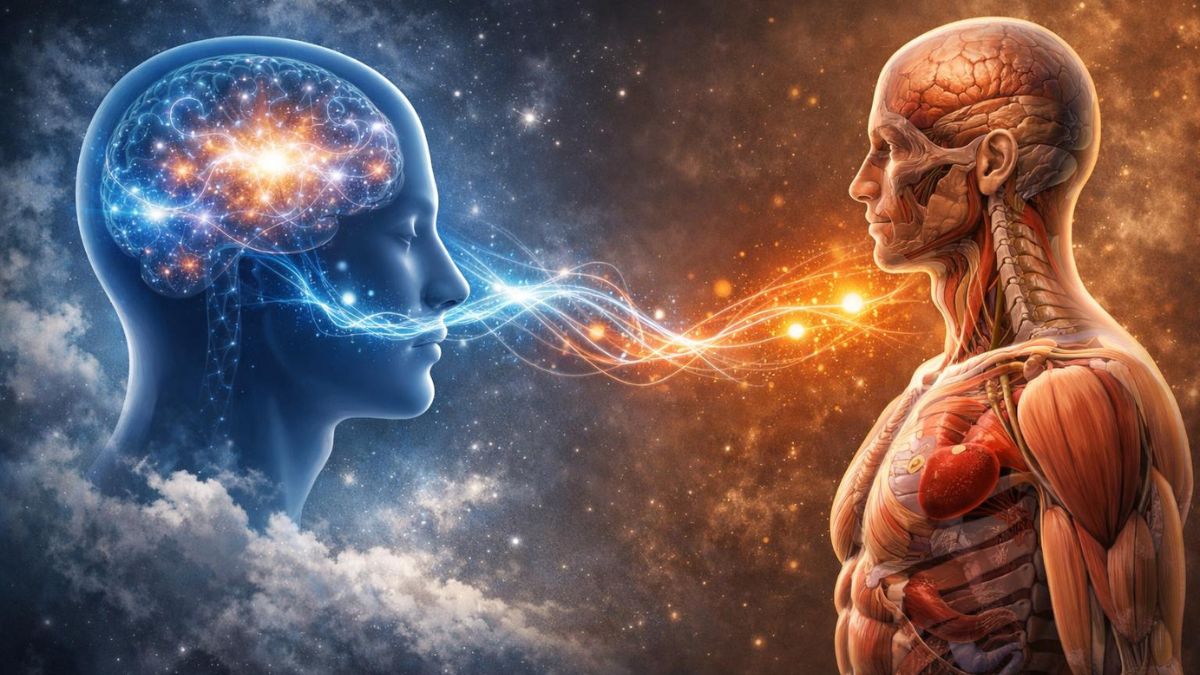
- The Ghost in the Machine
- The Cartesian Split: I Think, Therefore I Am… Confused?
- The Interaction Problem: How Does the Ghost Pull the Levers?
- Physicalism: Is It All Just Neurons Firing?
- Property Dualism: The Best of Both Worlds?
- Panpsychism: Is My Coffee Cup Conscious?
- The Hard Problem of Consciousness
- Living in the Mystery
- Focus on Language
- Critical Analysis
- Let’s Discuss
- Let’s Play & Learn
The Ghost in the Machine
You are currently performing a miracle. It is a quiet, mundane miracle, but a miracle nonetheless. You are looking at squiggles on a screen—pixels made of light, arranged in specific patterns—and somehow, inside the wet, grey sponge floating in your skull, you are hearing a voice. You are understanding concepts. You are feeling curiosity, or perhaps skepticism, or maybe just a vague desire for coffee.
This transition from the physical world of photons and neurons to the subjective world of thoughts and feelings is the single greatest mystery of human existence. It is the gap between the “it” and the “I.” We call this the Mind-Body Problem, and frankly, it is a headache that has lasted for about four hundred years.
For most of us, this duality feels intuitive. We feel like we have a body, not that we are a body. When your foot hurts, you say, “My foot hurts,” as if the foot is a possession that is currently malfunctioning, like a car with a flat tire. You don’t say, “I am hurting in the foot-region.” We naturally separate the pilot from the plane. But the moment you try to pin down exactly how the pilot (your mind) controls the plane (your body), things get messy.
The Cartesian Split: I Think, Therefore I Am… Confused?
We have to blame René Descartes for this mess. In the 17th century, this French philosopher sat by a fireplace, doubted everything he could possibly doubt, and arrived at the conclusion that the only thing he couldn’t doubt was his own doubting. Cogito, ergo sum. I think, therefore I am.
Descartes decided that the mind and the body were two fundamentally different substances. The body was res extensa—extended stuff. It had height, width, depth; it occupied space. It was a machine made of meat and bone, governed by the laws of physics. The mind, however, was res cogitans—thinking stuff. It had no physical dimensions. You can’t measure the width of a thought or weigh an emotion on a scale. It was non-physical, indivisible, and immortal.
This is Substance Dualism. It’s a neat, tidy little box. It allows for the existence of the soul, it preserves free will, and it keeps the church happy. But it creates a logical nightmare that we still haven’t woken up from. If the mind is non-physical—like a ghost—and the body is physical—like a machine—how on earth do they talk to each other?
The Interaction Problem: How Does the Ghost Pull the Levers?
Imagine a ghost trying to drive a tank. The ghost can scream “Left turn!” all it wants, but its spectral hands will pass right through the steering wheel. If the mind has no mass, no energy, and no physical location, it cannot exert force on a physical object. It’s physics 101. Energy cannot be created or destroyed. If your non-physical mind causes your physical arm to raise, energy is magically appearing in the physical system.
Descartes knew this was a problem. His solution was, frankly, hilarious. He pinpointed the pineal gland—a tiny, pinecone-shaped structure in the center of the brain—and said, “That’s where it happens.” He thought the soul sat in the pineal gland and tilted it back and forth to direct the flow of “animal spirits” (his version of nerves) to the muscles.
It was a valiant effort, but it didn’t solve anything. It just moved the problem to a smaller location. Princess Elisabeth of Bohemia, a brilliant thinker and pen pal of Descartes, called him out on this immediately. She essentially asked, “René, how can a non-material soul push a material gland?” Descartes never gave her a satisfactory answer. To this day, Interactionism—the idea that the mind and body causally influence each other—stumbles over this hurdle. We know that getting hit in the head (physical) causes pain (mental), and deciding to wave (mental) causes your arm to move (physical). But explaining the mechanism without breaking the laws of physics is surprisingly difficult.
Physicalism: Is It All Just Neurons Firing?
Because the ghost-in-the-machine theory is so problematic, the modern scientific world has largely pivoted to Physicalism (or Materialism). This theory shrugs and says, “There is no ghost. There is only the machine.”
According to this view, mental states are just brain states. Your feeling of love? That’s just dopamine and oxytocin. Your memory of your grandmother? That’s just a specific pattern of neurons firing in the hippocampus. Consciousness isn’t a magical mist floating above the brain; it is the brain doing its job. This is the “Reductionist” view—we are reducing the mind to biology, and biology to chemistry, and chemistry to physics.
It sounds clean. It sounds scientific. But it feels deeply unsatisfying. It fails to account for the “what it is like” quality of experience. We call this “Qualia.”
The Mary’s Room Argument
Let’s try a thought experiment proposed by philosopher Frank Jackson. Imagine a brilliant neuroscientist named Mary. Mary knows everything there is to know about the color red. She knows the wavelength of light (roughly 700 nanometers). She knows exactly which cones in the retina fire when they see it. She knows how the signal travels the optic nerve and how the visual cortex processes it. She knows the physics, the biology, and the chemistry of “red” perfectly.
But here is the catch: Mary has lived her entire life in a black-and-white room. She has never actually seen the color red.
One day, Mary walks out of the room and sees a ripe tomato. Does she learn something new?
Most of us would say, “Yes, obviously. She learns what red looks like.” She learns the experience of redness. If she learns something new, then her previous physical knowledge was incomplete. Therefore, there must be something about consciousness that isn’t just physical facts. The feeling of seeing red is not the same thing as the description of red neurons. This suggests that Physicalism leaves something out.
Property Dualism: The Best of Both Worlds?
If Substance Dualism is too spooky and Physicalism is too dry, maybe we can meet in the middle with Property Dualism. This theory suggests that there is only one substance (the physical brain), but it has two different kinds of properties: physical properties (mass, electrical activity) and mental properties (pain, joy, the smell of coffee).
Think of it like a wet sponge. The sponge is physical. But “wetness” isn’t a molecule you can find inside the sponge; it’s a property that emerges when water and sponge interact. In this view, consciousness is an “emergent property” of a complex brain. When you get enough neurons firing in a complex enough network, consciousness pops into existence, kind of like how “traffic” emerges from a collection of cars but isn’t a car itself.
This sounds promising, but it leads to a depressing idea called “Epiphenomenalism.” This is the theory that mental states are just froth on the wave of brain activity. They are by-products. They don’t actually do anything. Your brain decides to move your hand due to electrical signals, and then it generates the thought “I want to move my hand” just to make you feel involved. In this view, you are a spectator in your own life, watching a movie that pretends to be a video game.
Panpsychism: Is My Coffee Cup Conscious?
If we can’t explain how non-conscious matter (atoms) suddenly becomes conscious just by arranging it into a brain, maybe we are looking at it backward. Maybe matter is conscious.
This is Panpsychism. It’s an ancient idea that is making a trendy comeback in academic philosophy. It suggests that consciousness is a fundamental property of the universe, like gravity or electromagnetism. It suggests that even an electron has a tiny, primitive shimmer of experience. Not that an electron is thinking about its taxes or wondering if it looks fat in this orbital, but that there is something it is like to be an electron.
When you stack enough of these conscious atoms together in a complex system like a human brain, you get a unified, complex consciousness like yours. It solves the “emergence” problem—you don’t get magic consciousness out of dead matter because the matter was never dead to begin with. But it sounds absurd to the modern ear. It implies that the chair you are sitting on has a very dull, low-level form of existence.
The Hard Problem of Consciousness
We have circled the drain, but we haven’t unclogged it. The philosopher David Chalmers famously distinguished between the “Easy Problems” of consciousness and the “Hard Problem.”
The Easy Problems are things like: How do we focus attention? How do we discriminate between colors? How do we sleep and wake? These are puzzles for neuroscientists. They are complicated, sure, but we can imagine how, in 50 years, we might map them out completely.
The Hard Problem is: Why does all that processing feel like something? Why aren’t we just “philosophical zombies”—creatures that walk, talk, and react exactly like humans but have no inner light on inside? You could build a robot that screams when you hit it, detects damage, and repairs itself. But does the robot feel pain? Probably not. We do. Why?
There is no answer yet. We are stuck in a strange loop where the very instrument we use to study the universe (our conscious mind) is the one thing the universe cannot explain.
Living in the Mystery
So, are you a ghost in a machine? Are you a wet robot? Are you a collection of conscious atoms? Or is the distinction between mind and body an illusion of language?
Maybe the discomfort you feel with these answers is the point. We are trying to use a three-pound organ evolved to hunt antelopes on the savanna to understand the fundamental nature of reality. It’s possible that our brains just aren’t built to solve this puzzle, just as a dog isn’t built to understand calculus.
But there is something beautiful about the mystery. It reminds us that for all our MRIs and neural maps, the simple act of being—of seeing the blue sky, of feeling the warmth of tea, of loving someone—remains a private, untouchable sanctuary. You are a visceral enigma. You are an impossible thing that happens to exist. And that is enough to make you think, isn’t it?
Reading Comprehension Quiz
Focus on Language
Vocabulary and Speaking
Let’s pause the philosophy lecture for a moment and look at the words we just used to build that argument. Discussing abstract concepts requires a specific toolkit—a set of words that act like keys to unlock complex ideas. If you want to sound sophisticated at a dinner party (or just understand what on earth is going on in a sci-fi movie), you need to own these words.
We started by talking about the visceral nature of existence. I mentioned you are a “visceral enigma.” Visceral literally relates to the viscera, your internal organs—your guts. But in conversation, we use it to describe feelings that are deep, instinctual, and not intellectual. A “visceral reaction” isn’t something you think about; it’s a punch to the stomach. Fear is visceral. Disgust is visceral. If you say, “I had a visceral dislike for that politician,” you mean you hated him in your bones, even if you couldn’t explain why logically. It contrasts sharply with “cerebral” or “intellectual.”
Then we have the word enigma. I called you a visceral enigma. An enigma is a person or thing that is mysterious, puzzling, or difficult to understand. It’s cooler than just saying “mystery.” The Mona Lisa’s smile is an enigma. If your boss fires the best employee and promotes the worst one, his decision-making process is an enigma. It implies a riddle that might not have an answer.
We threw around the term reductionist. We talked about the “reductionist view” of the brain. To be reductionist is to analyze a complex phenomenon by explaining it in terms of its simpler, fundamental parts. Often, this is used as a criticism. If someone says, “Love is just a chemical reaction,” you can reply, “That is a very reductionist way of looking at it.” You are saying they are missing the beauty of the whole by focusing too much on the parts. It’s a great word for critiques in art, science, or politics.
We discussed the inextricable link between mind and body—or at least, the problem of it. Inextricable means impossible to disentangle or separate. Think of a pair of headphones left in your pocket for five minutes. The knots are inextricable. In a more abstract sense, we say that poverty and crime are inextricably linked. You can’t solve one without touching the other. If you are in a relationship where you work together, live together, and share a dog, your lives are inextricable.
We used the word mundane. We called reading a “mundane miracle.” Mundane means lacking interest or excitement; dull. It comes from the Latin mundus meaning “world”—so literally, “of this world.” Paying taxes is mundane. Washing dishes is mundane. But when you pair it with a word like “miracle” or “horror,” it creates a lovely contrast. The “mundane horror” of a boring office job implies a soul-crushing ordinariness.
Let’s look at epiphenomenon. This is a ten-dollar word. We used it in the context of Epiphenomenalism. An epiphenomenon is a secondary effect or byproduct that arises from but does not causally influence a process. The shadow of a running horse is an epiphenomenon. The shadow is real, but the shadow doesn’t help the horse run. If you want to be incredibly snarky, you could say to a colleague who talks a lot but does no work, “Are you contributing, or are you just an epiphenomenon of this meeting?” (Disclaimer: They might hit you).
We talked about cognitive dissonance. We didn’t use the exact phrase in the text, but the feeling of the Mind-Body problem is cognitive dissonance. This is the state of having inconsistent thoughts, beliefs, or attitudes, especially as relating to behavioral decisions and attitude change. It’s the mental discomfort you feel when you know smoking is bad for you, but you are smoking a cigarette. Your mind is fighting itself. “I love animals, but I eat meat” causes cognitive dissonance.
We mentioned substance. In philosophy, substance isn’t just “stuff” or “goo.” It means the fundamental reality that supports a thing. Substance Dualism argues there are two fundamental realities. In daily life, we use this to mean solidity or importance. “This report lacks substance” means it’s all fluff and no facts. “He is a man of substance” means he is wealthy, powerful, or has strong character.
We used the term sentience. We implied this with the robot example. Sentience is the capacity to feel, perceive, or experience subjectively. It is different from intelligence. A calculator is intelligent (it can do math better than you), but it is not sentient (it doesn’t care if you drop it). We often debate the sentience of animals. A dog is clearly sentient. Is a lobster? Is a fly? This word is key for any discussion on AI or animal rights.
Finally, let’s look at manifestation. We see the mind manifest in the body. A manifestation is an event, action, or object that clearly shows or embodies something abstract or theoretical. A fever is a manifestation of an infection. His shaking hands were a manifestation of his fear. It’s a way of making the invisible visible.
Now, let’s turn this into a speaking challenge. It’s one thing to read these words; it’s another to let them roll off your tongue without tripping.
Here is your assignment: The “Ghost” Monologue.
I want you to record yourself for two minutes. You are going to pretend you are an alien scientist reporting back to your home planet about humans. You are confused by them. I want you to use at least three of the keywords we just discussed to describe these strange human creatures.
For example, you might say: “Commander, these humans are an enigma. They seem to be biological machines, yet they claim to have visceral feelings of love. Their society is inextricably linked to these small rectangular screens they carry. It seems their consciousness is just a manifestation of electricity, but they believe it is a soul.”
Don’t write it down first. Just speak. Try to use “reductionist” or “mundane” in a sentence about human eating habits. This exercise forces you to map the definition to a context instantly, which is how fluency happens. If you stumble, good. That’s just your brain building new neural pathways—a physical change for a mental gain.
Vocabulary and Speaking Quiz
Grammar and Writing
Now we move from the spoken word to the written word. Writing about philosophy is a dangerous game. It is very easy to sound like a pretentious bore or a confused stoner. The trick is clarity, control of tone, and the ability to handle abstract concepts without losing the concrete reality of the reader.
The Writing Challenge: The Body Snatchers Dialogue
I want you to write a dialogue. Not an essay. A dialogue.
I want a conversation between Your Mind and Your Body.
Imagine they are an old married couple, or perhaps reluctant roommates who have been stuck together for decades. They are arguing about something specific—maybe the Mind wants to stay up late reading philosophy, and the Body is demanding sleep. Maybe the Mind wants to exercise to look good, and the Body is screaming about how comfortable the couch is.
The Prompt:
- Characters: Mind (The Voice) and Body (The Vessel).
- Setting: 2:00 AM, the kitchen.
- Conflict: The Mind wants a midnight snack; The Body knows this will result in heartburn.
- Length: 300-400 words.
Grammar Focus: Anthropomorphism and Voice Distinction
To make this work, you need to use Anthropomorphism. This is the attribution of human characteristics or behavior to a god, animal, or object. You are turning “The Body” (a biological object) into a character with a voice.
The grammar challenge here is Voice Distinction. The Mind and the Body should sound different.
- The Mind might use complex sentences, abstract nouns, and the Subjunctive Mood (hypotheticals).
- Example: “If we were to consume the cheese now, the resulting dopamine hit would suffice to inspire our poetry.”
- The Body might use short, punchy, imperative sentences and sensory language (Physicalism).
- Example: “Stop talking. My stomach hurts. Go to bed.”
Grammar Focus: The Subjunctive Mood for Hypotheticals
Philosophy loves the Subjunctive Mood. This is the verb form used to explore conditional or imaginary situations.
- “If I were a brain in a vat, I wouldn’t know it.”
- “It is essential that he be aware of the consequences.”
In your dialogue, have the Mind use the subjunctive to propose wild ideas.
- “If I were free of you, I could float through the cosmos!”
- “I wish it were possible to detach my stomach.”
Notice we use “were” instead of “was” for “I” and “It” in these hypothetical if-clauses. This signals to the reader that we are in the realm of imagination, not reality.
Grammar Focus: Dialogue Punctuation
Dialogue is the wildest west of grammar, and people mess it up constantly. Here are the iron rules you must follow for your challenge:
- New Speaker = New Paragraph. Never lump the Mind and Body into the same block of text. It confuses the reader.
- Punctuation Goes INSIDE the Quotation Marks.
- Correct: “I am hungry,” said the Body.
- Incorrect: “I am hungry”, said the Body.
- The Comma Tag. If you are identifying the speaker after the speech, use a comma, not a period.
- “This is illogical,” the Mind argued.
- Action Beats instead of Tags. You don’t always need “he said” or “she said.” You can use an action to identify the speaker.
- Example: “I need water.” The Body reached for the glass with a trembling hand.
Writing Tips for Philosophical Comedy
This challenge is inherently funny because of the Juxtaposition (placing two things close together with contrasting effect). You are juxtaposing high concepts with low reality.
- Tip 1: Use Specificity. Don’t let the Body say “I feel pain.” Let it say “My left knee feels like it’s being stabbed with a rusty spoon.” Specificity creates texture.
- Tip 2: The Status Game. Who is in charge? Usually, the Mind thinks it is in charge, but the Body actually holds the veto power. Play with this power dynamic. The Mind commands; the Body refuses.
- Tip 3: Avoid Adverbs in Tags. Don’t write: “I hate you,” the Body said angrily. The dialogue itself should be angry. If you have to tell us he said it “angrily,” your dialogue is weak.
Example Snippet:
“We are contemplating the infinite nature of the void,” the Mind declared, staring at the ceiling fan. “It is profound. It is—”
“It is two in the morning,” the Body interrupted. A heavy eyelid twitched. “And I have to pee.”
“Ignore the biological imperative! If we were creatures of pure light, we wouldn’t have to deal with this plumbing.”
“If we were creatures of pure light,” the Body grumbled, swinging legs out of bed, “we wouldn’t be able to eat that leftover pizza you’re thinking about.”
The Mind paused. “Touché.”
Give it a try. This exercise forces you to separate the abstract (Mind) from the concrete (Body) in your writing style, which is a masterclass in tonal control.
Grammar and Writing Quiz
Critical Analysis
Now, I’m putting on my professor’s glasses. We’ve covered the standard Western history of the Mind-Body problem—Descartes, physicalism, property dualism. But if we are being honest, this article missed some massive perspectives that challenge the very premise of the debate.
First, we completely ignored Eastern Philosophy. The whole idea of “Mind vs. Body” is a deeply Western, dualistic obsession. In Buddhism, for example, the separation is an illusion (Maya). The concept of Namarupa (name-form) suggests that mind and body are not two things interacting, but two sides of a single coin, or a knot in a string. You cannot have the knot without the string. By framing the article purely through Descartes, we trapped ourselves in a binary that half the world’s philosophers think is ridiculous.
Secondly, we glossed over Embodied Cognition. This is a modern theory that says the mind isn’t just in the brain; it extends into the body. Studies show that our physical posture affects our hormones and confidence. We think with our hands when we gesture. The gut microbiome affects our mood (serotonin production). The idea that the brain is the sole CEO and the body is just the mailroom is scientifically outdated. The mailroom is arguably running the company.
Third, what about Language? Wittgenstein would argue that the “Hard Problem” is just a language game. We created the word “Mind” and the word “Body,” and now we are confusing ourselves because the grammar of our language treats them as two nouns. If we changed our language, would the problem disappear? Are we just fighting with ghosts of our own invention?
Finally, we didn’t touch on the ethical implications. If Physicalism is true and we are just moist robots, what happens to free will? If my crime was just “neurons firing,” can you blame me? The justice system relies on the Dualist idea of a “guilty mind” (mens rea). If we prove Dualism is false, does the entire legal system collapse? That’s a can of worms we left unopened.
Let’s Discuss
Here are some questions to break your brain—and maybe the comment section.
If we successfully transplant your head onto a different body, are you still “you”?
Does your identity reside solely in the brain? Or would the new hormones, the new height, and the new gut bacteria change your personality so much that “you” would slowly disappear?
Is a “Smart Home” that regulates temperature and locks doors a very simple body for a very simple mind (AI)?
Where do we draw the line for a “body”? If an AI can manipulate the physical world (sensors, locks) based on inputs, does it solve the Interaction Problem?
Does pain exist if no one feels it?
If a tree falls on a zombie that has no consciousness, is there pain? This forces us to define “pain” as a mental event, not a physical damage event.
Why do we assume the “Mind” is one thing?
Split-brain patients (corpus callosum severed) sometimes have two hands trying to do opposite things. Does this mean we have two minds that usually just agree? Are you actually a committee?
Could the internet eventually wake up?
Based on the Panpsychism or Emergence theories, if the internet becomes complex enough (more connections than the human brain), could it suddenly develop Qualia? How would we know?
Is “Free Will” compatible with Physicalism?
If your thoughts are just chemical reactions following the laws of physics, and physics is predictable (mostly), was your decision to read this article determined at the Big Bang?
Why is “Gut Feeling” often more accurate than logical thought?
Challenge the hierarchy of Mind over Body. Is the visceral intelligence of the body actually superior to the cerebral processing of the mind in survival situations?
If you could upload your mind to a computer, would you do it?
This is the ultimate test of your belief in Dualism. If you believe you are just information/patterns (Physicalism), you’d say yes. If you believe in a non-physical soul that can’t be copied, you’d say no.









0 Comments