Vocabulary Preview
- Subterfuge: Deceit used in order to achieve one’s goal.
- Verisimilitude: The appearance of being true or real.
- Innocuous: Not harmful or offensive.
- Conspicuous: Standing out so as to be clearly visible.
- Audacious: Showing a willingness to take surprisingly bold risks.
- Phenotype: The set of observable characteristics of an individual resulting from the interaction of its genotype with the environment.
- Duplicity: Deceitfulness; double-dealing.
- Efficacious: Successful in producing a desired or intended result; effective.
- Imperceptible: Impossible to perceive.
- Evolutionary Arms Race: A struggle between competing sets of co-evolving genes, traits, or species that develop adaptations and counter-adaptations against each other.
Listen
Or Read
Animal Mimicry: Deception in the Natural World
While we humans might throw on a pair of sunglasses to avoid an awkward conversation at the grocery store, the natural world takes the concept of disguise to a level that would make even the most skilled Hollywood makeup artist weep with envy. We are diving into the rabbit hole of mimicry, a biological phenomenon that proves, quite literally, that appearances can be fatally deceiving. In the wild, telling the truth about who you are—”I am a tasty, defenseless caterpillar”—is often a one-way ticket to a bird’s stomach. So, evolution has stepped in as the ultimate costume designer, outfitting creatures with an arsenal of tricks, lies, and visual subterfuge designed to cheat death.
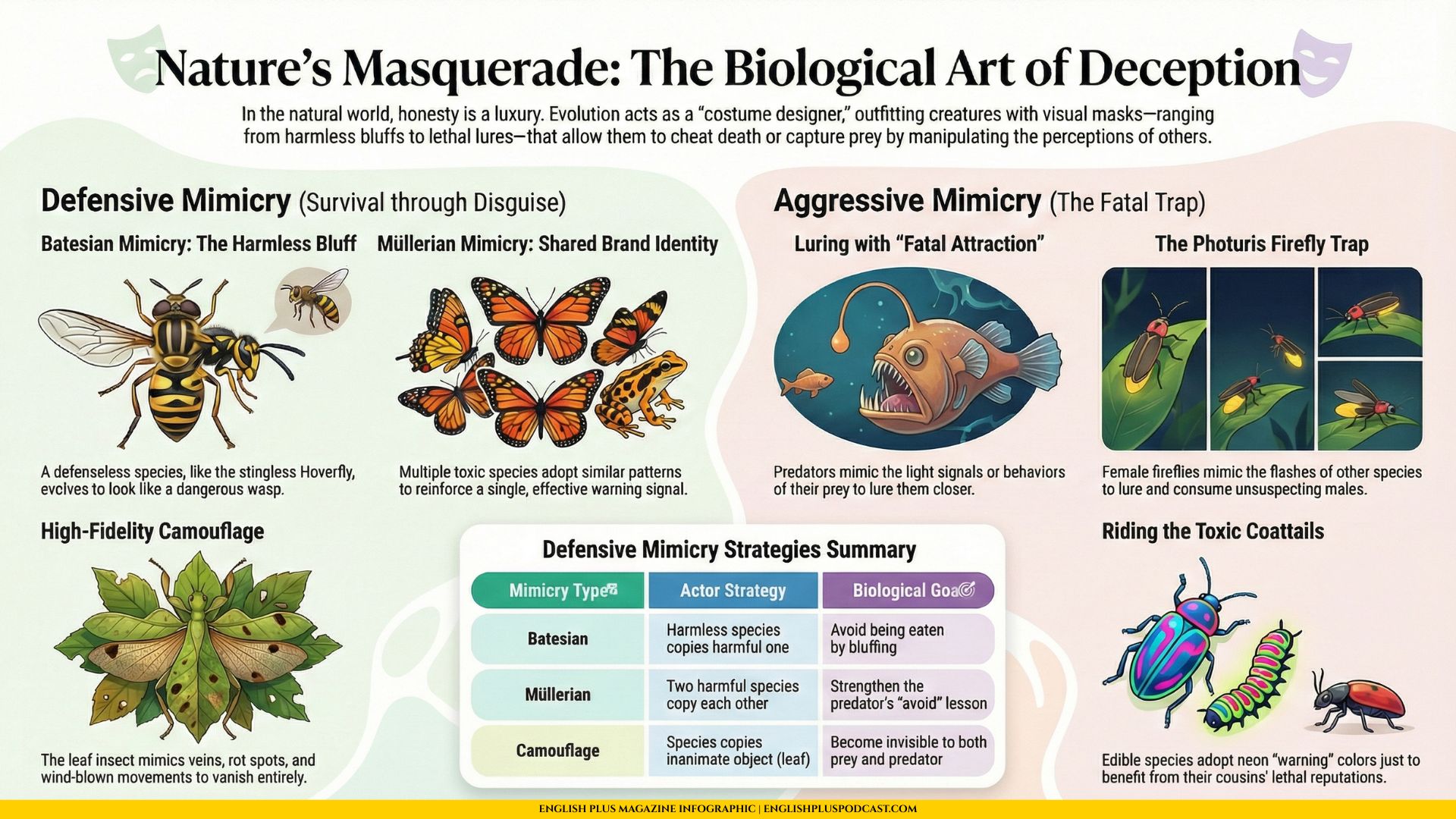
Consider for a moment the Hoverfly. To the untrained eye, and more importantly to the hungry bird, this little insect looks exactly like a wasp or a bee. It has the same black and yellow stripes, the same buzzing flight pattern, and the same “don’t mess with me” attitude. But it is all a bluff. The Hoverfly is completely innocuous; it has no stinger, no venom, and no defense other than its ability to look like a tough guy.
This is a classic example of Batesian mimicry, where a harmless species evolves to imitate the warning signals of a harmful one. It relies entirely on the duplicity of the signal. The predator learns to avoid the stinging wasp and, in a moment of hesitation, spares the harmless fly. It is a gamble, of course. If the predator calls the bluff, the game is over.
But nature doesn’t stop at simple copycat games. Sometimes, two dangerous species will evolve to look like each other, a phenomenon known as Müllerian mimicry. Imagine a biker gang where everyone wears the same leather jacket to signal that they are all tough. This mutual reinforcement makes the warning signal more efficacious because predators learn the lesson faster: “Bright orange wings equal a bad stomach ache.” The Monarch and Viceroy butterflies were long thought to be a case of the harmless copying the harmful, but recent science suggests they are both toxic, sharing the burden of educating their predators.
This shared “brand identity” benefits everyone involved—except the predator, of course. It is an evolutionary arms race played out over millions of years, where every tiny adjustment in wing pattern or coloration is a move on a genetic chessboard.
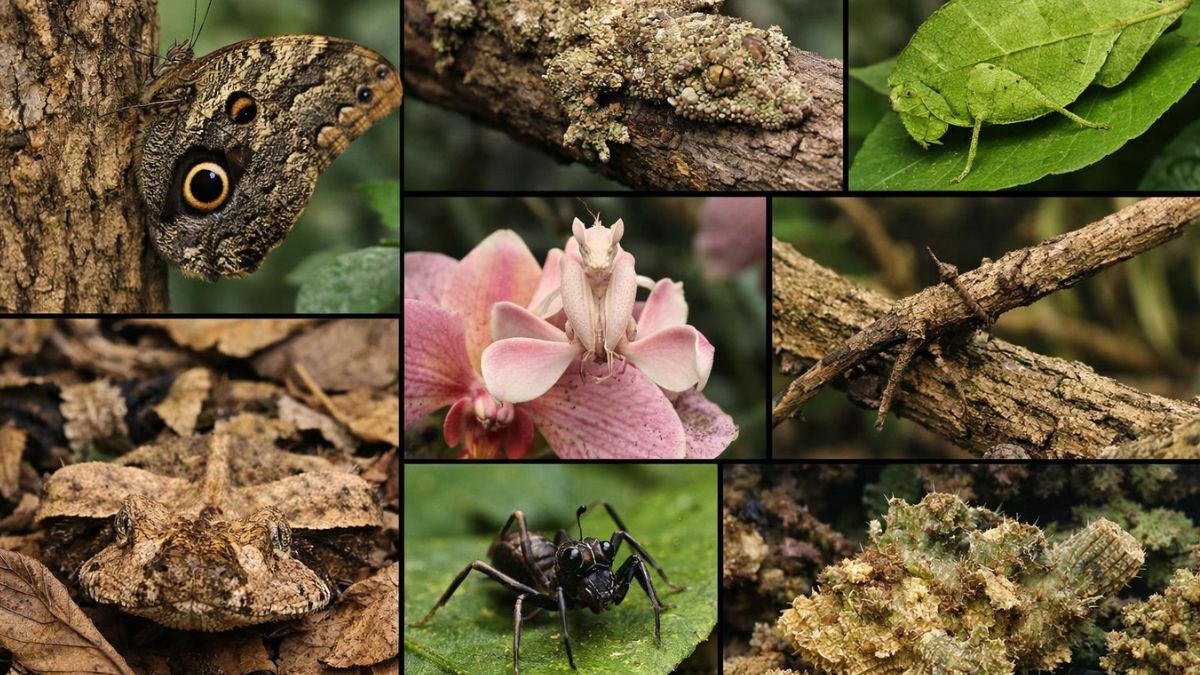
The level of verisimilitude some of these creatures achieve is mind-bending. Take the leaf insect, for example. This isn’t just a green bug; it has evolved a phenotype that mimics the veins, the rot spots, and even the bite marks of a decaying leaf. When it walks, it rocks back and forth to simulate a leaf blowing in the wind. This is camouflage so audacious that these insects have been known to accidentally nibble on their own family members, mistaking them for foliage.
This level of commitment to the bit suggests that survival isn’t just about being the strongest or the fastest; it is often about being the best liar. It challenges our perception of reality. We tend to trust our eyes, assuming that what is conspicuous is true. A bright red frog screams “poison,” and usually, we listen. But in the rainforests, there are perfectly edible frogs that have adopted the same neon colors just to ride the coattails of their toxic cousins.
Then there is the aggressive mimicry, the “wolf in sheep’s clothing” strategy. This is where the story takes a darker turn. Some predators use mimicry not to hide, but to lure. The female Photuris firefly mimics the light flash pattern of a different firefly species, the Photinus. The male Photinus, thinking he has found a romantic partner, flies over with love in his heart, only to be promptly eaten. It is a brutal reminder that in nature, attraction can be a trap, and the difference between a mate and a meal is often imperceptible until it is too late.
These biological marvels force us to ask profound questions about identity and truth. If a harmless snake lives its entire life successfully pretending to be a venomous coral snake, does the truth of its DNA matter to the hawk that avoids it? In the theater of the wild, perception is reality. The mask becomes the face. It’s a dizzying realization that the natural world is built on layers of illusions, where honesty is a luxury few can afford.
As we strip away these layers, we find that mimicry is more than just a biological curiosity; it is a testament to the creativity of life under pressure. It reminds us that adaptation isn’t always about brute force. Sometimes, it’s about wit, timing, and the sheer nerve to stand in front of a giant and say, “I am not the snack you are looking for.” So, the next time you see a bee buzzing around your picnic, take a closer look. Is it really a bee, or is it a masterful little actor putting on the performance of a lifetime just to survive another day? And this brings me to a question I’d love for you to ponder: We humans don’t have wings or venom, but we certainly wear masks. In your own life, have you ever used “social mimicry”—acting like someone you’re not—just to fit in or survive a tough situation? I’d love to hear your stories in the comments below!
Word Power
Let’s take a magnifying glass to the vocabulary we just discovered. These aren’t just fancy words to impress your friends; they are tools to help you describe the subtle and complex world around you.
First up, we have subterfuge. This is a great word for when someone is being tricky or deceitful to get what they want. It sounds a bit like a spy movie, doesn’t it? In our story, nature uses subterfuge to hide the truth. In real life, you might say, “He used a lot of subterfuge to get that promotion,” implying he wasn’t entirely honest about his methods.
Then there is verisimilitude. This is a mouthful, but it’s a beautiful word. It means the appearance of being true. It’s not necessarily the truth, but it looks like it. A movie with great special effects has high verisimilitude. The leaf insect we talked about? Its disguise has such high verisimilitude that even other bugs get confused.
We described the Hoverfly as innocuous. This means harmless. It’s a soft, gentle word. A comment can be innocuous, meaning it wasn’t meant to hurt anyone’s feelings. If you see a spider, your friend might scream, but you can say, “Relax, it’s innocuous.”
On the flip side, we have conspicuous. This means standing out, impossible to miss. A person wearing a neon green suit at a funeral is conspicuous. In nature, poison dart frogs are conspicuous to warn predators away. If you’re trying to hide, you definitely don’t want to be conspicuous.
We called the leaf insect audacious. This word is all about boldness and daring. It’s taking a risk that surprises people. An audacious plan might be quitting your job to start a rock band. Nature is audacious for evolving a bug that looks like a leaf.
We used the scientific term phenotype. This refers to the physical look of a creature—its height, color, shape. It’s the result of your genes mixing with your environment. You can use this metaphorically too, perhaps joking that your “morning phenotype” involves messy hair and sleepy eyes.
Duplicity is another word for double-dealing or two-facedness. It’s related to “duplicate.” If someone says one thing to your face and another behind your back, that is duplicity. Batesian mimicry relies on the duplicity of the signal—promising a sting that isn’t there.
Efficacious is a fancy, academic way of saying “effective.” But it specifically means effective at producing a result. A medicine is efficacious if it cures the disease. The shared warning colors of butterflies are efficacious because they teach predators quickly.
Imperceptible means so small or slight that you can barely notice it. A sound can be imperceptible to human ears. The difference between the mimic and the model is often imperceptible, which is why the disguise works so well.
Finally, the evolutionary arms race. This is a concept where two sides keep improving to beat the other. In business, you see an arms race between competitors launching new features. In nature, it’s the predator getting faster and the prey getting better at hiding.
Speaking Tips & Challenge
Now, let’s get these words off the page and into your mouth. The goal isn’t to sound like a dictionary, but to sound precise.
- Use “Innocuous” for reassurance: When someone is worried about a small problem, use this word. “Don’t worry about that error message; it’s innocuous.”
- Use “Audacious” for compliments: When a friend has a bold idea, tell them, “That is an audacious goal, I love it!”
- Use “Conspicuous” for observation: “You were quite conspicuous leaving the party early.”
Your Speaking Challenge:
I want you to observe a pet, a bird outside your window, or even a person in a crowd today.
Describe their behavior or appearance using phenotype, conspicuous, and imperceptible.
Example: “That dog has a very fluffy phenotype, which makes him conspicuous in the park, but his tail wag is almost imperceptible when he is sleeping.”
Go out there and start observing the details!









0 Comments