The Cult of the New
We are addicted to the “launch.” The ribbon-cutting ceremony. The gender reveal party. The unboxing video. The IPO. We live in a culture that fetishizes the beginning of things. We worship the disruptors, the innovators, and the “visionaries” who stand on stages in black turtlenecks and tell us how they are going to change the world with a new app that is essentially just a juicer with Wi-Fi.
This obsession with the “New” is baked into our economic DNA. It is the logic of late-stage capitalism: grow or die. If you aren’t disrupting, you are stagnating. If you aren’t pivoting, you are perishing. We treat our lives like startup companies, constantly looking for the next pivot, the next upgrade, the next fresh start. We discard phones because the battery is slightly tired. We ghost relationships because the spark has faded into the routine of grocery shopping. We treat the past like a sunk cost and the future like a promised land.
But here is the uncomfortable truth that the “move fast and break things” crowd doesn’t want to discuss: breaking things is easy. Cleaning up the broken glass? That is the hard part. Starting a war is simple; maintaining peace is a grind. Having a baby is a biological event; raising a human being is a twenty-year endurance sport of laundry, emotional regulation, and repetitive motion.
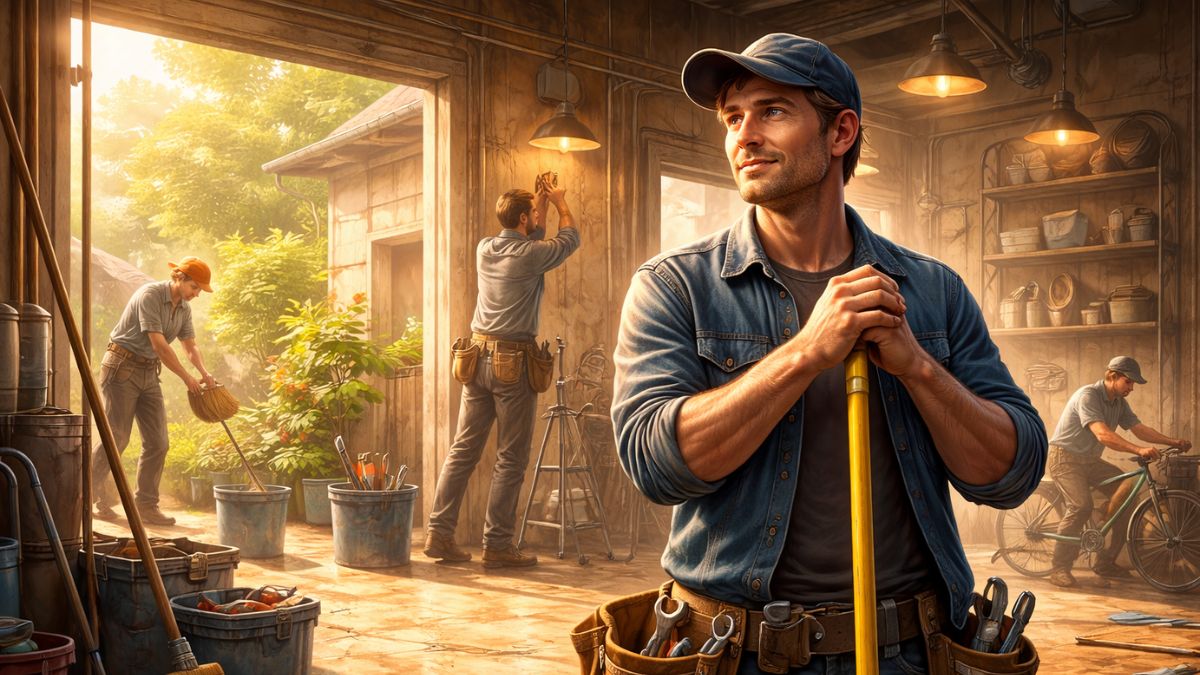
We have built a civilization that idolizes the architect and ignores the janitor. And that is a problem, because without the janitor, the architect’s building is just a future ruin.
Mierle Laderman Ukeles and the Manifesto
The Art of the Scrub
To understand why we undervalue the daily grind, we have to look back to 1969. The art world was dominated by Minimalism and Conceptual Art—mostly men making big, stoic, permanent objects. Enter Mierle Laderman Ukeles. She was an artist, but she had also just become a mother. She found herself split in two. As an artist, she was “free” and “creative.” As a mother, she was stuck in a cycle of cooking, cleaning, and changing diapers—tasks that, the moment you finish them, need to be done again.
She realized that society didn’t consider her domestic labor “art” or even “culture.” It was just… nothing. It was invisible background noise. So, she wrote a document that should be required reading for every human being on earth: the “Manifesto for Maintenance Art 1969!”
In it, she divided human activity into two systems: Development and Maintenance.
Development is: pure individual creation; the new; change; progress; advance; excitement; flight or fleeing.
Maintenance is: keep the dust off the pure individual creation; preserve the new; sustain the change; protect progress; defend and prolong the advance; renew the excitement; repeat the flight.
She famously asked, “After the revolution, who’s going to pick up the garbage on Monday morning?”
Making the Invisible Visible
Ukeles didn’t just write about it. She performed it. She went to museums and, instead of hanging a painting, she scrubbed the steps. She washed the floors. She declared that the act of cleaning the museum was the art itself.
Later, she spent decades as the artist-in-residence at the New York City Department of Sanitation. She didn’t paint murals on the garbage trucks. She shook the hand of every single sanitation worker in New York City—over 8,500 men. She looked them in the eye and said, “Thank you for keeping New York City alive.” She understood that without these “maintenance workers,” the city of finance, fashion, and culture would suffocate under its own filth in three days.
The Psychology of the Grind
The Dopamine Deficit
Why do we hate maintenance? Biologically, we are wired for novelty. The “New” triggers a dopamine hit. Buying the treadmill feels like an identity shift (“I am now a runner!”). Using the treadmill every Tuesday and Thursday for three years feels like drudgery. Development is a straight line—it goes up and to the right. It has a climax. Maintenance is a circle. It is Sisyphus pushing the rock up the hill, only to watch it roll down, and then doing it again. And again.
There is no “finish line” in maintenance. You don’t “win” laundry. You don’t “complete” a marriage. You just keep them going. And because there is no finale, there is no applause. No one gives you a trophy for doing the dishes every night for ten years. But if you write a book, you get a launch party. If you build a bridge, you get a plaque. If you paint the bridge every year to keep it from rusting, you get traffic complaints.
The Illusion of Independence
Our disdain for maintenance also stems from a delusion of independence. We like to think of ourselves as autonomous agents, carving our own path. Acknowledging maintenance forces us to acknowledge our dependency. We depend on the sewer system working. We depend on the person who stocks the shelves at the grocery store. We depend on our partners to listen to our same stories for the hundredth time.
Maintenance is an act of care, and care implies vulnerability. To maintain something is to admit that it is fragile, that it decays, that it needs you. In a culture of “invincibility” and “hustle,” admitting that things (and people) need constant, gentle tending feels like weakness.
Reframing the Mundane
Stewardship over Innovation
We need a cultural recalibration. We need to stop viewing maintenance as the “stuff we have to do so we can get back to the important work.” Maintenance is the important work.
Think about the climate crisis. We don’t necessarily need a shiny new “disruptive technology” to save us (though it might help). Mostly, we need to maintain the planet we have. We need stewardship. We need to repair what is broken rather than buying new. We need to care for our forests, our oceans, and our communities. The mindset of “Development” got us into this mess—the idea that we can endlessly extract and expand. The mindset of “Maintenance” is the only thing that will get us out.
Nobility in the Routine
On a personal level, embracing Maintenance Art means finding nobility in the routine. It means looking at a sink full of dirty dishes not as a failure or a burden, but as evidence of life. You ate. You were nourished. Now you restore the order.
There is a Zen-like quality to maintenance if you stop fighting it. There is a richness in the repetition. When you water your plants, you are participating in a cycle of life that is far older than the iPhone in your pocket. When you listen to your friend vent about their job for the fifth time, you are doing the heavy lifting of friendship. You are maintaining the structural integrity of your social world.
The Radical Act
In a world that screams “New! Improved! Faster! Disruption!”, the most radical thing you can do is simply keep things going. The most rebellious act is to repair your socks. The most profound art is to raise a child with patience. The most essential work is to pick up the garbage on Monday morning.
We are not just creators. We are caretakers. And maybe, just maybe, if we started giving out awards for “Best Sustainer” instead of just “Best Innovator,” we wouldn’t feel so exhausted all the time. We might realize that the meaning of life isn’t found in the breakthrough, but in the follow-through.
Reading Comprehension Quiz
Focus on Language
Part 1: Vocabulary and Speaking
Let’s dive into the language we used to deconstruct this topic. We aren’t just looking for big words to impress people at cocktail parties; we want words that carry weight, words that change the texture of how you describe your daily life.
First, let’s talk about drudgery. We often use this word to describe hard, menial, or dull work. “I can’t stand the drudgery of filing taxes.” It implies a heaviness, a lack of spirit. In the article, we contrasted the excitement of the “launch” with the drudgery of the daily grind. But the whole point of Maintenance Art is to try to strip the drudgery away from the task and find meaning in it.
That brings us to stewardship. This is a beautiful, almost sacred word. It refers to the job of supervising or taking care of something, such as an organization or property. But it’s deeper than just “management.” Stewardship implies an ethical responsibility to pass something on in better condition than you found it. We talked about environmental stewardship. You can use this in your career, too. “I see my role as stewardship of the company’s legacy.”
We used the word obsolescence. This refers to the process of becoming obsolete or outdated and no longer used. You’ve probably heard of “planned obsolescence,” where companies design phones to break after two years so you have to buy a new one. It’s the enemy of maintenance. If you feel like your skills are fading in a fast-paced market, you might fear professional obsolescence.
Let’s look at ephemeral. Something that is ephemeral lasts for a very short time. It is fleeting. The thrill of buying a new car is ephemeral. The “New” is always ephemeral because the moment you touch it, it starts becoming old. We often chase ephemeral joys at the expense of lasting satisfaction.
We contrasted the “architect” with the “janitor” to highlight the mundane. Mundane means lacking interest or excitement; dull. It comes from the Latin word for “world,” meaning “of this earthly world” rather than heavenly. Washing dishes is mundane. But the challenge of the article is to find the divine in the mundane.
We talked about infrastructure. Usually, this means roads, bridges, and power lines. The basic physical and organizational structures needed for the operation of a society. But we can talk about “emotional infrastructure” or “social infrastructure.” Your friends are your support system; they are your emotional infrastructure. Maintenance keeps that infrastructure from collapsing.
A key concept was the cyclical nature of maintenance. Cyclical means occurring in cycles; recurrent. Development is linear (a line); maintenance is cyclical (a circle). Dealing with seasons is cyclical. Moods can be cyclical. Understanding that life is cyclical helps you be patient when things are difficult, because you know the wheel will turn.
We mentioned sustain. To sustain means to strengthen or support physically or mentally. It means to keep something going over time. Sustainability is the ability to be maintained at a certain rate or level. “Coffee sustains me in the morning.” “We need to find a way to sustain this momentum.”
Then there is fetishize. To fetishize something is to have an excessive and irrational commitment to or obsession with it. We argued that society fetishizes innovation. We treat it with almost religious or sexual obsession. You might say, “Our culture fetishizes youth.”
Finally, let’s look at recalibration. To calibrate is to adjust a machine so it works precisely. To recalibrate is to adjust it again or differently. We need a cultural recalibration. You might need a personal recalibration if you are feeling burnt out—a reset of your priorities.
Speaking Section: The Art of the Mundane
Now, how do we use these in speech? The trick when talking about “boring” topics like maintenance is to use elevated language to show that you value the topic. If you say, “I have to clean the house,” you sound tired. If you say, “I need to attend to the maintenance of my domestic space,” you sound ironic and sophisticated.
Here is a speaking challenge for you. I want you to pick one chore you hate. Maybe it’s ironing, or weeding the garden, or deleting emails. I want you to describe it to a friend (or to your mirror) without complaining. Instead, treat it as a vital act of stewardship.
Don’t say: “I hate doing laundry.”
Say: “I am engaging in the cyclical restoration of my wardrobe. It’s a bit mundane, but it prevents the obsolescence of my favorite shirts.”
Try to be playful with it. Use the word infrastructure. “I’m not just walking the dog; I’m maintaining the biological infrastructure of the family.” By changing the vocabulary, you change the frame. You stop being a victim of the chore and become the manager of it.
Vocabulary and Speaking Quiz
Part 2: Grammar and Writing
For this section, we are going to focus on a writing challenge that pushes you to use a specific grammatical structure that is perfect for this topic: Gerunds as Subjects and Parallel Structure.
The Writing Challenge: The Maintenance Manifesto
I want you to write a short “Maintenance Manifesto” for your own life. It should be about 200 words. I want you to list the things you promise to maintain—your health, your relationships, your home—and explain why.
But here is the constraint: You must start at least three sentences with a Gerund.
Grammar Focus: Gerunds as Subjects
A gerund is a verb ending in -ing that functions as a noun.
- Verb: Clean
- Gerund: Cleaning
When we use gerunds as the subject of a sentence, it turns an action into a concept. It makes your writing sound philosophical and timeless.
- Weak: It is important to listen to friends.
- Strong (Gerund): Listening to friends is the foundation of trust.
- Weak: I like to repair old things.
- Strong (Gerund): Repairing the broken connects us to the history of the object.
In your manifesto, use gerunds to elevate the chores.
“Scrubbing the floor is an act of grounding.”
“Folding clothes is a meditation on order.”
Grammar Focus: Parallel Structure
Since maintenance is about rhythm and repetition, your writing should reflect that. Parallel structure means using the same grammatical pattern for two or more parts of a sentence or list.
- Not Parallel: I like cooking, to clean the house, and paying bills is okay. (Gerund, Infinitive, Clause – messy!)
- Parallel: I find peace in cooking, cleaning, and paying bills. (Gerund, Gerund, Gerund – smooth!)
In the article, recall this sentence: “We live in a culture that fetishizes the beginning… worships the disruptors… and ignores the janitor.” The verbs all match.
Writing Tips for the Challenge:
- Elevate the Verb: Don’t just use “doing.” Be specific. Instead of “Doing the dishes,” use “Restoring the kitchen.” Instead of “Walking the dog,” use “Patrolling the neighborhood.”
- The Shift: Start with the small task, then shift to the big meaning.
- Structure: [Gerund Phrase] + [Verb “is” or “creates”] + [Abstract Noun].
- Example: Mending a torn pocket creates a sense of resilience.
- Sensory Details: Maintenance is physical. Use words that evoke touch or smell. The warmth of the soapy water. The hum of the vacuum. The smell of the lemon polish.
Example Snippet:
“Sweeping the porch is not a chore; it is a boundary line between the chaos of the street and the sanctuary of the home. Watering the ferns is a daily reminder that I am responsible for living things. Mending what is torn is an act of rebellion against a disposable world. I commit to the grind. I commit to the care.”
Now, it’s your turn. Write your manifesto. Make the mundane sound majestic.
Grammar and Writing Quiz
Critical Analysis
Okay, let’s take a step back and look at this article with a critical eye. I’ve been selling you hard on the idea that “Maintenance is Noble” and “Innovation is Overrated.” But as an expert in sociology, I have to point out the flaws in this romantic argument.
First, there is a danger in romanticizing poverty and drudgery. It is very easy for a privileged person to say, “Oh, washing dishes is such a spiritual practice!” It is very different to be a dishwasher at a restaurant working 12 hours a day for minimum wage. For that person, maintenance isn’t “art”; it’s exhaustion. We have to be careful not to use “Maintenance Art” as an excuse to ignore the fact that maintenance work is often exploited and underpaid. Telling a janitor that their work is “noble” doesn’t pay their rent.
Secondly, let’s not swing the pendulum too far against Innovation. The article bashes “disruption,” but let’s be real: Penicillin was a disruption. The internet was a disruption. Vaccines were a disruption. If we only maintained the status quo, we would still be dying of smallpox and riding horses. We need Development and Maintenance. The problem isn’t innovation itself; it’s the imbalance and the lack of respect for what comes after the innovation.
Thirdly, the article suggests that maintenance is a “circle.” But sometimes, things shouldn’t be maintained. Some systems are broken and need to be destroyed, not fixed. Maintaining a corrupt political system or a toxic relationship isn’t “stewardship”; it’s enabling. We need the wisdom to know when to patch the wall and when to knock the house down.
So, while Mierle Laderman Ukeles gives us a beautiful framework, we shouldn’t use it to become passive. Maintenance is powerful, but only when it serves a structure worth keeping.
Let’s Discuss
Here are five questions to help us dig deeper into the concept of Maintenance Art. These questions are designed to challenge your assumptions about work, value, and progress.
1. The Gender of Maintenance
Historically, “Development” (building bridges, fighting wars, writing laws) was coded as male, and “Maintenance” (cooking, cleaning, child-rearing) was coded as female. Even today, in the corporate world, women often get stuck with “office housework” (taking notes, planning parties) while men get the “glamour projects.” How does reframing maintenance as “Art” change the power dynamic? Does it elevate women’s traditional labor, or does it just romanticize drudgery?
2. The Salary Gap: Architects vs. Janitors
Why do we pay the people who “disrupt” millions, and the people who “maintain” minimum wage? If the garbage collectors stopped working, society would collapse faster than if the software engineers stopped working. Should salaries reflect the essential nature of the work, or the rarity of the skill? What would an economy look like that valued maintenance financially?
3. The Right to Repair
Technology companies (like Apple or John Deere) often make it impossible for you to repair your own devices. They want you to replace, not maintain. This creates e-waste and dependency. Is the “Right to Repair” movement a form of “Maintenance Art”? Is repairing your own phone a political act against capitalism?
4. Automation and the End of Drudgery
We are rushing to build robots and AI to do the “dull, dirty, and dangerous” jobs. If robots do all the maintenance, will we be happier? or will we lose something essential about the human experience? If you never have to wash a dish or fold a shirt again, do you lose your connection to your physical reality?
5. Relationships: The Spark vs. The Sustain
In dating culture, we are addicted to the “Spark”—the newness. Long-term relationships are mostly maintenance. How can we apply the “Maintenance Art” philosophy to love? Can we learn to find the same dopamine hit in reliability that we get from novelty?





0 Comments