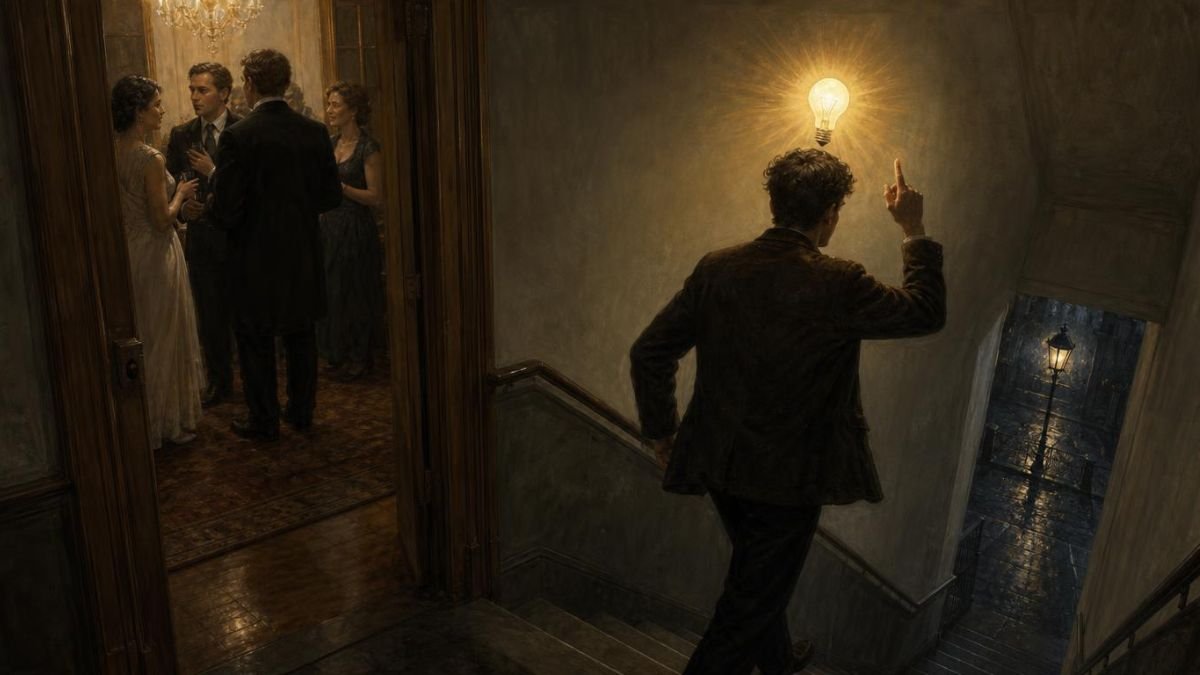
Why does your best answer always wait until the door has closed behind you?
Not a minute before. Not while the room is still there and the person is still looking at you. It waits until you're outside, in the cold, halfway down the stairs — and then it arrives whole, perfect, devastating, and completely useless.
The French named this. L'esprit d'escalier. The spirit of the staircase. Staircase wit.
And the naming has an address, which I love. It comes from Denis Diderot, the philosopher who spent twenty years assembling the Encyclopédie, a man whose entire professional identity was knowing things. He was at a dinner at the home of the statesman Jacques Necker. Someone made a remark that landed on him, and Diderot — by his own account — simply lost his head. He sat there. He had nothing. And he only came back to himself, he wrote, at the bottom of the stairs.
Now, that detail is architecturally literal, and it matters. In an eighteenth-century Parisian townhouse, the reception rooms were on the floor above the street. To leave a dinner party you physically descended a grand staircase. So the phrase measures a distance you can walk: from the chair where you failed, to the step where you finally became yourself again.
Other languages loved this enough to build their own version. German has Treppenwitz. Yiddish has trepverter — stair-words, which might be my favorite compound noun in any language, because it sounds like a species of small animal that only lives in stairwells and comes out after guests leave.
English has nothing. English borrowed the French. Which is its own quiet admission.
So here's the question I actually want to ask: what is happening in those minutes?
The folk explanation is that you're slow. That the quick people are quick and you aren't, and the staircase is where your inferior processor finally finishes the job.
Cognitive psychology says something close to the opposite, and it's worth understanding properly.
Wit is expensive. It requires holding several things in working memory simultaneously — what was said, what it implies, three possible responses, the social consequence of each, the timing. That's a heavy load on a system with a famously small capacity.
Now add the room. Under social evaluation — when you know you're being watched and judged — a significant share of that same working memory gets consumed by monitoring. Researchers who study choking under pressure find this repeatedly: the performer's attention turns inward and sideways, tracking their own performance and the audience's reaction, and that surveillance runs on the exact hardware the task needs. You don't have less capacity than the quick person. You're spending yours on the audience.
So the staircase is not where your mind finally starts working.
The staircase is where the tax stops being collected.
The moment the door closes, the monitoring process has nothing left to monitor. All that capacity comes free at once, and it goes straight to the unfinished problem — because the problem is still open. Psychologists have known since the 1920s that interrupted and unresolved tasks stay unusually active in memory; the waiter remembers the order until the bill is paid. Your conversation never got its bill paid. So it stays live, humming in the background, and the answer surfaces the second there's bandwidth for it.
That reframes the whole experience. The staircase isn't evidence of your dullness. It's evidence that you were fully present in that room — present enough to be affected by it. The people who never experience l'esprit d'escalier are sometimes not faster. Sometimes they're just not spending anything on you.
But I promised not to hand you comfort without its complication, and here it comes.
The staircase reply is almost always better than what would have worked in the room. And that's exactly the problem with it.
It's polished for an argument nobody is still having. It's aimed at a version of the person who is standing perfectly still, waiting to receive it, with no reply of their own. It assumes the conversation was a contest with a scoreboard, when most conversations are weather — they pass through, and people mostly remember the temperature, not the sentences.
And there's something else, which I'll say plainly. A lot of what we compose on the staircase is cruel. The staircase is where cruelty gets to rehearse in a soundproof room, wearing the costume of justice. In the actual moment, something in you declined to be that person. We call that failure. I'm not sure it always was.
There's a version of this that turns pathological, too. Some people are still walking down a staircase from 2011. The argument replays at three in the morning, the reply gets sharper every year, and the person it's addressed to has genuinely forgotten the entire evening. That's not wit anymore. That's a room you've refused to leave — you just moved the furniture into the stairwell.
So what do you do with it?
I don't think the answer is to become faster. Speed in conversation is mostly a matter of how little you have at stake, and I'm suspicious of buying it at that price.
I think the answer is to notice what the staircase is telling you. It arrives loudest after the conversations where something real was on the line — where you cared what that person thought, where a value of yours got stepped on, where you had more to say than the format allowed. The staircase is a receipt. It shows you what you were actually protecting.
And occasionally — this is the good part — you can go back. Not up those stairs, that night. But a week later, in an email, in a walk, in a sentence that starts I've been thinking about what you said. Delivered late, without the crowd, without the sting, to a person who is actually listening this time. That's not a lesser version of the perfect reply.
That might be the only version that was ever going to work.
So here's what I'll leave you with. Think of the last reply you composed too late. Take it out and look at it honestly. Was it a truth you needed that person to hear — or was it a wound you wanted to give them? And if it was the first one, what exactly is stopping you from going back up the stairs?




0 Comments