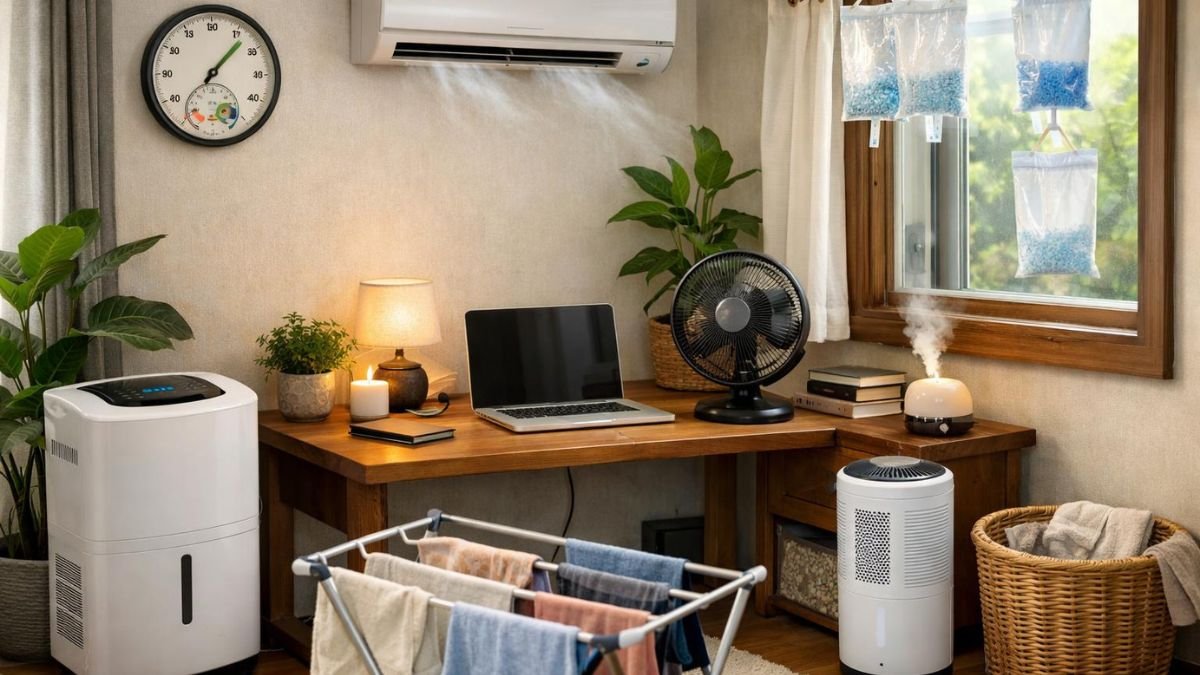
Have you ever walked into a room and immediately felt like you’d entered a sauna — except nobody asked you if you wanted to be in a sauna? That’s humidity for you. It turns your hair into something unrecognizable, makes your shirt stick to your back, and somehow manages to make 28 degrees feel like 40. And if you live or work somewhere humid, you know the struggle is real. So let’s talk about it — in English, at every level.
This might not seem like the most glamorous topic in the world, but trust me, it’s one of the most practical. You’ll use this language every single day if you live in a warm climate, work in an office with questionable air conditioning, or just want to complain about the weather like a proper English speaker. And let’s be honest — complaining about the weather is basically a sport in English-speaking countries.
LEVEL 1 — THE BASICS (A1/A2)
Let’s start with the most important word: humid. When we say the weather is humid, we mean there’s a lot of moisture in the air. It makes everything feel wet, heavy, and uncomfortable. The noun form is humidity — ‘The humidity is terrible today.’
At this level, you need some simple weather and comfort words. Hot means the temperature is high. Cold means it’s low. Warm is between hot and comfortable. Cool is between cold and comfortable. Dry means there isn’t much moisture. Wet means there’s a lot. And sticky is the informal way to describe that unpleasant feeling when humidity makes your skin feel damp and clingy.
How do you talk about it in simple sentences?
“It’s very hot today.”
“The room is too humid.”
“I’m sweating a lot.”
“Can we turn on the air conditioning?”
“This room feels sticky.”
The structure ‘It’s + adjective’ is your go-to for describing weather and room conditions. ‘It’s hot.’ ‘It’s humid.’ ‘It’s stuffy.’ That last word — stuffy — is super useful. A stuffy room is one where the air feels old, heavy, and unpleasant, usually because there’s not enough ventilation (fresh air coming in).
Some essential nouns: a fan is the thing that blows air (either a ceiling fan or a standing fan). An air conditioner (often shortened to AC) cools the air. A window lets fresh air in. And sweat is what your body produces when it’s too hot — ‘I’m covered in sweat.’
A really useful phrase at this level: ‘I can’t stand the heat.’ This means you really hate hot weather. ‘Can’t stand’ is an informal way of saying you strongly dislike something. It works for so many situations: ‘I can’t stand this humidity.’ ‘I can’t stand working in this room.’
LEVEL 2 — ADDING COLOR AND DEPTH (B1/B2)
Okay, now let’s get more specific. At the intermediate level, you can describe exactly what the problem is, suggest solutions, and have actual conversations about home and workplace comfort.
Let’s level up your vocabulary. Ventilation is the process of circulating fresh air through a space. Condensation is the water droplets that form on cold surfaces — like your windows or cold water bottles — when the air is humid. Mold (or mould in British English) is that nasty fungus that grows in damp areas. A dehumidifier is a machine that removes moisture from the air. And insulation refers to the materials in walls and ceilings that help regulate temperature.
Now let’s talk about describing degrees of discomfort, because ‘it’s hot’ just doesn’t cut it anymore:
“It’s absolutely sweltering in here — I can barely concentrate.”
“The air feels really muggy today, like there’s no oxygen left.”
“My office is so poorly ventilated that by 3 PM, it feels like a greenhouse.”
‘Sweltering’ means extremely and uncomfortably hot. ‘Muggy’ specifically describes hot and humid weather. ‘Stifling’ means so hot that it’s hard to breathe. These adjectives are much more expressive and natural than just saying ‘very hot.’
Grammar spotlight: comparatives and superlatives become really useful here. ‘Today is even more humid than yesterday.’ ‘This is the stickiest summer I can remember.’ ‘The upstairs rooms are far worse than the ground floor.’ And the structure ‘the + comparative, the + comparative’ is perfect: ‘The more humid it gets, the less productive I am.’
Phrasal verbs in this context: to cool down means to become cooler or make something cooler. To dry out means to remove moisture. To air out a room means to open windows and let fresh air in. To heat up means to become hotter. ‘We need to air this place out — it smells like a locker room.’
Speaking tip: when complaining (which, let’s face it, is the main activity during humid weather), English speakers love exaggeration. ‘I’m literally melting.’ ‘You could fry an egg on the pavement.’ ‘I stepped outside and my glasses immediately fogged up.’ These aren’t literal, but they’re colorful and very natural.
LEVEL 3 — FLUENCY AND NUANCE (C1/C2)
At the advanced level, you can discuss the science, the health implications, and the practical solutions to humidity with precision and sophistication. This is where your English goes from everyday conversation to something you’d hear on a home improvement show or in a workplace health assessment.
Advanced vocabulary: the dew point is the temperature at which air becomes fully saturated and moisture begins to condense — it’s actually a better measure of how uncomfortable you’ll feel than humidity percentage alone. Relative humidity is the percentage of moisture in the air compared to the maximum it could hold at that temperature. A hygrometer is the instrument that measures humidity. Off-gassing refers to the release of chemicals from materials like paint, furniture, or carpet, which is made worse by heat and humidity. And thermal comfort is the technical term for that subjective feeling of being comfortable with the surrounding temperature.
“The dew point has been hovering around 24 degrees all week, which explains why even the air-conditioned office feels clammy.”
“Chronic exposure to high indoor humidity can exacerbate respiratory conditions and create an environment conducive to mold proliferation.”
“We’ve been advocating for a building-wide HVAC audit, but management seems reluctant to allocate the budget.”
Grammar at this level: subjunctive and formal recommendation structures. ‘It’s essential that the ventilation system be inspected regularly.’ ‘We recommended that the humidity levels be monitored throughout the day.’ The subjunctive here — ‘be inspected’ rather than ‘is inspected’ — is a marker of formal, educated English.
For writing: if you’re drafting a complaint email about working conditions, the language needs to be diplomatic but firm. Instead of ‘The office is disgusting and way too hot,’ you’d write: ‘I’d like to bring to your attention the ongoing issue of inadequate climate control in our workspace. The persistent humidity has begun to affect both staff wellbeing and the condition of equipment.’ See how different that is? Same complaint, completely different register.
Idiomatically, English has some great expressions related to heat and discomfort. ‘To be in hot water’ means to be in trouble. ‘A heated debate’ is an intense argument. ‘To take the heat’ means to accept criticism. ‘To let off steam’ means to release frustration — originally a reference to steam engines, now used for people who need to vent. And ‘under the weather’ means feeling slightly ill, which, fittingly, is exactly how chronic humidity makes most of us feel.
YOUR CHALLENGE
Write a formal email (about 120 words) to your building manager or boss, politely complaining about humidity in your workspace and suggesting solutions.
Then record an informal voice message to a friend complaining about the same problem, using at least two idioms and two expressive adjectives.
Compare the two versions — notice how register completely changes the language even though the topic is identical.









0 Comments