Vocabulary Preview
- Hubris: Excessive pride or self-confidence.
- Inhospitable: (of an environment) harsh and difficult to live in.
- Labyrinthine: Like a labyrinth; irregular and twisting.
- Succor: Assistance and support in times of hardship and distress.
- Vestige: A trace of something that is disappearing or no longer exists.
- Enigmatic: Difficult to interpret or understand; mysterious.
- Attrition: The action or process of gradually reducing the strength or effectiveness of someone or something through sustained attack or pressure.
- Palpable: (of a feeling or atmosphere) so intense as to seem almost tangible.
- Calamity: An event causing great and often sudden damage or distress; a disaster.
- Ephemeral: Lasting for a very short time.
Listen
Or Read
The Fate of the HMS Erebus and HMS Terror (Franklin Expedition)
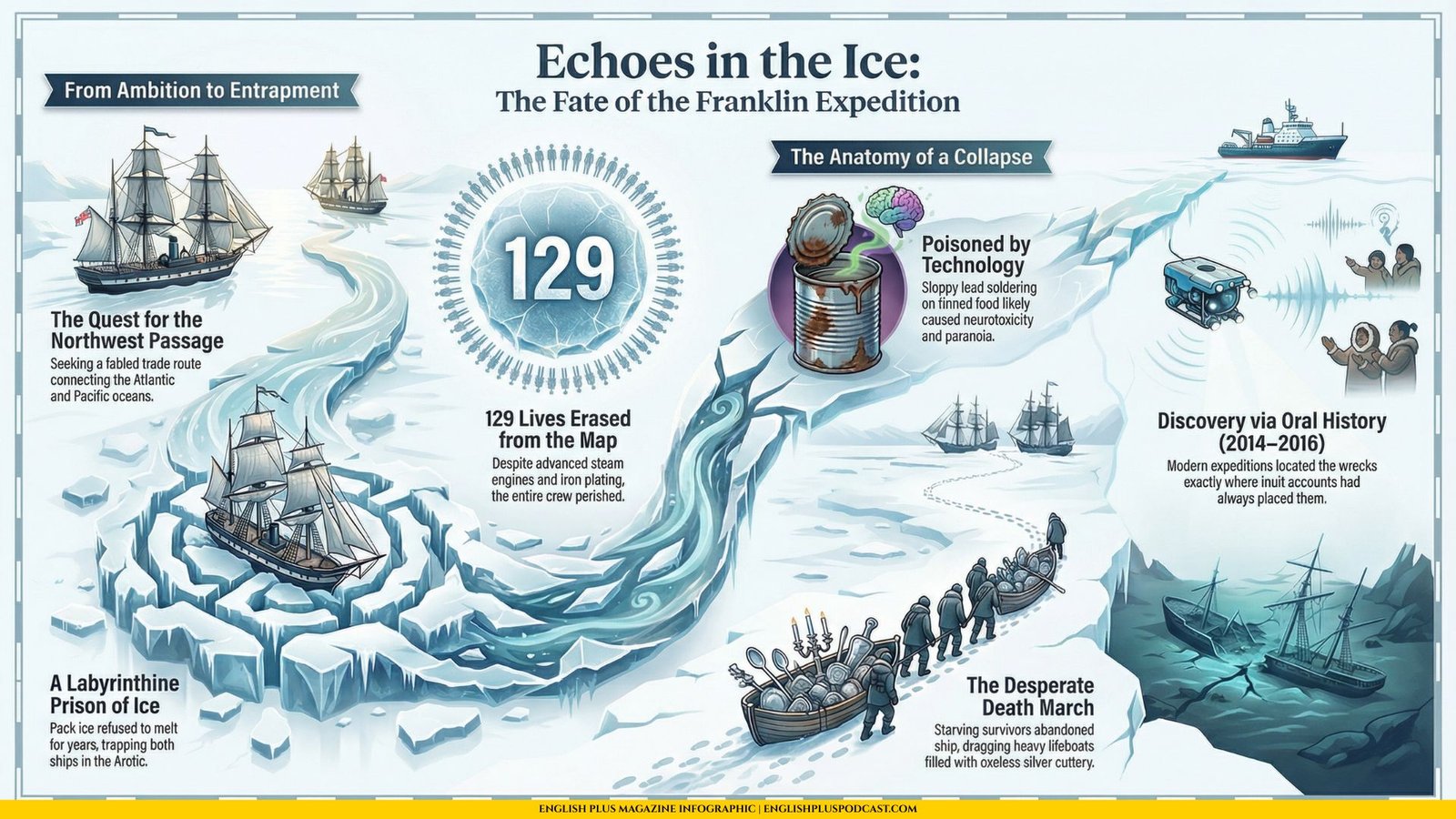
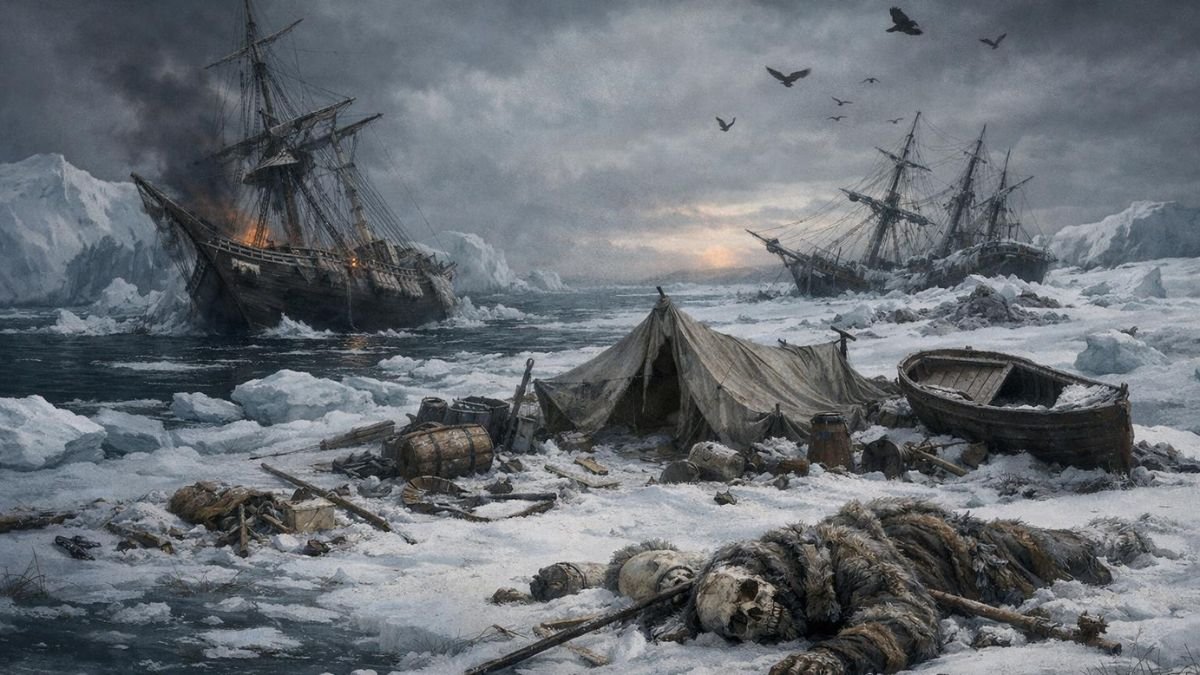
It is a story that has haunted historians and adventurers for nearly two centuries, a ghost story played out on the grandest and coldest stage imaginable. We are setting our sights on the Franklin Expedition, the 19th-century equivalent of a moon landing, which vanished into the white void of the Canadian Arctic, leaving behind only whispers, bones, and a mystery that refuses to die. In 1845, Sir John Franklin, a seasoned polar explorer, set sail from England with two state-of-the-art ships, the HMS Erebus and the HMS Terror. These weren’t just wooden tubs; they were the technological marvels of their day, reinforced with iron plating to smash through ice, equipped with steam engines, and stocked with enough food to last three years. The British Empire, in a display of supreme hubris, believed they had finally conquered nature. They were wrong.
The goal was to navigate the Northwest Passage, a fabled trade route connecting the Atlantic and Pacific oceans. It was the Holy Grail of exploration, a shortcut that promised immense wealth and glory. But the Arctic is indifferent to human ambition. It is an inhospitable kingdom of ice and wind where the compass spins uselessly and the sun disappears for months at a time. The expedition sailed into this frozen maw and was never heard from again. 129 men, two massive ships, simply erased from the map. For years, the world waited. Then, slowly, the silence broke. Search parties began to find disturbing clues scattered across King William Island: a single grave here, a discarded button there, and eventually, a grim note hidden in a cairn of stones.
The note revealed a calamity in slow motion. The ships had become trapped in pack ice, not for a few weeks, but for years. The ice, usually a seasonal visitor, refused to melt. The men were locked in a labyrinthine prison of shifting white walls. Can you imagine the psychological toll? Sitting in the dark, hearing the wood of your ship groan under the pressure of millions of tons of ice, waiting for a summer that never comes? The note mentioned that Franklin had died early on, and the survivors, desperate and starving, had abandoned the ships to walk south across the ice towards the Back River. It was a death march. They were seeking succor from the nearest trading posts hundreds of miles away, dragging heavy lifeboats filled with useless items like silver cutlery and silk handkerchiefs—a heartbreaking sign that their minds were beginning to fracture under the strain.
The tragedy was compounded by a slow, invisible killer. Modern analysis of the few bodies found suggests that the tinned food—the very technology meant to save them—might have poisoned them. The lead soldering on the cans was sloppy, likely leaching neurotoxins into their soup and meat. Lead poisoning doesn’t just kill you; it makes you paranoid, erratic, and weak. It causes a war of attrition on your nervous system. So, you have a crew of men who are freezing, starving, suffering from scurvy, and slowly going mad from heavy metal poisoning, stumbling through a white wasteland.
For over a century, the final resting place of the ships remained enigmatic. The Inuit, the indigenous people of the Arctic who have lived there for thousands of years, told stories of “wood that floated” and men who fell down and died while walking. But Victorian society, blinded by prejudice, often dismissed these accounts. They couldn’t accept that their sophisticated explorers had resorted to cannibalism—a grim detail the Inuit reported—or that the “savages” knew more than the Royal Navy. It wasn’t until 2014 and 2016 that the wrecks of Erebus and Terror were finally located, almost exactly where the Inuit oral histories said they would be.
The discovery was electrifying. The Terror was found in a bay named—believe it or not—Terror Bay. The cold water had preserved it so perfectly that plates were still on the shelves and glass windows were intact. It was as if the crew had just stepped out for a moment. But these findings only deepened the mystery. The position of the ships suggests that perhaps some men returned to them after the failed march. Did they try to sail out one last time? Did they live on the ships for years, watching their hope become ephemeral as the seasons turned?
The story of the Franklin Expedition is more than just a history lesson; it is a mirror reflecting our own vulnerability. We build our towers and our technologies, believing we can tame the world, but the palpable silence of the Arctic reminds us that we are guests here. The vestiges of their camp—the scraps of cloth, the rusted metal—serve as a somber monument to the limits of human endurance. It forces us to ask: at what point does bravery become foolishness? When does determination cross the line into delusion?
As we look back at those men, freezing in the dark, we can’t help but feel a shiver that has nothing to do with the temperature. It is the realization that no matter how advanced we become, there are forces vastly more powerful than us. And that brings me to the question I want to leave you with: In our modern age of GPS and satellite phones, do you think true exploration still exists, or have we lost the ability to get truly, wondrously, and dangerously lost? I’d love to hear your take in the comments below!
Word Power
Let’s thaw out some of those frozen vocabulary words and see how we can use them to heat up your daily conversations.
First on the list is Hubris. This is a fantastic word from Greek tragedy. It’s not just pride; it’s dangerous, over-the-top arrogance that usually leads to a downfall. The Titanic is a classic example of engineering hubris. In real life, you might say, “It was pure hubris to think I could fix the plumbing without turning off the water first.”
Then we have Inhospitable. We used this to describe the Arctic, but you can use it for anything unwelcoming. A desert is inhospitable, but so is a waiting room with hard plastic chairs and no Wi-Fi. It describes an environment where you just can’t get comfortable or survive easily.
Labyrinthine comes from the word “labyrinth” or maze. Use this when something is confusing, twisted, and hard to navigate. The tax code is labyrinthine. The old streets of a medieval city are labyrinthine. It implies you are likely to get lost.
Succor is a literary word for help or relief. It’s rarely used in casual slang (“Hey, give me some succor with this box”), but it’s powerful in storytelling or formal contexts. You might seek succor from a friend during a breakup. It implies a deep need for aid.
A Vestige is a trace of something that is mostly gone. Your tailbone is a vestige of when humans had tails. An old wall might be the last vestige of a castle. It’s a poetic way to talk about leftovers of the past.
Enigmatic describes something mysterious and hard to figure out like a riddle. The Mona Lisa’s smile is enigmatic. If your cat stares at the wall for hours, her behavior is enigmatic. It adds a layer of intrigue to the unknown.
Attrition is the process of wearing something down over time. In business, “employee attrition” means losing staff faster than you hire them. In war, a “war of attrition” is where you just try to outlast the enemy’s resources. It’s a slow, grinding reduction.
Palpable means something so intense you can almost touch it. The tension in the room before an exam is palpable. The excitement at a concert is palpable. It turns an emotion into a physical sensation.
Calamity is a major disaster. Losing your keys is a nuisance; losing your house in a flood is a calamity. It’s a heavy word for a heavy event.
Finally, Ephemeral. This describes things that are fleeting and short-lived. A rainbow is ephemeral. Social media fame is often ephemeral. It’s a beautiful word to remind us to appreciate the moment because it won’t last.
Speaking Tips & Challenge
Now, let’s put these into practice. The trick is to use them naturally without forcing them.
- For “Palpable”: Use it when describing atmosphere. “The awkwardness at dinner was palpable.”
- For “Hubris”: Use it when analyzing mistakes. “His hubris kept him from asking for directions.”
- For “Labyrinthine”: Use it for bureaucratic headaches. “The process to renew my license was labyrinthine.”
Your Speaking Challenge:
Think of a time you tried to do something difficult and failed (a DIY project, a new recipe, a hiking trip).
Tell the story of that failure using Hubris, Calamity, and Palpable.
Example: “My hubris made me think I could build a bookshelf without instructions. The confusion was palpable as I stared at the leftover screws, and the whole thing collapsed—a total calamity.”
Give it a shot! Embracing your mistakes with fancy words makes them sound much more heroic.





0 Comments