
- The Myth of the Genius Jerk
- The Anatomy of the Intangible
- The ROI of “Soft” Skills
- The Crisis Test: When the Sky is Falling
- The Trap of the “Technically Brilliant” Promotion
- Can You Teach an Old Boss New Tricks?
- The Future is Human
- Focus on Language: Vocabulary and Speaking
- Critical Analysis
- Let’s Discuss
- Let’s Play & Learn
- Check Your Understanding
The Myth of the Genius Jerk
We all know the archetype. You have probably seen it in movies, or worse, sat across from it in a boardroom. It is the “Genius Jerk.” This is the manager who is undeniably brilliant, a human calculator who can forecast market trends with frightening accuracy and code circles around the IT department. They have an IQ that practically vibrates in the air around them. And yet, their team is a revolving door of resignation letters. Morale is in the toilet. Innovation is stifled by fear.
For decades, the corporate world operated on a very specific, very flawed equation: Intelligence Quotient (IQ) equals success. If you were the smartest person in the room, you were naturally the leader. We hired for hard skills, promoted for competence, and then wondered why our organizations were toxic wastelands of interpersonal conflict. We treated management like an engineering problem, assuming that if the logic was sound, the humans would just fall into line like well-behaved algorithms.
But humans are not algorithms. We are messy, emotional, volatile biological machines driven more by the limbic system than the prefrontal cortex. This is where the old model breaks down, and this is where Emotional Intelligence (EQ) enters the chat. It turns out that being the smartest person in the room is useless if nobody in that room wants to listen to you. We are witnessing a fundamental shift in the currency of power. IQ gets you hired; EQ gets you promoted. And more importantly, EQ is what prevents you from getting fired when the pressure mounts and the cracks in the foundation start to show.
The Anatomy of the Intangible
So, what are we actually talking about when we discuss Emotional Intelligence? It is not just “being nice.” That is a dangerous oversimplification. You can be polite and have zero EQ. You can be “nice” and be a terrible leader who avoids conflict until the company burns down.
Daniel Goleman, the psychologist who blasted this concept into the mainstream, broke it down into five pillars. Understanding these isn’t just academic; it is the difference between a manager who plays checkers and a leader who plays chess.
Self-Awareness: The Mirror Test
This is ground zero. Self-awareness is the ability to recognize your own emotions as they happen. It sounds easy, right? It isn’t. Most of us are walking around in a state of reactive autopilot. A subordinate misses a deadline, and you feel anger. A low-EQ manager acts on that anger immediately—they yell, they send a passive-aggressive email, they shame the employee.
A high-EQ manager, however, has a split-second internal monitor. They recognize the physical spike of adrenaline. They label the emotion: “I am frustrated because this impacts my reputation.” By bringing the emotion from the subconscious to the conscious, they strip it of its power to control the next action. They look in the mirror and see the reality of their state, not just the projection of their ego. Without this, you are flying blind, crashing into everyone around you and blaming them for being in the way.
Self-Regulation: The Power of the Pause
If self-awareness is seeing the fire, self-regulation is choosing not to throw gasoline on it. This is the hallmark of maturity. In management, you are essentially a professional shock absorber. You absorb stress from upper management, from clients, and from the market. If you transmit that stress directly to your team without a filter, you create chaos.
Self-regulation is the ability to suspend judgment and think before acting. It is the discipline to say, “I need a moment to process this,” instead of snapping back. It creates an environment of trust and fairness. In an organization where the leader lacks self-regulation, the culture becomes one of walking on eggshells. People stop bringing you bad news because they are afraid of the messenger-shooting ritual. And when a leader stops hearing bad news, the end is near.
Motivation: The Internal Engine
We often think motivation is about the carrot and the stick—bonuses and threats. But high-EQ leaders are driven by something deeper. They have a passion for the work itself, for the challenge, for the sheer joy of building something. This intrinsic motivation is infectious.
When a manager is only in it for the status or the money, the team smells it. It reeks of inauthenticity. But when a leader is resilient, optimistic in the face of failure, and driven by a vision that exceeds their own bank account, that energy permeates the culture. It is the difference between a mercenary and a missionary. Mercenaries leave when the battle gets hard. Missionaries dig in.
Empathy: The Business Case for Feeling
Empathy is often soft-pedaled in business schools as a “nice-to-have.” In reality, it is a hard skill. Empathy is not about agreeing with everyone or coddling underperformers. It is the ability to understand the emotional makeup of other people and treat them according to their emotional reactions.
It is knowing that Employee A needs public praise to thrive, while Employee B finds it mortifying. It is sensing the tension in a meeting before a word is spoken. It is understanding that the dip in productivity from your star performer isn’t laziness, but burnout or a personal crisis. When you lead with empathy, you gain loyalty. And in the modern talent war, loyalty is more valuable than gold. People do not leave bad jobs; they leave bad bosses who make them feel invisible.
Social Skills: Proficiency in Managing Relationships
This is the culmination of the other four. It is friendliness with a purpose. It is the ability to move people in the direction you desire. It encompasses persuasion, conflict management, and collaboration.
A manager with high social skills is a master of the “nudge.” They don’t have to order people to do things; they build the consensus so that people want to do things. They are the social glue. They are the ones who can walk into a room of warring factions and walk out with a peace treaty. It is about network building—not for political gain, but for functional efficiency. You cannot manage a silo; you have to manage a network.
The ROI of “Soft” Skills
Let’s pivot to the cold, hard numbers, because I know there is a skeptic in the back of the room thinking, “This is all very touchy-feely, but does it make money?”
The answer is an emphatic yes. The Return on Investment (ROI) for Emotional Intelligence is staggering. Research consistently shows that companies with high-EQ leadership outperform their competitors. Why? Because the cost of low EQ is astronomical.
Consider the cost of turnover. Replacing a highly trained employee can cost up to 200% of their annual salary. People quit bosses, not companies. If your managers lack EQ, they are essentially burning cash by driving away talent.
Consider the cost of innovation. Innovation requires risk. Risk requires safety. Psychological safety—the belief that you won’t be punished or humiliated for speaking up with ideas, questions, concerns, or mistakes—is entirely dependent on the EQ of the leader. If a manager is defensive, critical, or dismissive (low EQ traits), the team shuts down. They stop offering new ideas. They just execute the minimum. The company stagnates.
Consider sales. A salesperson with high IQ knows the product specs. A salesperson with high EQ knows the client. They can read the hesitation in a client’s voice, address the unstated objection, and build the rapport necessary to close the deal. In the service economy, the relationship is the product.
The Crisis Test: When the Sky is Falling
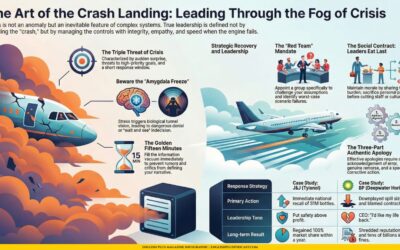
It is easy to be a good manager when profits are up and the coffee machine is working. The true test of EQ happens when the crisis hits. When the server crashes, the client sues, or the pandemic shuts down the office.
In a crisis, the collective amygdala of the organization lights up. Panic sets in. A low-EQ leader amplifies this panic. They get frantic, they blame, they micromanage. They become a chaotic element that accelerates the disaster.
A high-EQ leader becomes the anchor. They regulate their own fear (Self-Awareness/Regulation). They acknowledge the fear of the team (Empathy). They communicate with clarity and calm (Social Skills). They provide a vision of the path forward (Motivation).
Think about the leaders you admire in history. It wasn’t their ability to solve a differential equation that saved the day. It was their ability to stand in the middle of the storm and say, “I see you, I hear you, and we are going to get through this.” That is pure EQ.
The Trap of the “Technically Brilliant” Promotion
One of the biggest mistakes organizations make is the “Peter Principle” promotion based on technical skill. You take your best coder and make them the Engineering Manager. You take your top salesperson and make them the Sales Director.
This is often a disaster. The skillset required to do the work is fundamentally different from the skillset required to manage the people doing the work. The coder deals with logic, syntax, and predictable outputs. The manager deals with egos, insecurities, and messy interpersonal dynamics.
When we promote based on IQ and ignore EQ, we lose a great individual contributor and gain a terrible manager. It is a lose-lose. We need to stop viewing management as the only path for career progression, or we need to start training for EQ as rigorously as we train for technical skills.
Can You Teach an Old Boss New Tricks?
Here is the good news: unlike IQ, which is relatively static after a certain age, EQ is highly plastic. You can learn it. You can improve it. It isn’t a fixed trait like eye color; it’s a muscle.
However, it requires something that many egos resist: vulnerability. To improve your EQ, you have to admit that you might be the problem. You have to ask for feedback—the brutal, honest kind—and you have to listen to it without getting defensive.
It involves coaching, mentorship, and a lot of uncomfortable introspection. It means catching yourself in that moment of anger and forcing a pause. It means practicing active listening when you really just want to interrupt with the answer. It is hard work. It is character work. But the payoff is a career—and a life—that is infinitely richer.
The Future is Human
As we barrel into the age of Artificial Intelligence, the premium on Emotional Intelligence is only going to skyrocket. AI is already better than us at processing data, recognizing patterns, and performing logical tasks. If your value proposition as a manager is “I know more facts than you,” you are obsolete.
What AI cannot do is inspire. It cannot mediate a dispute between two creative directors with bruised egos. It cannot sit with an employee who has just lost a parent and make them feel supported. It cannot read the room.
The future of work is not about competing with machines; it is about doubling down on the things machines can’t do. Management is evolving from a role of oversight to a role of facilitation. It is no longer about command and control; it is about connect and collaborate.
In this new world, the “Genius Jerk” is a liability. The future belongs to the empathetic strategist, the self-aware motivator, the emotionally intelligent leader. So, by all means, keep your IQ sharp. Read the books, learn the tech, analyze the data. But do not neglect the human element. Because at the end of the day, business is people. And if you can’t understand people, you can’t understand business.
Focus on Language: Vocabulary and Speaking
Let’s step away from the management theory for a moment and look under the hood at the language we used to build that argument. If you want to sound sophisticated and insightful when talking about leadership, business, or human psychology, you need a vocabulary that goes beyond the basics. We are going to look at some heavy-hitting words and phrases that appeared in the article, dissect them, and figure out how to weave them into your daily conversations without sounding like you swallowed a thesaurus.
Let’s start with archetype. We used this right at the beginning to describe the “Genius Jerk.” An archetype is a very typical example of a certain person or thing; it’s like a universal symbol or pattern. In literature, the “Hero” is an archetype. In business, the “Workaholic” is an archetype. You can use this in real life when you want to describe someone who fits a stereotype perfectly but in a more intellectual way. Instead of saying, “He’s a typical strict teacher,” you could say, “He is the archetype of the authoritarian educator.” It elevates your observation.
Next, we have visceral. We didn’t use this exact word in the text, but we talked about the “limbic system” and “biological machines.” Visceral refers to deep, inward feelings rather than to the intellect. It comes from “viscera,” which means your internal organs—your guts. So a “visceral reaction” is a gut feeling, something raw and physical. If you are in a meeting and someone proposes a terrible idea, and you feel sick in your stomach, that is a visceral reaction. Use this when you want to emphasize that a feeling wasn’t just a thought, but a physical experience. “I had a visceral dislike for that marketing campaign.”
We talked about nuance. This is a beautiful word. Nuance is a subtle difference in or shade of meaning, expression, or sound. High-EQ leaders understand nuance. The world isn’t black and white; it’s gray. When you say someone “lacks nuance,” you are saying they are too blunt or simplistic. In conversation, use this to defend a complex position. “I think you’re missing the nuance of the situation; it’s not just about money, it’s about reputation.”
Then there is volatile. In chemistry, a volatile substance evaporates or explodes easily. In people, it means liable to change rapidly and unpredictably, especially for the worse. A “volatile manager” is a nightmare because you never know which version of them you are going to get. You can use this to describe markets, weather, or your friend’s mood. “The stock market is incredibly volatile right now,” or “Let’s not ask him for a favor today, his mood is a bit volatile.”
We mentioned introspection. This is the examination or observation of one’s own mental and emotional processes. It is looking inward. It is the engine of self-awareness. If you are “introspective,” you spend time thinking about why you do what you do. You can use this to describe a quiet evening or a personality trait. “I’ve been doing a lot of introspection lately regarding my career path.” It sounds much more profound than “I’ve been thinking about my job.”
Let’s look at permeate. We said energy “permeates the culture.” To permeate is to spread throughout something; to pervade. Imagine a drop of red dye in a glass of water—it permeates the water. In business, toxic attitudes or positive vibes can permeate a team. “The smell of fresh coffee permeated the office,” or “A sense of dread permeated the meeting.”
Intrinsic vs. Extrinsic. We talked about “intrinsic motivation.” Intrinsic means belonging naturally; essential. It comes from within. Extrinsic comes from outside. If you work because you love the job, that is intrinsic. If you work for the bonus, that is extrinsic. Use this when discussing reasons for doing things. “I don’t need a reward; the satisfaction is intrinsic.”
Rapport. This is a crucial business word. It’s a close and harmonious relationship in which the people or groups concerned understand each other’s feelings or ideas and communicate well. You “build rapport.” It’s that click you feel with someone. “The salesperson established excellent rapport with the client immediately.” If you struggle to talk to someone, you can say, “We just couldn’t build any rapport.”
Micromanage. This is a common one, but important. It means to control every part, however small, of an enterprise or activity. It implies a lack of trust. “Stop micromanaging me” is a plea for autonomy. Use it when someone is hovering over your shoulder. “He’s a nice guy, but he has a tendency to micromanage.”
Finally, obsolete. We said if you rely only on IQ, you are obsolete. This means no longer produced or used; out of date. Replaced by something newer. Typewriters are obsolete. In a fast-changing world, skills become obsolete. “My old phone is officially obsolete; it can’t even run the new apps.”
Now, let’s move to the speaking section. It is one thing to know these words; it is another to let them roll off your tongue when the pressure is on.
We are going to practice a technique called “The Softener.” In management and high-EQ communication, being too direct can sometimes be perceived as aggression. We use vocabulary to soften the blow and maintain rapport.
Instead of saying “You are wrong,” which is volatile and destroys rapport, a high-EQ speaker uses nuance. They might say, “I see where you are coming from, but have you considered…?” or “I have a slightly different perspective.”
Here is your Speaking Challenge:
I want you to imagine you are a manager. You have an employee, Alex, who is brilliant (high IQ) but keeps interrupting people in meetings (low EQ). You need to have a correction conversation.
I want you to record yourself giving Alex this feedback. But here is the rule: You must use the “Sandwich Method” (positive, negative, positive) and you must use at least three of our vocabulary words from today (Rapport, Nuance, Introspective, etc.).
For example: “Alex, I love the energy you bring; you have a great archetype of the passionate innovator. However, I’ve noticed you interrupting others, which damages your rapport with the team. I’d like you to be a bit more introspective about how that lands. Your ideas are great, and I want everyone to hear them.”
Try it. Record it. Listen to it. Do you sound like a jerk, or do you sound like a leader? The difference is in the language.
Critical Analysis
Now, let’s take off the “EQ cheerleader” hat and put on the “skeptical expert” hat. We have spent this entire article praising Emotional Intelligence as the silver bullet for management. But is it? A critical thinker needs to look for the cracks in the theory.
First, we need to talk about the Dark Side of EQ. The article frames EQ as a force for good—empathy, connection, support. But the skills that make up EQ—reading people, influencing emotions, managing relationships—are value-neutral. They are tools. And like any tool, they can be weaponized.
A manipulative sociopath often has incredibly high EQ. They know exactly what to say to charm you, how to feign empathy to get your trust, and how to push your emotional buttons to control you. We often confuse “high EQ” with “moral goodness,” and that is a dangerous mistake. You can have a high-EQ con artist. In management, this can look like a boss who gaslights you so effectively you thank them for it.
Secondly, is there an “Empathy Trap”? Can a manager be too empathetic? Yes. If a leader is so tuned into the feelings of their team that they cannot make hard decisions, the business suffers. If you can’t fire an incompetent employee because you are too worried about their feelings, you are failing the rest of the team who has to carry the slack. This is sometimes called “Ruinous Empathy.” Management requires a balance of caring personally and challenging directly. The article glosses over the fact that sometimes, the “nice” thing to do is the wrong thing for the business.
Thirdly, let’s look at Contextual Relevance. Does EQ matter equally in all fields? The article implies it does. But if I am undergoing brain surgery, I frankly do not care if my neurosurgeon has high EQ. I care if they have off-the-charts IQ and steady hands. If I am on a plane with an engine fire, I don’t need the pilot to empathize with my fear; I need them to execute the emergency checklist with robotic precision. While EQ is vital for leadership, there are technical domains where competence (IQ) is still the primary and non-negotiable currency. We must be careful not to swing the pendulum so far that we devalue technical mastery.
So, while EQ is essential for the modern manager, it is not a replacement for competence, and it is not a guarantee of morality. It is a power multiplier—it makes the good better, and the bad much, much more dangerous.
Let’s Discuss
Here are five questions to spark some debate in the comments. I don’t want easy answers; I want you to wrestle with the grey areas.
1. Is it possible to be a great leader with zero empathy?
Think about figures like Steve Jobs or Elon Musk. They are often described as having low empathy or being “tough” to work for, yet they achieved massive success. Is their success because of their lack of empathy or in spite of it? Can vision replace connection?
2. Should we hire based on personality tests?
If EQ is so important, should companies require psychological screening or EQ tests during the interview process? Or is that an invasion of privacy? Can these tests be faked?
3. At what point does “influence” become “manipulation”?
We teach managers to “influence” their team to work harder. Where is the line? If you use your knowledge of an employee’s insecurities to motivate them, is that good management or emotional abuse?
4. Can you really teach EQ to an adult?
The article claims neuroplasticity allows us to learn EQ. But do you believe a 50-year-old narcissist can truly become empathetic? Or can they only learn to fake the behaviors of empathy? Is there a difference between “acting nice” and “being nice”?
5. Is the push for EQ biased against neurodivergent people?
Corporate definitions of “good social skills” (eye contact, small talk, reading subtle cues) can be extremely difficult for people on the autism spectrum, who might be brilliant at the job. Are we creating a definition of leadership that excludes neurodiversity?







0 Comments